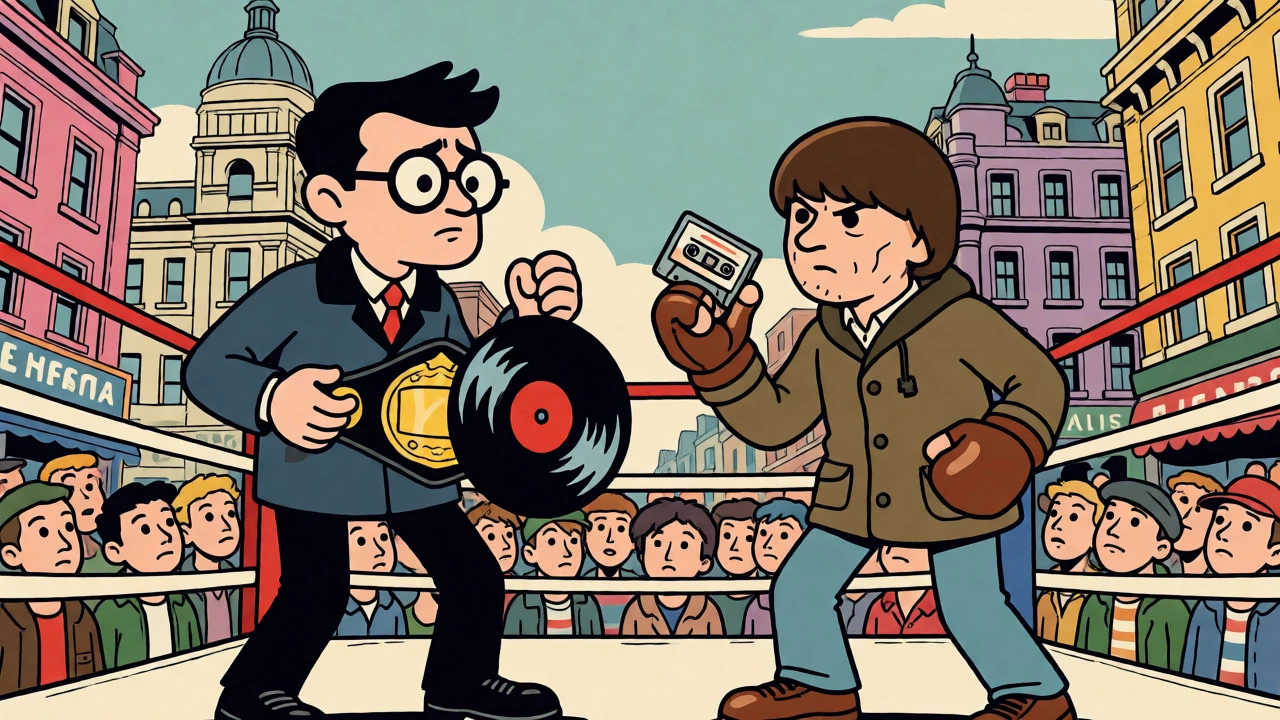

Imagine spending your entire week's allowance on a single that might be obsolete by next Tuesday. That was the reality for British teenagers in August 1995. The airwaves weren't just playing music; they were broadcasting a war. On one side, Blur with their witty, middle-class anthem "Country House." On the other, Oasis, the working-class heroes from Manchester, dropping "Roll With It." This wasn't just a musical rivalry. It was a meticulously engineered commercial collision designed to squeeze every last penny out of a saturated market.
If you think streaming playlists are manipulated today, wait until you hear how record labels in the 90s treated the UK Singles Chart like a battlefield. They didn't just release songs; they staged events. They coordinated radio pushes, TV appearances, and magazine covers to create artificial scarcity and urgency. The goal? To turn a three-minute pop song into a national crisis. And at the center of this storm was the so-called "Battle of Britpop," a marketing stunt that changed how we think about chart success forever.
The Anatomy of a Britpop Single Release
To understand why the 1995 clash mattered, you have to look at how a Britpop single was built. It wasn't just an audio file or a vinyl disc. It was a product package designed for maximum extraction. Labels knew that fans would buy multiple versions of the same track if you gave them a reason. So, they created a format zoo. You had the standard 7-inch vinyl, the extended 12-inch remix, the cassette single (still popular in rural areas), and the CD single. But it went deeper than formats. We're talking about exclusive B-sides, limited-edition picture discs, and free gifts like posters or stickers.
This multi-format strategy was crucial because of the rules governing the charts. In the early 90s, you could count up to five different physical formats toward a single title's chart position. By April 1995, however, the Official Charts Company (then compiled by Gallup) reduced this to three eligible formats per title. Why? Because retailers were complaining that big labels were flooding the market and confusing consumers. This rule change forced labels to make hard choices. Which three editions would you push hardest? If you picked wrong, your sales got diluted across ineligible formats, hurting your overall chart impact.
Pricing played a huge role too. Richard Osborne’s academic analysis of UK chart manipulation highlights a common tactic: pricing singles at half the recommended retail price during the first week. Sometimes, labels took a loss on each copy sold, banking on the volume to drive album sales later. This "loss leader" strategy made buying the single a no-brainer for teens. It wasn't just about owning the music; it was about participating in the moment. If you didn't buy it that week, you missed the party. And in the world of Britpop, missing the party meant social exile.
Engineering the Clash: Blur vs. Oasis
The most famous example of this engineering is the head-to-head release of Blur’s "Country House" and Oasis’s "Roll With It." Originally, these releases weren't scheduled for the same day. Creation Records, Oasis's label, had penciled in August 14, 1995, for "Roll With It." Food Records, home to Blur, saw an opportunity. They moved "Country House" to the exact same date. This wasn't accidental. It was a calculated risk. By forcing a collision, both labels guaranteed massive media coverage. You couldn't ignore it. Every newspaper, TV news broadcast, and radio show had to talk about it.
The music press, particularly NME, ate it up. NME ran a cover featuring Damon Albarn and Liam Gallagher posed as boxers, framing the contest as a sporting event rather than a musical comparison. Mainstream newspapers jumped on the bandwagon, spinning it as a North versus South cultural divide. Was it really? Or was it two London-based labels selling a narrative of regional conflict to sell records? The truth is murky, but the effect was undeniable. Sales for that week spiked by 40% compared to previous weeks, according to Official Charts data. The public bought more records not necessarily because they loved the songs more, but because they felt compelled to pick a side.
This strategy relied heavily on the "Cool Britannia" narrative, a political and cultural branding effort that marketed British identity as cool, modern, and exportable. Britpop bands became the soundtrack to this rebranding. Blur represented the art-school irony and metropolitan wit, while Oasis offered raw, anthemic rock energy. The clash allowed consumers to choose their identity through their purchase. Buying "Country House" said you were clever and urban. Buying "Roll With It" said you were authentic and rebellious. The single became a badge of allegiance.
The Numbers Game: Who Actually Won?
So, who won the battle? On paper, Blur did. "Country House" debuted at Number 1 with approximately 274,000 units sold in its first week. "Roll With It" entered at Number 2 with around 216,000. A gap of nearly 60,000 copies. For a brief moment, Blur were the kings of the hill. But here’s where the story gets interesting. Winning the first week doesn't mean winning the war. Long-term sales tell a different tale.
According to current Official Charts data, "Roll With It" has accumulated significantly higher lifetime engagement than "Country House." While "Country House" sold roughly 492,000 physical copies historically, "Roll With It" has surpassed it in total chart units when including downloads and streams. More importantly, Oasis’s subsequent singles, like "Wonderwall" and "Don't Look Back in Anger," dominated the charts for months afterward. "Wonderwall" alone has sold over 1.4 million units in the UK. Blur’s victory in August 1995 was symbolic, but Oasis’s catalog proved far more durable commercially.
| Song Title | Artist | Release Year | Peak Chart Position | Long-Term Legacy |
|---|---|---|---|---|
| Country House | Blur | 1995 | #1 | Won the immediate battle; defined the 'cool' aesthetic. |
| Roll With It | Oasis | 1995 | #2 | Lost the battle but fueled the album's massive global success. |
| Common People | Pulp | 1995 | #2 | Cultural anthem; critical darling with sustained relevance. |
| Bitter Sweet Symphony | The Verve | 1997 | #2 | Expanded Britpop's sonic palette; massive streaming numbers today. |
The disparity between first-week hype and long-term value is a key lesson from this era. Labels focused on the debut because the chart system rewarded concentrated demand. Once the initial frenzy died down, many of these singles faded quickly. However, the albums behind them often had longer tails. Oasis’s (What’s the Story) Morning Glory? sold millions worldwide, proving that even a "losing" single could contribute to a massive win if the underlying product was strong.
Beyond the Big Two: Pulp, Suede, and the Wider Market
Focusing only on Blur and Oasis ignores the broader ecosystem that supported Britpop. Artists like Pulp and Suede used similar strategies but carved out distinct niches. Pulp’s "Common People," released in 1995, peaked at Number 2 but spent 17 weeks on the chart. Its success wasn't driven by a manufactured clash but by genuine cultural resonance. Jarvis Cocker’s lyrics tapped into class tensions that resonated deeply with listeners, allowing the single to have longevity without the gimmickry of a head-to-head battle.
Suede, often credited with kicking off the movement in 1993, faced a different challenge. Their early hits like "Animal Nitrate" established the sound, but by the mid-90s, the market was crowded. They struggled to maintain chart dominance against the sheer marketing firepower of Blur and Oasis. Meanwhile, newer acts like Supergrass used high-energy videos and relentless touring to break through. Their hit "Alright" became a staple, showing that charisma and live performance could still cut through the noise of manufactured rivalries.
Even outside the traditional guitar-band mold, the Britpop umbrella expanded. Cornershop’s "Brimful of Asha" reached Number 1 in 1998, blending Indian influences with indie pop. The Verve’s "Bitter Sweet Symphony" in 1997 showed that orchestral ambition could compete with stripped-back rock. These successes suggest that while the major labels tried to control the narrative through clashes, the audience ultimately decided what stuck. The market was permeable, allowing diverse sounds to thrive under the Britpop banner if they connected emotionally.

The Decline: When Saturation Killed the Star
By 1997 and 1998, the magic started to fade. Why? Market saturation. Everyone wanted a piece of the Britpop pie. Record labels signed dozens of bands hoping to replicate the success of Blur and Oasis. Many of these acts were mediocre, leading to consumer fatigue. The backlash began with Oasis’s own album Be Here Now. Despite huge initial sales, critics panned it as bloated and self-indulgent. This signaled a shift in taste. The raw, urgent energy of 1994-1995 felt dated compared to the emerging electronic and dance scenes.
The release strategies also stopped working. Fans grew cynical about the multi-format games. Buying four versions of the same song felt exploitative. The novelty of the "chart battle" wore thin. Additionally, the rise of internet culture and changing youth trends meant that the monoculture required for such mass-market clashes was disappearing. Music consumption was becoming fragmented. The era of the unified national conversation around a single guitar-pop tune was ending, replaced by niche interests and digital discovery.
Lessons for Today’s Music Industry
While we no longer buy physical singles in bulk, the principles of the Britpop era still echo in today’s industry. Think about how artists drop surprise albums or coordinate visualizers across social media platforms. It’s the same logic: create urgency, leverage multiple touchpoints, and frame the release as an event. The difference is speed and scale. What took weeks to coordinate in 1995 happens in hours now.
However, the cautionary tale remains relevant. Artificial hype can boost first-week numbers, but it doesn't guarantee lasting relevance. Blur won the battle, but Oasis won the catalog. For modern artists, focusing on building a deep connection with fans-like Pulp did-might yield better long-term results than chasing viral moments. The 1990s taught us that you can engineer a hit, but you can't engineer loyalty.
Why did Blur move the release date of "Country House"?
Food Records moved the release date to coincide with Oasis's "Roll With It" to create a high-profile media event. This strategy generated massive press coverage and boosted overall sales for both singles by turning the release into a national spectacle.
Did Blur actually beat Oasis in sales?
In the first week, yes. "Country House" sold approximately 274,000 copies compared to 216,000 for "Roll With It." However, over time, Oasis's singles generally achieved higher lifetime sales and streaming figures, meaning Oasis had greater long-term commercial success despite losing the specific chart battle.
How did chart rules affect Britpop singles?
The Official Charts Company limited the number of eligible physical formats per title, eventually capping it at three. This forced labels to strategically choose which versions (e.g., CD, vinyl, cassette) to promote heavily, as sales from ineligible formats wouldn't count toward the main chart position.
What was "Cool Britannia"?
Cool Britannia was a political and cultural branding campaign in the mid-1990s that promoted Britain as a hub of creativity and modernity. Britpop was a central part of this narrative, with bands like Blur and Oasis serving as cultural ambassadors for a renewed sense of British pride.
Why did Britpop decline?
Britpop declined due to market saturation, consumer fatigue with manufactured rivalries, and shifting musical tastes toward electronic and dance genres. The backlash against perceived excess, exemplified by criticism of Oasis's Be Here Now, also contributed to the movement's end.
