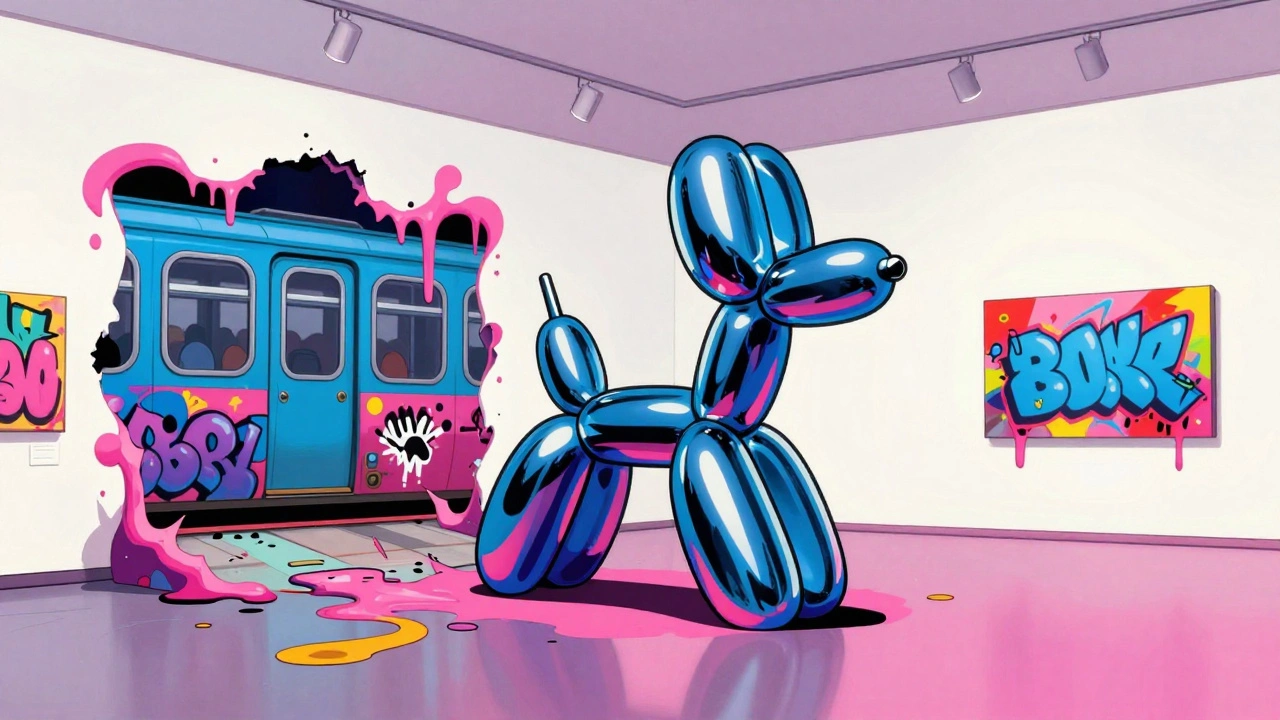

genre blending is the practice of merging elements from different artistic styles, mediums, or cultural traditions to create a hybrid work. In the 80s, this became the heartbeat of the era, fueled by Postmodernism, a movement that traded a single "correct" way of making art for a messy, exciting plurality of voices.
The Rise of the New Pop
While Pop Art started in the 50s and 60s, the 1980s version-often called Neo-Pop-was different. It didn't just observe consumer culture from a distance; it dove headfirst into it. Artists weren't just painting soup cans; they were making sculptures that looked like they belonged in a high-end toy store.Jeff Koons is the poster child for this approach. He took everyday kitsch-vacuum cleaners, balloon animals, and even porcelain sculptures of Michael Jackson-and presented them with a polished, industrial finish that demanded they be seen as fine art. By using manufactured aesthetics, Koons blurred the line between a factory product and a gallery piece.
Then you have Keith Haring, who took art out of the sterile white cube of the gallery and put it on the walls of the New York City subway. Haring didn't see a difference between a public mural and a museum piece. He even integrated sound into his installations to turn a visual experience into a full sensory environment, effectively blurring the line between the visual and auditory arts.
A Palette of Neon and Noise
If the 80s had a color, it was neon. But these electric blues, hot pinks, and acid greens weren't just fashion choices; they were a statement of intent. This palette mimicked the flashing lights of nightclubs and the aggressive saturation of advertising campaigns. By using colors that felt "commercial," artists were intentionally collapsing the distinction between a painting and a billboard.This visual loudness extended to the materials used. Some artists ditched oil paints for velvet, tulle, and glitter. For example, Australian artists experimented with these DIY materials to challenge gender stereotypes, blending the grit of punk with the glitz of pop. It was a physical manifestation of genre-blurring: using "cheap" fabrics to tell complex, feminist narratives.
| Movement/Style | Primary Mediums | Key Goal | Core Influence |
|---|---|---|---|
| Neo-Pop | Sculpture, Installation | Merge kitsch with fine art | Consumerism & Celebrity |
| Art Pop | Music, Fashion, Video | Elevate pop music to avant-garde | Electronic Synths & Bowie |
| Country Rap | Audio/Lyricism | Blend rural and urban aesthetics | Southern Identity |
When the Gallery Met the Dance Floor
Music in the 80s was doing exactly what the visual artists were: breaking the rules of categorization. Art pop emerged as a way to bridge the gap between experimental noise and catchy radio hits. Artists like Grace Jones and the New Romantic movement didn't just make songs; they created visual personas that were as much about fashion and performance art as they were about melody.Groups like Duran Duran were heavily influenced by the electronic pioneers Kraftwerk and the chameleon-like nature of David Bowie. They moved away from standard rock guitars and embraced the synthesizer, turning the arena concert into a baroque, romantic escape. This wasn't just a change in sound; it was a boundary-crossing that shifted pop music toward a more theatrical, artistic expression.
Regional Revolutions: The Southern Shift
Genre-blurring wasn't just happening in the art galleries of New York or the clubs of London. In the American South, a sonic rebellion was brewing. For years, hip-hop was dominated by the styles of New York and Los Angeles. But Miami introduced "booty bass," which proved that the South had its own distinct rhythmic identity.This evolved into a bold blend of country and rap. Artists like Pimp C of UGK famously rejected the label of "hip-hop," calling their work "country rap tunes." This wasn't a mistake; it was a philosophy. By blending verses about John Deere tractors and cold beers with rap beats, artists created a hybrid style that appealed to young Southern listeners who loved both country rock and urban beats. It was a cultural bridge-building exercise that eventually led to massive cross-genre collaborations, such as Willie Nelson working with hip-hop artists, proving that the divide between "rural" and "urban" music was thinner than people thought.
Marginalized Voices and Global Perspectives
One of the most important aspects of 80s genre-blurring was who was doing the blurring. For too long, the "fine art" world was a closed circle of white men. In the 80s, artists from marginalized communities broke in by bringing their own aesthetics with them.Jean-Michel Basquiat is a prime example. He brought the raw, visceral energy of street graffiti into the high-end gallery scene. His work didn't just "use" graffiti; it elevated the street language to a level of academic study, blending African American history, anatomy, and urban grit. At the same time, artists like Barbara Kruger used the visual language of advertising-bold text over images-to create feminist critiques of consumerism.
The blurring also went global. The Transavanguardia movement, with artists like Francesco Clemente, blended Western expressive painting with Eastern mysticism. This created an eclectic, international visual language that proved genre-blurring wasn't just a Western trend, but a global shift toward hybridity.
The Tech Merger
As the decade closed, technology became the ultimate tool for blurring lines. Artists stopped choosing between a sculpture and a movie. Tony Oursler began projecting video onto sculptures, creating talking dolls and disembodied faces. This blend of surrealism and tech reflected a world that was becoming increasingly saturated by screens.By integrating these different mediums, artists created immersive environments. You weren't just looking at a painting; you were standing inside a multimedia experience. This paved the way for the digital art and immersive installations we see today. The 80s taught us that a medium is just a tool, not a boundary. If you can imagine a way to combine a barcode, a tropical beach, and a corporate logo-as Ashley Bickerton did-then that is where the art happens.
What is the difference between 60s Pop Art and 80s Neo-Pop?
While 60s Pop Art focused on observing and commenting on mass media and consumer culture, 80s Neo-Pop was more immersive. Neo-Pop artists, like Jeff Koons, didn't just paint consumer goods; they used industrial manufacturing processes to create the art itself, completely dissolving the line between the art gallery and the commercial factory.
How did the New Romantics influence music genre-blurring?
The New Romantics, such as Duran Duran, shifted the focus of pop music away from traditional rock instrumentation. By embracing synthesizers and high-fashion theatricality, they blended the boundaries between pop music, avant-garde performance art, and electronic experimentation, making "art pop" a commercially viable arena-filling genre.
What was "country rap" in the 1980s?
Country rap was a regional genre-blurring movement primarily based in the American South. It merged the lyrical themes and sonic textures of country music (like references to rural life and farming) with the beats and delivery of hip-hop, challenging the dominance of Northern rap styles and establishing a unique Southern identity.
Why was the use of neon colors significant in 80s art?
Neon colors were used to mimic the visual language of advertising, nightclub culture, and the fast-paced nature of the 80s. By using these high-impact palettes, artists intentionally blurred the distinction between high-brow fine art and commercial production, signaling that art belonged in the loud, neon world of the streets, not just the quiet of a museum.
Who were some of the key figures in 1980s visual genre-blurring?
Key figures included Jeff Koons, who merged kitsch and fine art; Keith Haring, who brought gallery art to the subways; Jean-Michel Basquiat, who blended graffiti with high art; and Barbara Kruger, who used advertising aesthetics for feminist critique.


