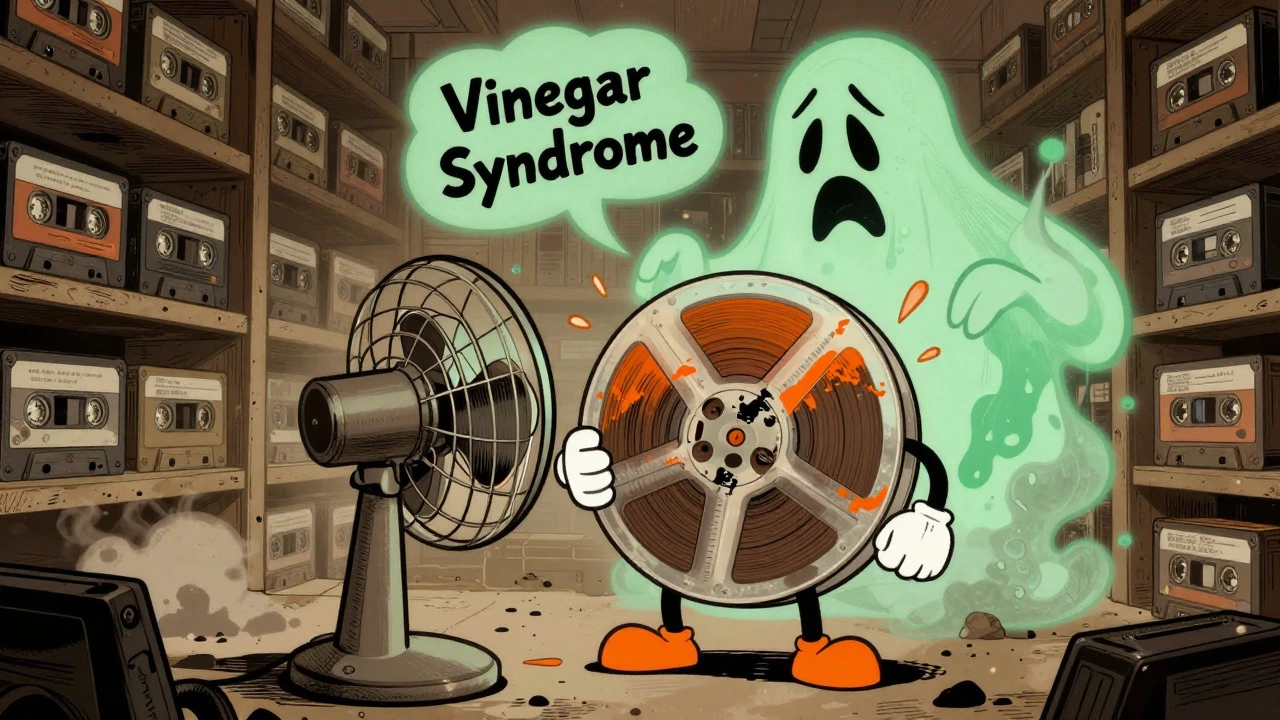

Imagine walking into a room that smells faintly of vinegar. That sharp scent isn't coming from a kitchen; it is the sound of your favorite album dying. This phenomenon, known as "vinegar syndrome," happens when acetate film bases break down, releasing acetic acid. For decades, this was just one of many silent threats to the physical history of recorded music. Behind every song you stream or buy on vinyl lies a fragile chain of custody involving magnetic tape, digital files, and strict archival policies designed to stop these losses before they happen.
The story of how record labels protect their most valuable assets-original master recordings-is not just about keeping things in a box. It is a complex intersection of engineering, legal contracts, and disaster recovery planning. From the catastrophic fires of the past to the sub-zero underground mines of today, the evolution of archival policy defines what we are able to hear from our musical heritage.
Why Archival Policy Matters More Than Ever
At its core, an archival policy is a set of rules governing how a record label creates, stores, copies, and protects original sound recordings. These policies determine whether a band's unreleased demos from 1975 survive for a future reissue or vanish forever. The stakes are incredibly high. We are talking about intellectual property that generates income for decades, but also cultural artifacts that define generations.
In 2012, the Library of Congress published the National Recording Preservation Plan, a comprehensive guide written by experts like Brenda Nelson-Strauss and Alan Gevinson. This plan laid out 32 recommendations for both public institutions and private companies, emphasizing that preserving recorded sound is a shared responsibility. It pushed the industry toward better infrastructure and clearer strategies for disaster preparedness.
For independent labels and major conglomerates alike, these guidelines have become the baseline. They dictate everything from the temperature of a storage room to the format of a digital backup file. Without these standardized policies, the risk of losing entire catalogs increases exponentially.
Setting the Standard: Delivery and Duplication Rules
Preservation doesn't start in the vault; it starts in the studio. In 2018, the Producers & Engineers Wing of the Recording Academy released strict master delivery guidelines. These rules changed how producers hand off work to labels. Previously, engineers might only send the final mix. Now, the policy demands everything: all open-reel analog tapes, hard drives, solid-state drives, and even incremental backups.
The key requirement here is redundancy. The guidelines state that a producer must deliver the master in its original format plus at least two secondary safety masters. Crucially, one of those safety masters must be on a different medium. If the original is analog tape, a safety copy should be digital. This ensures that if one format degrades or becomes obsolete, another version survives.
This approach aligns with recommendations from the International Association of Sound and Audiovisual Archives (IASA). Their policy suggests keeping two high-quality copies of each item in separate locations. Ideally, studios should record two tapes simultaneously during the session itself-one for the archive and one for security. This dual-recording method minimizes the need to handle fragile originals later on.
The Science of Storage: Temperature and Humidity
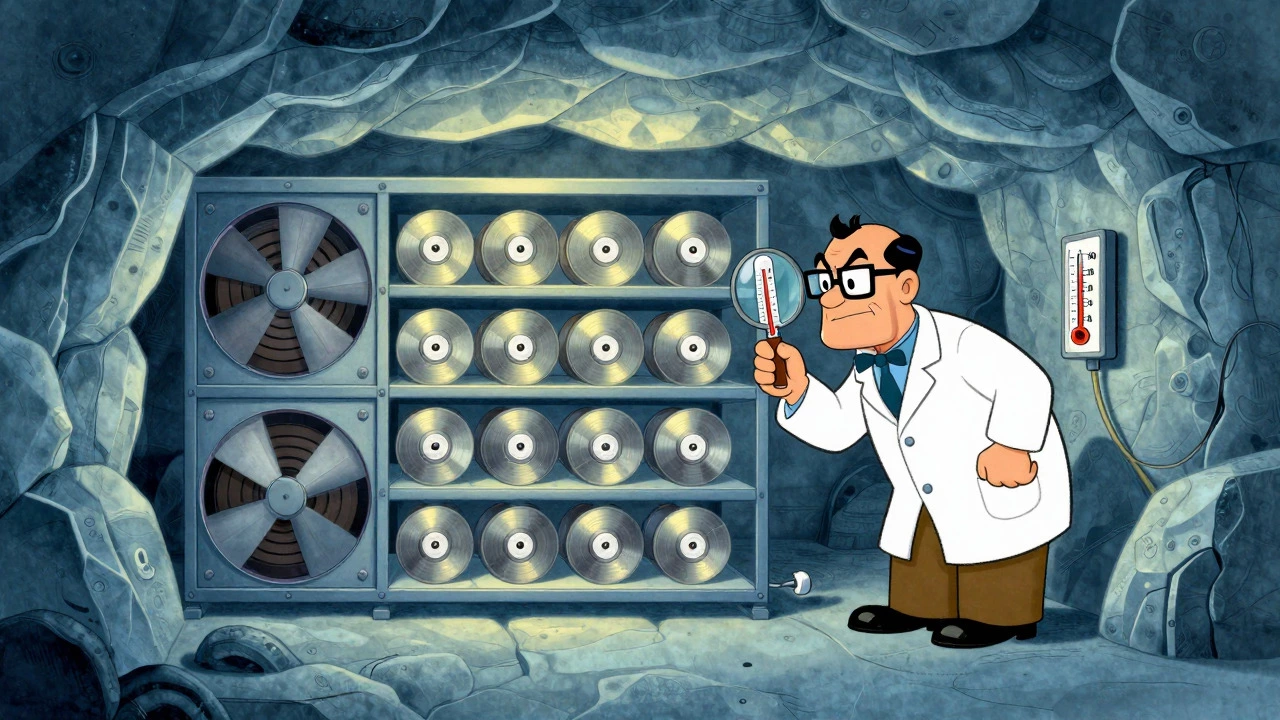
Once the tapes arrive at the label, the environment becomes the biggest enemy. Magnetic tape is sensitive to heat and moisture. To combat this, the industry follows technical standards set by IASA Technical Committee publication TC-05, edited by Albrecht Häfner and Dietrich Schüller. This document provides precise numerical targets for storing audio carriers.
| Storage Type | Temperature Range | Relative Humidity (RH) | Preservation Quality |
|---|---|---|---|
| Room Conditions | 60-74°F | Varies | Fair |
| Cool Storage | 46-60°F | 40-50% | Good |
| Cold Storage | 32-46°F | 25-35% | Very Good |
| Subzero Storage | -4-32°F | ±3% variability | Excellent |
Notice the emphasis on stability. A fluctuating temperature is worse than a slightly warm one because it causes condensation inside the tape reels. Schüller’s research highlights that humidity must be controlled alongside cooling. If you cool a room without dehumidifying it, the relative humidity rises, leading to mold growth and sticky shed syndrome-a condition where the binder holding the magnetic particles falls apart.
Professional vaults aim for a very narrow humidity band, often between 25% and 35% RH for cold storage. This level of control requires expensive HVAC systems and constant monitoring, which is why many labels outsource this task.
Handling Protocols and Physical Care
Even in perfect environmental conditions, poor handling can destroy a tape. IASA TC-05 outlines detailed procedures for cleaning and shelving. When tapes enter an archive, especially older collections from dusty environments, they must be cleaned first. Archivists use compressed clean air from filtered cans to remove loose particles that could scratch the oxide layer during playback.
Shelving geometry matters too. Tapes should always be stored upright, never flat. Flat storage puts pressure on the bottom reels, causing them to warp over time. Shelf dividers should match the diameter of the reel, with separators placed at half the disc diameter to prevent warping while avoiding overly tight packing.
Facility design also plays a role. Archives ban eating, drinking, and smoking in storage areas. Carpets are avoided because they trap dust. Air filtration systems keep particulate matter low. For optical discs like CD-Rs, protection from UV light is critical, as prolonged exposure degrades the dye layers. Every small detail contributes to the longevity of the asset.
The Role of Commercial Vaults: Iron Mountain and Beyond
Building a sub-zero, fireproof vault is prohibitively expensive for most record labels. As a result, the industry relies heavily on commercial storage providers. The most prominent name in this space is Iron Mountain. By the 2020s, Iron Mountain had become synonymous with high-security media storage.
Iron Mountain operates massive facilities worldwide, including a 315-acre complex in a former limestone quarry in Pennsylvania. These underground mines provide natural insulation, maintaining stable temperatures year-round without excessive energy costs. In 2013, reports indicated Iron Mountain held about 22 million entertainment assets. Today, that number has grown significantly, serving clients ranging from Hollywood studios to the estate of Prince.
Their policy emphasizes geographic separation. Instead of keeping all copies in one building, Iron Mountain creates multiple duplicates and stores them in different locations. This strategy mitigates the risk of a single disaster wiping out an entire catalog. Additionally, their Digital Content Repository allows for advanced metadata tagging and previewing, while ensuring that master assets remain air-gapped from the public internet.
Meg Travis, Iron Mountain’s global head of marketing for entertainment services, noted in 2026 that original analog masters rarely leave the building. When digitization is required, it happens in on-site studios under rigorous chain-of-custody protocols. This minimizes shipping risks, which were once a common source of loss.
Lessons from Catastrophic Losses
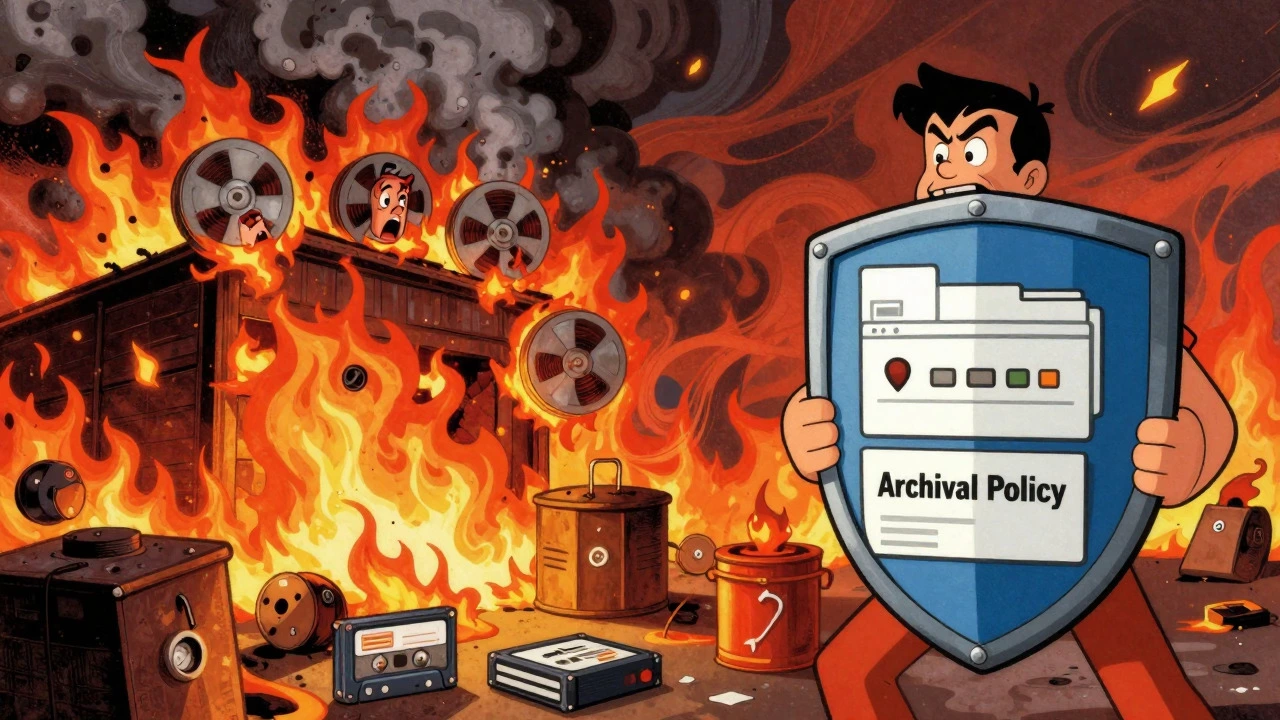
To understand why these policies exist, we have to look at what happens when they fail. Two events stand out in music history as cautionary tales: the Atlantic Records fire of 1978 and the Universal Studios fire of 2008.
In February 1978, a fire destroyed a warehouse in Long Branch, New Jersey. Atlantic Records stored thousands of unreleased master tapes there. An estimated 5,000 to 6,000 reels containing alternate takes, rehearsals, and session multitracks from 1948 to 1969 were lost. Fortunately, the released back catalog survived because it was stored separately in New York. This event highlighted the danger of centralizing archives without adequate climate control or fire suppression.
The 2008 Universal Studios fire was far more devastating. On June 1, a blaze consumed three acres of the Universal backlot, including a warehouse housing original master tapes and digital backups. Estimates vary wildly. Internal documents suggested around 118,000 to 175,000 assets were destroyed. Some reports claimed up to 500,000 individual song titles were affected. Artists like Elton John, Nirvana, and Sheryl Crow confirmed the loss of their masters.
The aftermath sparked intense debate. Universal Music Group initially claimed that only 22 original masters were truly lost, arguing that high-quality safety copies existed for the rest. However, fans and archivists remained skeptical. The discrepancy underscored the importance of transparent inventory management and verifiable redundancy policies.
Digital Preservation and Future Strategies
Today, archival policy is hybrid. While analog tapes remain valuable for their sonic quality, digital preservation is essential for accessibility and safety. The Association for Recorded Sound Collections (ARSC) recommends creating a preservation master in Broadcast WAV (BWF) format. This file should be uncompressed, high-resolution, and free of signal processing.
Labels now create three tiers of files:
- Preservation Master: Stored offline in secure vaults, used only for future restoration.
- Access Master: A slightly lower resolution version used for routine duplication and licensing.
- Access Copy: Compressed files for streaming platforms and consumer distribution.
This hierarchy ensures that the highest quality version is protected from daily wear and tear. Furthermore, continuous migration is key. Digital formats become obsolete quickly. Policies must include regular checks to ensure files remain readable and data integrity is maintained through checksum verification.
Implementing Your Own Archival Strategy
If you are managing a label or an artist's catalog, implementing these policies requires discipline. Start with a full inventory. Survey all carriers, noting their condition and format. Clean and stabilize any damaged tapes following TC-05 guidelines. Prioritize digitization based on risk-older acetate disks and brittle tapes should go first.
Contractually, embed archival requirements into recording agreements. Require producers to deliver all session materials and specify the number of safety copies needed. Choose a storage partner that offers geographic separation and climate-controlled environments. Finally, treat archival storage as a permanent operational function, not a one-time project. The cost of preservation is far less than the value of losing your history.
What is vinegar syndrome in audio tapes?
Vinegar syndrome is a chemical breakdown process affecting acetate-based film and tape bases. As the material deteriorates, it releases acetic acid, giving off a strong vinegar smell. This causes the tape to shrink, become brittle, and eventually crumble, destroying the recorded information. Cold storage slows this process significantly.
How many copies of a master tape should a label keep?
Industry standards, such as those from the Producers & Engineers Wing and IASA, recommend at least three independent carriers: the original master, a safety master on the same medium, and a second safety master on a different medium (e.g., digital). These copies should be stored in geographically separate locations.
What happened in the 2008 Universal Studios fire?
A fire destroyed a warehouse on the Universal lot, damaging or destroying an estimated 118,000 to 175,000 audio and visual assets. Many original master tapes for popular artists were lost, sparking debates about corporate transparency and the adequacy of backup policies at the time.
Why is geographic separation important in archival policy?
Geographic separation ensures that a single local disaster, such as a fire, flood, or earthquake, does not destroy all copies of a master. By storing duplicates in different cities or regions, labels mitigate the risk of total loss and ensure continuity of access.
What is the ideal temperature for storing magnetic tape?
According to IASA TC-05, cold storage between 32°F and 46°F with 25-35% relative humidity is considered "very good" for preservation. Subzero storage (-4°F to 32°F) offers excellent long-term protection. Stability is crucial; fluctuations cause more damage than consistently higher temperatures.