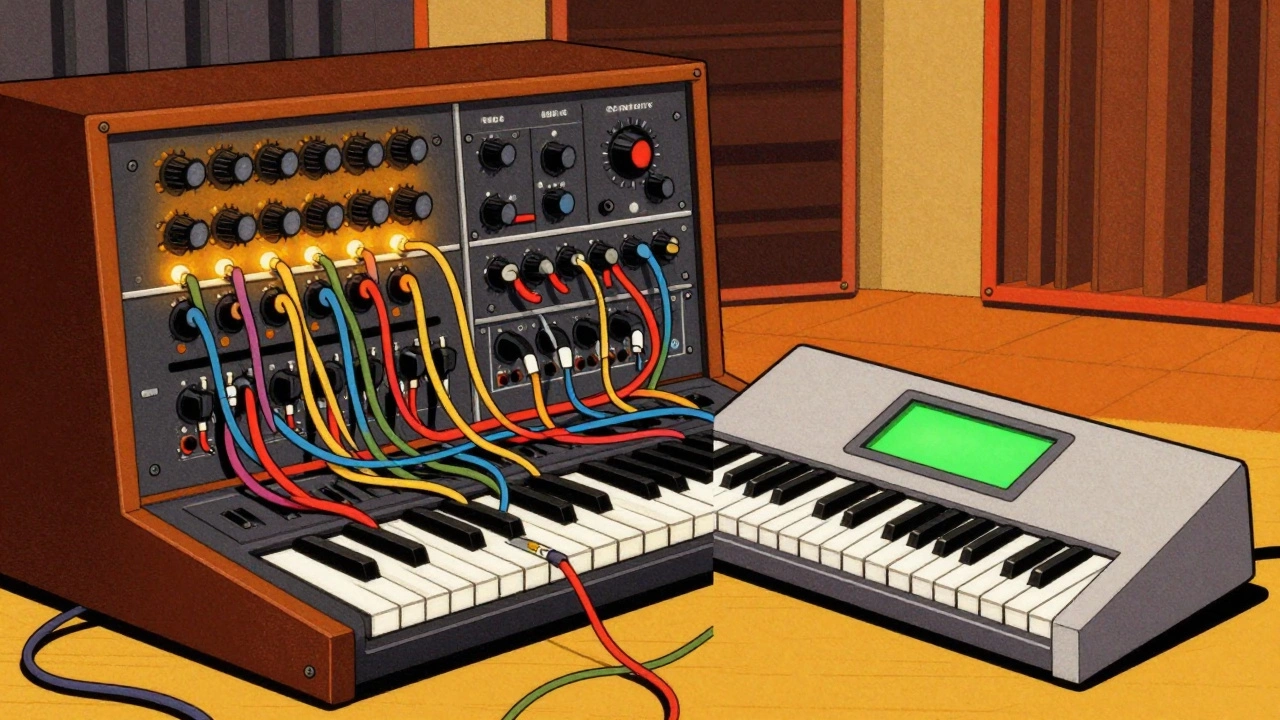

Imagine walking into a recording studio in 1983. On one side, you have a massive, humming wall of knobs and patch cables that smells like warm electronics. On the other, a sleek, lightweight plastic keyboard with a glowing screen and almost no knobs. This was the great sonic divide of the 1980s. Musicians weren't just choosing a brand; they were choosing between two entirely different ways of manipulating electricity to create art. If you're trying to recreate that specific 80s vibe today, understanding this split is the only way to get the textures right.
For a long time, Analog Synthesizers is a type of electronic instrument that generates sound using continuous electrical voltages. These machines dominated the 70s, with the Minimoog Model D setting the gold standard. In an analog setup, you're dealing with Voltage-Controlled Oscillators (VCOs) and filters. Because the signal is a continuous wave, it has a "near-infinite" resolution. This is why people always talk about analog "warmth." It's not just a buzzword; it's the result of subtle instabilities and signal degradation that make the sound feel alive and breathing.
The Analog Vibe: Raw Power and Happy Accidents
If you wanted a bassline that could shake the floor or a lead synth that screamed, you went analog. These instruments provide a raw, pushable sound that feels thick and forgiving. One of the coolest things about old analog gear is that it's unpredictable. Because of temperature changes or aging components, a synth might sound slightly different on Tuesday than it did on Monday. In the world of sound design, we call these "favorable accidents." A bit of unplanned distortion or a slightly drifting pitch adds a human element that a computer struggles to mimic.
However, early analog gear had a huge drawback: it was mostly monophonic. This means you could only play one note at a time. If you wanted a chord, you had to record one note, then another, then another, or buy four separate synthesizers. By the time polyphonic analog synths arrived in the 80s, they were often gargantuan, heavy, and a nightmare to take on tour. They were powerful, sure, but they were starting to feel like dinosaurs in a fast-paced studio environment.
The Digital Revolution: Precision and Polyphony
Then came the 80s shift. Suddenly, Digital Synthesis entered the scene, and everything changed. Instead of flowing voltages, these synths used numbers and digital signal processing. The most iconic example is the Yamaha DX7, which brought FM Synthesis (Frequency Modulation) to the masses. Unlike the warm blur of analog, FM synthesis gave musicians bright, crystalline, and bell-like tones that were impossible to achieve with VCOs.
The biggest game-changer wasn't just the sound, but the convenience. Digital synths allowed for full polyphony-you could play massive chords without needing a room full of equipment. They were lighter, cheaper, and stayed in tune. Along with this came MIDI (Musical Instrument Digital Interface), a standardized protocol that let different instruments talk to each other. For the first time, a keyboard could trigger a drum machine and a sequencer simultaneously. This democratization is what actually fueled the explosion of synth-pop and new wave; you didn't need a million-dollar studio anymore-just a few digital boxes and a vision.
Comparing the Sonic Fingerprints
So, what's the actual difference when you close your eyes? Analog signals are smooth and organic. They don't suffer from "aliasing" (that weird digital artifacting you hear at high pitches). On the other hand, digital signals are discretized approximations. While modern digital gear is nearly perfect, 80s digital synths had a specific "stepped" quality that gave them a sterile, futuristic edge. While analog is often described as timeless, some argue that digital sounds have a shorter shelf life because they are so tied to the specific technology of their era.
| Feature | Analog Synthesizers | Digital Synthesizers |
|---|---|---|
| Sound Quality | Warm, rich, slightly unstable | Bright, precise, crystalline |
| Polyphony | Limited (often monophonic) | High (multiple simultaneous notes) |
| Stability | Drifts with temperature | Rock solid / Always in tune |
| Portability | Heavy, bulky hardware | Compact and lightweight |
| Control | Knobs and sliders (Immediate) | Menus and screens (Precise) |
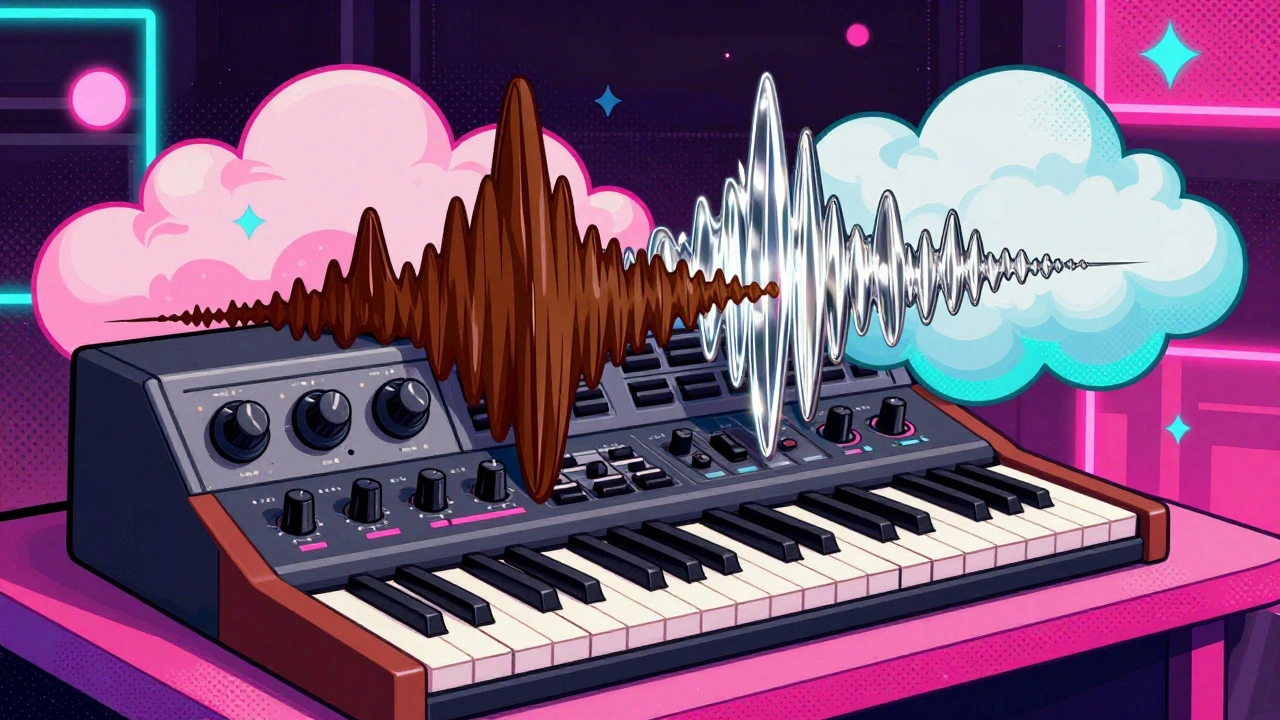
The Hybrid Middle Ground
As the decade progressed, manufacturers realized that musicians wanted the best of both worlds. This led to hybrid instruments. Take the Roland Juno 106 or the DW8000. These machines often used digital control for stability and memory (so you could actually save your sounds!) but kept analog filters to retain that creamy, warm texture. It was a compromise that allowed the "first analog era" to fade out gracefully while embracing the efficiency of the digital age.
If you're choosing a sound for a track today, ask yourself: do I want this to feel like a living, breathing organism or a precise, futuristic machine? Analog wins for bass, fat leads, and anything that needs to feel "vintage." Digital wins for atmospheric pads, metallic percussive hits, and complex chords that need to stay perfectly in pitch.
Practical Tips for Choosing Your Sound
When hunting for that 80s sound, don't just grab the first "retro" plugin you find. Consider these heuristics:
- Use Analog for: Sub-bass, sweeping filter effects, and soulful, "imperfect" melodies. Think of the deep growls in early electronic music.
- Use Digital for: Electric piano sounds, glassy bells, and sharp, cutting-edge leads. Think of the shimmering pops of mid-80s chart-toppers.
- Embrace the Drift: If you're using a digital emulator, look for a "vintage" or "slop" knob. This mimics the instability of old VCOs and makes the sound feel less sterile.
- Layering is Key: The secret to a professional 80s sound is often layering a digital pad for clarity and an analog bass for weight.
Why is analog sound called "warm"?
The "warmth" comes from harmonic distortion and slight inconsistencies in the voltage. Analog circuits don't produce a perfect mathematical wave; they add subtle saturation and a natural drift in pitch that the human ear perceives as organic and pleasing, unlike the clinical precision of digital audio.
Did digital synths completely replace analog in the 80s?
Not entirely, but they dominated the market. While professional studios still used analog gear, the portability and affordability of digital synths like the DX7 made them the go-to for touring bands and home producers. This led to the end of the "first analog era," though analog synthesis eventually saw a massive revival in later decades.
What is FM synthesis and how does it differ from analog?
Frequency Modulation (FM) synthesis uses one digital waveform to modulate the frequency of another. Unlike analog subtractive synthesis, which starts with a rich sound and filters it down, FM builds complex tones from simple sine waves, resulting in the metallic, bright, and sharp sounds typical of 80s pop.
What is MIDI and why was it so important?
MIDI (Musical Instrument Digital Interface) is a communication protocol that allows electronic instruments to talk to each other. Before MIDI, connecting a synth to a sequencer was a nightmare of custom cables. MIDI standardized this, allowing musicians to control multiple synths from one master keyboard or computer.
Which is better for recreating synth-pop?
Neither is "better" because synth-pop relies on the contrast between the two. The iconic sound usually combines the driving, thick bass of an analog synth (like a Juno or Moog) with the bright, poppy textures of a digital synth (like a DX7). The best approach is to use both.


