

Imagine dropping the needle on a thick slab of vinyl in 1974. You aren't just listening to a collection of songs; you're entering a curated sonic world. In the 1970s, hard rock album sequencing wasn't some afterthought-it was a psychological game. Bands didn't just pick their best songs and throw them in a random order. They were architects, building a journey that could take a listener from a crushing riff to a psychedelic daydream and back again, all while keeping them hooked for forty minutes.
The secret to those legendary records lay in the tension between momentum and variety. If you put four high-energy anthems in a row, the listener gets "ear fatigue," and the songs start to blend into one giant wall of noise. But if you drop the energy too early, you lose the adrenaline that defines the genre. The goal was to create an immersive experience where the order of the tracks amplified the emotional impact of the music.
The Physical Constraint of the Vinyl Era
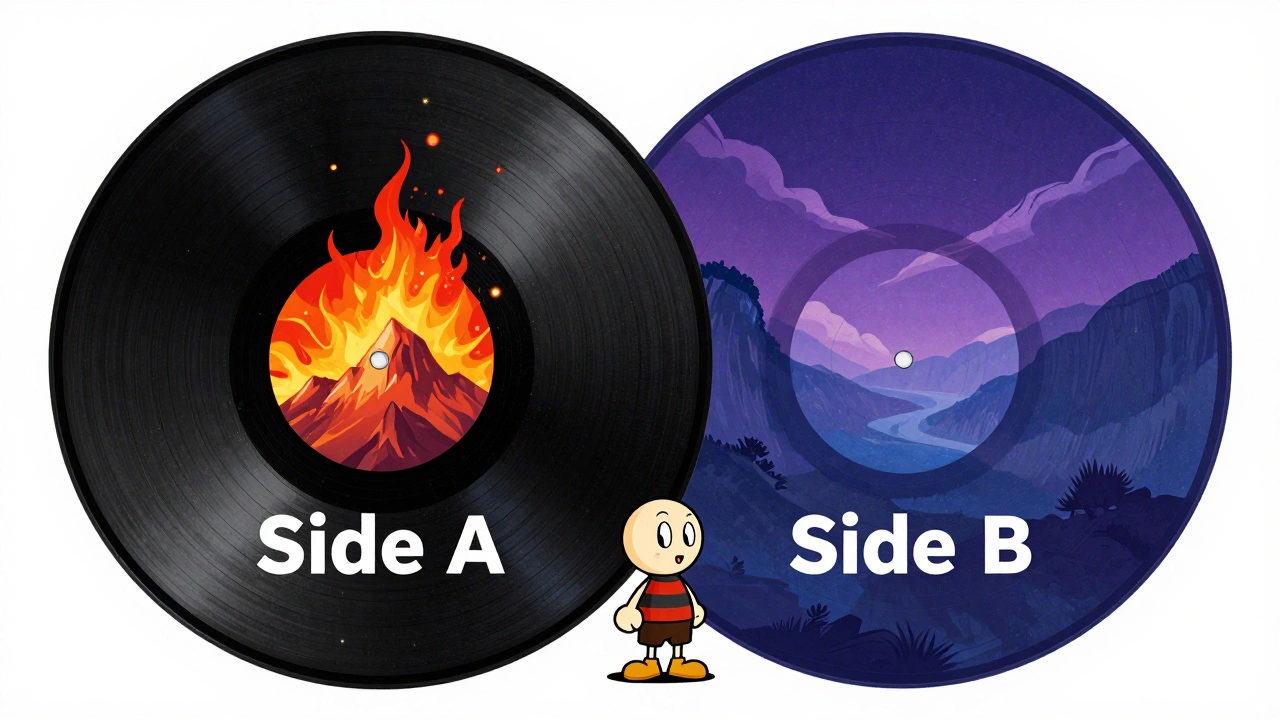
Before streaming and CDs, the physical medium dictated the art. Vinyl Records are analog sound storage discs that physically divide an album into two distinct sides, Side A and Side B. This wasn't just a technical detail; it was a narrative tool. Because each side could only hold about 20 to 23 minutes of music before the sound quality degraded, bands were forced to think in "chapters."
Side A was usually the "statement." It started with a bang to grab attention and built toward a peak. Side B was where the experimentation happened. You'd often find the longer, more indulgent jams or the atmospheric ballads here. This natural split created a psychological break for the listener, acting like an intermission in a play. When you physically stood up to flip the record, your brain reset, making you ready for a new set of sonic textures.
The Art of the Opening Statement
The first track of a hard rock album has one job: establish the vibe and prove the band's power. In the 70s, this often meant leading with a hit or a high-energy riff that acted as a gateway. If the opening track didn't land, the listener might not bother with the rest of the record.
But the real magic happened in the transition from track one to track two. Producers looked for Sonic Continuity, which is the practice of linking songs through similar tempos, keys, or atmospheric textures to prevent jarring jumps. For instance, a band might end a fast-paced opener with a crashing chord that rings out, fading directly into the drum intro of the next song. By modulating the key or maintaining a similar "groove," they could keep the momentum flowing without making the listener feel like they were jumping between unrelated demos.
Managing Energy and the "Groove"
Hard rock of this era relied heavily on a specific rhythmic foundation. Most songs used a "4-to-the-floor" drum pattern, where the kick drum hits on beats 1 and 3 and the snare hits on 2 and 4. While this sounds simple, the variety in an album came from how the band tweaked this template. To keep an album from feeling monotonous, sequencing required a careful balance of these grooves.
| Album Segment | Goal | Typical Groove/Tempo | Psychological Effect |
|---|---|---|---|
| The Hook (Tracks 1-2) | Engagement | High energy, driving 4/4 | Adrenaline & Excitement |
| The Valley (Tracks 3-4) | Contrast | Mid-tempo or slow jam | Emotional depth, breath |
| The Climb (Tracks 5-6) | Build-up | Increasing complexity/tempo | Anticipation |
| The Peak (Finale) | Resolution | Epic, heavy, or orchestral | Catharsis & Completion |
If you put two "mid-tempo slogs" back-to-back, you risk the listener tuning out. The strategy was to sandwich a slower, more melodic track between two high-voltage rockers. This contrast makes the heavy songs feel even heavier and the melodic songs feel more poignant.
The Psychology of the Finale
How you end an album determines how the listener remembers the whole experience. In the 70s, hard rock bands generally chose one of three closing strategies. Some went for the "Controlled Chaos" approach, ending with an epic, ten-minute track that pushed the instruments to their absolute limit, leaving the listener breathless.
Others preferred a reflective finale. Ending with a slower, stripped-back song provides a sense of closure and lets the listener process the intensity of the previous tracks. Then there was the "Full Circle" technique. This is where a band reprises a theme or a melody from the opening track in the final song. This creates a satisfying loop, making the album feel like a complete, self-contained piece of art rather than just a list of songs.

Common Sequencing Pitfalls
Even the best bands made mistakes. One of the most common errors was "The Mid-Album Slump," where the energy drops too drastically in the middle of Side B and never recovers. When three ballads in a row appear, the driving spirit of the hard rock experience vanishes.
Another issue was poor key transitions. When a song in a bright, major key is immediately followed by one in a dark, dissonant minor key without a proper bridge, it can feel like a sonic car crash. Professional producers in the 70s often used short atmospheric bridges-wind noises, feedback, or simple drum fills-to smooth over these gaps and keep the immersive experience intact.
From Hard Rock to the Birth of Metal
As the 70s progressed, these sequencing rules evolved into what we now recognize as the blueprint for heavy metal. The shift toward Concept Albums, which are albums where the tracks are linked by a central theme, story, or narrative, took sequencing to a new level. Instead of just managing energy, bands began managing plot points. The sequence became a script, and the music became the soundtrack to a larger story.
This transition turned the album from a product into an experience. The focus shifted from "which song is the hit?" to "how does this track serve the story?" This mindset paved the way for the complex, multi-part epics of the 80s and beyond.
Why was the order of songs so important on vinyl?
Vinyl physically split albums into two sides, forcing artists to create two distinct "chapters." This prevented listener fatigue and allowed bands to structure the album's emotional arc, using the physical act of flipping the record as a mental reset for the listener.
What is "ear fatigue" in the context of hard rock?
Ear fatigue occurs when a listener is exposed to high-intensity, loud, or distorted sounds for too long without variation. In sequencing, this is avoided by placing mid-tempo or melodic songs between high-energy tracks to give the listener's brain a break.
How did the "4-to-the-floor" drum pattern affect sequencing?
Since many 70s rock songs shared this basic rhythmic foundation, variety had to come from subtle deviations in the groove. Sequencing required placing songs with different rhythmic feels together so the album didn't sound like one continuous, unchanging beat.
What is the "Full Circle" closing strategy?
This is a technique where the final track of an album references or reprises elements from the first track. It creates a sense of thematic completion, making the listening experience feel like a closed loop rather than a linear list.
Did producers use gaps of silence intentionally?
Yes. Small gaps of silence or atmospheric noise were often inserted between tracks to act as "palate cleansers." This helped separate different moods and prevented the transition between two different song keys from feeling too abrupt.


