

Most listeners don't realize that the order of songs on an album is a deliberate compositional choice, not just a random shuffle. In Jazz Fusion is a genre that blends jazz harmony with rock rhythms and electric instrumentation, this ordering becomes critical because many records are designed as continuous narratives rather than collections of standalone hits. When you sequence a fusion album, you aren't just listing tracks; you are building a sonic architecture where Suites is multi-movement compositions that maintain thematic links across distinct sections and codas guide the listener through emotional peaks and resolutions. If you get this wrong, even the most technically brilliant performance can feel disjointed. Get it right, and the album feels like a single, breathing entity.
The Architecture of the Fusion Suite
In classical music, a suite is a set of dances. In fusion, it’s something different. A fusion suite typically spans 10 to 20 minutes and consists of three to seven distinct movements. These movements might shift from a slow, modal ballad to a double-time funk groove, but they share harmonic vocabulary or rhythmic motifs. Think of Oscar Peterson’s “Canadiana Suite” (1964). It follows a train journey across Canada, with each movement representing a different city. The key changes and tempo shifts aren't random; they mirror the geographic progression from east to west. This is the core of thematic flow: every transition serves the story.
Unlike a standard pop song with a verse-chorus structure, a suite allows for extended development. You can introduce a motif in the first movement, deconstruct it in the second, and resolve it in the fifth. This requires careful planning. If you place two high-energy, complex instrumental pieces back-to-back without a dynamic contrast, the listener’s attention will sag. The goal is to create a narrative arc within the suite itself before moving to the next track. As mastering engineer Mat Leffler-Schulman noted in 2026, sequencing is a compositional act, not a technical one. You decide the flow when you write the transitions, not when you master the file.
Designing the Emotional Arc
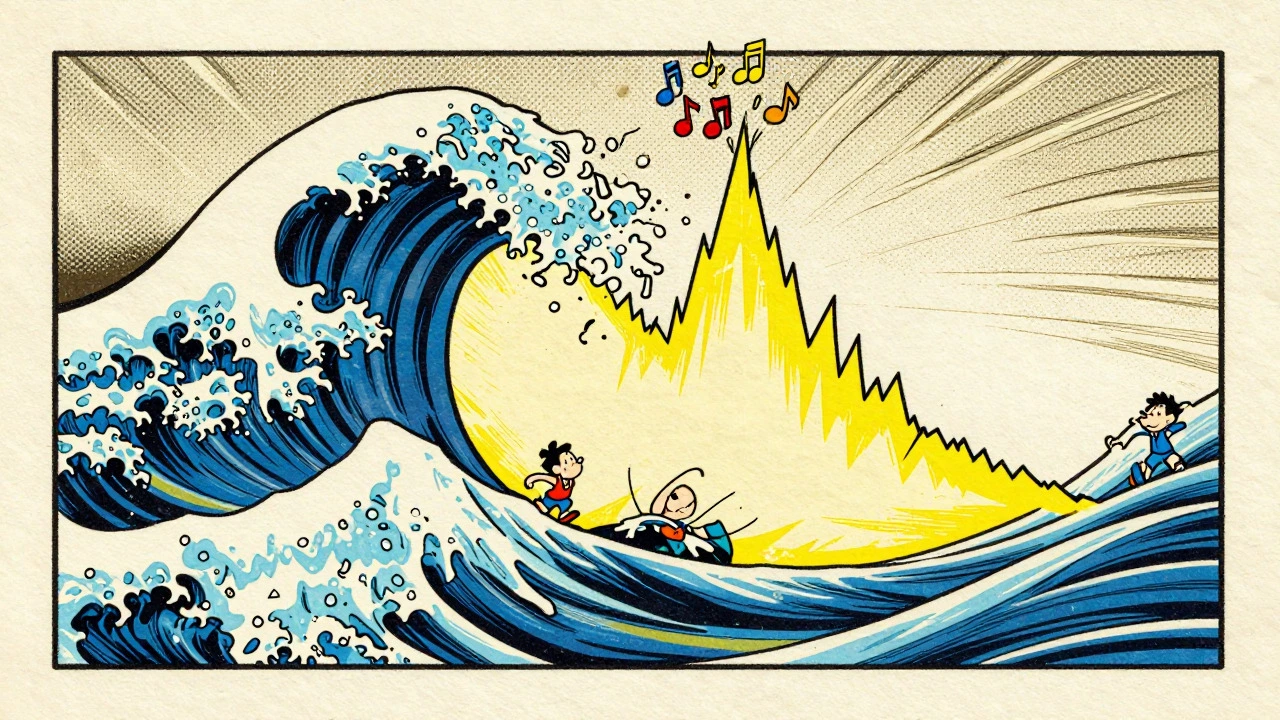
How do you arrange 10 to 12 tracks to keep someone engaged for 45 minutes? The answer lies in understanding energy dynamics. Research into feature arcs suggests that professional albums often follow an inverted U-shape for tempo and intensity. Slower, more introspective tracks usually bookend the album, while the highest energy and complexity cluster in the middle. This creates a natural rise and fall that mirrors human emotional endurance.
- Act I (Tracks 1-3): Set the scene. Track 1 should be inviting but not necessarily your absolute best song. It needs to establish the tonal palette. Track 2 can be the "hook" or the first major statement.
- Act II (Tracks 4-9): This is the tumultuous middle. Introduce the most complex suites here. Place your "gold nugget"-the most compelling, high-concept piece-around the 50% to 60% mark. This keeps listeners from dropping off before the climax.
- Act III (Tracks 10-12): Resolution. The energy descends, leading to a final coda that summarizes the album's themes. The last track should feel like a curtain call, providing a clear sense of ending.
Avoid clustering similar songs together. If you have two tracks in the same key and tempo, separate them with a contrasting piece. This prevents monotony and maintains momentum. The listener should feel a push-and-pull rhythm throughout the record.
The Role of Codas and Transitions
Codas are often misunderstood as mere endings. In fusion, they are bridges. A well-crafted coda can summarize a theme, provide a moment of reflection, or seamlessly lead into the next track. For example, Don Cherry’s “Complete Communion” (1966) uses minimal breaks between tracks, creating a continuous flow that blurs the line between individual songs and a single epic work. This technique demands precise matching of key, tempo, and texture at the seams.
When designing these transitions, consider the silence between tracks. In digital streaming, gaps can disrupt the flow. Mastering engineers now use gapless playback techniques, where fades overlap or end abruptly to maintain continuity. If you want a hard stop, ensure the final chord resolves completely. If you want a blend, align the outro of one track with the intro of the next so they harmonize. This is where the "thematic flow" truly lives. It’s not just about how the songs sound individually, but how they interact at the boundaries.
Practical Steps for Sequencing Your Album
You don’t need to guess. There is a methodical process to arranging your tracks. Here is a workflow that works for complex fusion projects:
- Map Your Tracks: List all your completed songs. Assign each an energy level (1-10), a key, and a primary emotional register (e.g., aggressive, melancholic, playful).
- Identify Anchors: Choose your opening and closing tracks first. The opener must grab attention; the closer must provide resolution. These are your fixed points.
- Place the Peak: Identify your strongest, most complex suite. Place it in the second half of the album, around the 60% mark. This is your centerpiece.
- Fill the Gaps: Arrange the remaining tracks to create contrast. Alternate high-energy pieces with slower, reflective ones. Ensure no two tracks share the same mood or key consecutively unless intentional.
- Test the Seams: Listen to the last 30 seconds of one track and the first 10 seconds of the next. Does it flow? Does it clash? Adjust the order or edit the transitions until the seam is smooth.
- Full Listen-Throughs: Play the entire album from start to finish multiple times. Do this with headphones, then speakers, then in a car. Context matters. What works in a studio may feel flat in a living room.
Don’t rush this step. It can take dozens of passes to find the perfect order. But the payoff is an album that feels cohesive and intentional, rather than a collection of unrelated demos.
Case Studies in Effective Sequencing
Looking at classic fusion and progressive rock albums reveals common patterns. Herbie Hancock’s “Sextant” (1973) uses a mix of solo piano ballads and full-band fusion tracks. The sequencing alternates between intimacy and power, keeping the listener engaged by shifting textures. Similarly, Jan Hammer’s “The First Seven Days” (1975) uses recurring rhythmic motifs across its tracklist to suggest a continuous story. Each track builds on the last, creating a sense of progression.
Radiohead’s “OK Computer” (1997), while not strictly fusion, demonstrates the power of thematic sequencing. Tracks like “Airbag” and “Paranoid Android” establish sonic motifs that are developed and resolved later in the album. This narrative approach holds attention far better than a random assortment of hits. For fusion artists, this means thinking beyond the song. Think about the album as a whole. What is the story? How does each track contribute to that story?
| Strategy | Best For | Risk |
|---|---|---|
| Inverted U-Arc | Standard 10-12 track albums | May feel predictable if not varied |
| Continuous Suite | Concept albums, side-long epics | Harder to market singles, requires strong transitions |
| Contrast-Based | Diverse styles, eclectic bands | Can feel disjointed if contrasts are too sharp |
Frequently Asked Questions
How long should a fusion suite be?
A typical fusion suite ranges from 10 to 20 minutes. This length allows for distinct movements while maintaining listener engagement. Longer suites risk losing focus, while shorter ones may not allow for sufficient development.
Do I need to release singles from a concept album?
Yes, but choose carefully. Pick tracks that stand alone well enough to attract new listeners, but that also fit the album's narrative. Avoid releasing the most abstract or transitional pieces as singles, as they may confuse casual listeners.
How important is the gap between tracks?
Very important. For continuous flow, use gapless playback or very short gaps (under 0.5 seconds). For distinct songs, use 2-5 seconds of silence to signal a boundary. Test both to see which serves your narrative better.
Can I change the track order after mastering?
Technically yes, but it’s risky. Mastering is often done with specific loudness and frequency balance in mind for the intended order. Changing the order can disrupt the dynamic flow. Ideally, finalize the sequence before mastering.
What tools help with album sequencing?
You can use simple spreadsheet software to map energy levels and keys. Some DAWs offer playlist features that allow you to audition sequences quickly. Data-driven tools are emerging, but ear-based testing remains essential for fusion genres.