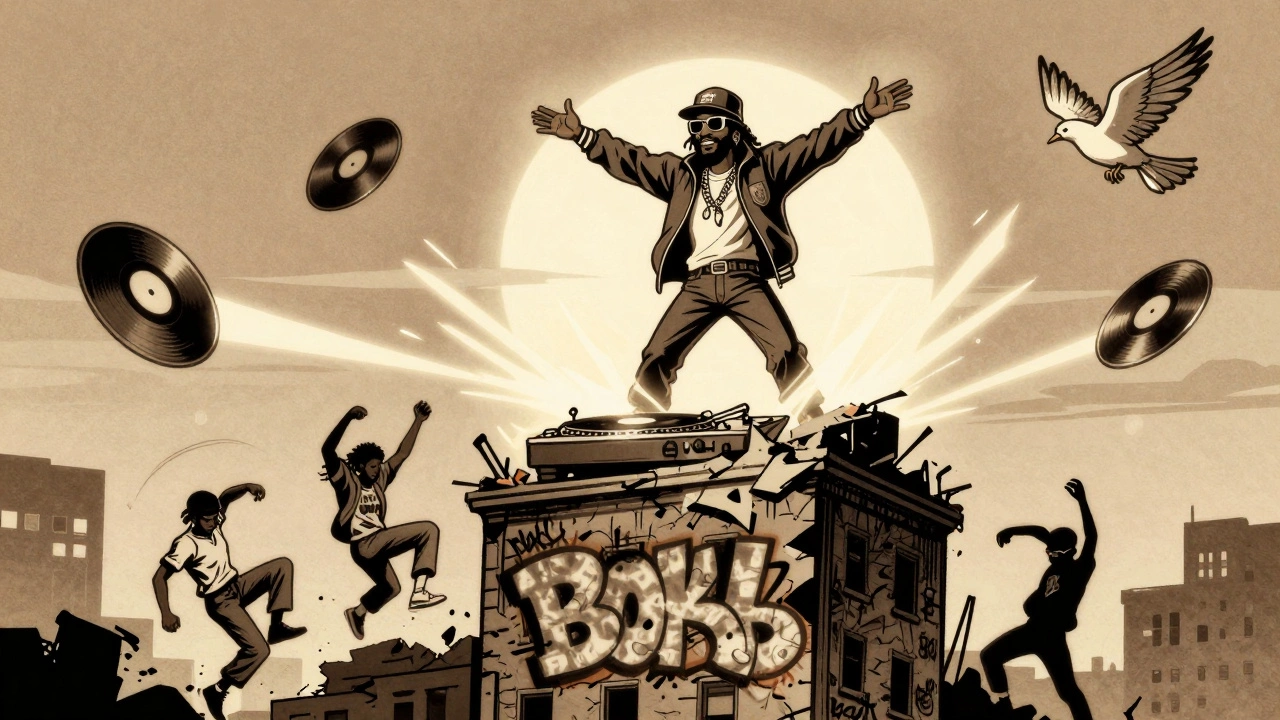

Afrika Bambaataa didn’t just make music-he rebuilt a neighborhood. In the 1970s, the South Bronx was burning. Abandoned buildings, broken windows, and gang violence defined life for young Black and Puerto Rican kids. But Bambaataa saw something else: potential. He turned street gangs into dance crews. He turned block parties into global movements. And he turned a handful of records, a drum machine, and a lot of raw energy into something bigger than music-something called hip-hop culture.
The Gang That Became a Movement
Before he was a DJ, Afrika Bambaataa led the Black Spades, one of the biggest street gangs in the Bronx. He wasn’t just a member-he was their leader. But everything changed after a trip to Africa. He came back with a new name, a new mission, and a new vision: peace, not power. He didn’t disband the gang. He rebranded it. The Black Spades became the Universal Zulu Nation - a global network of youth focused on creativity, not conflict.
The motto? "Peace, Love, Unity and Having Fun." Simple. Radical. Revolutionary. In a time when young men were dying over turf, Bambaataa offered them something better: a dance battle. A graffiti wall. A turntable war. Suddenly, status wasn’t about who had the sharpest knife-it was about who had the wildest breakbeat.
The Four (Plus One) Pillars of Hip-Hop
Before Bambaataa, hip-hop was just noise. DJs spun records. Kids danced. Graffiti artists tagged walls. Rappers yelled over beats. But no one connected the dots-until he did.
Bambaataa was the first to name the four core elements of hip-hop: deejaying, rapping, breakdancing, and graffiti. He didn’t invent any of them. But he saw them as parts of a whole. And then he added a fifth: knowledge of self.
This wasn’t just about music. It was about identity. It was about knowing where you came from, why you were angry, and how to turn that anger into art. He taught kids to read Malcolm X speeches. To study African history. To understand that their pain wasn’t random-it was systemic. Hip-hop, to him, wasn’t entertainment. It was education. It was resistance. It was survival.
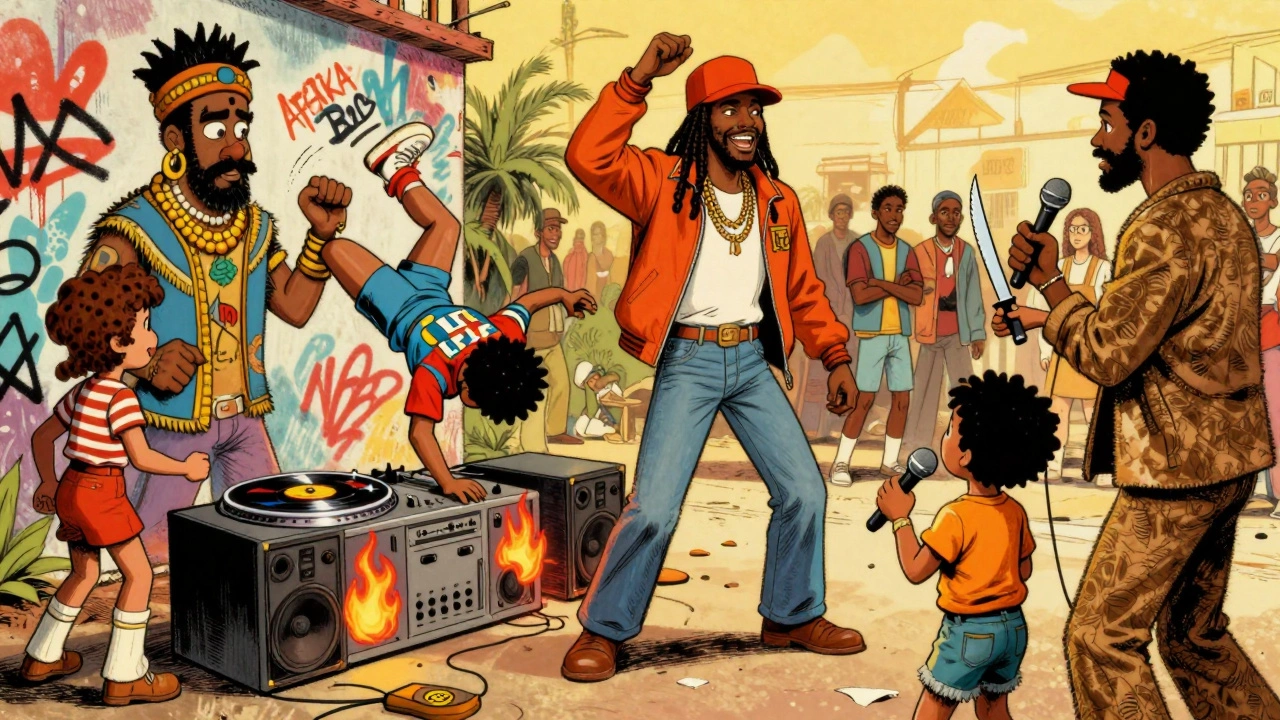
Planet Rock: The Sound That Changed Everything
In 1982, Bambaataa dropped "Planet Rock"-a track that didn’t just top charts, it rewired music forever.
He took a robotic beat from Kraftwerk’s "Trans-Europe Express," layered it with a Roland TR-808 drum machine, and added a sped-up synth line from "Numbers." Then he slapped on a funky bassline and a spoken-word chant: "We are the Zulu Nation, and we are here to rock." The result? A sound no one had ever heard. Electro-funk. A fusion of German synth-pop and Black American groove.
It wasn’t just a hit. It was a blueprint. Producers copied it. Radio stations played it. Kids in Tokyo, Paris, and Johannesburg started making their own versions. "Planet Rock" didn’t just introduce a new sound-it proved hip-hop could be global, futuristic, and deeply African at the same time.
Bambaataa became known as the "Master of Records" because he didn’t just play records-he dug through them like an archaeologist. He found funk from James Brown, jazz from Sun Ra, and even the "Theme to the Pink Panther"-and turned them all into hip-hop. He was the first to sample speeches by Martin Luther King Jr. over breakbeats. He didn’t just make music. He made history.
From the Bronx to the World
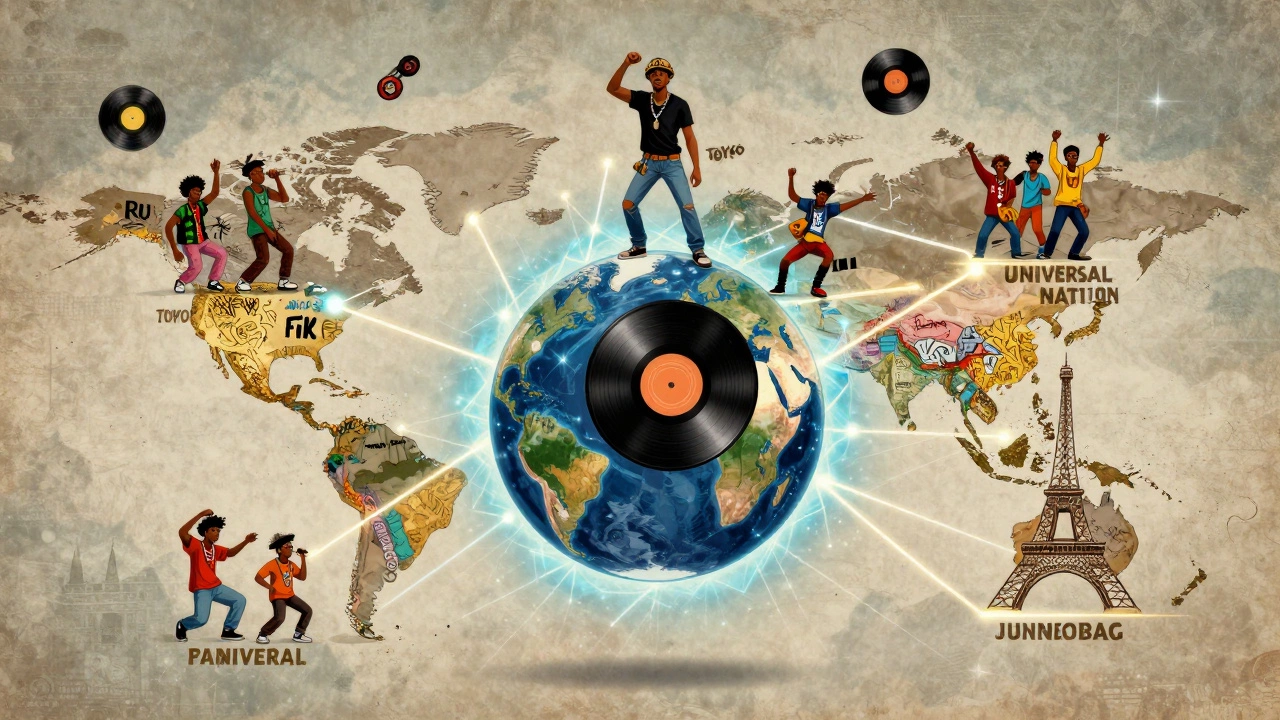
Most DJs stayed local. Bambaataa went global. He didn’t wait for record labels to notice him. He took hip-hop downtown-to the Village, to clubs, to white audiences who had never heard a breakbeat. He brought graffiti artists to galleries. He turned breakdancers into performers. He didn’t just show people hip-hop-he taught them how to live it.
By the mid-1980s, the Universal Zulu Nation had chapters in Canada, the UK, Japan, and Brazil. He organized the first international hip-hop tour. He didn’t care if you were Black, white, Latino, or Asian. If you had the spirit, you were part of the movement. He built safe spaces for kids who had nowhere else to go. He gave them turntables instead of guns. He gave them spray cans instead of knives.
And when the East Coast-West Coast feud exploded in the 1990s, Bambaataa didn’t stay quiet. He tried to mediate. He called for peace summits. He reminded everyone: "If we do not sit down and unite, I can see hip-hop becoming destroyed." He wasn’t asking for fame. He was asking for survival.
The Legacy That Keeps Growing
Think of De La Soul. A Tribe Called Quest. The Jungle Brothers. These artists didn’t just sound different-they thought differently. They rapped about consciousness, not cash. They sampled jazz, not just drums. They wore colorful clothes, not gold chains. Where did that come from? The Universal Zulu Nation. Bambaataa’s influence wasn’t just in beats-it was in values.
He didn’t just create a genre. He created a philosophy. One that said: You don’t need permission to be creative. You don’t need money to be powerful. You just need a beat, a mic, a wall, and a community.
Today, hip-hop is the biggest music genre on the planet. Billions stream it. Corporations monetize it. But how many know its roots? How many know that it was born not in a studio, but in a Bronx park? That it was shaped not by CEOs, but by a former gang leader who chose peace over power?
Afrika Bambaataa didn’t want to be a star. He wanted to be a teacher. He didn’t want to sell records-he wanted to save lives. And in doing so, he gave the world more than music. He gave it a way to heal.
Who is Afrika Bambaataa and why is he called the "godfather" of hip-hop?
Afrika Bambaataa, born Keith Donovan, is a DJ and activist from the Bronx who helped turn hip-hop from a local street scene into a global cultural movement. He’s often called the "godfather" because he didn’t just make music-he built the framework for hip-hop as a lifestyle. He organized block parties, founded the Universal Zulu Nation, and defined the four (later five) core elements of hip-hop culture. Unlike other pioneers who focused on technique, Bambaataa focused on meaning, community, and peace.
What is the Universal Zulu Nation?
The Universal Zulu Nation is a global hip-hop awareness organization founded by Afrika Bambaataa in the early 1970s. It started as a reformed version of the Black Spades street gang and became a network of youth committed to peace, love, unity, and having fun. The Zulu Nation promotes hip-hop’s four elements-deejaying, rapping, breakdancing, and graffiti-and adds a fifth: knowledge of self. It has chapters in over 40 countries and continues to host events, workshops, and educational programs for young people.
How did "Planet Rock" change hip-hop music?
"Planet Rock" was the first major hip-hop track to use the Roland TR-808 drum machine and electronic synths from Kraftwerk. It created a new subgenre called electro-funk and proved hip-hop could be futuristic, not just rooted in funk and soul. The track’s success opened doors for electronic production in hip-hop, influencing everything from 1990s techno to modern trap beats. It also showed that hip-hop could cross racial and cultural lines, appealing to audiences far beyond the Bronx.
Why is "knowledge of self" considered the fifth element of hip-hop?
Afrika Bambaataa added "knowledge of self" as the fifth element to remind people that hip-hop wasn’t just about entertainment-it was about awareness. This means understanding your history, your identity, and your place in society. It’s why artists like Public Enemy, KRS-One, and the Native Tongues crew rapped about Black history, systemic racism, and community empowerment. Without this element, hip-hop risks becoming just another product. With it, it becomes a tool for liberation.
How did Bambaataa influence artists like De La Soul and A Tribe Called Quest?
The Native Tongues collective-including De La Soul, A Tribe Called Quest, and the Jungle Brothers-directly drew from the values of the Universal Zulu Nation. They embraced positive lyrics, jazz samples, colorful imagery, and conscious messaging. Bambaataa didn’t produce their records, but he created the culture they grew up in. He showed them that hip-hop could be playful, intellectual, and spiritually grounded. Their music is the living proof that his vision lasted beyond the 1980s.


