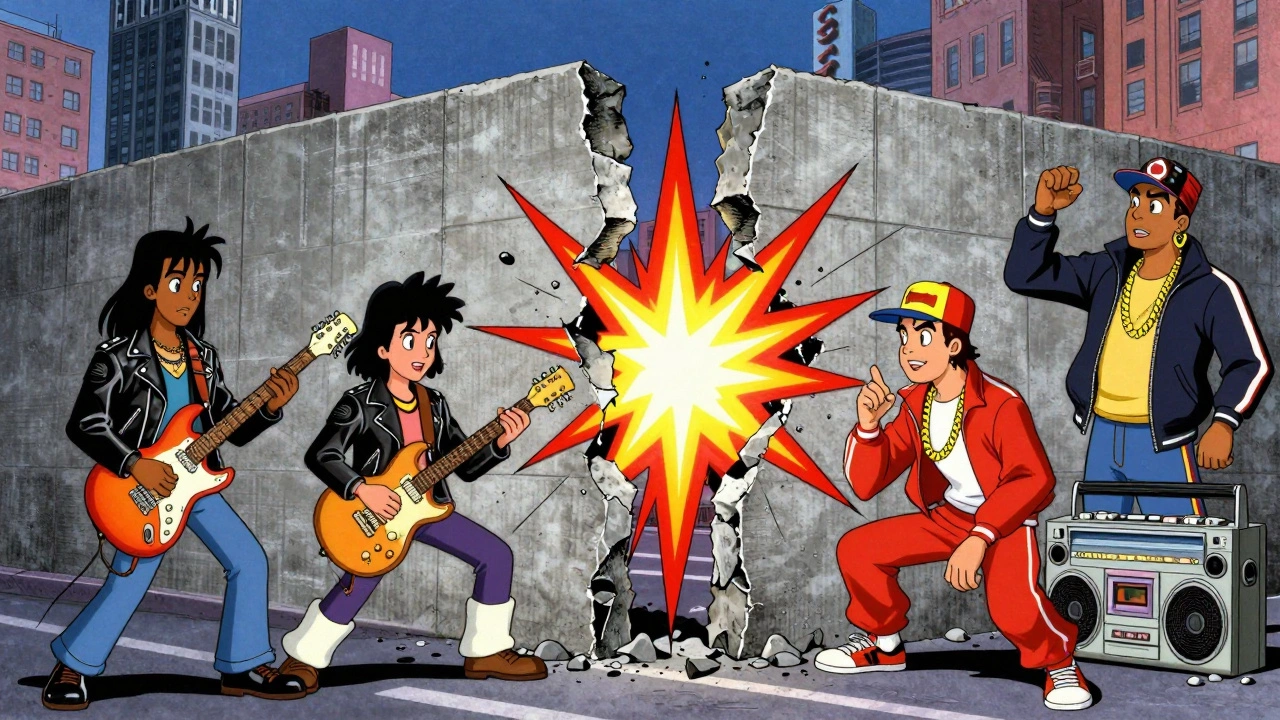

Imagine a world where hip-hop wasn't allowed on MTV and rap songs were practically banned from rock radio. That was the reality in the mid-1980s. The wall between genres wasn't just a preference; it was a professional barrier. Then came a song that didn't just knock that wall down-it blew it up. Walk This Way is a groundbreaking fusion of arena rock and hip-hop that served as a catalyst for rap's mainstream acceptance in the United States. By blending the grit of Boston rock with the punch of Queens rap, this track did more than just climb the charts; it changed who got to be a superstar.
The Quick Take: Why This Collaboration Mattered
- It was the first rap song to break into mainstream rock radio.
- It forced MTV to give hip-hop a seat at the table, leading to shows like Yo! MTV Raps.
- It saved Aerosmith from a commercial slump and catapulted Run-D.M.C. to global stardom.
- It proved that cross-genre partnerships could bypass industry gatekeepers.
Two Worlds Colliding by Necessity
To understand why this happened, you have to look at where both groups were in 1986. Aerosmith is a legendary American rock band formed in 1970, known for their hard rock sound and the songwriting duo of Steven Tyler and Joe Perry. While they had a massive hit with the original version of "Walk This Way" in 1975, by the mid-80s, the band was struggling. Their commercial fortunes were dipping, and they were staring down a potential artistic dead end.
On the other side, you had Run-D.M.C. is a pioneering hip-hop group from Hollis, Queens, credited with introducing a harder, stripped-down sound to rap music. They were the kings of the underground, but the mainstream-especially white rock audiences-still viewed rap as a niche trend rather than a legitimate musical movement.
Neither group was exactly thrilled about the idea at first. In later interviews, it came out that both parties felt the other needed the partnership more. It wasn't a meeting of kindred spirits so much as a strategic move. The bridge between them was Rick Rubin is the co-founder of Def Jam Records and a producer known for blending rock and hip-hop elements. Rubin saw the potential for a sonic explosion and pushed Run-D.M.C. to cover the track, even though the group wasn't particularly familiar with the song.
The 'Trojan Horse' Effect
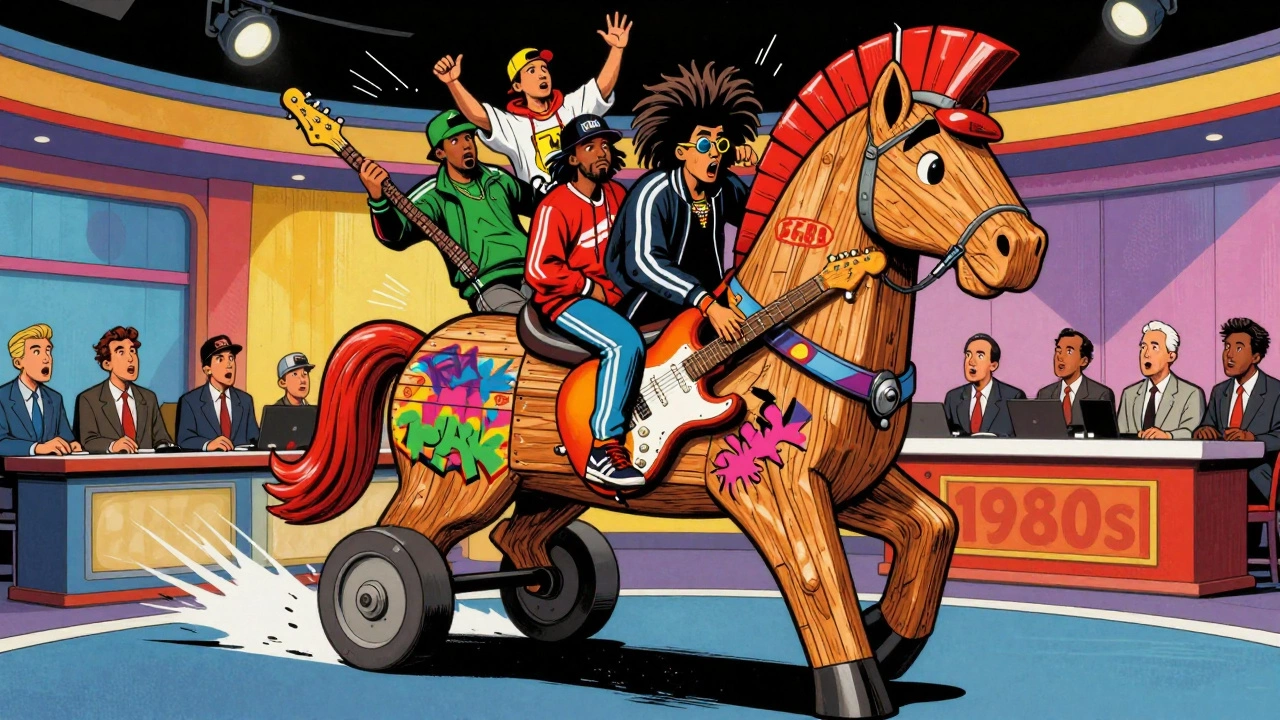
When the song was released on July 4, 1986, as part of the album Raising Hell is the second studio album by Run-D.M.C., which became a landmark release in the fusion of rap and rock. , it acted as a "Trojan horse." Here is how that worked: radio programmers and MTV executives were terrified of rap, but they loved Steven Tyler's vocals and Joe Perry's iconic guitar riffs. Because the song sounded like a rock record, they let it in the door.
Once the song started playing, the audience was exposed to the aggressive, rhythmic delivery of Run-D.M.C. It was a genius move. If the track had been purely rap, it likely would have been ignored by rock stations. Instead, the familiar rock elements provided a safety net that allowed the rap verses to reach millions of people who had never heard a hip-hop track before.
The impact was immediate. It became the first music video of its kind to get heavy rotation on MTV. Before this, hip-hop had virtually no presence on the network. This single track paved the way for the eventual launch of Yo! MTV Raps, which turned hip-hop into a visual culture for a global audience.
| Feature | 1975 Original | 1986 Collaboration |
|---|---|---|
| Primary Genre | Hard Rock | Rap-Rock Fusion |
| Main Goal | Establish rock credibility | Break genre barriers |
| Chart Success | Top 10 (Billboard Hot 100) | Higher peak than original |
| Media Reach | Traditional Rock Radio | MTV & Mainstream Crossover |
Production Chaos and Unexpected Heroes
The recording process wasn't as smooth as the final product suggests. There were significant technical and creative hurdles during the sessions. Interestingly, the Beastie Boys is an influential American hip-hop group known for their eclectic mix of rap and punk rock. played a crucial role behind the scenes. Joe Perry noted that the Beastie Boys actually helped rescue the production when things were falling apart, providing the kind of support and energy needed to get the track across the finish line.
The song's structure was also a calculated risk. Chuck D of Public Enemy later pointed out that the arrangement was specifically tuned for the hip-hop ear. The tension and release in the music were designed to keep listeners hooked, creating a high-energy loop that made it impossible for DJs to ignore. If a DJ tried to cut the track for a commercial too early, they were essentially fighting against the natural momentum of the song.

The Lasting Legacy of a Genre Mashup
The success of "Walk This Way" didn't just benefit the artists involved; it shifted the entire business model of the music industry. It proved that the "crossover" was a goldmine. Once the industry saw that rock fans would listen to rap and rap fans would appreciate rock, the floodgates opened.
For Aerosmith, the song acted as a career resuscitation. It reminded the world they were still relevant and gave them a modern edge that helped them dominate the late 80s and early 90s. For Run-D.M.C., it was the moment they stopped being an underground sensation and became the first global superstars of hip-hop. They didn't just get a hit song; they got a passport into every living room in America.
Without this specific moment in 1986, the trajectory of music television and radio would look very different. The acceptance of the "urban" sound in mainstream spaces started here. Every modern collaboration between a rapper and a pop or rock star owes a debt to the risk taken by Rick Rubin and the reluctant partnership of these two legendary acts.
Was the original song "Walk This Way" a hit?
Yes, the original version released in 1975 by Aerosmith was quite successful. It peaked at number 10 on the Billboard Hot 100 in early 1977 and helped establish the band as a major force in the 70s rock scene.
Who came up with the idea for the rap cover?
Rick Rubin, the founder of Def Jam Records, was the visionary behind the collaboration. He encouraged Run-D.M.C. to record the cover despite the group's initial hesitation and limited familiarity with the song.
Why was the song called a "Trojan horse" for hip-hop?
It's called a Trojan horse because the familiar rock elements-like Steven Tyler's vocals and the guitar riffs-made the song palatable to rock radio stations and MTV. Once the "rock package" was accepted, it allowed the rap verses to reach a mainstream audience that would have otherwise ignored hip-hop.
Did Aerosmith and Run-D.M.C. get along during the recording?
It was a professional arrangement rather than a deep friendship. Later interviews revealed that both parties initially felt the other needed the collaboration more than they did, though the resulting chemistry on the track was undeniable.
How did this song affect MTV's programming?
The song's massive success and the popularity of its music video forced MTV to integrate hip-hop into its regular rotation. This shift eventually led to the creation of specialized programming like Yo! MTV Raps, which brought hip-hop culture to millions of viewers.


