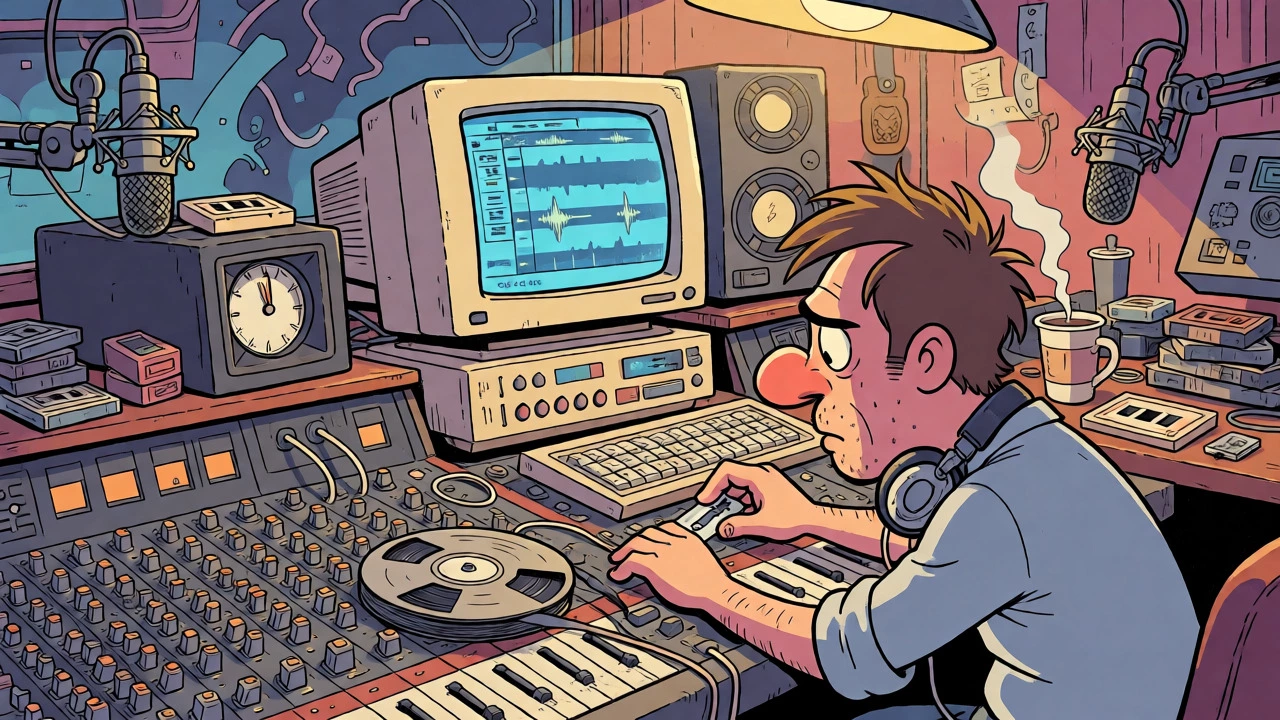

You hear it in every second pop song on the radio today: a voice that glides between notes with robotic precision, thickened by layers of digital doubles. But rewind to 1995, and that sound didn't exist. The 1990s was the decade where music production crossed a critical threshold. It wasn't just about analog tape anymore, nor was it fully digital. It was a messy, creative hybrid era where engineers fought for perfection using razor blades, hardware boxes, and early software. If you're wondering how we got from raw grunge vocals to the polished sheen of late-90s teen pop, you need to understand the specific tools and techniques that defined this transition.
The Analog-Digital Hybrid Workflow
Before you can tune or double a vocal, you have to record it. In the 1990s, the studio workflow was a strange beast. Most major hits weren't recorded entirely "in the box" (on a computer) like they are now. Instead, studios used a hybrid approach. You'd sing into a high-end microphone, run through an expensive analog preamp, and send the signal into a digital audio workstation. This setup gave producers the best of both worlds: the warm, saturated character of analog gear and the editing flexibility of digital systems.
The game-changer here was Pro Tools, developed by Digidesign. Released in its multitrack form in 1991, Pro Tools allowed engineers to edit audio non-destructively. Remember, before this, if you wanted to fix a bad line in a vocal take, you had to physically cut the magnetic tape with a razor blade and splice it together. One mistake could ruin hours of work. With Pro Tools, you could move, copy, paste, and crossfade audio clips instantly. By 1997, Pro Tools supported up to 24 tracks at 24-bit resolution, making it the industry standard for comping-combining the best parts of multiple takes into one perfect performance.
This shift meant that perfection became easier to achieve. Engineers could spend hours tweaking timing and pitch without worrying about destroying the original tape. However, this also led to a new aesthetic problem: when everything is too perfect, it can sound sterile. That's why the 1990s relied heavily on other techniques to add human feel back into the mix.
Doubling: Real Takes vs. Artificial Thickness
One of the most common ways to make a vocal sound bigger and more exciting is doubling. In the 1990s, there were two main ways to do this, and they sounded very different.
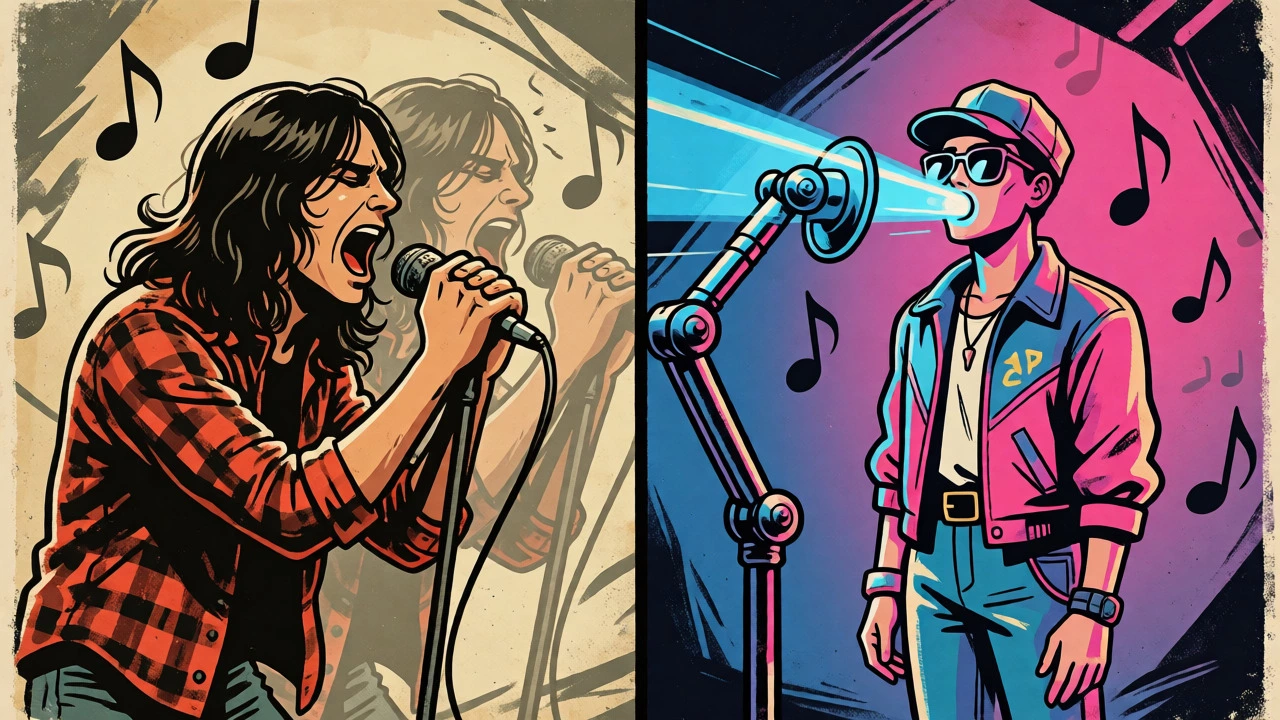
True Double-Tracking involved having the singer perform the same part again. The engineer would then layer the second take over the first. Because humans aren't robots, the second take wouldn't match the first perfectly. There would be slight variations in timing, pitch, vibrato, and breath control. These tiny discrepancies created a natural thickening effect known as "chorusing." When panned slightly left and right, true doubles created a wide, immersive stereo image that felt organic and alive. Bands like Nirvana or R.E.M. often used this method to give their vocals power without losing grit.
Automatic Double Tracking (ADT) was the shortcut. Originally invented in the Beatles' era, ADT returned in the 90s via digital processors. Instead of recording a second take, the processor took the single lead vocal, delayed it by a few milliseconds, and slightly modulated the pitch. This mimicked the effect of a second singer. While faster and cheaper, ADT could sometimes sound phasey or unnatural if not dialed in carefully. Producers had to choose wisely: use real doubles for emotional weight and ADT for quick texture enhancement.
Pitch Correction: Before and After Auto-Tune
For most of the 1990s, fixing a flat note was hard work. You couldn't just draw a curve on a screen. If a singer missed a note, the engineer had to use a hardware pitch shifter or manually edit the tape. Hardware units like the Eventide H3000 Ultra-Harmonizer were legendary. Introduced in 1986 but ubiquitous in the 90s, the H3000 could shift pitch, create harmonies, and add delays. It was expensive, complex, and required deep technical knowledge to operate.
Then came September 19, 1997. Dr. Andy Hildebrand released Auto-Tune. Initially, it wasn't meant to be heard. It was designed to subtly correct out-of-tune notes so listeners wouldn't notice the correction. It analyzed the incoming audio, identified the key, and nudged off-pitch notes toward the nearest correct semitone.
But producers quickly realized they could break the rules. By setting the retune speed to zero, Auto-Tune forced the voice to jump instantly from one pitch to the next, eliminating the natural glide between notes. Cher’s 1998 hit "Believe" famously showcased this effect. Critics initially thought it was a vocoder, but it was actually aggressive Auto-Tune. This moment marked the end of the "invisible" tuning era and the beginning of tuning as a creative instrument.
Spatial Effects: Reverb and Delay
If doubling added width, effects added depth. The 1990s sound is defined by its spaciousness, largely thanks to two types of processors: reverb and delay.
Lexicon 480L was the gold standard for digital reverb during this decade. Designed by David Griesinger, it offered lush, realistic room simulations that could make a dry vocal sound like it was being sung in a cathedral or a small club. Engineers loved it because it preserved clarity while adding size. Unlike cheap reverbs that muddy the mix, the 480L provided distinct early reflections and smooth tails.
Delay was used differently. While reverb creates a continuous wash of sound, delay repeats the signal at specific intervals. In hip-hop and R&B, slapback delay (a single short echo) added body and attitude to rap verses. In dance music, tempo-synced delays (like eighth-note echoes) filled the gaps between phrases, creating rhythmic interest. Producers often combined these: a tight slapback for immediacy, plus a long hall reverb for atmosphere.
The Genre Divide: Grunge vs. Pop
It’s a mistake to think all 1990s vocals sounded the same. The technology enabled vastly different aesthetics depending on the genre.
| Genre | Vocal Character | Primary Techniques | Key Technology |
|---|---|---|---|
| Grunge / Alt-Rock | Raw, dynamic, exposed | Minimal processing, heavy compression, real doubles | Analog consoles, Neve preamps |
| R&B / Hip-Hop | Intimate, close-miked, rhythmic | Stacked harmonies, ad-libs, precise EQ | SSL Consoles, Early Digital Compressors |
| Dance / Electronic | Synthetic, processed, wide | Vocoders, heavy delay, pitch-shifting | Eventide H3000, Synthesizers |
| Late 90s Pop | Polished, bright, hyper-perfect | Auto-Tune, massive harmony stacks, ADT | Pro Tools, Auto-Tune, Lexicon Reverbs |
Grunge bands like Pearl Jam preferred a rougher edge. They avoided excessive tuning or artificial doubling, favoring the raw emotion of a live-feeling take. On the other hand, the Stockholm Cheiron Studios team (Max Martin, Denniz Pop) perfected the pop formula. They treated vocals like instruments, meticulously comping dozens of takes, stacking harmonies in thirds and fifths, and using Auto-Tune not just for correction, but for sonic signature.
Legacy: Why It Matters Today
The 1990s established the template we still use. Modern plugins mimic the sound of Lexicon reverbs and Eventide harmonizers. Auto-Tune is now a staple in almost every genre, from country to trap. But the core lesson remains: technology should serve the emotion. The best 1990s records didn't hide the artist; they amplified their intent. Whether it was Kurt Cobain’s scream or Britney Spears’ whisper, the production choices made those moments unforgettable.
Was Auto-Tune available throughout the entire 1990s?
No. Auto-Tune was only released commercially in September 1997. For the majority of the decade, pitch correction was done manually using hardware pitch shifters like the Eventide H3000 or by physically editing tape. The widespread, audible use of Auto-Tune didn't become mainstream until after Cher's "Believe" in 1998.
What is the difference between true doubling and ADT?
True doubling involves recording the same vocal part twice with a human performer, resulting in natural micro-variations in timing and pitch. Automatic Double Tracking (ADT) uses a processor to create a delayed, modulated copy of a single take. True doubling sounds more organic and thicker, while ADT is faster but can sound phasey or artificial if not carefully adjusted.
Why did 1990s recordings use a hybrid analog-digital workflow?
Studios wanted the warmth and saturation of analog equipment (microphones, preamps, compressors) combined with the editing convenience of digital systems (Pro Tools). Recording through analog gear captured the "character," while tracking into Pro Tools allowed for non-destructive editing, easy comping, and recall capabilities that tape couldn't offer.
How did Pro Tools change vocal production in the 90s?
Pro Tools eliminated the need for physical tape splicing. Engineers could easily cut, copy, paste, and crossfade vocal phrases. This made "comping" (combining the best parts of multiple takes) much faster and less risky, allowing producers to assemble flawless performances from imperfect takes without destroying the original material.
What role did the Eventide H3000 play in 1990s music?
The Eventide H3000 was a multi-effects processor widely used for pitch shifting, harmonizing, and creating synthetic textures. It allowed producers to generate vocal harmonies from a single source, create robotic effects, and add spatial modulation. It was essential for the electronic and experimental sounds of the mid-to-late 90s.
