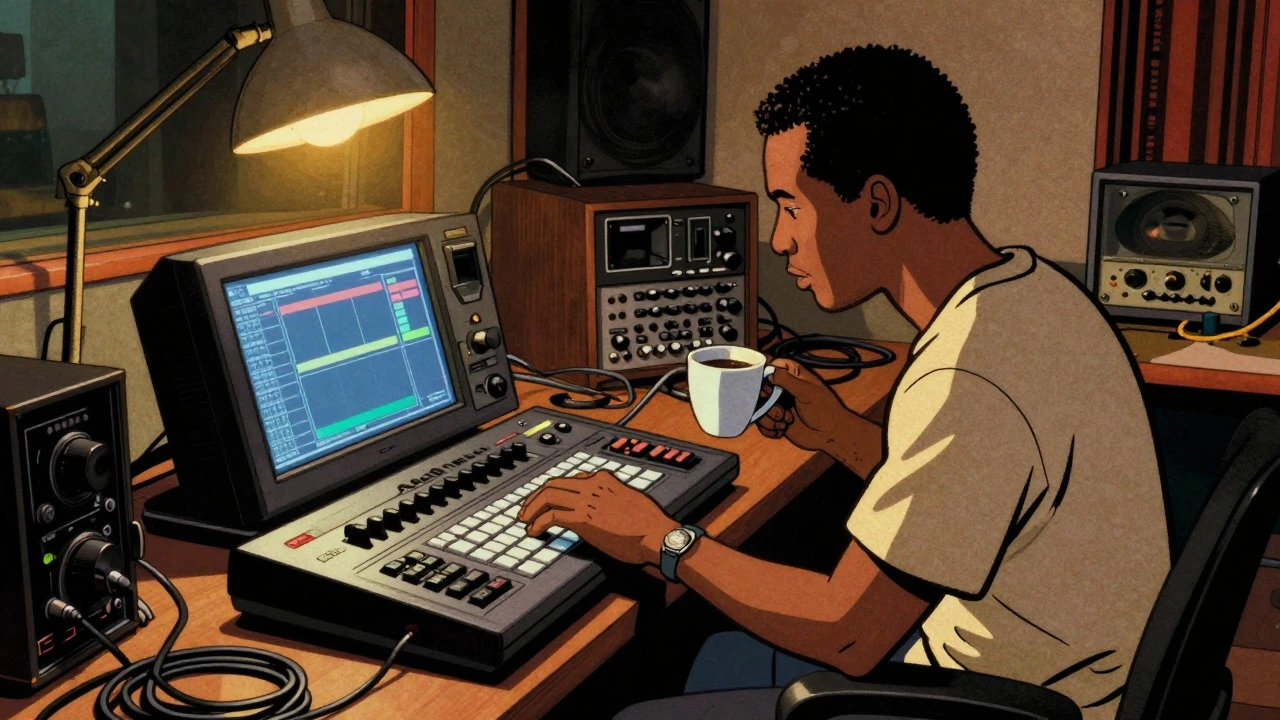

Walk into a Kingston studio in 1994 and you wouldn't hear a live band warming up. You'd see a producer hunched over a Korg Triton is a digital workstation keyboard that became the central tool for creating 1990s reggae riddims by integrating sequencing and synthesis capabilities. or an Akai MPC is a hardware sampler and sequencer used to program precise drum patterns and manage audio samples in digital music production., pressing buttons to build a beat from scratch. This wasn't just a trend; it was a complete overhaul of how Jamaican music was made. The shift from analog tape and live musicians to digital Digital Riddims is loop-based instrumental tracks created using digital instruments like keyboards and drum machines, designed to support multiple vocal versions. changed the speed, sound, and economics of the industry overnight.
The core promise of this new era was simple: speed and repeatability. A producer could program a complete backing track in a few hours, then invite ten to thirty deejays and singers to voice on that same pattern within a single week. What used to take years to accumulate as different versions of a song now happened in a single season. This article breaks down exactly how that worked, the specific gear involved, and why the "juggling" era defined the sonic identity of 90s dancehall.
The Shift from Live Bands to Digital Workstations
To understand the 90s, you have to look back at the late 80s. Producers like King Jammy is a pioneering Jamaican record producer known for introducing digital instrumentation into reggae and dancehall music in the 1980s. started experimenting with small, affordable digital tools. On tracks like Anthony Red Rose's *Tempo*, Jammy used a Casio CZ-1000 and a Yamaha DX-100 alongside an Oberheim DX drum machine. This minimal rig proved that you didn't need a full rhythm section to make a hit. You just needed a crisp, bright, machine-like rhythm that still felt heavy enough for a sound system.
By the early 90s, these small keyboards evolved into more powerful workstations. The typical studio setup shifted toward the Korg Triton and the Akai MPC series. Why these two? The Korg Triton allowed a producer to sketch entire riddims-drums, bass, chords, and synth stabs-inside a single device. Its integrated sequencer meant you could layer sounds without jumping between different pieces of hardware. Meanwhile, the Akai MPC gave producers precise control over swing and groove, allowing them to humanize the rigid digital timing to keep that organic, bouncy feel essential to reggae.
| Feature | Analog Era (Pre-1990) | Digital Era (1990s) |
|---|---|---|
| Primary Tools | Live band, multitrack tape | Korg Triton, Akai MPC, Drum Machines |
| Creation Time | Days to weeks per song | Hours per riddim loop |
| Vocal Versions | Accumulated over years | Dozens produced in one week |
| Tempo Range | ~60 BPM (Roots/Skank) | 85-100 BPM (Dancehall) |
| Sonic Character | Warm, organic, live dynamics | Punchy, quantized, synthetic precision |
Anatomy of a 90s Digital Riddim
What did these tracks actually sound like? Technically, they were built on a specific rhythmic formula. While classic roots reggae sat around 60 beats per minute, 90s digital riddims pushed the tempo up to 85-100 BPM. This faster pace was crucial because it created space for rapid-fire deejay flows and complex syncopation.
The groove itself relied on a 3+3+2 beat subdivision. This forward-leaning, marching feel is what distinguished dancehall from the slower skanking styles of the past. Here’s how a producer would construct the layers:
- Drums: Quantized and spacious. A tight kick pattern playing with off-beats, a snare or rimshot on beats 2 and 4, and crisp hi-hats. No unnecessary fills.
- Bass: The main hook. Deep, simple sub-bass lines using sustained notes and octave jumps. It had to lock tightly to the kick to maintain a heavy yet uncluttered low end.
- Chords: Off-beat chord stabs replacing the classic skank guitar or piano. These were often short digital hits or synth plucks.
- Harmony: Minimal movement. Most riddims stayed within one-to-four-chord minor-key vamps. Repetition was key, not complexity.
This structure wasn't accidental. It was designed for functionality. A riddim had to be a backbone that could support many different moods and lyrical themes. If the arrangement was too intricate, it would clash with the next artist's lyrics. By keeping it minimal, the producer ensured the riddim remained versatile.
The Juggling Era: Speed as Currency
In the 90s, the business model of reggae production changed dramatically. We call this the "juggling era." In the old days, a producer might release one song on a rhythm, wait a year, then release another. In the 90s, if you had a good riddim, you had to exploit it immediately.
The workflow was ruthless but effective. A producer like Dave Kelly is a prominent Jamaican producer known for his prolific output of influential dancehall riddims during the 1990s. would build a rhythm on his workstation. He’d press a small run of records or dubplates. Then, he’d invite as many artists as possible to voice on that riddim in a single week. Sometimes twenty or thirty cuts came out of one session.
Why rush? Because the market moved fast. A riddim that ran the dance today might be obsolete next month. Producers had to constantly create new digital templates to maintain visibility. This compressed timeline meant that songs weren't written first; the riddim came first. The deejay or singer had to adapt their flow to fit the pre-programmed loop. This reversed the traditional songwriting process entirely.
Key Producers and Their Signatures
Not all digital riddims sounded the same. Different studios and producers developed distinct signatures based on their gear choices and mixing preferences.
Bobby Digital is a Jamaican producer and engineer who collaborated extensively with King Jammy to pioneer digital reggae aesthetics. and King Jammy focused on crisp, bright timbres. They embraced the synthetic sounds of the DX-100 and CZ-1000, creating a punchy, clean aesthetic that stood out against the warmer analog productions of competitors. Their approach prioritized clarity and impact, ensuring the drums cut through large sound systems without mud.
Dave Kelly, also known as The Stranger, brought a different energy. His riddims were often more aggressive and structurally tight. Tracks like the *Distress Riddim* showed a collaborative approach where programming duties were shared, blurring the lines between individual authorship and collective creation. Kelly’s work topped local and international charts, proving that the digital sound wasn't just a novelty-it was commercially dominant.
Then there were producers like Philip Fattis Burrell at Xterminator, who blended roots-derived rhythms with digital multi-version contexts. He showed that even conscious, lyrical content could thrive on a digital bed. This blend appealed to audiences who wanted the depth of roots reggae but the immediacy of dancehall.
Mixing for Sound Systems: The Technical Reality
You can't talk about 90s reggae production without talking about how the music was consumed. It wasn't listened to on headphones or car stereos; it was blasted through massive sound systems in clubs and on streets. This dictated every mixing decision.
Producers had to ensure mono compatibility. If the bass and kick weren't centered, they could cancel each other out when played in mono, killing the low end. So, the mix was always bass-forward and mid-range clear. High-pass filters were applied to guitars and synths to avoid muddiness. Dub-style delays and spring reverbs were used selectively, not on everything, but only on fills and drop-ins to create space.
The goal was a bright, punchy, and spacious sound field. When the bass dropped, it had to hit physically. When the deejay toasted, their voice had to sit right on top of the beat without getting lost in the synth stabs. This technical constraint actually drove the creative minimalism of the era. Less clutter meant better translation on big speakers.
Legacy and Modern Influence
The 90s digital riddim era didn't just pass away; it laid the groundwork for modern global pop and hip-hop. The emphasis on low-end impact, off-beat accents, and loop-based structures is everywhere today. Producers worldwide use drum machines and workstations to emulate these grooves because they are efficient and effective.
Even though technology has advanced, the core principles remain. The idea that a single loop can generate dozens of commercial hits is still a valid business strategy in many genres. And the aesthetic of the "quantized but groovy" drum pattern is a direct descendant of the 90s dancehall experiments. The 90s proved that you don't need a live band to make music that moves people. You just need a strong loop, a deep bassline, and the right attitude.
What is a digital riddim?
A digital riddim is a loop-based instrumental track created using digital instruments like keyboards, drum machines, and samplers. Unlike live-band recordings, it is designed to be reusable, allowing multiple vocalists to record different songs over the same backing track.
Why did producers switch to digital equipment in the 1990s?
The primary reasons were speed and cost-efficiency. Digital workstations allowed producers to create complex backing tracks in hours rather than days. This enabled the "juggling" era, where one riddim could support dozens of singles in a short period, maximizing revenue and market presence.
What was the typical tempo for 90s dancehall riddims?
Most 90s digital dancehall riddims sat between 85 and 100 beats per minute (BPM). This was significantly faster than the ~60 BPM tempo of classic roots reggae, allowing for quicker deejay flows and a more energetic dance floor vibe.
How did sound system playback affect mixing decisions?
Mixes were optimized for mono compatibility and low-end impact. Kick and bass were centered to prevent cancellation in mono systems. Mids were kept clear, and effects like reverb were used sparingly to ensure the vocals and lead instruments cut through the loud, bass-heavy playback environment.
Who were the most influential producers of this era?
Key figures include King Jammy, Bobby Digital, Dave Kelly, and Stephen McGregor. King Jammy pioneered the digital approach in the 80s, while Dave Kelly and others refined the sound in the 90s, producing some of the most chart-topping and widely sampled riddims of the decade.


