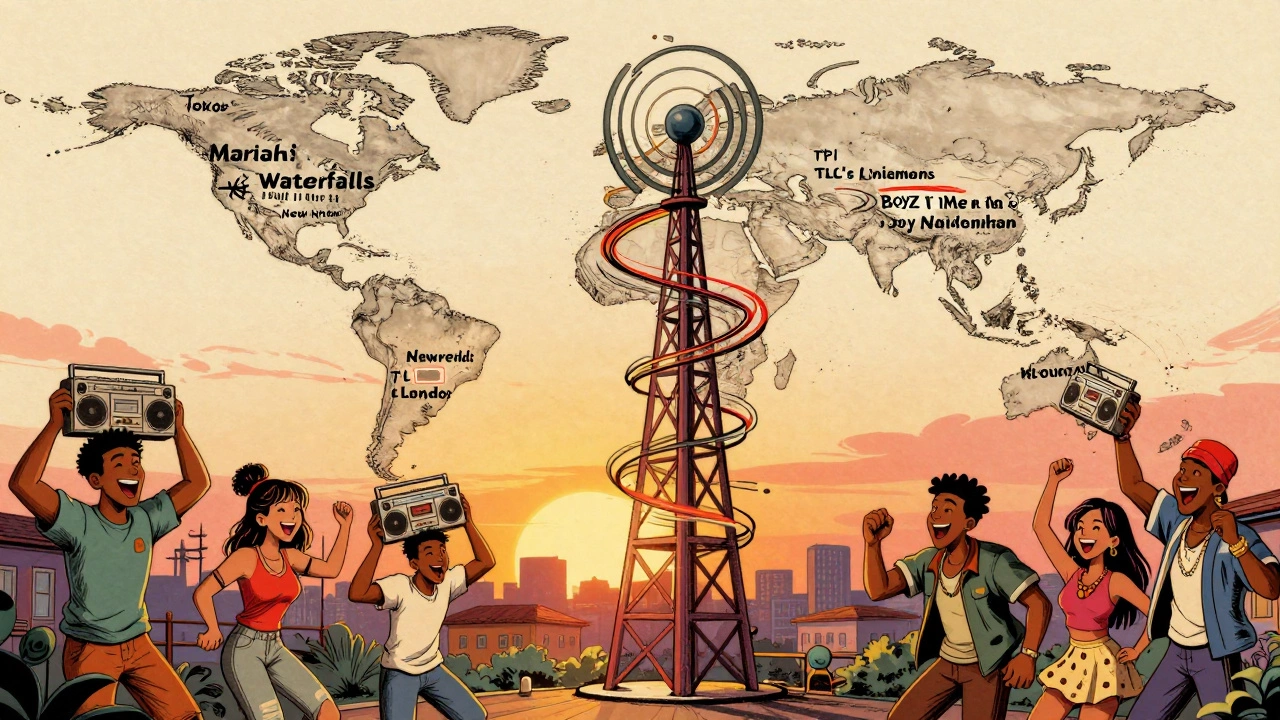

When you think of 1990s R&B, you probably picture Mariah Carey’s whistle notes, TLC’s sassy harmonies, or Boyz II Men’s slow jams blasting from car stereos. But what happened when those songs crossed oceans? While most records focus on U.S. charts, the real story of 1990s R&B is how it took over radios from London to Tokyo, sold out arenas in Australia, and inspired a whole generation of artists outside America.
From U.S. Charts to Global Airwaves
In 1990, Billboard changed the name of its "Hot Black Singles" chart to "Hot R&B Singles"-a small shift, but it signaled something bigger: R&B was no longer just a Black American genre. It was becoming a global language. By the mid-90s, R&B singles were climbing charts far beyond the U.S. In the UK, artists like TLC, Whitney Houston, and Boyz II Men regularly hit the Top 10. TLC’s "Waterfalls" didn’t just top the U.S. R&B chart-it reached No. 2 on the UK Singles Chart in 1995. The same year, Mary J. Blige’s "My Life" album cracked the UK Top 20, a rare feat for an R&B artist at the time.
In Japan, R&B became a cultural phenomenon. Record stores in Tokyo stocked imported U.S. R&B CDs faster than local releases. Artists like Aaliyah and D’Angelo became household names. Japanese radio stations began dedicating entire shows to "American Soul," and local bands started covering U.S. R&B hits in Japanese. By 1997, Aaliyah’s "One in a Million" sold over 200,000 copies in Japan alone-more than most Japanese pop acts that year.
Even in countries with little exposure to American pop culture, R&B found a foothold. In South Africa, after apartheid ended in 1994, R&B became a symbol of freedom and modernity. Artists like Brenda Fassie blended R&B with township beats, creating a new sound called "Afro-R&B." In Brazil, Mariah Carey’s "Fantasy" was played in clubs in São Paulo and Rio, and local singers began adopting her vocal runs in their own ballads.
Tours That Crossed Continents
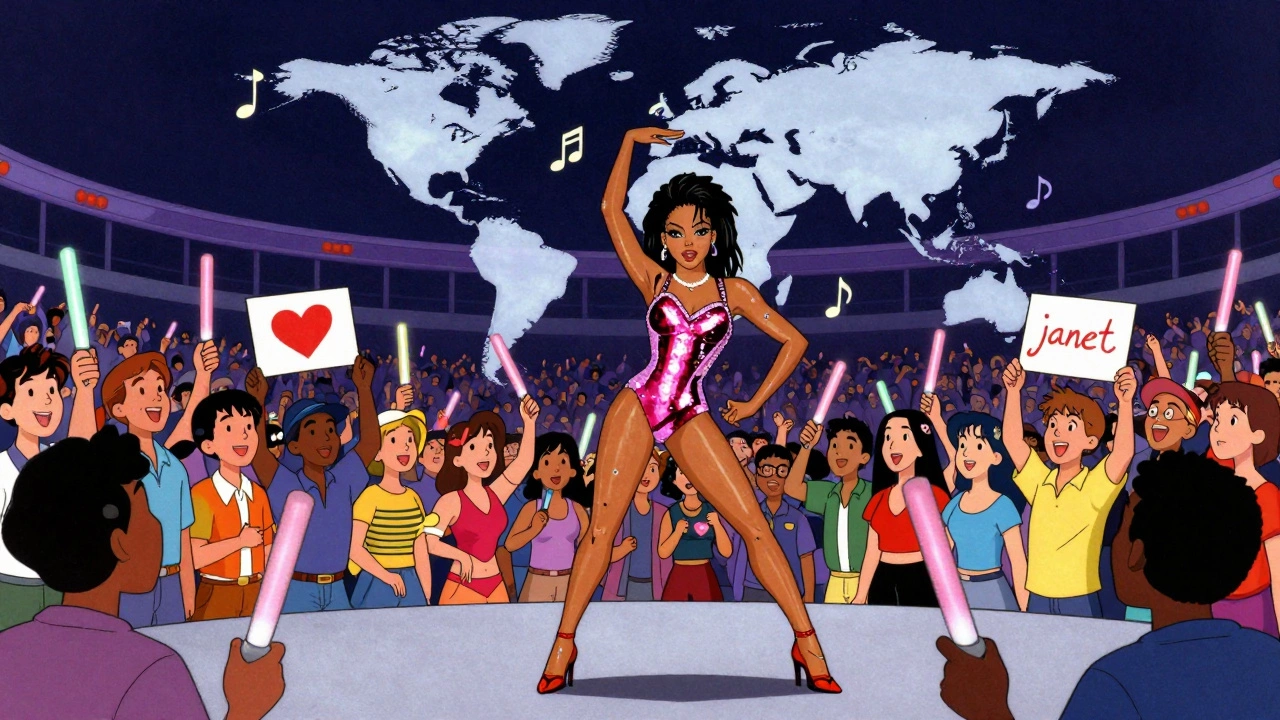
It wasn’t just radio play-R&B stars were touring like rock legends. Janet Jackson’s 1993 "janet. Tour" wasn’t just a U.S. run. It hit 17 countries, including Germany, France, Australia, and Japan. She sold over 1.2 million tickets globally, making her one of the highest-grossing female artists of the decade. In London’s Wembley Arena, she played to packed crowds who knew every lyric-even the deep cuts.
Boyz II Men didn’t just sing about love-they lived it on stage across the world. Their 1994 "II Tour" included stops in Canada, the Netherlands, and South Korea. In Seoul, fans waited overnight outside the concert hall. One fan, a 17-year-old student named Min-jun, later told a local paper: "I didn’t understand English, but I felt every note. It was like my heart was speaking through their voices."
Even artists known for slow jams went global. Luther Vandross headlined the Montreux Jazz Festival in Switzerland in 1996, drawing 15,000 people. His performance of "Dance with My Father"-a song that didn’t even exist yet-was so emotional that the crowd stood in silence for a full minute after he finished. The performance went viral on bootleg VHS tapes across Europe.
The Neo-Soul Bridge to Europe
While mainstream R&B ruled the charts, a quieter revolution was happening in Europe. Neo-soul artists like Erykah Badu, D’Angelo, and Lauryn Hill didn’t just make music-they created movements. In 1995, D’Angelo’s "Brown Sugar" became an underground sensation in London. Jazz clubs in Camden started hosting late-night R&B sessions, and young British producers began blending soul with house music, giving birth to what would later be called "UK Soul."
Erykah Badu’s 1997 tour of Europe was a revelation. She didn’t perform in stadiums-she played intimate venues in Paris, Amsterdam, and Barcelona. Fans came not just to hear music, but to experience a spiritual connection. At her Paris show, a French journalist wrote: "She didn’t sing about love. She made you remember what love felt like before the world broke it."
By 1998, French radio stations began playing neo-soul tracks on daytime playlists. In Germany, the music magazine Spex declared neo-soul "the most honest sound of the decade." Even in countries like Sweden and Norway, where pop dominated, young musicians started recording soulful ballads in basements, using cheap samplers and vintage microphones.
How R&B Changed Global Music
The 1990s didn’t just export R&B-it changed how music was made everywhere. In Nigeria, producers began using American drum machines to recreate the slow, syncopated beats of Usher and Ginuwine. In the Philippines, local boy bands started singing in Tagalog with R&B harmonies, and by 1999, bands like Smokey Mountain were topping local charts with songs that sounded like they were made in Atlanta.
In South Korea, R&B became the foundation of K-pop. Groups like Seo Taiji and Boys, who blended rock and hip-hop, started adding R&B vocals in the mid-90s. By 1997, the first Korean R&B group, g.o.d, debuted with a sound so heavily influenced by Boyz II Men that fans called them "Korean Boyz II Men."
Even in places where English wasn’t spoken, R&B’s influence was undeniable. In Italy, a group called La Crus released a 1996 album called "Soul in the City"-all in Italian, but with U.S.-style backing tracks and vocal runs. It sold over 500,000 copies. In Russia, after the fall of the Soviet Union, young musicians turned to R&B as a symbol of Western freedom. By 1999, Russian R&B artists like Zemfira Ramazanova were headlining festivals in Moscow, singing about heartbreak in a way no one had heard before.
Why It Mattered
R&B in the 1990s wasn’t just music-it was a global conversation. It gave people outside the U.S. a way to express pain, joy, and longing in a language that felt personal, not political. While rock and hip-hop dominated international headlines, R&B slipped in quietly-through radio waves, bootleg tapes, and word-of-mouth-and changed the sound of music forever.
Today, you can hear its fingerprints everywhere: in the vocal runs of K-pop idols, the soulful grooves of French indie artists, the slow jams of South African pop stars. The 1990s didn’t just give us Mariah Carey or TLC. It gave the world a new way to feel.
Did 1990s R&B artists tour outside the U.S.?
Yes, major R&B artists of the 1990s regularly toured internationally. Janet Jackson’s 1993 "janet. Tour" visited 17 countries, including the UK, Germany, Japan, and Australia. Boyz II Men played sold-out shows in South Korea and the Netherlands. Luther Vandross headlined major European festivals like Montreux Jazz, and Erykah Badu’s intimate European tour in 1997 became legendary for its emotional impact. These tours weren’t just promotional-they built lasting fanbases abroad.
How did R&B chart in countries like Japan and the UK?
In the UK, R&B singles consistently entered the Top 10. TLC’s "Waterfalls" hit No. 2 in 1995, and Mary J. Blige’s "My Life" reached the Top 20. In Japan, R&B albums sold better than most local pop acts. Aaliyah’s "One in a Million" sold over 200,000 copies there by 1997. Japanese radio stations dedicated entire shows to American R&B, and local artists began covering U.S. hits in Japanese, proving the genre’s deep cultural penetration.
Was neo-soul popular outside the U.S.?
Absolutely. Neo-soul artists like D’Angelo, Erykah Badu, and Lauryn Hill found massive underground followings in Europe. In London, jazz clubs turned into R&B sanctuaries. In France and Germany, critics hailed neo-soul as the most authentic sound of the decade. French band La Crus released a full R&B album in Italian that sold 500,000 copies. The genre’s emotional depth resonated far beyond English-speaking audiences.
Did R&B influence non-Western music scenes?
Yes. In Nigeria, R&B fused with local rhythms to create Afro-R&B. In South Korea, early K-pop groups like g.o.d modeled their harmonies after Boyz II Men. In the Philippines, local boy bands adopted R&B vocal styles. Even in Russia, after the Soviet Union collapsed, young musicians turned to R&B as a symbol of personal freedom. These weren’t imitations-they were adaptations that shaped entirely new musical identities.
Why did R&B connect so deeply with global audiences?
R&B spoke to universal emotions-love, loss, longing, resilience-without needing translation. Its blend of smooth vocals and raw honesty made it feel personal, even to people who didn’t speak English. Unlike rock’s rebellion or hip-hop’s bravado, R&B offered intimacy. Listeners didn’t just hear the music-they felt seen. That’s why it spread faster than any marketing campaign could have planned.
What Happened After
By the early 2000s, the sound shifted. The slow jams gave way to uptempo beats, and R&B merged with pop and hip-hop. But the global foundation laid in the 1990s never faded. Today’s global R&B stars-whether from Canada, Brazil, or Indonesia-carry the same emotional weight that Mariah, Aaliyah, and D’Angelo brought to the world. They didn’t invent the sound. They inherited it.


