
You walk into a modern arena today, and the lights snap to life in perfect sync with the bass drop. The singer hears her mix clearly through tiny earpieces, not from a wall of speakers blasting at her feet. The video on the giant screen isn't just a broadcast feed; it's a synchronized, high-definition stream controlled by software that remembers every cue from soundcheck. It feels seamless, almost magic. But this wasn't always the case. Before the 1990s, live production was a chaotic patchwork of proprietary gadgets, analog cables, and manual guesswork. If you wanted to automate a light, you needed a specific console from the same manufacturer as the light. If you wanted to record a show, you hoped your analog tape didn't hiss too loudly.
The 1990s were the decade when live production grew up. It wasn't about inventing everything from scratch-some tech existed before-but about standardizing it. This shift turned isolated devices into interoperable systems. We stopped building one-off rigs for every tour and started building infrastructure that worked everywhere. Let's look at the specific innovations that defined this era and why they still dictate how shows are run today.
DMX512: The Language of Light
If there is one protocol that saved the lighting industry, it's DMX512. While the protocol had roots in the 1980s via USITT (United States Institute for Theatre Technology), the 1990s were when it became the universal language. Before DMX, if you bought a dimmer pack from Company A and a console from Company B, they likely couldn't talk to each other without expensive adapters or custom wiring. DMX changed that by defining a simple electrical standard using EIA-485 physical layer connections.
The core innovation wasn't just the cable; it was the concept of the "universe." A single DMX line could control up to 512 channels. One channel might control the brightness of a spotlight, another its color, and another its position. This allowed lighting designers to mix and match equipment freely. By 1998, USITT transferred maintenance of the standard to ESTA (now part of PLASA), cementing its status as an official industry norm.
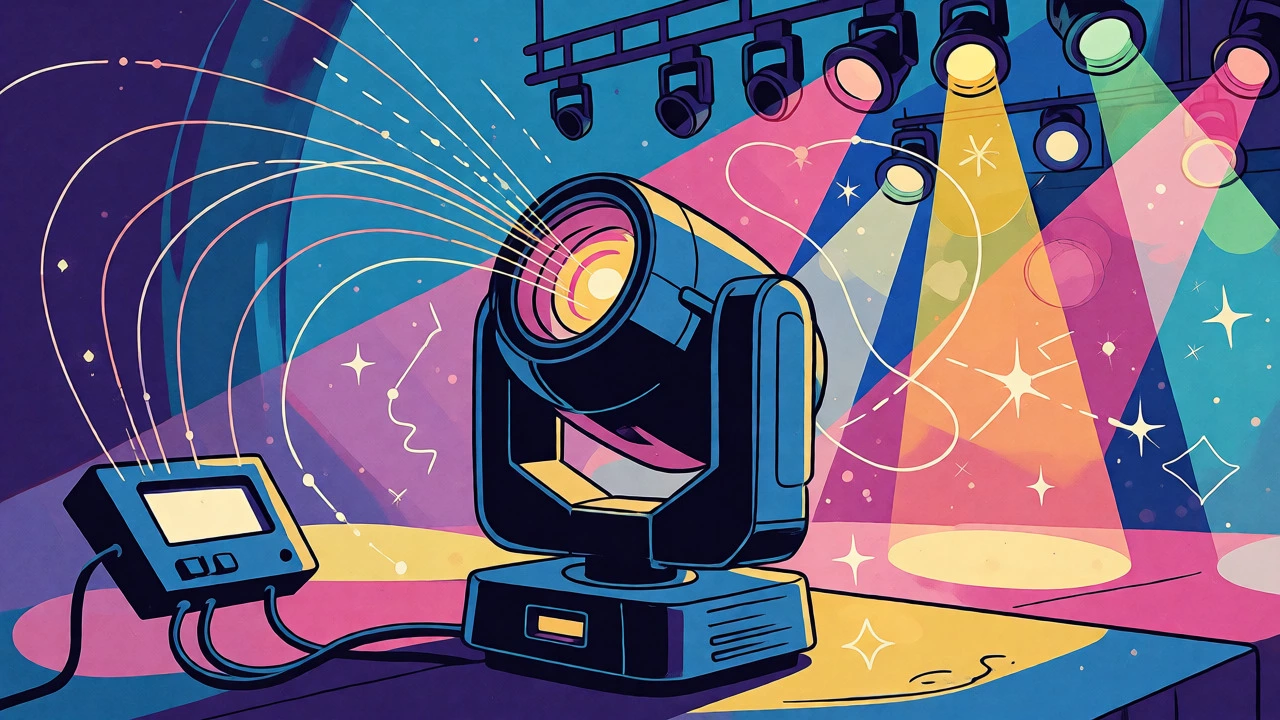
This standardization enabled the rise of automated moving fixtures. In the early '90s, companies like Clay Paky introduced intelligent lights that could pan, tilt, change colors, and project gobos-all controlled via DMX. Suddenly, one fixture could do the work of ten conventional lamps. You didn't need a crew of twenty people manually adjusting shutters during a concert. You needed a programmer who could write cues. The limit of 512 channels per universe forced creativity, but it also created a clear framework that engineers understood globally. Even today, while we use Ethernet to carry these signals (via Art-Net or sACN), the underlying data structure remains DMX.
Digital Audio Consoles and DSP: From Analog Hiss to Digital Precision
Sound reinforcement was long dominated by analog signal chains. You had microphones going into preamps, then equalizers, compressors, and finally amplifiers. Each stage added noise and required physical space. The 1990s saw the widespread adoption of Digital Signal Processing (DSP) and digital mixing consoles. This wasn't just about better sound quality; it was about workflow efficiency.
Yamaha’s DMP7D, launched in 1991, was a landmark. It was an eight-channel digital mixer with motorized faders and AES/EBU digital outputs. But the real game-changer came later in the decade with consoles like the Yamaha PM1D (debuted around 1999). These systems separated the control surface from the processing engine. You could have a small desk on stage and a massive rack of processors backstage. More importantly, they offered recallability. Sound engineers could save their entire mix settings for a specific venue or artist. If a fader got bumped during a show, you could reset it instantly. No more scribbling notes on masking tape.
To connect these digital brains, new standards emerged. AES3 standardized two-channel digital audio over twisted-pair cables, replacing fragile analog line-level connections. For larger needs, MADI (Multichannel Audio Digital Interface) allowed dozens of audio channels to travel over a single coaxial or fiber optic cable. This reduced the massive snakes of copper wire that used to tie down stages. The result was a cleaner signal path, less interference, and the ability to integrate digital recording directly into the live mix.
MIDI Show Control and Timecode: Synchronizing the Chaos
Imagine trying to coordinate pyrotechnics, lighting, and a video playback all at once. In the '80s, this often meant a human hitting buttons based on visual cues, which led to drift and errors. The solution was MIDI Show Control (MSC), ratified in 1991. MSC didn't send audio or video itself; it sent commands like "Go," "Stop," "Pause," and "Cue." It acted as a conductor, telling different subsystems when to act.
For this to work precisely, you needed a common clock. SMPTE timecode (developed earlier but widely adopted in live contexts in the '90s) provided the timing backbone. Shows began using frame-accurate synchronization. A lighting console could read a timecode track and trigger a strobe effect exactly when a drummer hit a specific beat in a backing track. Productions like Disney’s Magic Kingdom Parade (1991) proved that large-scale automation was possible and reliable. This shifted the role of the operator from reactive button-pusher to proactive designer. You built the show in advance, tested it, and let the computer execute it with millisecond precision.
CobraNet: The First Step Toward Networked Audio
While digital consoles processed audio, getting that audio from point A to point B was still a cabling nightmare. Enter CobraNet, developed by Peak Audio in 1996. CobraNet was revolutionary because it transmitted uncompressed, multichannel digital audio over standard Ethernet cables. Yes, the same Cat5 cables used for computers.
This was huge for permanent installations like stadiums, theaters, and theme parks. Instead of running thick, expensive analog snakes across a football field, you could run thin network cables. QSC licensed the technology, and it was famously used for the Super Bowl XXXI halftime show in 1997. Early versions had latency issues-around 5 milliseconds-which made them less ideal for tight touring applications where musicians need instant feedback. However, for fixed venues, it was a revelation. It allowed logical reconfiguration of audio zones without rewiring the building. CobraNet paved the way for modern standards like Dante and AVB, proving that audio could live on a data network.
SD-SDI: Uncompressed Video Over Coax
Video in live events was traditionally analog, suffering from signal degradation over long distances. The introduction of SMPTE 259M (SD-SDI) in the early '90s standardized serial digital interface video. It carried uncompressed standard-definition video, embedded audio, and ancillary data over a single coaxial cable.
Why does this matter? Because it eliminated generation loss. In analog, every copy or split degraded the picture. With SD-SDI, the signal remained pristine regardless of routing complexity. Broadcast trucks, production switchers, and large LED screens adopted it rapidly. It simplified the rack room massively. Instead of separate boxes for video distribution and audio embedding, one cable did it all. While we've moved to HD and IP video now, SD-SDI established the expectation that video infrastructure should be digital, robust, and integrated with audio.
Wireless In-Ear Monitoring: Quiet Stages, Clear Mixes
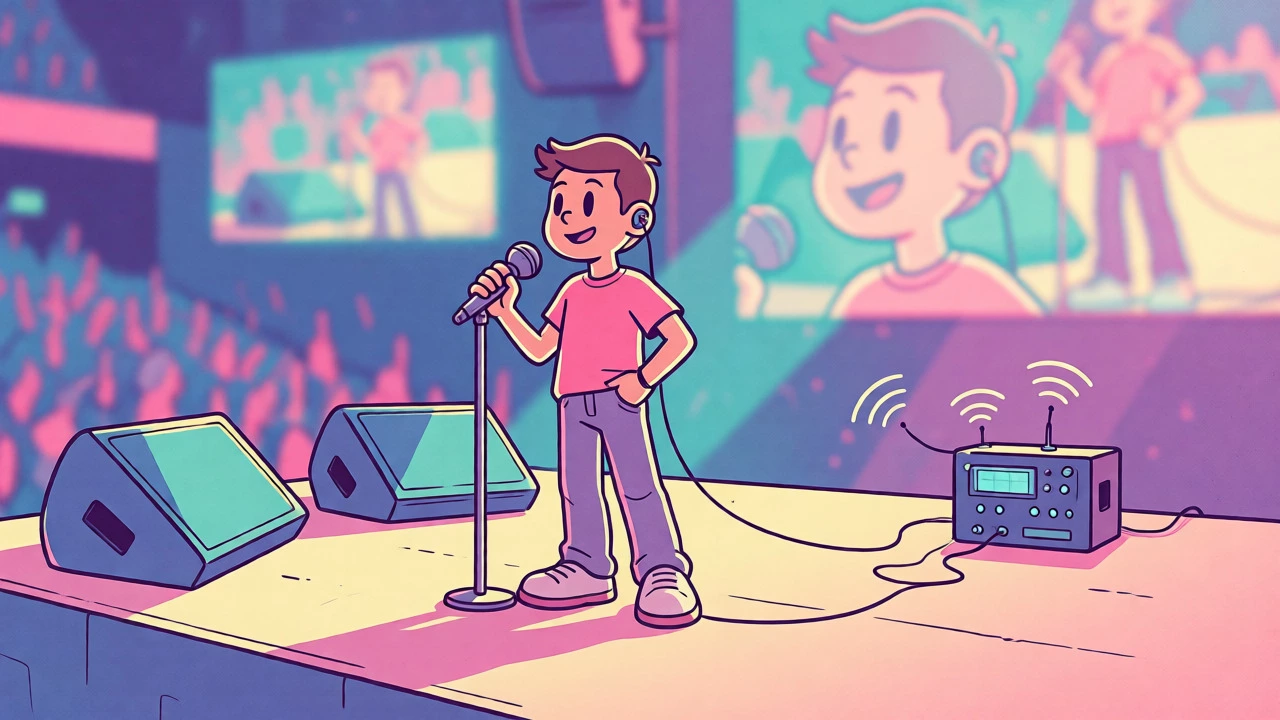
Perhaps the most visible change for performers was the shift from floor wedges to Wireless In-Ear Monitors (IEMs). Systems like Garwood’s Radio Station existed in the late '80s, but costs were prohibitive-often exceeding $65,000 for a full rig. By the mid-to-late '90s, companies like Shure (with the PSM 600) and Sennheiser brought prices down and reliability up.
IEMs transformed stage dynamics. Performers no longer needed deafeningly loud monitors to hear themselves. This lowered overall stage volume, reducing feedback risks and making front-of-house mixes cleaner. Musicians could hear their instruments clearly, leading to tighter performances. It also gave artists privacy; their personal mix wasn't blasted into the audience. While RF coordination became a new challenge, the benefits outweighed the headaches. Today, seeing a band with zero floor wedges is normal, but in 1995, it was a luxury reserved for U2 or Peter Gabriel.
Comparison of 1990s Standards vs. Modern Successors
| Innovation | 1990s Standard | Key Limitation Then | Modern Successor |
|---|---|---|---|
| Lighting Control | DMX512 (RS-485) | 512 channels per universe; dedicated cabling | Art-Net/sACN (Ethernet transport of DMX) |
| Audio Transport | AES3 / MADI | Limited channel counts; point-to-point links | Dante / AVB / AES67 (Networked Audio) |
| Show Control | MIDI Show Control (MSC) | Slow baud rates; limited device count | OSC / MQTT / Proprietary Protocols |
| Video Interface | SD-SDI (Coax) | Standard Definition only; heavy cables | HD-SDI / 12G-SDI / NDI / ST 2110 (IP Video) |
| Monitoring | Analog Wireless IEMs | High cost; poor RF stability | Digital Wireless IEMs (Shure Axient, etc.) |
Why Interoperability Won
The common thread across all these innovations is interoperability. The successful technologies of the 1990s weren't necessarily the best-performing products in isolation; they were the ones that played nice with others. DMX allowed any brand of light to talk to any brand of console. AES3 allowed any digital device to swap audio. This openness drove competition and innovation. Manufacturers competed on features and price, not on locking users into proprietary ecosystems.
This decade also highlighted the importance of documentation and training. As systems became more complex, the industry needed shared knowledge bases. The shift from analog intuition to digital configuration required new skills. Engineers had to learn networking basics, file management, and software interfaces. This professionalization raised the bar for entry into the industry, turning technical directors into IT specialists.
Looking back, the 1990s didn't just give us new toys. They gave us a blueprint. The constraints of that era-like the 512-channel limit of DMX or the latency of early CobraNet-forced clever engineering solutions that shaped future designs. When we struggle with modern IP video latency or network congestion, we're dealing with the evolved children of those '90s problems. Understanding this history helps us appreciate why current standards exist and anticipate what might break next.
Was DMX512 invented in the 1990s?
No, DMX512 was developed by USITT in the mid-1980s. However, the 1990s were crucial because this is when it transitioned from a niche theater protocol to the universal standard for concerts, TV, and clubs. The transfer of governance to ESTA in 1998 solidified its status as an industry-wide norm rather than a specialist tool.
What was the main advantage of digital consoles over analog in the 90s?
The primary advantage was recallability and flexibility. Digital consoles allowed engineers to save entire show files, including EQ, dynamics, and routing. This meant a mix set up for one city could be loaded instantly in the next. It also reduced noise floors and eliminated the physical clutter of outboard gear racks, integrating effects directly into the processor.
How did MIDI Show Control differ from regular MIDI?
Regular MIDI transmits musical performance data like note on/off and velocity. MIDI Show Control (MSC) transmits operational commands such as Go, Stop, Pause, and Cue. It was designed specifically for triggering events in lighting, sound, and automation systems, allowing different departments to synchronize their actions without sharing media files.
Why was CobraNet significant for live venues?
CobraNet demonstrated that standard Ethernet cables could transmit high-quality, multichannel digital audio. This replaced bulky analog snake cables in permanent installations like stadiums and theaters. It allowed for easier expansion and reconfiguration of audio zones without pulling new wires, laying the groundwork for modern networked audio protocols like Dante.
Did wireless in-ear monitors replace floor wedges entirely in the 90s?
Not entirely, but they became the preferred choice for major tours. High costs initially limited IEMs to elite acts. By the late 90s, prices dropped enough for mid-tier professionals to adopt them. The shift improved stage clarity and reduced feedback, but many smaller venues and genres continued using wedges due to tradition and performer preference for feeling the sound physically.