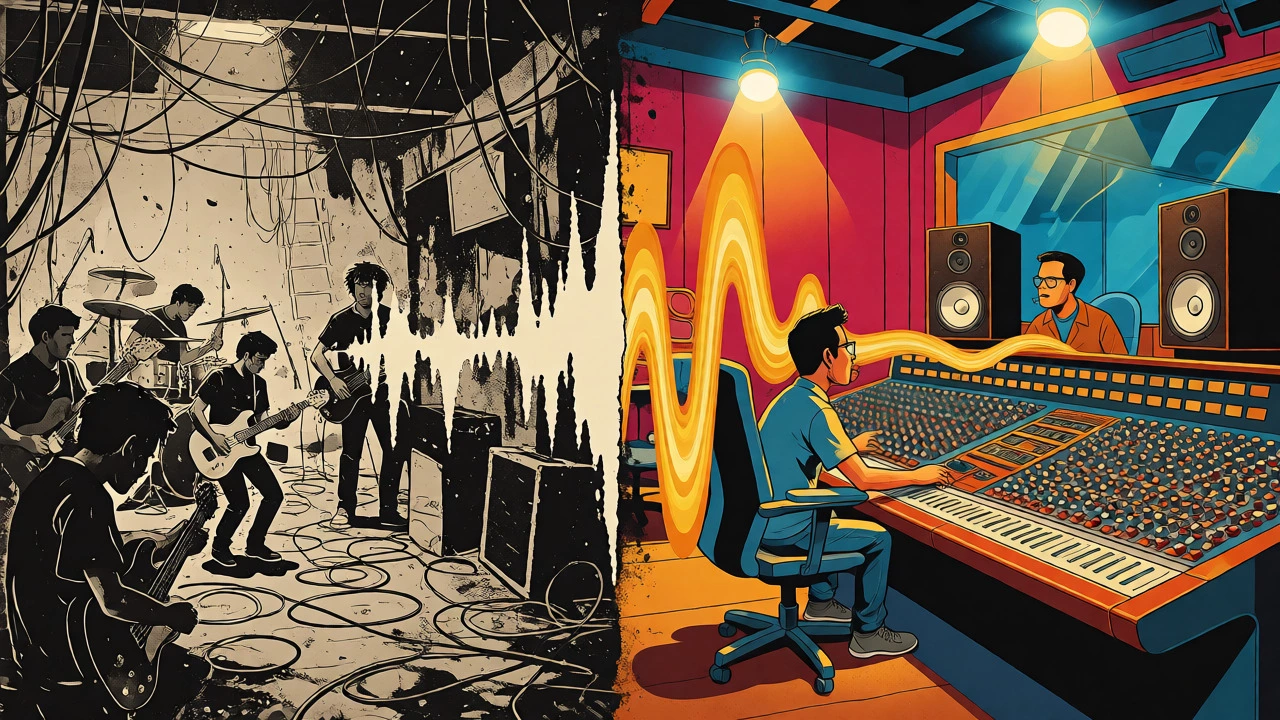

You hear the crackle of tape hiss, the thud of a kick drum that feels like it’s in your chest, and the sudden shift from a whisper to a scream. That sound isn’t an accident. It was engineered. The 1990s alternative rock defined its identity by balancing two opposing forces: the raw, immediate energy of lo-fi grit and the clear, punchy clarity of radio polish. This decade didn’t just change what music sounded like; it changed how we record it.
If you’ve ever wondered why Nirvana’s *Nevermind* hits so hard while *In Utero* sounds like you’re standing in the room with them, you’re asking the right questions. The difference wasn’t just attitude. It was a deliberate choice in microphones, consoles, editing philosophy, and studio time. Let’s break down how engineers turned garage-band chaos into stadium anthems, and why those choices still matter today.
The Loud-Quiet-Loud Blueprint
Before we talk about knobs and cables, let’s talk about structure. The defining arrangement trick of 90s alt-rock was the "loud-quiet-loud" dynamic. The Pixies pioneered it, but Nirvana made it a global template. Verses were restrained, often clean or lightly distorted. Choruses exploded with full-band saturation.
This structure dictated the production. Engineers had to capture a band that could go from 5% volume to 100% in four bars. If you compressed too much during the quiet parts, you lost the intimacy. If you left too much headroom for the loud parts, the verses got buried. The solution? Dynamic control. Producers used compression not to squash everything flat, but to glue the explosion together without killing the spark. They kept the low end tight so the bass wouldn’t muddy up when the guitars kicked in. It was a high-wire act between fragility and power.
Steve Albini and the Documentary Aesthetic
Steve Albini is the godfather of the lo-fi documentary style. He didn’t believe in "producing" in the traditional sense. He believed in capturing. His philosophy was simple: if the band sounds good in the room, the microphone will catch it. If they don’t, no amount of post-production can fix it.
Take *In Utero*. Albini recorded it at Pachyderm Studio in Minnesota in less than two weeks. No fancy fixes. No endless overdubs. Kurt Cobain sang most vocals in one take, playing a broken acoustic guitar. The result was abrasive, immediate, and unpolished. You hear the room. You hear the amp buzz. You hear the strain in the voice. Albini wanted the record to reflect the band’s reality, not a polished fantasy. He avoided heavy effects, letting feedback and noise become part of the texture. For many fans, this was the true sound of grunge-raw and uncompromising.
But here’s the twist: even Albini’s work required technical precision. His "no production" stance relied on expert microphone placement, gain staging, and phase alignment. He didn’t ignore technique; he hid it. The grit wasn’t incompetence. It was a curated choice to prioritize performance over perfection.
Butch Vig and the Radio Polish Model
On the other side of the spectrum sits Butch Vig and his work on *Nevermind*. Vig took Nirvana’s aggression and organized it. He spent more time in the studio, tracking basics together but then fixing errors, doubling guitars, and tightening drums. His goal was translation. Could this song survive on MTV? Would it sound good on car speakers? Would it cut through on the radio?
Vig’s approach was interventionist but respectful. He didn’t change who Nirvana was; he clarified it. He used close mics on the drums to get definition, layered reverb on vocals to create space, and EQ’d the guitars to carve out room for the bass. The result was a wall of sound that felt massive but remained intelligible. Every word was clear. Every hit was precise. This was "radio polish"-not making the band sound pop, but making their rock sound bigger and clearer.
Interestingly, Vig later said 90% of the sound came from drummer Dave Grohl’s playing. Gear doesn’t make the record; people do. But gear helps the world hear what those people are doing. Vig removed the technical barriers between the listener and the emotion.
The Tech Shift: From Tape to Digital Hybrid
The 90s weren’t just analog or digital. They were a messy, exciting hybrid. At the start of the decade, big studios ran on large-format analog consoles like SSL 4000s and Neve desks. These machines added warmth and coloration. Tape saturation softened harsh frequencies, giving records a cohesive glue.
But digital tech was exploding. In 1991, Alesis ADAT arrived, offering eight tracks of digital audio on cheap VHS tapes. Suddenly, bands could afford multi-track recording in garages. Then came Pro Tools, which evolved from a two-track editor into a full DAW by 1994. By 1999, you could record 24 tracks on a home computer.
This created a new workflow. Engineers might track live to tape for the vibe, transfer to Pro Tools for editing, and mix back through analog gear for the finish. This hybrid approach allowed for non-linear editing-copy-pasting choruses, fixing timing, comping vocals-without losing the organic feel of the original performance. It democratized recording. You didn’t need $50,000 a day at Sound City anymore. You needed a laptop, some interfaces, and good ears.
Beyond Grunge: Sampling and Shoegaze Textures
Not every 90s alternative record was three chords and a shout. Bands like Radiohead and Garbage pushed production boundaries further. Radiohead’s *OK Computer* used unconventional spaces, electronic loops, and processed vocals to create a dystopian atmosphere. Garbage blended hip-hop beats, samples, and heavy guitars, creating a collage-like sound where the studio itself became an instrument.
This expanded the definition of "alternative." Production wasn’t just about capturing a band; it was about constructing a world. Loop-based rhythms, reversed cymbals, and synthesized textures coexisted with live drums and amps. The line between "rock" and "electronic" blurred. Producers started treating the mix as a canvas, painting with frequency and space rather than just documenting sound.

How to Recreate the 90s Sound Today
You don’t need vintage gear to get that 90s vibe, but you do need the right mindset. Here’s how to balance grit and polish in your own projects:
- Commit Early: Don’t rely on fixing things in the mix. Get the tone right at the source. Use fewer microphones and place them carefully. Phase issues kill impact faster than bad EQ.
- Embrace Imperfection: Leave the string squeak. Keep the breath before the vocal line. If the drummer rushes the chorus slightly, leave it. Those flaws add humanity.
- Control the Low End: 90s mixes were dense. Use high-pass filters on guitars to clear mud. Sidechain compress the bass to the kick so they don’t fight. Make space for the vocal.
- Dry vs. Wet: Use short, dark reverbs (plates or rooms) instead of long, shimmering halls. Delay should be rhythmic, not wash. Keep vocals forward and dry enough to cut through.
- Saturation is Key: Drive your preamps or use tape emulation plugins. Gentle harmonic distortion glues tracks together better than clean digital processing.
| Feature | Lo-Fi Documentary (Albini Style) | Radio Polish (Vig Style) |
|---|---|---|
| Primary Goal | Capture authenticity and immediacy | Maximize impact and radio compatibility |
| Editing | Minimal; commit to takes | Extensive; comping, tuning, quantizing |
| Room Sound | Prominent; ambient mics mixed high | Controlled; tight, isolated sources |
| Dynamic Range | Wide; natural contrast | Compressed; consistent loudness |
| Example Album | *In Utero* by Nirvana | *Nevermind* by Nirvana |
Frequently Asked Questions
Was all 90s alternative rock really lo-fi?
No. While lo-fi aesthetics were popular in indie circles, major label releases like *Nevermind*, *The Bends*, and *Siamese Dream* were highly produced. Even bands associated with grunge often used expensive studios and skilled producers to achieve a polished, powerful sound that translated well to commercial radio.
Why does 90s rock sound different from modern rock?
Modern rock often relies on grid-aligned programming, sample replacement for drums, and extreme loudness via limiting. 90s rock retained more human timing variations, used real room ambience, and balanced dynamics rather than crushing them. The "loudness war" peaked later, leading to the flatter, more saturated sound common in 2000s and 2010s productions.
Did digital recording ruin the 90s sound?
Not at all. Digital tools like ADAT and early Pro Tools enabled creative flexibility that analog couldn’t match, such as easy sampling and complex editing. Many iconic 90s albums used hybrid workflows, combining the warmth of analog tracking with the convenience of digital editing. The perceived "loss" of character often stems from poor implementation, not the technology itself.
What is the "loud-quiet-loud" structure?
It’s a songwriting and production technique where verses are played quietly and simply, building tension, followed by loud, dense, energetic choruses. Popularized by The Pixies and perfected by Nirvana, this dynamic contrast allows producers to highlight the emotional payoff of the chorus by keeping the verses sparse and intimate.
Can I recreate the 90s sound with modern software?
Yes. Use tape saturation plugins, plate reverb emulations, and analog-modeled EQs. Focus on performance quality and arrangement rather than trying to mimic specific hardware. Limit your track count to force decision-making, and avoid over-editing to preserve the human element that defined the era.