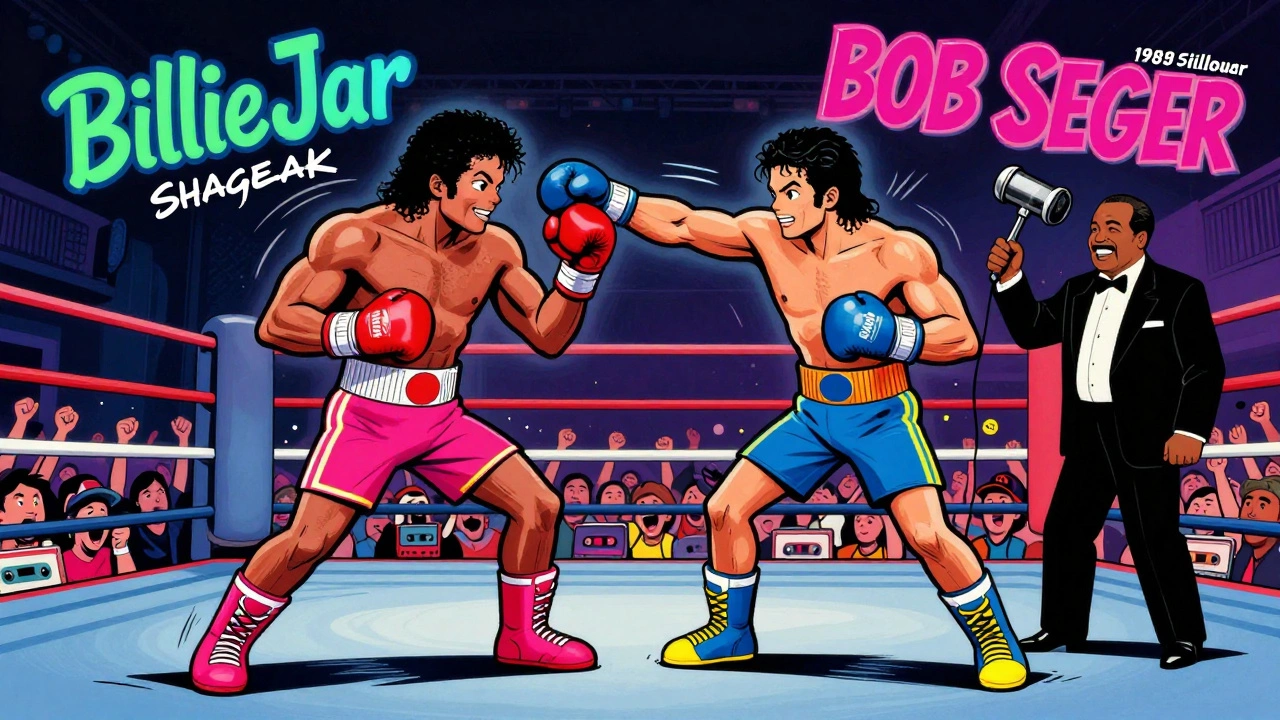

The 1980s weren’t just about big hair and synthesizers-they were a warzone for rock bands fighting for radio play, MTV slots, and chart dominance. It wasn’t just about who made the best music. It was about who could outlast, outmarket, and outmaneuver the competition. This wasn’t subtle. This was rock rivalry at its most intense.
Chart Battles: When a Single Song Could Shut Down a Legend
The Billboard charts weren’t just a scoreboard-they were a battlefield. In 1983, Michael Jackson’s "Billie Jean" climbed to number one, but it didn’t just rise. It blocked Bob Seger’s "Shakedown" from the top spot, holding it at number two for three straight weeks. What made this unusual? Both songs were produced by Quincy Jones. That’s right-the same producer behind two rival hits. It was the only time in the decade one producer had two songs locked in a head-to-head chart battle like that.
Then there was the Rolling Stones. Their 1981 single "Start Me Up" didn’t just chart-it ruled. For 13 straight weeks, it sat at number one on the Mainstream Rock chart. No other rock song in the 1980s held that long. It wasn’t just popularity. It was dominance. Bands like U2 and Bon Jovi were still climbing. The Stones were already on the roof.
And don’t forget the female artists. In 1986, Tina Turner’s "Typical Male" climbed to number two on the rock chart. But it couldn’t get past Janet Jackson’s "When I Think Of You," which held the top spot. This was the only time in the decade where two women blocked each other from the top, both on the same chart. No men. No backup bands. Just two powerhouses, one after the other, refusing to yield.
Album Wars: Back in Black vs Heaven and Hell
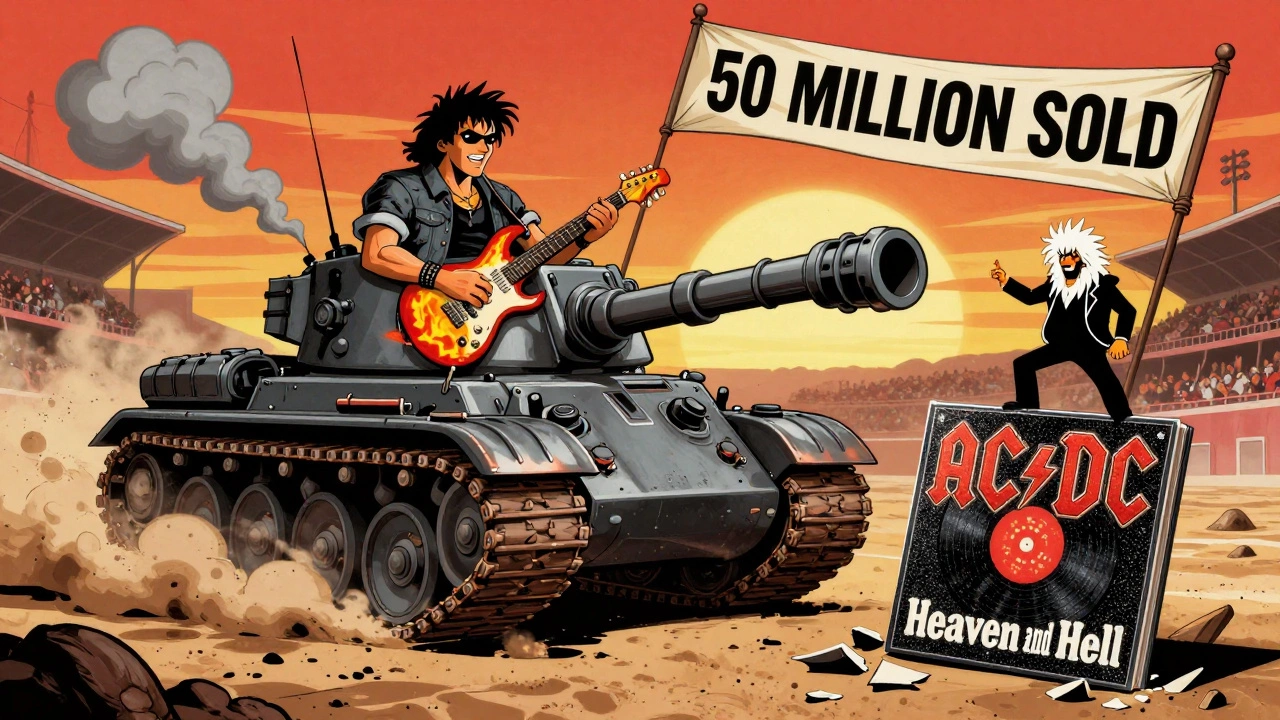
It wasn’t just singles. Albums were weapons. AC/DC’s "Back in Black," released in 1980 after the death of Bon Scott, didn’t just sell. It became the best-selling rock album of all time. Over 50 million copies. That’s not a record-it’s a monument. And it wasn’t just a tribute. It was a statement: we’re still here, and we’re louder than ever.
Black Sabbath responded with "Heaven and Hell" the same year, bringing in Ronnie James Dio as their new frontman. The album wasn’t just a reboot. It redefined heavy metal. The riffs were tighter. The vocals were sharper. The production? Cleaner. It forced every other band in the genre to step up. If you were a metal band in 1980, you had two choices: match Black Sabbath’s new standard or get left behind.
And then there was Toto. Their 1982 album "Toto IV" was a chart juggernaut. "Africa" hit number one. "Rosanna" was blocked from the top spot by Survivor’s "Eye of the Tiger"-a song written for Rocky III. But Toto didn’t quit. Seven months later, "Africa" finally broke through. That’s the kind of patience that wins wars. Not with screaming matches. With persistence.
MTV: The New Arena
Before MTV, rock was about live shows and radio. After MTV, it was about visuals. If your video didn’t pop, your song didn’t matter. The bands that understood this won. Michael Jackson’s "Thriller" wasn’t just a song-it was a 14-minute movie. It didn’t just top charts. It rewrote the rules.
But it wasn’t just Jackson. Prince turned "Purple Rain" into a visual masterpiece. Bruce Springsteen’s "Dancing in the Dark" video, with a young Courtney Cox dancing onstage, made him seem human again. And then there were the bands who refused to play the game. The Rolling Stones didn’t make flashy videos. They didn’t need to. Their music was raw enough to stand on its own.
MTV didn’t just change how music was sold. It changed who got heard. Synth-heavy bands like Duran Duran and A-ha got heavy rotation because their videos were colorful, stylish, and easy to watch. Meanwhile, older, grittier bands like Led Zeppelin’s offshoots struggled to find airtime. The divide wasn’t just musical. It was generational.
Tours: Who Played Where, and Why It Mattered
While the sources don’t detail specific tour clashes, the pattern is clear: venues were battlegrounds. When AC/DC toured in 1981, they played arenas that had once hosted Queen. When Springsteen hit the road in 1984, he played the same stadiums Metallica would fill in 1986. It wasn’t about direct competition-it was about legacy.
Imagine this: you’re a promoter in Chicago in 1985. You’ve got two options: book a reunion tour for a 70s legend, or a rising MTV star. You don’t pick both. You pick one. And that one choice shaped the entire city’s music scene for months. Bands didn’t always feud publicly-but they fought silently, through ticket sales, venue bookings, and radio play.
There were no public statements like "We hate them." But backstage? There were rumors. Rumors that one band’s crew sabotaged another’s soundcheck. Rumors that a promoter gave one band prime time because they paid more. Rumors that a band’s manager told a radio station to stop playing a rival’s song. These weren’t just gossip. They were strategy.
The Feuds That Never Made the Headlines
Most of the famous band feuds-like Paul McCartney vs John Lennon, or Led Zeppelin vs The Who-happened in the 70s. The 80s were quieter. But that doesn’t mean they didn’t exist.
Sting and The Police were at their peak, but internal tensions were growing. Andy Summers later said the band felt like "a machine running on fumes." They broke up in 1986. Was it creative differences? Or was it exhaustion from being the "biggest band" in a world that kept demanding more?
And what about the quiet war between Van Halen and Mötley Crüe? Both were stadium acts. Both had wild frontmen. Both had hits that dominated the charts. But Van Halen had the technical mastery. Mötley Crüe had the chaos. Fans picked sides. And the bands? They never called each other out. But their fans did-for years.
Even Bruce Springsteen and Bob Seger, both working-class icons, never openly clashed. But if you look at their tour schedules, you’ll notice something: they rarely played the same cities in the same year. Coincidence? Or a silent understanding that there was only room for one king in each market?
Why It All Mattered
These rivalries weren’t just about sales numbers. They were about identity. Was rock about raw power? Or polished production? Was it about legacy, or reinvention? Was it about the music-or the image?
The 1980s gave us the first generation of rock stars who had to compete not just with other bands, but with TV networks, fashion trends, and global marketing machines. The ones who survived didn’t just write songs. They built brands.
And that’s the real legacy. Not the chart positions. Not the album sales. But the fact that, in a decade full of noise, every band had to decide: are we here to make music-or to win?
Did any rock bands from the 1980s have public feuds?
Public feuds were rare in the 1980s. Most rivalries were silent-played out through chart positions, tour scheduling, and radio play. Bands like Van Halen and Mötley Crüe never publicly insulted each other, but fans picked sides. Even Sting and his Police bandmates never aired grievances, though tensions grew until their 1986 breakup. The biggest conflicts were behind the scenes: record labels pushing one artist over another, promoters favoring certain acts, or producers blocking rival songs on the same chart.
What was the longest-running #1 rock song of the 1980s?
"Start Me Up" by the Rolling Stones held the number one spot on Billboard’s Mainstream Rock chart for 13 consecutive weeks from September to November 1981. No other rock song in the decade matched that run. It wasn’t just popular-it was unstoppable. The song became a cultural touchstone, played at stadiums, rallies, and even political events. Its longevity proved that classic rock still ruled the airwaves, even as new wave and synth-pop surged.
How did MTV change rock music rivalries?
MTV turned rock into a visual competition. Suddenly, it wasn’t enough to have a great song-you needed a killer video. Bands like Duran Duran and Prince dominated because their videos were cinematic, stylish, and memorable. Meanwhile, older bands like the Rolling Stones, who didn’t invest in flashy visuals, still thrived because their music carried enough weight. MTV didn’t end rivalries-it amplified them. Now, bands were competing not just for radio play, but for screen time. The artist with the best video often got the edge, even if their song wasn’t the strongest.
Was there a rivalry between Michael Jackson and other rock artists?
Michael Jackson wasn’t a traditional rock artist, but his music dominated rock charts. In 1983, "Billie Jean" blocked Bob Seger’s "Shakedown" from the top spot, both produced by Quincy Jones. This was the only known case of a single producer having two rival hits at number one and two. Jackson’s "Thriller" also pushed rock bands like AC/DC and Bon Jovi off MTV playlists. His success forced rock acts to adapt-some embraced pop, others doubled down on guitar-driven sound. The rivalry wasn’t personal-it was commercial.
Why did AC/DC’s "Back in Black" outsell every other rock album?
"Back in Black" wasn’t just an album-it was a memorial. Released after lead singer Bon Scott’s death, it carried emotional weight that resonated worldwide. The music was raw, powerful, and perfectly timed. It had no gimmicks, no synthesizers, no music videos. Just guitars, drums, and a voice that screamed defiance. Plus, it was released during a time when rock was losing ground to pop and new wave. Fans clung to its authenticity. Over 50 million copies sold, it remains the best-selling rock album ever-not because of marketing, but because it felt real.
What Comes Next
If you want to understand how rock music evolved after the 1980s, look at what happened next. The 90s didn’t erase these rivalries-they inherited them. Nirvana didn’t just replace hair metal. They buried it. But the rules were the same: who gets heard? Who gets seen? Who gets to stay?
The 1980s taught us that rock isn’t just about notes. It’s about survival. And in that decade, the loudest bands didn’t always win. The smartest ones did.


