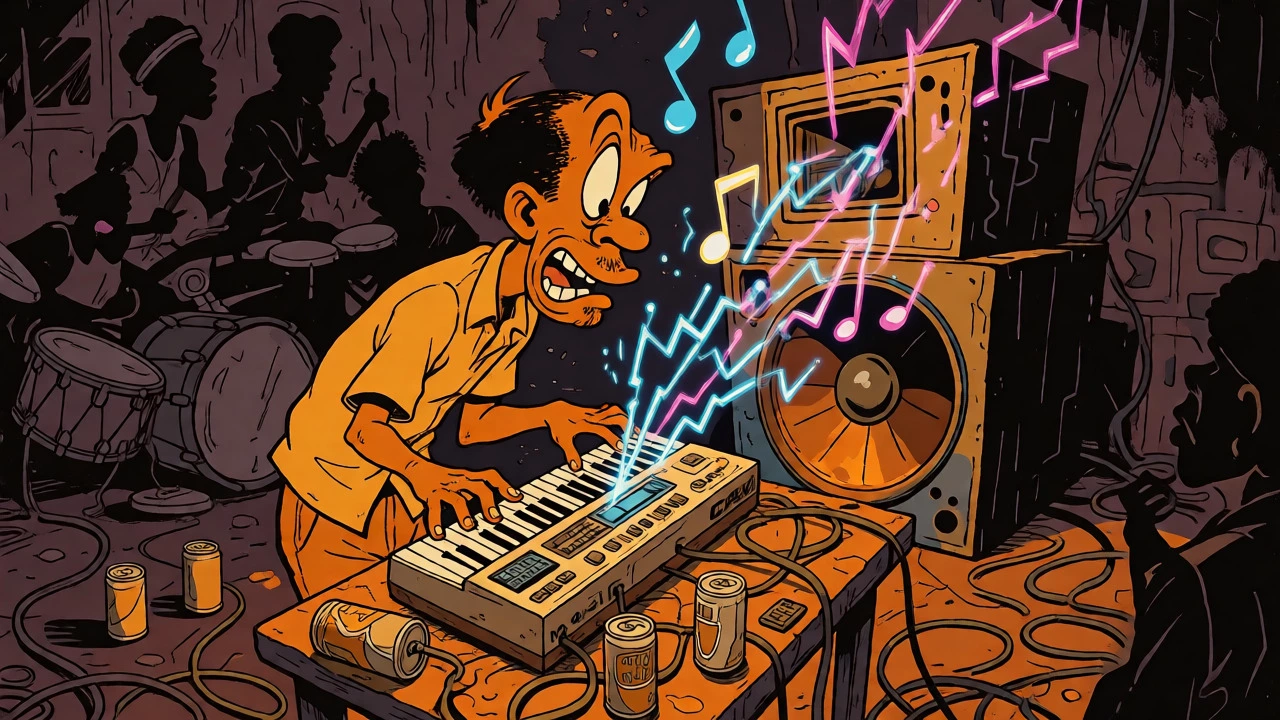

Imagine a keyboard so cheap you could buy it at a department store. Now imagine that same keyboard changing the course of music history. That is exactly what happened in Jamaica in 1985. A preset pattern from a Casio MT-40 didn't just make a song; it launched an entire genre. This wasn't about replacing tradition with cold technology. It was about finding new ways to let tradition breathe through digital circuits.
The story of 1980s reggae and world pop isn't a simple tale of old versus new. It’s a messy, exciting collision where synthesizers met talking drums, and drum machines learned to swing. If you think electronic music killed the soul of roots reggae, you’re missing the point. The electronics became part of the rhythm section, not just a replacement for it. Let’s look at how this shift actually worked on the ground, from Kingston studios to Parisian recording suites.
The Sleng Teng Revolution: Cheap Tech, Big Impact
You can’t talk about this era without starting with "Under Mi Sleng Teng." In late 1984, producer Lloyd "King Jammy" James took a preset bassline from a consumer-grade keyboard and turned it into a global phenomenon. The instrument was the Casio MT-40, released in 1981. It wasn’t a professional studio monster like the Yamaha DX7. It was a toy by comparison. But its rigid, repetitive bass pattern fit perfectly into the Jamaican sound system culture.
Why did this matter? Because it democratized production. Before this, making a track meant hiring a full band: bassist, drummer, guitarists, organ players. With the MT-40, one person in a small room could create a riddim. This shifted power from the musicians to the producer-programmer. It also created the "riddim economy," where one instrumental backing track would be reused by dozens of different deejays and singers. The technology didn’t erase the human element; it changed who held the controls.
| Instrument | Type | Primary Role in Reggae/World Pop | Cost & Accessibility |
|---|---|---|---|
| Casio MT-40 | Preset Keyboard | Basslines, basic rhythms (Sleng Teng) | Low cost, widely available |
| Yamaha DX7 | FM Synthesizer | Bright leads, electric piano, metallic textures | High cost, complex programming |
| Fairlight CMI | Sampler | Sampling acoustic instruments, orchestral hits | Very high cost, studio-only |
| Roland TR-808 | Drum Machine | Deep kick, crisp snare, programmed percussion | Moderate cost, programmable |
The Yamaha DX7: Polishing the Global Sound
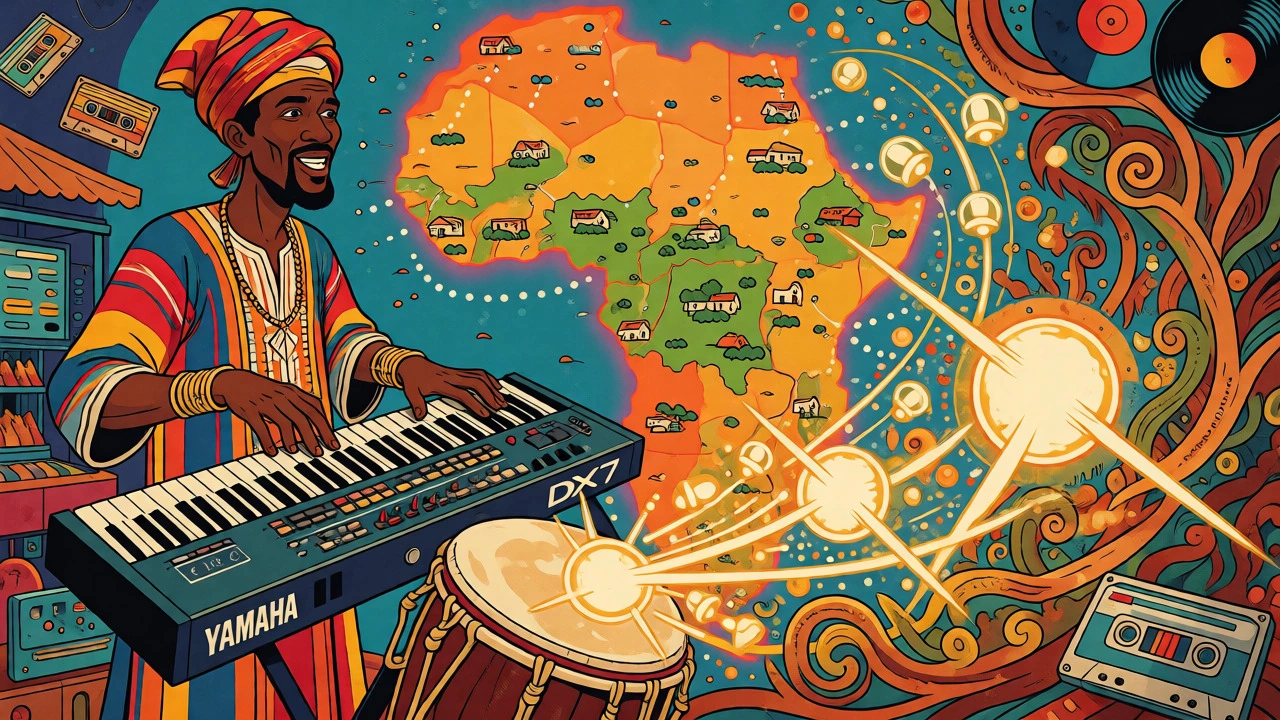
If the Casio was the street-level revolution, the Yamaha DX7 was the polished suit worn by international stars. Released in 1983, it used frequency modulation synthesis to create bright, bell-like tones that defined the decade. You hear it everywhere: in Peter Gabriel’s albums, in Michael Jackson’s tracks, and crucially, in African world pop.
In Senegal, musician Youssou N’Dour used the DX7 to complement his traditional mbalax rhythms. He didn’t replace the sabar drum with a synth. Instead, he used the DX7’s marimba-like sounds to mimic or harmonize with the acoustic percussion. The result was a hybrid texture that sounded modern but felt deeply local. The DX7 allowed these artists to tour globally without hauling a massive orchestra, yet their records retained the complex polyrhythms that defined their heritage.
Africa Meets Electronics: Mbalax and Soukous
Across West Africa, the integration of synths followed a similar logic. In Mali, Salif Keita’s 1987 album Soro blended synthesizers with traditional balafons and kora. The electronics provided a steady, spacious bed for the intricate acoustic melodies. This wasn’t about hiding tradition under a layer of plastic. It was about giving traditional instruments more space to shine by handling the rhythmic foundation with precise, unyielding electronic beats.
This approach challenged the Western idea that "world music" had to sound rustic or primitive. By using state-of-the-art gear, African artists asserted their place in the modern pop landscape. They weren’t folk relics; they were contemporary producers using the same tools as their European counterparts. The synthesizer became a bridge, allowing local rhythms to travel further than ever before.
The Producer as Architect: Sampling and Space
In London and New York, producers like Peter Gabriel were experimenting with sampling. His use of the Fairlight CMI allowed him to take a snippet of a real drum hit or a vocal cry and loop it, pitch it, or distort it. On his album Melt, he stripped away cymbals and hi-hats, relying on tight, sampled drum patterns. This created a stark, dramatic space that highlighted the emotional weight of the vocals.
This technique influenced how reggae was mixed too. Dub engineers had long used delay and reverb to create space. Digital samplers and effects units amplified this ability. Producers could isolate a single snare hit, echo it into infinity, and drop a synthesized bass note underneath. The arrangement became sparse but powerful. Every element had to justify its presence because there was nowhere to hide behind a wall of live noise.
Challenges and Criticisms
It wasn’t all smooth sailing. Early digital instruments were hard to program. The Yamaha DX7, for instance, required understanding algorithms and operators-concepts foreign to many traditional musicians. There was a risk of homogenization, where every record started sounding like the same preset patch. Critics argued that the mechanical precision of drum machines killed the human "swing" that made reggae feel alive.
But savvy producers fought back against this rigidity. They played their keyboards live rather than quantizing everything. They layered acoustic percussion over electronic beats to add grit. They used the limitations of cheap gear as aesthetic choices. The "wrong" sound of a Casio preset became a signature style. This resilience proved that technology is only as good as the artist wielding it.
Legacy: Why This Era Still Matters
The 1980s didn’t end with a clean break. The techniques developed then-sampling, looping, hybrid instrumentation-form the backbone of today’s global pop. When you hear a modern Afrobeats track mixing log drums with heavy 808 bass, you’re hearing the direct descendant of what Youssou N’Dour and King Jammy pioneered. They proved that you don’t have to choose between your heritage and the future. You can synthesize them.
This era teaches us that innovation often comes from constraint. A $100 keyboard sparked a genre. A complex synthesizer elevated a continent’s music to global stages. The key takeaway? Don’t fear the machine. Learn its language, then teach it your own.
What was the Casio MT-40?
The Casio MT-40 was a low-cost consumer keyboard released in 1981. It featured preset rhythms and bass lines. Its importance lies in the fact that a preset bass pattern from this keyboard became the basis for the iconic "Sleng Teng" riddim, launching the digital dancehall era in Jamaica.
How did the Yamaha DX7 influence world pop?
The Yamaha DX7 provided bright, clear FM synthesis sounds that were easily identifiable. Artists like Youssou N’Dour and Salif Keita used it to create modern textures that complemented traditional African rhythms, helping their music gain international commercial appeal while retaining cultural identity.
Did synthesizers replace live bands in reggae?
Not entirely. While drum machines and keyboards reduced the need for large ensembles, many recordings still featured live elements. The shift was more about redistribution of roles: producers gained control over rhythm structures, while musicians adapted to playing within tighter, electronically driven frameworks.
What is the "riddim economy"?
This refers to the practice where a single instrumental track (riddim) is produced once and then recorded over by multiple different artists. Digital production made it cheaper and easier to create these shared backings, leading to a boom in collaborative versions and remixes.
Why was the Fairlight CMI important?
The Fairlight CMI was one of the first digital samplers. It allowed producers to record real-world sounds and manipulate them digitally. Artists like Peter Gabriel used it to integrate non-Western percussion and textures into mainstream pop, bridging the gap between experimental art and commercial music.
