
Imagine a song recorded in one night that sells millions of copies and saves lives. That is exactly what happened in the mid-1980s when charity singles became a global phenomenon. Before this era, buying a record was just entertainment. After 1984, it became a direct act of humanitarian intervention. This shift didn't just raise money; it rewired how we view celebrity power, global responsibility, and the role of pop music in society.
The Spark: Band Aid and the Ethiopian Famine
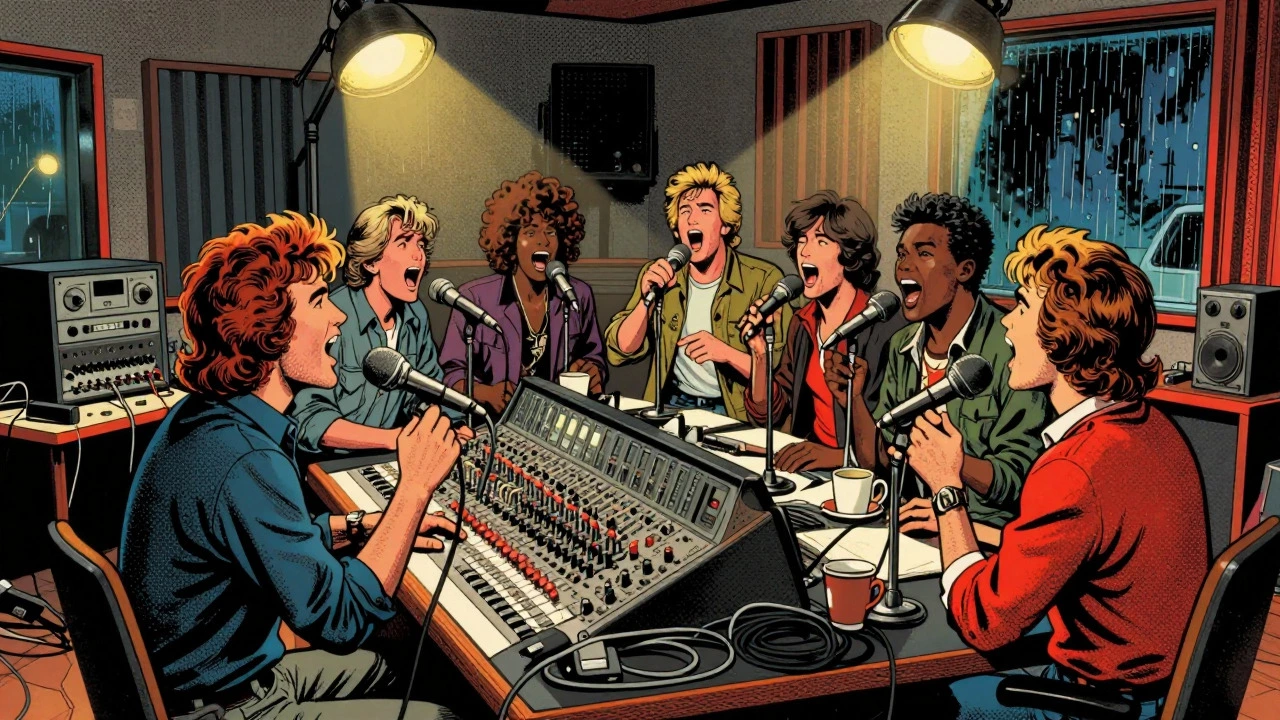
The story starts with two men: Irish musician Bob Geldof and Scottish musician Midge Ure. In late 1984, they watched TV reports about the devastating famine in Ethiopia. The images were harrowing, and the response from the Western world was slow. So, they decided to act fast. They gathered some of the biggest names in British and Irish pop at SARM Studios in London for an all-night recording session. The result was "Do They Know It's Christmas?" by the supergroup Band Aid.
The logistics were impressive. Producer Trevor Horn donated his studio time, and the artists-including Bono, Phil Collins, George Michael, and Boy George-recorded the track overnight. Just four days later, on December 3, 1984, the single hit stores. It wasn't just a hit; it was a cultural earthquake. It debuted at number one on the UK Singles Chart and stayed there for five weeks. At the time, it was the fastest-selling single in British history.
| Feature | Band Aid (UK) | USA for Africa (US) |
|---|---|---|
| Song Title | Do They Know It's Christmas? | We Are the World |
| Recording Date | November 1984 | January 28, 1985 |
| Release Date | December 3, 1984 | March 7, 1985 |
| Key Artists | Bono, Phil Collins, Sting, George Michael | Michael Jackson, Lionel Richie, Bruce Springsteen, Stevie Wonder |
| Funds Raised | ~£8 million (~$24 million) | $60-80 million (~$235 million in 2025 dollars) |
| Primary Focus | Ethiopian Famine Relief | African Famine & US Humanitarian Aid |
Going Global: The USA for Africa Response
Word of Band Aid's success crossed the Atlantic quickly. Singer and activist Harry Belafonte saw the impact and wanted a similar effort in the United States. He teamed up with manager Ken Kragen to organize USA for Africa. The goal was simple: bring together American superstars to raise funds for African famine relief and other humanitarian causes.
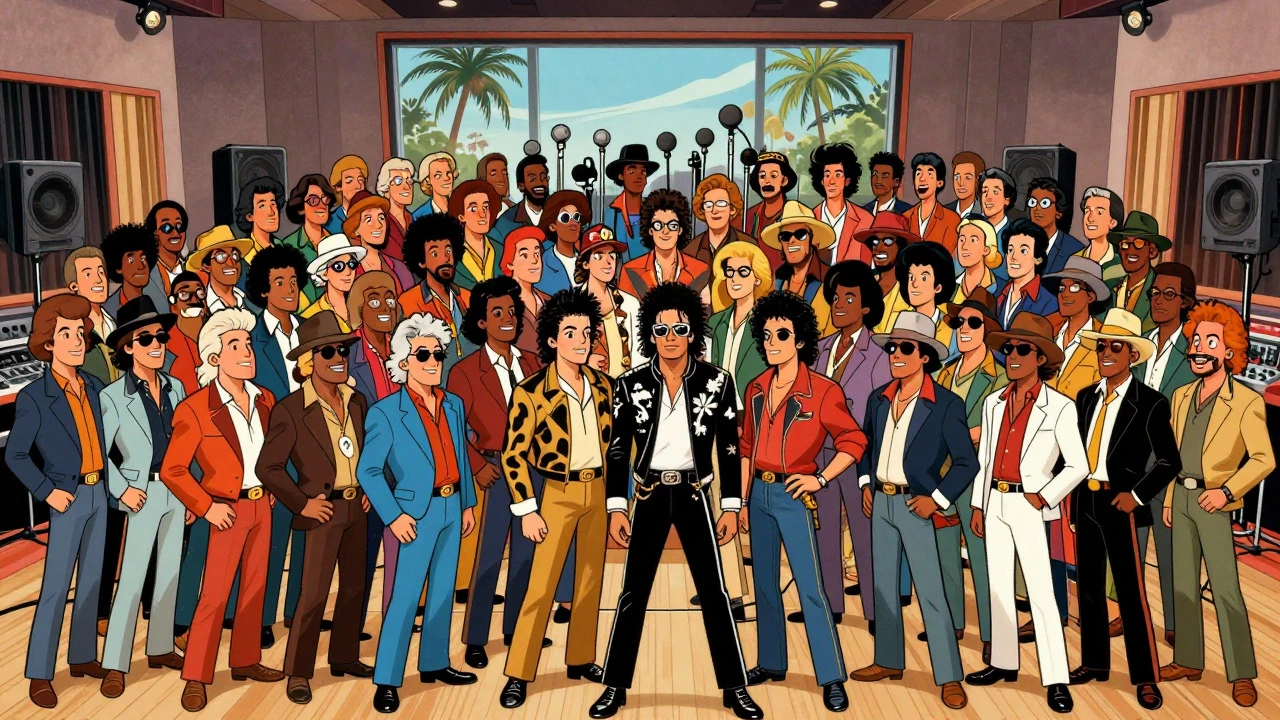
On January 28, 1985, immediately after the American Music Awards, more than 45 artists gathered in Los Angeles. This included heavy hitters like Michael Jackson, who co-wrote the song with Lionel Richie. They recorded "We Are the World" in a single night. The song featured a gospel-influenced ballad structure with a chorus that emphasized unity: "We are the world, we are the children." When it released on March 7, 1985, it sold 800,000 copies in just three days. It spent four weeks at number one on the Billboard Hot 100 and eventually sold over 7 million copies worldwide.
How the Model Worked: Media, Money, and Momentum
Why did these songs work so well? It wasn't just good music. It was a masterclass in media strategy. Both projects leveraged the intense media saturation of the 1980s. Music videos played on MTV and UK channels non-stop. Behind-the-scenes documentaries showed the stars working together, creating a sense of shared purpose. For listeners, buying the single felt like joining a team effort.
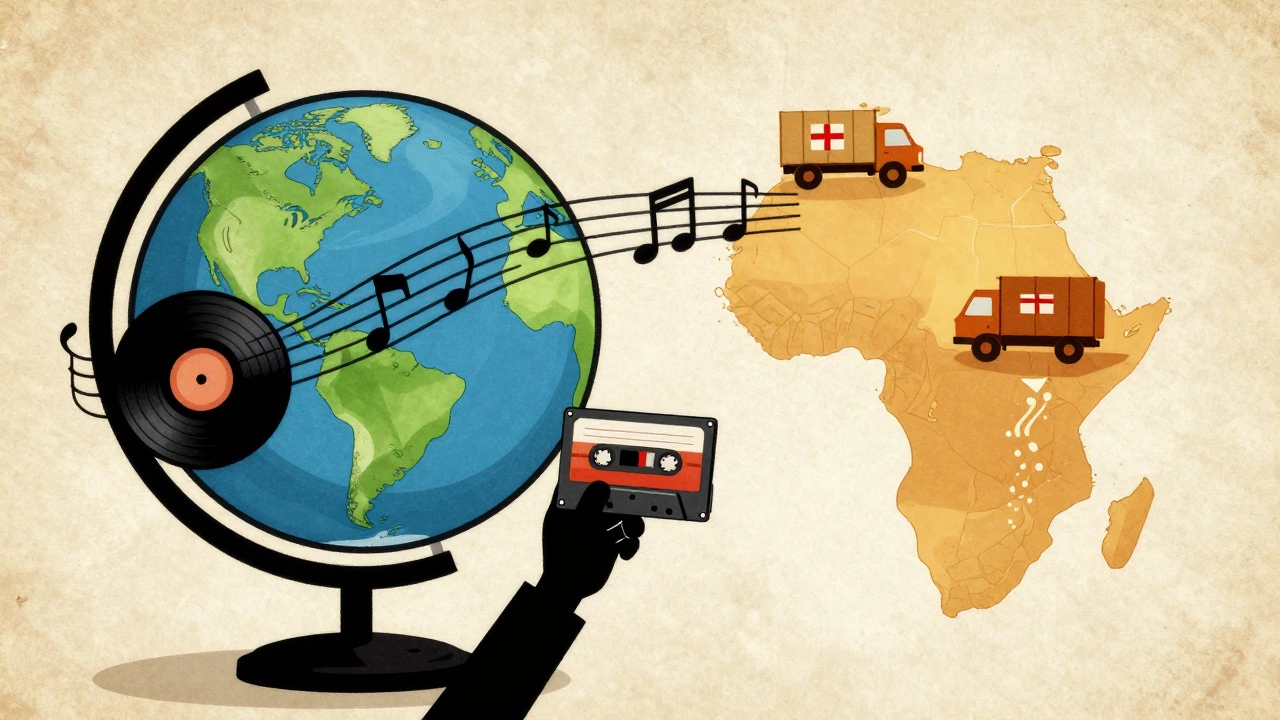
The financial impact was massive. Band Aid raised approximately £8 million, which translated to around $24 million at the time. USA for Africa raised between $60 and $80 million, a sum equivalent to roughly $235 million in 2025 dollars. These funds went directly to food shipments, medical supplies, and infrastructure in Ethiopia and other parts of Africa. But beyond the money, these singles changed the expectation of what celebrities could do. They proved that pop stars could mobilize public attention and resources faster than traditional charities or governments.
The Cultural Shift: From Entertainment to Activism
Before 1984, celebrity activism was often seen as niche or controversial. After Band Aid and USA for Africa, it became mainstream. The idea that consuming music-buying a CD or watching a video-could be a form of direct aid reshaped fan behavior. It normalized the concept of the "charity supergroup," where competing labels and artists set aside their differences for a greater cause.
This shift also influenced how artists managed their brand image. In an era where MTV was putting stars under a microscope, associating with a high-profile charity project signaled compassion and social responsibility. It wasn't just about doing good; it was about being seen doing good. This created a new template for future charitable efforts, where the spectacle of the collaboration was as important as the cause itself.
The Controversy: Representation and Stereotypes
However, the legacy of these singles is not without criticism. As the decades passed, critics began to question the messaging. Lyrics in "Do They Know It's Christmas?" described Africa with phrases like "where the only water flowing is the bitter sting of tears" and "a world of dread and fear." Critics argued that these lines painted the entire continent as a place of absolute deprivation, ignoring its diversity and complexity.
By the 2010s and 2020s, these critiques gained traction. African commentators and advocacy groups pointed out that the campaigns often relied on "white savior" narratives, centering Western heroism while erasing African agency. Ghanaian-British musician Fuse ODG refused to participate in later Band Aid projects, arguing that such campaigns perpetuated damaging stereotypes that hindered Africa's economic growth and dignity. Despite this, the songs remain cultural touchstones, illustrating the tension between their measurable charitable success and their contested representational politics.
Legacy and Lasting Impact
Today, "Do They Know It's Christmas?" remains a staple of British holiday radio, and "We Are the World" is still cited as an anthem of hope. Their impact extends beyond fundraising; they established the framework for modern celebrity philanthropy. They showed that a single song could mobilize tens of millions of dollars and reshape public agendas within weeks. While debates over representation continue, the fundamental model-using pop star power to drive rapid humanitarian response-remains a defining feature of 1980s pop culture and continues to influence charitable efforts today.
Who organized the first major 1980s charity single?
Bob Geldof and Midge Ure organized Band Aid, which released "Do They Know It's Christmas?" in December 1984 to raise funds for the Ethiopian famine.
How much money did "We Are the World" raise?
USA for Africa raised between $60 million and $80 million from the release of "We Are the World" and related merchandise, which is approximately $235 million in 2025 dollars.
What was the main criticism of 1980s charity singles?
Critics argued that the lyrics and imagery promoted stereotypes of Africa as a monolithic place of poverty and suffering, often ignoring regional diversity and local agency in favor of a "white savior" narrative.
Which artists were part of USA for Africa?
The group included over 45 artists, notably Michael Jackson, Lionel Richie, Bruce Springsteen, Stevie Wonder, Diana Ross, Tina Turner, Ray Charles, and Billy Joel.
How did charity singles change the music industry?
They demonstrated that pop stars could collaborate across label boundaries for humanitarian causes, normalizing celebrity activism and establishing a model where music consumption could be framed as direct humanitarian aid.


