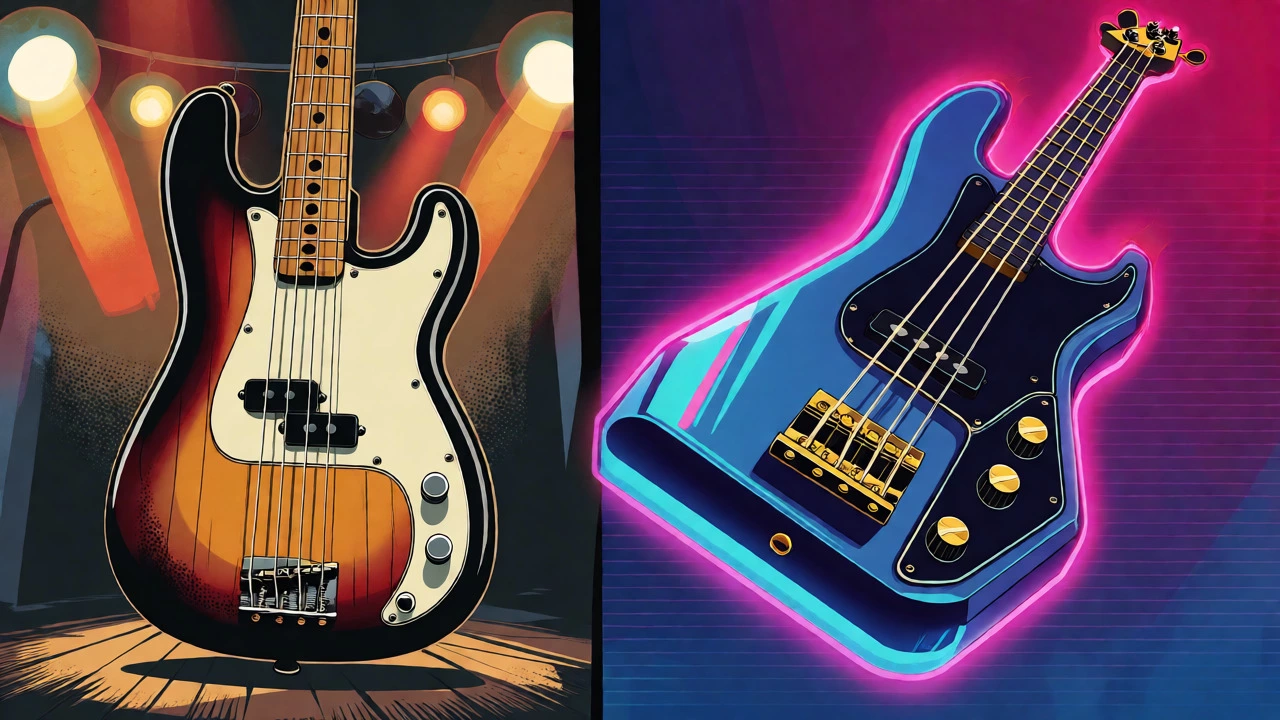

If you grew up listening to 1980s bass guitars, you know they sounded different. Deeper, punchier, and often more aggressive than the smooth tones of the 70s. This wasn't an accident. The decade between 1980 and 1989 was a battleground for bass design, where the long-standing dominance of the passive four-string standard collided with new technologies like active electronics and extended-range strings.
Why did this happen? Because music changed. Synth-pop demanded lower frequencies that a standard E string couldn't reach. Metal bands needed clarity in dense mixes. Jazz fusion players wanted precision control right at their fingertips. Manufacturers had to respond. They took the reliable workhorse designs of the past and injected them with modern engineering, creating a split market: one side sticking to tradition, the other racing toward the future.
The Enduring Power of the Passive Standard
At the start of the 1980s, the Fender Precision Bass is a solid-body electric bass guitar with a single split-coil pickup, defining the industry standard since the 1950s still ruled rock and pop. It was simple, rugged, and famously hard to break. Players like Steve Harris of Iron Maiden relied on it exclusively, proving that you didn't need fancy tech to cut through a wall of distorted guitars. The P-Bass offered a mid-focused tone that sat perfectly in a mix without eating up space.
But "standard" doesn't mean "static." Even within the traditional camp, things were shifting. In 1982, Fender launched the Vintage Reissue series, bringing back 1957 and 1962 specs. This created a dual market overnight. You could buy a brand-new instrument that looked and felt old-school, or you could look forward. This move acknowledged that while innovation was cool, nostalgia had serious commercial power. Many pros kept two basses: one vintage-style for warmth, one modern for bite.
Active Electronics Take Over
The real revolution started inside the body. Active electronics-basically a preamp built into the guitar-moved from niche experiments to mainstream gear. The catalyst? A desire for control. Instead of tweaking knobs on your amp across the stage, you could shape your tone right under your hand.
Fender jumped on this train early. In 1980, they released the Precision Bass Special is the first factory-produced Fender bass with active circuitry, featuring adjustable pickups and onboard EQ controls. It kept the familiar P-Bass shape but added three rotary controls for volume, bass, and treble, plus a switch to toggle between active and passive modes. It also featured a heavy brass bridge and gold hardware, signaling its premium status.
This wasn't just about sounding louder. It was about clarity. As amplification technology improved, speakers could reproduce deeper lows and sharper highs. Active circuits allowed bassists to exploit this range, boosting specific frequencies to stand out in complex arrangements. For studio musicians and live performers in large venues, this level of direct control was a game-changer.
The Rise of the Five-String Low B
While some players tweaked their tone, others expanded their range. The introduction of the five-string bass with a low B string was arguably the biggest structural shift of the decade. Why? Synthesizers. Bands like Duran Duran and Depeche Mode used keyboards that played notes below the lowest note on a standard bass (E). To keep up, bassists needed to go lower.
In 1984, Yamaha dropped the Yamaha BB5000 is the first commercially available production five-string bass guitar with a low B string, launching the extended-range era. It gave players access to those deep synth notes without detuning. Session legends like Jimmy Johnson adopted it quickly, using it on Allan Holdsworth's fusion albums to navigate complex harmonic structures. Suddenly, bass lines weren't just holding down the root; they were melodic, spanning nearly five octaves.
This change forced players to rethink their technique. Muting became harder with an extra string. Fingerings shifted. But the payoff was huge. Rock bands like Aerosmith and metal groups found they could write heavier, darker riffs that resonated physically in the chest, not just the ears.

Radical Designs: When Form Followed Function
If active electronics and extra strings were evolutionary steps, headless basses were a mutation. Enter the Steinberger L Series is a radical headless bass guitar with a graphite neck and compact body, designed for stability and portability. Launched in the early 80s, these instruments looked like nothing else on stage. No headstock meant less weight and better balance. The graphite neck resisted warping from humidity and temperature changes, offering incredible tuning stability.
Players like Stanley Clarke and Jeff Berlin embraced them for their consistency. However, they remained controversial. Purists hated the lack of wood resonance and the futuristic aesthetic. Yet, they proved that you could build a high-performance instrument without traditional materials. This sparked a wave of boutique builders experimenting with carbon fiber, aluminum, and exotic woods, pushing the boundaries of what a bass could be.
Comparing the 1980s Landscape
To understand how these innovations coexisted, let's look at the key players. The market wasn't a zero-sum game; different tools served different jobs.
| Feature | Standard P-Bass (Passive) | Precision Bass Special (Active) | Yamaha BB5000 (5-String) | Steinberger L2 (Headless) |
|---|---|---|---|---|
| Primary Advantage | Simplicity, classic tone, reliability | Tonal flexibility, onboard EQ control | Extended low range, matches synths | Portability, tuning stability, modern feel |
| Electronics | Passive split-coil | Active circuit with bass/treble boost/cut | Active or passive options (varied by model) | Typically active with graphic EQ |
| Best For | Rock, punk, garage, touring | Studio work, jazz-fusion, precise mixing | Metal, R&B, film scoring, synth-heavy pop | Traveling musicians, technical players |
| Learning Curve | Low | Moderate (managing EQ switches) | High (new fingerings, wider neck) | Moderate (different balance, no headstock) |
Manufacturing Shifts and Quality Control
You can't talk about 1980s basses without mentioning where they were made. The decade saw massive changes in production locations, which affected quality and collectibility today. Fender, struggling with corporate instability in the early 80s, moved some production overseas. From 1986 to 1991, many standard P-Basses were built in Japan. These "Made in Japan" (MIJ) models are now highly sought after because Japanese craftsmanship during this period was exceptional, often rivaling or exceeding US standards at a lower price point.
Then came the big reset. In 1987, Fender opened a new plant in Corona, California, launching the American Standard series. This marked a return to domestic production with higher quality control. If you're shopping for a vintage 80s bass today, knowing the origin matters. A late-80s American Standard will likely have better fit and finish than an early-80s CBS-era Fender, while MIJ models offer a sweet spot of value and performance.
Practical Tips for Today's Players
So, why does this history matter if you're buying gear in 2026? Because understanding the DNA of your instrument helps you use it better. If you pick up an active bass from this era, remember that batteries are critical. A dead battery kills your signal. Always carry spares. Also, active pickups are sensitive to cable quality; cheap cables can introduce noise that active circuits amplify.
If you're considering a five-string, don't just tune down. Practice muting. The extra string width requires disciplined left-hand technique. Start with simple scales before attempting complex lines. And if you love the sound of a P-Bass but want modern convenience, look for reissues of the Precision Bass Plus or similar hybrid models. They offer the best of both worlds: the classic growl with modern playability.
Frequently Asked Questions
Why did active electronics become popular in the 1980s?
Active electronics allowed bassists to shape their tone directly on the instrument rather than relying solely on amplifier settings. This provided greater clarity and frequency control, which was essential as music genres like metal and fusion became denser and recording technologies improved.
What was the first production five-string bass?
The Yamaha BB5000, introduced in 1984, is widely recognized as the first commercially available production five-string bass with a low B string. It paved the way for other manufacturers like MusicMan and Ibanez to enter the extended-range market.
Are Made in Japan Fender basses from the 1980s good?
Yes, they are generally considered excellent. During the mid-to-late 1980s, Japanese factories produced Fender basses with high-quality materials and precise craftsmanship, often surpassing contemporaneous US models in consistency. They remain highly collectible today.
Why do some people dislike headless basses like the Steinberger?
Traditionalists often prefer the resonance and aesthetic of wooden bodies with headstocks. Headless basses use graphite necks and synthetic bodies, which some players feel lack the organic warmth of traditional wood. Additionally, the unique balance and lack of visual cues can take time to adjust to.
Can I use an active bass passively?
Many 1980s active basses, such as the Fender Precision Bass Special, included an active/passive switch. This feature allows players to bypass the onboard preamp and run the pickups directly to the output jack, providing a backup option if the battery dies or if a simpler tone is desired.