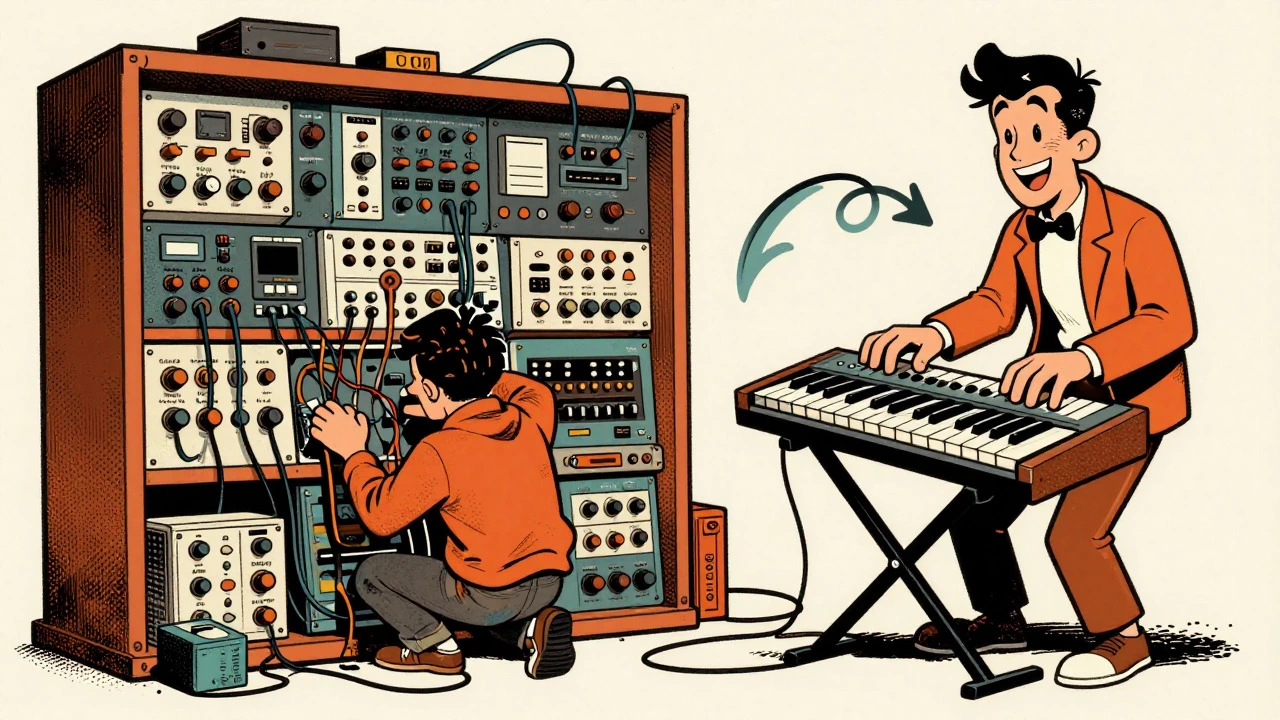

Grab a modern Minimoog reissue and look at the knobs. Now grab a 1970 original. The layout is nearly identical. This isn't an accident; it's a direct line of influence. The legacy of 1970s synth design didn't just create classic sounds-it established the physical and electrical blueprints that almost every modern analog gear manufacturer still follows today.
We often think of vintage synths as museum pieces or expensive collector items. But for engineers building new instruments in 2026, those 1970s machines are active reference manuals. They solved specific problems-how to make sound portable, how to let performers control tone in real-time, and how to keep complex circuits stable-that digital software still struggles to replicate perfectly. Understanding this history helps you see why your current favorite synth feels the way it does.
The Birth of the Standard Architecture
Before the 1970s, synthesizers were huge, modular racks that looked like server rooms. You needed patch cables to connect everything, and if one wire fell out, your sound died. That changed with the introduction of the Minimoog Model D by Moog Music in 1970. It was the first widely available self-contained synthesizer with a built-in keyboard. More importantly, it standardized the signal flow known as subtractive synthesis.
This architecture follows a strict path: Voltage-Controlled Oscillator (VCO) → Voltage-Controlled Filter (VCF) → Voltage-Controlled Amplifier (VCA). In the Minimoog, these components were pre-wired internally. This "normalized" routing meant players could get a full sound without touching a single cable. If you wanted to change the modulation source, you used switches instead of plugging in wires. This design choice made analog synthesis accessible to live performers who couldn't afford a roadie to manage a rack of modules. Today, when you buy a semi-modular synth from any major brand, you are using this exact logic: a default internal path that can be overridden via patch points.
Key Instruments That Defined the Era
The decade produced several landmark instruments, each solving a different problem and leaving a distinct mark on modern design. Here is how the big four shaped the industry:
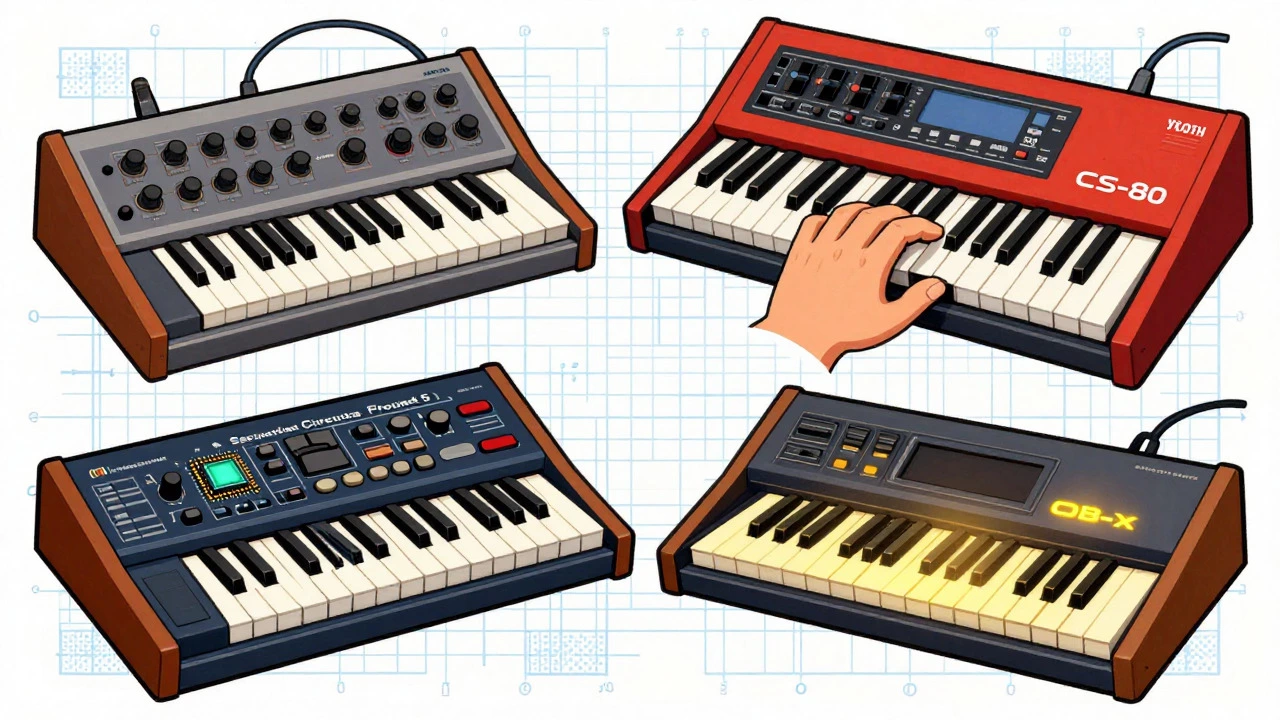
- ARP 2600 (1971): This instrument offered a semi-modular approach. It had a pre-patched internal flow but exposed front-panel jacks for experimentation. Its versatility made it a benchmark for educational and performance use. Modern reissues and emulations frequently cite its flexible routing as a key feature.
- Yamaha CS-80 (1977): Launched with two layers of 8-note polyphony, velocity sensitivity, and individual key pressure (polyphonic aftertouch). These features were unheard of at the time. High-end modern synths that offer MPE-like expressivity explicitly cite the CS-80 as their historical inspiration, even though they implement it with digital scanning rather than purely analog methods.
- Sequential Circuits Prophet-5 (1978): This was the breakthrough for workflow. While the sound generation remained analog, the Prophet-5 used a microprocessor to generate control voltages and, crucially, store patches. It was the first synth that could save an entire voice as a preset. This "analog brain, digital memory" hybrid model is the standard for most professional analog synths released in the last 40 years.
- Oberheim OB-X (1979): Known for its warm tones and robust polyphony, the OB-X exemplified late-70s design. It combined analog voices with digitally controlled parameters, proving that you could have the character of analog hardware with the convenience of digital stability.
| Instrument | Year | Polyphony | Key Innovation | Modern Legacy |
|---|---|---|---|---|
| Minimoog Model D | 1970 | Monophonic | Portable form factor, normalized wiring | Standard keyboard synth layout, VCO-VCF-VCA chain |
| ARP 2600 | 1971 | Semi-Modular | Front-panel patching with internal defaults | Semi-modular design philosophy in modern units |
| Yamaha CS-80 | 1977 | 8-voice (2 layers) | Polyphonic aftertouch, velocity sensitivity | Reference for high-end expressive controls |
| Prophet-5 | 1978 | 5-voice | Microprocessor patch memory | Analog sound with digital preset storage |
From Discrete Components to Integrated Circuits
It wasn't just about the signal path; it was also about the hardware itself. Early designs like Yamaha's GX-1 weighed approximately 300 kilograms because they used discrete components molded in thick epoxy harnesses for stability. These modules were heavy and difficult to transport. By the mid-1970s, manufacturers shifted to dedicated integrated circuits (ICs). Yamaha, for example, worked with Mitsubishi to develop IG-series ICs that replaced bulky discrete modules with compact chips. This shift allowed for lighter, more reliable instruments like the SY-1 and later the CS-80. Today, modern analog builders face the same trade-off: balancing serviceability and cost with stability. Some contemporary instruments explicitly recreate these 1970s component choices to achieve specific tonal qualities, while others use modern ICs for reliability. Both approaches are valid, but both trace back to the engineering decisions made in that decade.
Why We Still Chase the "Analog Sound"
You might wonder why we don't just use digital emulation. Digital models can be mathematically perfect, but they often lack the subtle imperfections that musicians love. 1970s analog synths suffered from tuning instability and oscillator drift. Instead of fixing these issues completely, modern designers often preserve them intentionally. Subtle drift in a VCO adds movement and life to a static note. The "warmth" associated with analog gear comes from the non-linear distortion of vacuum tubes and transistors in the filter and amplifier stages. When you hear a modern synth described as having a "classic ladder filter," it’s referring to the specific circuit topology pioneered by Moog in the 1970s. This filter shape creates a resonant peak that cuts through a mix differently than a linear-phase digital filter. That sonic signature is so embedded in genres like progressive rock, disco, and film scores that listeners expect it. Modern gear designers aren't just copying circuits; they are replicating a cultural expectation of what music should sound like.
Workflow and User Interface Evolution
The user interface of 1970s synths was designed for immediate tactile feedback. There were no menus. Every parameter had a physical knob or slider. This forced players to develop strong ears and manual dexterity. The absence of patch memory in early models meant musicians had to document settings physically or memorize them. When the Prophet-5 introduced presets in 1978, it changed the workflow forever. Players could now build libraries of stored sounds. However, the core parameters-oscillator waveforms, filter cutoff, resonance, and envelope times-remain organized in ways that would be immediately familiar to a 1970s user. Even in 2026, where we have touchscreens and deep menu systems, the most successful performance synths still prioritize a front panel with direct-access knobs. This is a direct homage to the usability standards set by the Minimoog and ARP 2600. The lesson from the 70s is clear: if you want to play live, you need instant access to the controls that shape your sound.
Frequently Asked Questions
What is the main difference between 1970s analog synths and modern analog synths?
The primary difference is stability and convenience. Modern analog synths use improved components and digital tuning assistance to deliver analog tone with greater pitch stability. They also include features like MIDI connectivity, USB interfaces, and extensive preset memory, which were absent or limited in 1970s models. However, the core audio signal path remains largely the same, preserving the characteristic analog timbre.
Why do modern synths still use the VCO-VCF-VCA architecture?
This architecture, standardized by the Minimoog in 1970, provides a logical and effective way to shape sound. It allows for intuitive control over pitch, timbre, and volume. Because this method became the industry standard, it created a shared mental model for musicians. Deviating from this structure requires significant education for users, so most manufacturers stick to the proven VCO-VCF-VCA chain to ensure familiarity and ease of use.
Is the Yamaha CS-80 still relevant to modern synth design?
Yes, primarily as a reference for expressive controls. The CS-80's implementation of polyphonic aftertouch and velocity sensitivity set a high bar for performer interaction. While modern synths often use digital scanning to achieve similar effects due to cost and complexity, the CS-80 remains the historical benchmark for high-end analog performance capabilities. Many premium modern instruments cite it as inspiration for their control surfaces and expressive features.
How did the Prophet-5 change synthesizer workflows?
The Prophet-5 introduced microprocessor-based patch memory, allowing users to save and recall complex sound configurations instantly. Before this, players had to manually re-dial every parameter for each piece or song. This innovation established the workflow pattern of preset libraries, which is now ubiquitous in both analog and digital synthesizers. It bridged the gap between the flexibility of analog sound and the convenience of digital storage.
Are modern analog synths just copies of 1970s models?
Not exactly. While many modern instruments emulate the circuitry and behavior of classic 1970s models, they also incorporate modern manufacturing efficiencies and digital conveniences. Some brands focus on faithful reissues, while others use 1970s architectures as a starting point for new innovations. The result is a blend of vintage aesthetics and modern functionality, creating instruments that belong to both eras in terms of design philosophy.