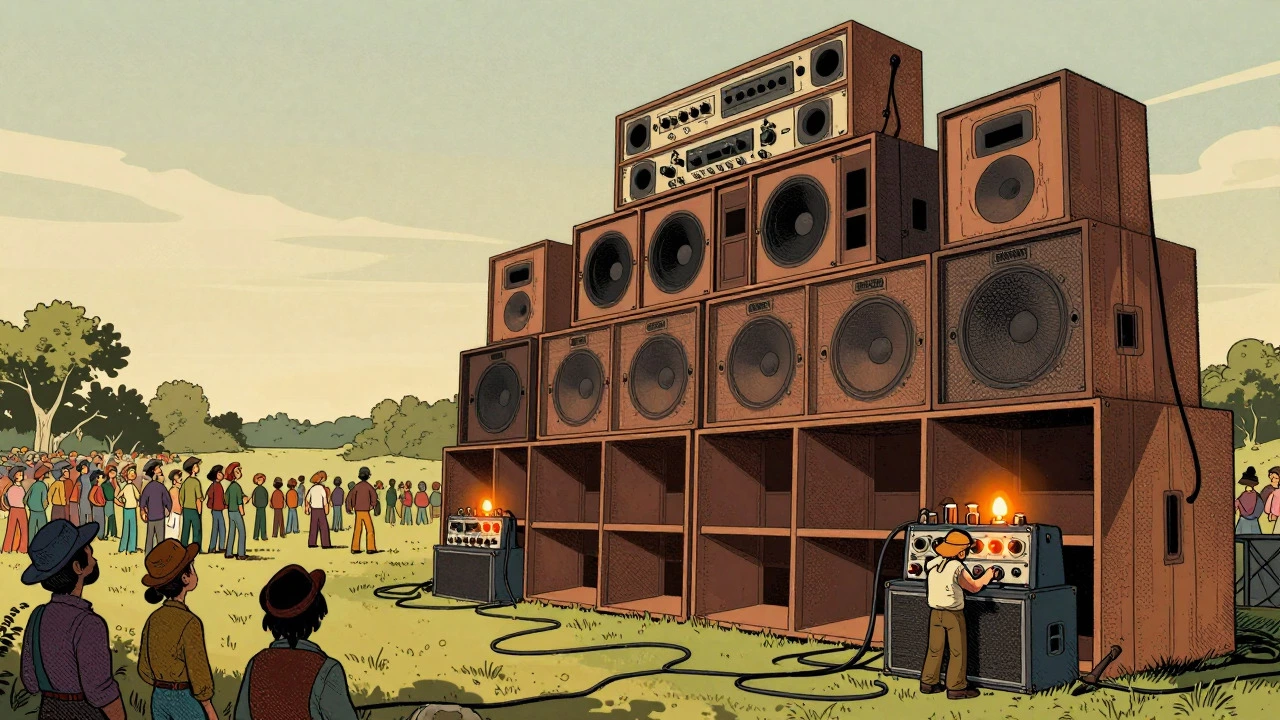

Imagine standing in the back row of a stadium in 1974. The band is playing, but you don't just hear a wall of noise; you can pick out the individual pluck of a bass string or the crisp snap of a snare drum. This wasn't magic-it was engineering. In the 1970s, sound system technology shifted from ad-hoc festival stacks to massive, calculated powerhouses that could fill venues with hundreds of thousands of people without turning into mud.
The jump from the roughly 10,000 watts used at Woodstock in 1969 to the nearly 30,000 watts of the Grateful Dead’s "Wall of Sound" in 1974 happened fast. It was driven by engineers who realized that raw volume didn't equal clarity. To achieve high power without distortion, they had to split the audio signal, build custom cabinets, and deploy armies of amplifiers. Here is how they pulled it off.
From Woodstock Baseline to Multi-Way Systems
The starting point for 1970s power was Bill Hanley’s system at Woodstock in August 1969. Hanley designed a rig using seventeen McIntosh MC3500 tube amplifiers and additional units to deliver about 10,000 watts RMS. He mounted these on 70-foot towers to cover a crowd that ended up being much larger than the planned 150,000 attendees. While impressive, this was still a relatively simple setup compared to what came next.
By 1970 and 1971, the industry moved toward multi-way systems. Instead of one big speaker handling all frequencies, engineers like John Meyer and Bob Cavin at McCune Sound Service created systems that split the signal into separate bands: bass, mid, high, and super-high. Each band got its own dedicated amplifier and speaker cabinet. This approach, pioneered by companies like Clair Brothers, allowed for significantly higher acoustic output with lower distortion. You weren't just pushing more air; you were managing specific frequency ranges with precision.
The Architecture of the Wall of Sound
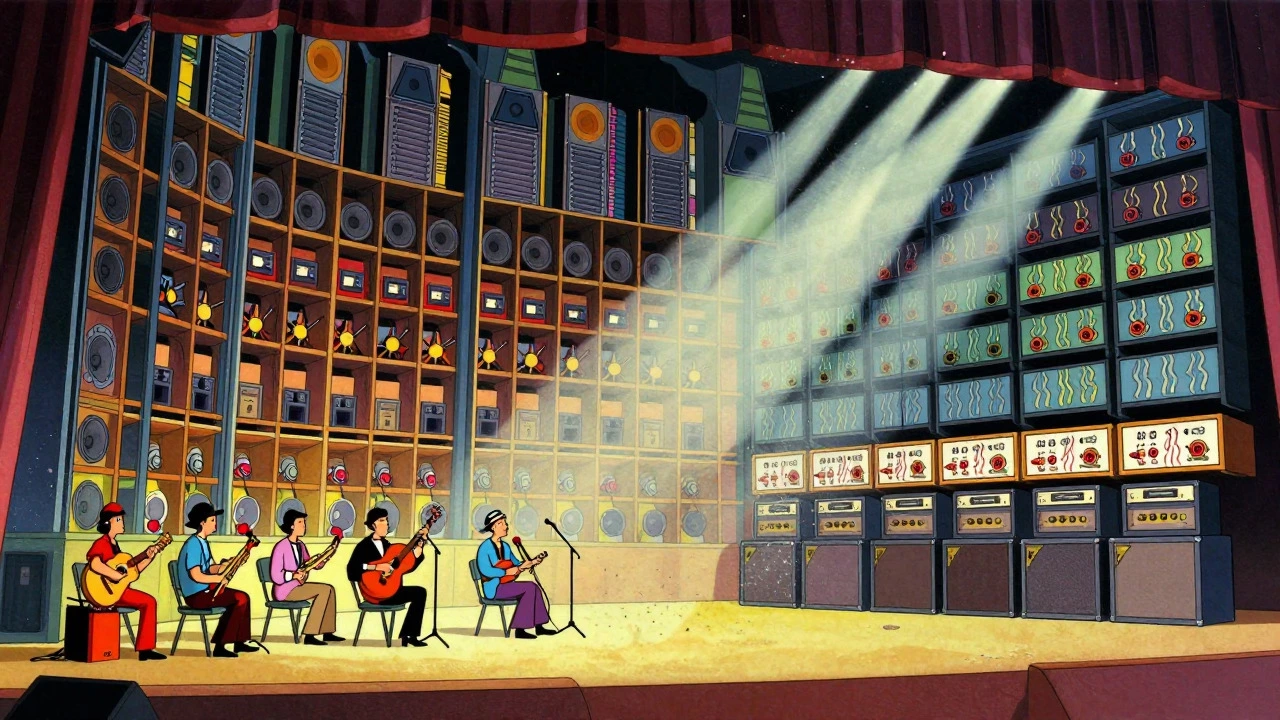
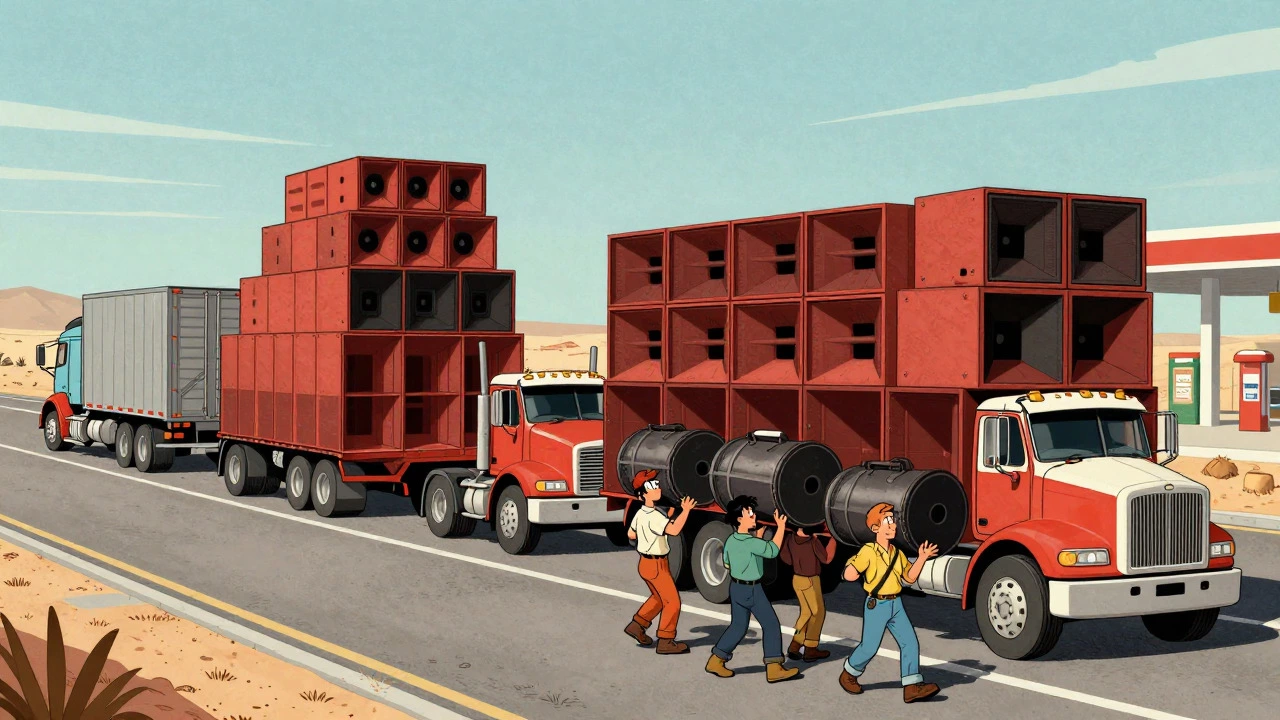
No example better illustrates the peak of 1970s power than the Grateful Dead’s Wall of Sound. Conceived by Owsley “Bear” Stanley and Dan Healy, this system debuted in March 1974. It wasn't just a loudspeaker stack; it was a physical structure spanning 98 feet across the stage and rising 36 feet high. Weighing approximately 75 tons, it traveled on four semi-trailers and required a crew of 21 people to load in each day.
The core innovation here was separation. The system divided the audio into six distinct subsystems handling vocals, piano, drums, lead guitar, rhythm guitar, and bass. There were even separate channels for each of Phil Lesh’s four bass strings. This meant that instead of mixing everything into a single stereo pair, each instrument had its own column of speakers and amplifiers. The result was an incredibly clear sound where instruments didn't bleed into one another, even at extreme volumes.
| System / Event | Year | Total Power (Watts) | Loudspeakers | Key Feature |
|---|---|---|---|---|
| Woodstock Festival | 1969 | ~10,000 | 16 Arrays | Tower-mounted coverage for 500k+ crowd |
| Pink Floyd Earls Court | 1973 | Undisclosed (High) | 4 Corner Stacks | Quadraphonic 360-degree immersion |
| Grateful Dead Wall of Sound | 1974 | 28,800 | ~600 Units | Per-instrument channel separation |
Amplification and Power Delivery Challenges
Generating that much power required serious hardware. The Wall of Sound used 48 McIntosh MC2300 solid-state amplifiers, each rated at 300 watts per channel. When fully driven, this delivered a continuous 28,800 watts. But running that many amps drew hundreds of amperes of current. Engineers faced constant battles with thermal issues, line-voltage fluctuations, and component failures.
Power distribution was a nightmare. At Woodstock, three dedicated transformers provided about 2,000 amperes of current behind the stage. For touring rigs, this meant heavy-gauge cabling and redundant amplifiers to ensure that if one unit died, the show wouldn't stop. Solid-state amplifiers like the MC2300 were crucial because they offered better reliability and heat management than the older tube amps, allowing engineers to pack more power into smaller racks.
Logistics: The Cost of Clarity
All that power came with a price tag in labor and logistics. Ground-stacked systems dominated the decade because flying line arrays hadn't been invented yet. Bass bins sat directly on the ground for coupling, with mid and high cabinets stacked on top, often reaching heights of 12 to 16 feet. This limited sightlines and made loading time-consuming.
The Wall of Sound is the perfect case study for why extreme power isn't always sustainable. Despite its sonic superiority, the system required four trucks and a full day to set up. Combined with the fuel crisis of the mid-1970s, the production costs became unsustainable. The band retired the Wall after only seven months of touring in 1974. Even mainstream providers like Showco, which handled tours for Led Zeppelin and James Taylor, had to balance power with practicality, often using fewer, more efficient cabinets rather than sheer tonnage.
Legacy of 1970s Engineering
The 1970s established the blueprint for modern concert sound. The shift from single-ended stacks to multi-way, electronically crossed-over systems is still standard today. Companies like Showco and Clair Brothers proved that live sound could be a specialized, repeatable service rather than a one-off experiment. The focus on low distortion and instrument separation paved the way for the digital consoles and flown line arrays that dominate the industry now. Without the brute-force experimentation of the '70s, we wouldn't have the clarity and coverage standards expected in stadiums today.
How did the Wall of Sound differ from regular PAs?
The Wall of Sound used six separate subsystems for different instruments, including individual channels for each bass string. This allowed for much clearer separation and less crosstalk compared to standard stereo mixes.
What amplifiers were commonly used in 1970s concerts?
McIntosh solid-state amplifiers, particularly the MC2300 and MC3500 models, were staples due to their reliability and power density. Crown amplifiers were also frequently used in earlier setups.
Why did the Grateful Dead retire the Wall of Sound?
The system weighed 75 tons and required four trucks and a large crew to operate. Rising fuel costs and logistical complexity made it economically unviable for long-term touring after 1974.
What was the first major step toward high-power concert sound?
Bill Hanley's design for Woodstock in 1969, which used tower-mounted arrays and multiple high-wattage amplifiers to cover a massive open-air audience, set the baseline for subsequent developments.
How did multi-way systems improve sound quality?
By splitting the audio signal into bass, mid, and high frequencies and driving each with dedicated amplifiers and speakers, multi-way systems reduced distortion and increased overall efficiency and headroom.


