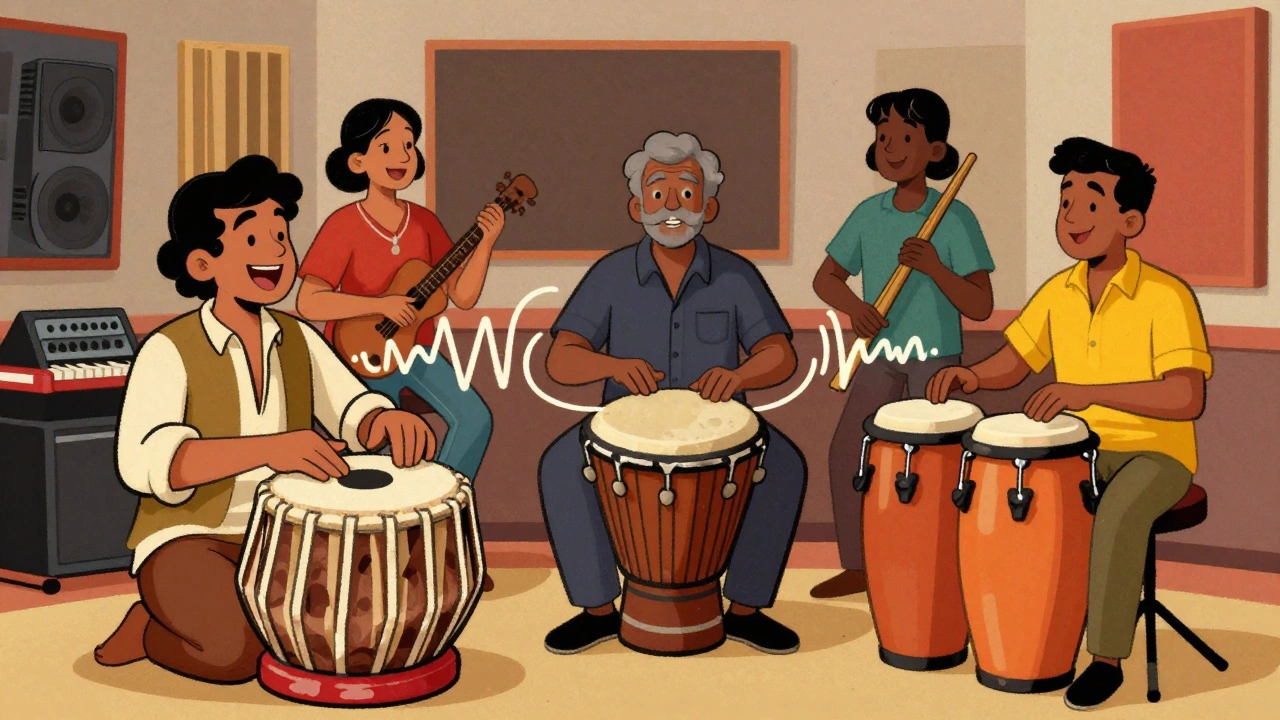

Imagine a song that starts with a tabla rhythm, then layers in West African drums, and suddenly shifts into a Latin salsa groove-all while the singer switches between Hindi, Spanish, and English. This isn't just a random experiment; it's the reality of world music fusion today. Musicians from India, Africa, and Latin America are creating music that crosses borders in ways that feel both fresh and deeply respectful. This isn't about mixing genres for novelty-it's a deliberate effort to honor cultural traditions while forging new artistic paths.
Artists Leading the Fusion Movement
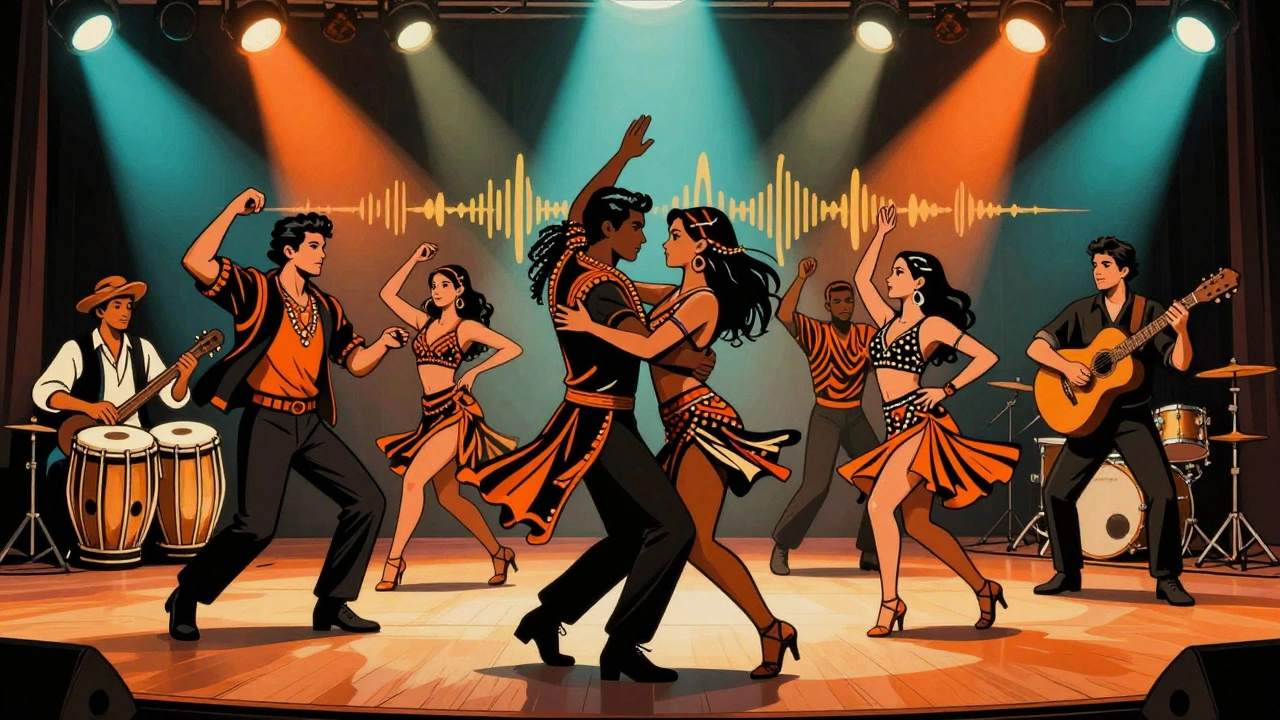
ShiShi is a New York-based Indian-American DJ and producer whose work blends Indian classical music with reggaeton and Latin rhythms. Known for his track 'Conmigo (Remix)' with SAMAA, ShiShi's mission is to bring together different cultures in fresh and unexpected ways. His music combines Hindi lyrics, Spanish vocals, and dancehall beats to create globally resonant tracks. The 2024 remix features dancers from Latin salsa, Bhangra, and hip-hop backgrounds, making the visual and musical elements equally diverse.
SAMAA is a vocal group known for their YouTube cappella videos. They collaborated with ShiShi on 'Conmigo (Remix)', singing in Hindi and Spanish while maintaining cultural authenticity. Their work shows how multilingual lyrics can flow naturally within a single song, avoiding forced integration.
Anuradha Pal is a tabla virtuoso who bridges Indian classical music with global traditions. Her Tabla Fusion projects pair Indian tabla with Flamenco guitar, African percussion, and Latin rhythms. In one performance, she paired tabla with Flamenco guitar, creating a rhythmic conversation that moved between Indian classical and Spanish flamenco. She also collaborated with African percussionists, layering the tama drum's deep tones with tabla's intricate patterns. This cross-cultural dialogue has earned her recognition worldwide, from jazz festivals to world music conferences.
Surabhi Ensemble brings together instruments from multiple cultures. Their lineup includes veena (Saraswathi Ranganathan), tabla (Dhananjay Kunte), West African tama drum (Massamba Diop), mridangam (Sai Raghavan), and classical flamenco guitar (Carlo Basile). Carlo explains they 'strive for the right balance' between traditions, noting that 'the balance comes from a lot of listening and adapting' rather than forced integration. Their international tours include performances in India during festive periods, where audiences experience the fusion firsthand.
Rudra, led by Bobby Rozario, combines South Indian Carnatic rhythms with jazz, funk, and Afro-Latin elements. The international collective of musicians from New York, Africa, and South India creates 'improvisational fireworks within jazz fusion music' while maintaining intense melodic lines. Their performances highlight how jazz fusion can serve as a bridge between Indian classical and global sounds, with each musician contributing expertise from their cultural background.
How the Music Comes Together
Creating world music fusion isn't as simple as throwing different instruments together. It requires technical precision. Take polyrhythms-layering distinct cultural rhythmic patterns. For example, an Indian tala (rhythmic cycle) might use a 7/8 beat, while reggaeton's dembow rhythm is in 4/4. When these sync up, the result is a groove that feels familiar yet surprising.
Multilingual lyrics are another key element. In ShiShi's 'Conmigo (Remix)', the song shifts between Hindi, Spanish, and English within verses. This isn't just for show-it's about making each language feel natural in the context. As ShiShi says, 'SAMAA did an amazing job of singing the Spanish and Hindi sections in a way that is true to those cultures.' This attention to detail prevents the fusion from feeling superficial.
Harmonic blending is also crucial. Different musical traditions use different scales and tuning systems. For instance, Carnatic music from India uses specific ragas, while Latin music often uses major and minor scales. Fusion artists like Carlo Basile of Surabhi Ensemble describe finding unexpected compatibilities: 'surf guitar techniques, specifically the style popularized by Dick Dale, with Arabic music traditions revealed unexpected rhythmic compatibilities during our fusion experiments.' This shows how deep listening leads to innovative combinations.
ShiShi's creative process starts with existing tracks. He received stems for SAMAA's original song and 'sped it up to a more club-ready tempo, and then infused some of [his] signature sounds' to create the Indo-Latin fusion. This approach ensures each culture's essence remains intact while creating something new.
Why Authenticity Matters
One common pitfall in cultural collaborations is appropriation-using elements without understanding or respect. Successful fusion projects avoid this by prioritizing authenticity. Anuradha Pal emphasizes that her work 'brings together dancers from a bunch of different cultures' to create multidimensional experiences that transcend musical boundaries alone. This means involving artists from each tradition in the creative process.
ShiShi notes the challenge: 'making sure that each culture and musical style is being represented in a high quality way and not being shortchanged for the sake of just adding as many cultures into the pot as possible.' This requires deep knowledge of each tradition. For example, when blending Indian classical music with jazz, Rudra's musicians spend time studying Carnatic rhythms to ensure they're interpreted correctly.
Cultural ambassadors like tabla virtuoso Zakir Hussain have been instrumental in facilitating cross-cultural understanding. As Apple Music notes, 'Hindustani and Carnatic music have infiltrated many genres, thanks largely to cultural ambassadors like tabla player Zakir Hussain and Bangladesh's Badal Roy.' These artists help bridge gaps between traditions, ensuring collaborations are respectful and authentic.
The Global Impact
Streaming platforms are recognizing this movement. Apple Music's 'Best of Indian Fusion' playlist and Spotify's 'WORLD MUSIC FUSION African Indian Euro Latin Celtic Asian Jazz' collection position these collaborations as 'high-energy, polyrhythmic, modern folk/afrobeat songs and instrumental fusion' that are 'experimental' and 'psychedelic' while maintaining 'ethnic roots with western influences.' This institutional support helps bring fusion music to wider audiences.
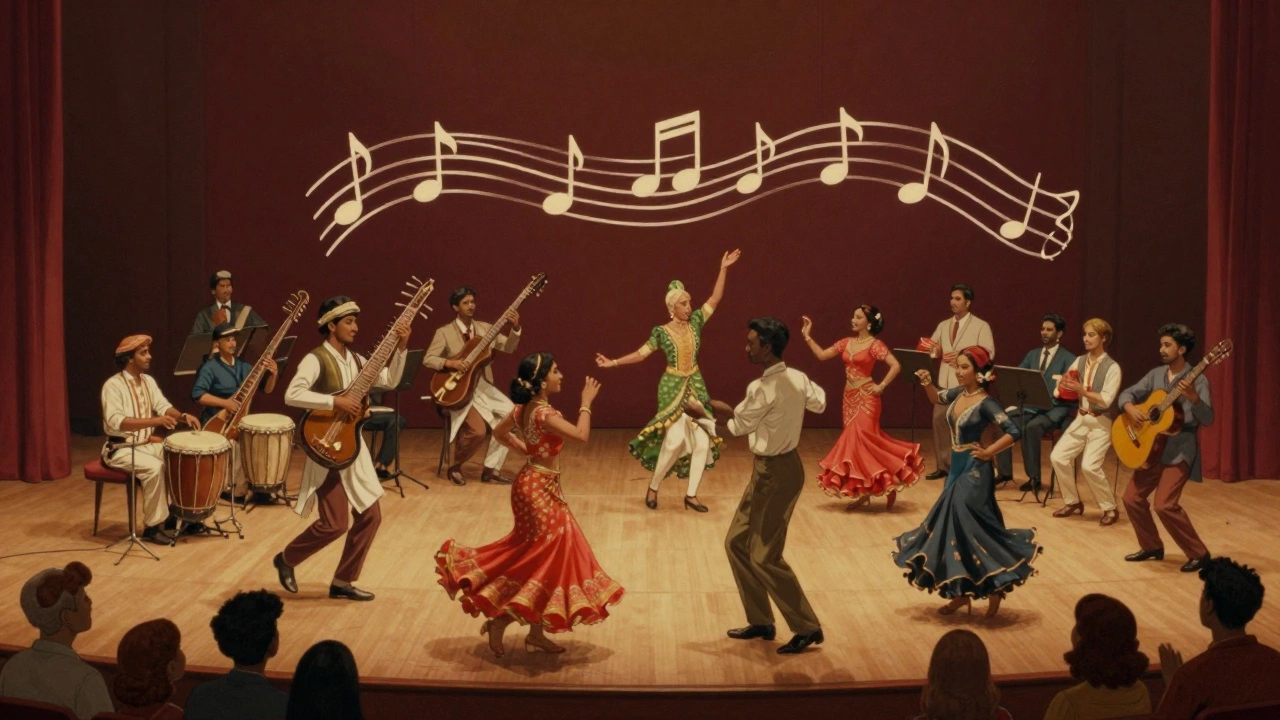
International touring is key to the genre's viability. Surabhi Ensemble regularly tours internationally, including performances in India during the festive period. These live shows allow audiences to experience the fusion firsthand, where the energy of the music connects across cultural lines.
Current developments show increasing sophistication. ShiShi is incorporating elements from recent travels to Brazil and Costa Rica alongside influences from France, Africa, and India to create 'music that [he's] never heard before.' This evolution points toward more nuanced integrations rather than superficial blending. As industry analysts observe, successful fusion projects increasingly emphasize 'improvisational fireworks within jazz fusion music' while maintaining 'intense and groovy melodic lines emphasizing virtuosity and energy.'
Frequently Asked Questions
What makes world music fusion different from traditional music?
World music fusion blends elements from multiple cultural traditions into a single composition, creating new sounds that honor each heritage while innovating. Unlike traditional music which stays within strict cultural forms, fusion projects like Anuradha Pal's Tabla Fusion layer Indian tabla rhythms with Flamenco guitar and African percussion, resulting in polyrhythmic structures that are both complex and danceable.
How do artists avoid cultural appropriation in fusion projects?
Artists avoid appropriation by involving musicians from each tradition in the creative process and deeply studying the source material. For example, SAMAA's Hindi and Spanish vocals in 'Conmigo (Remix)' were crafted with respect to cultural authenticity. ShiShi emphasizes 'making sure each culture is represented in high quality,' not just adding elements for novelty. Collaboration with cultural experts and performers ensures accuracy and respect.
Is jazz fusion part of world music fusion?
Yes, jazz fusion is a key component. Projects like Rudra combine South Indian Carnatic rhythms with jazz, funk, and Afro-Latin elements. This creates a bridge between Indian classical music and Western jazz traditions. Jazz fusion's improvisational nature allows for spontaneous blending, making it a natural fit for cross-cultural collaboration. As Bobby Rozario explains, their work features 'improvisational fireworks within jazz fusion music' while maintaining melodic intensity.
What instruments are commonly used in world music fusion?
Fusion projects often blend instruments from each tradition. For example, Surabhi Ensemble uses veena (Indian classical), tama drum (West African), mridangam (South Indian), Flamenco guitar (Spanish), and tabla. ShiShi's work combines electronic beats with bansuri flute and Latin percussion. These instruments create a rich tapestry where each sound retains its cultural identity while contributing to a new whole.
How can I explore world music fusion?
Start with curated playlists like Apple Music's 'Best of Indian Fusion' or Spotify's 'WORLD MUSIC FUSION' collection. Artists like Anuradha Pal and Rudra have live performances available online. Attend world music festivals where fusion acts perform, or follow artists on social media for updates on collaborations. Many projects, like ShiShi's 'Conmigo (Remix)', are easily accessible on YouTube and streaming platforms.


