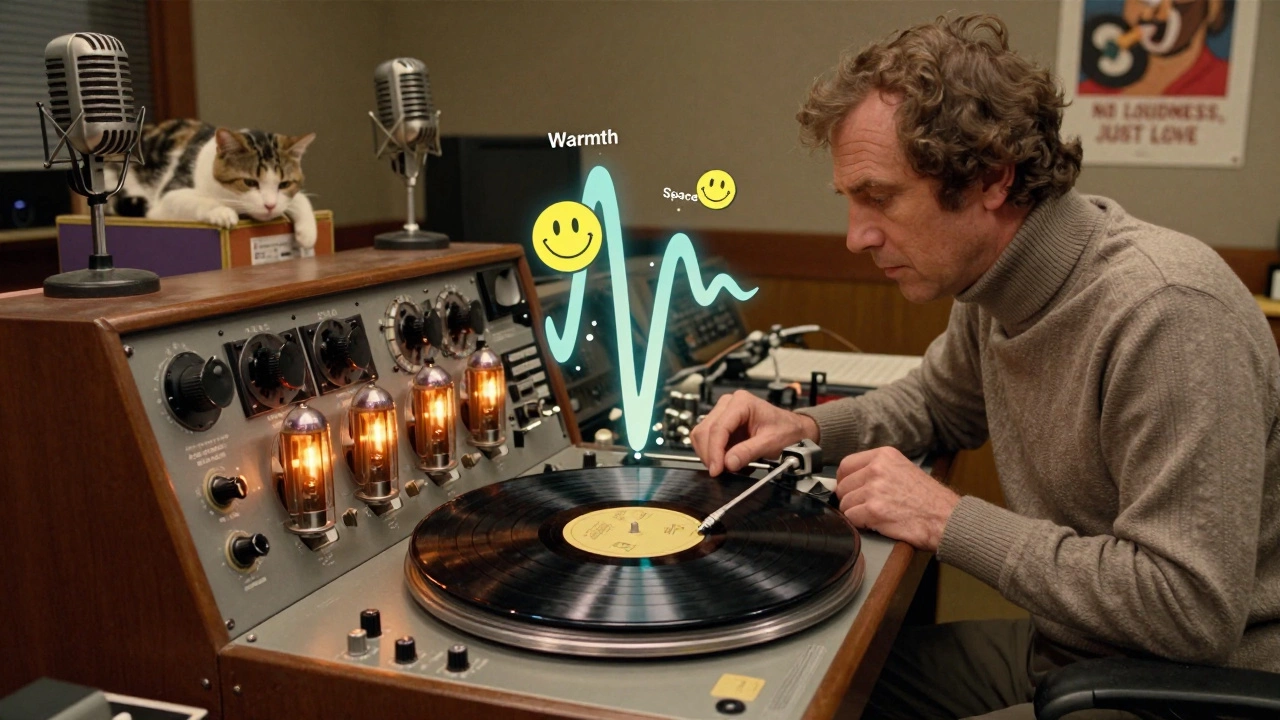

Back in the 1970s, vinyl records weren’t just music-they were an experience. The crackle before the first note, the warm hum of a tube amp, the way Stevie Nicks’ voice floated just above the groove. That sound didn’t come from magic. It came from limits. Engineers worked within the physical boundaries of a spinning disc: the needle could only track so much energy, the groove could only hold so much bass, and if you pushed too hard, the record would skip. Today, we have tools that can fix almost anything. But do they make better records? Or just more consistent ones?
What Made 1970s Vinyl Sound So Warm
The magic of 1970s vinyl mastering wasn’t about being perfect. It was about being human. Engineers like Doug Sax and Bob Ludwig didn’t have spectrum analyzers or digital undo buttons. They used tube compressors, analog tape machines, and custom consoles that added subtle harmonic distortion-around 0.5% to 1.5% THD-something modern plugins try to mimic but rarely capture fully. That warmth wasn’t intentional. It was unavoidable. The gear just didn’t sound clean. And that’s why so many collectors still swear by original pressings.
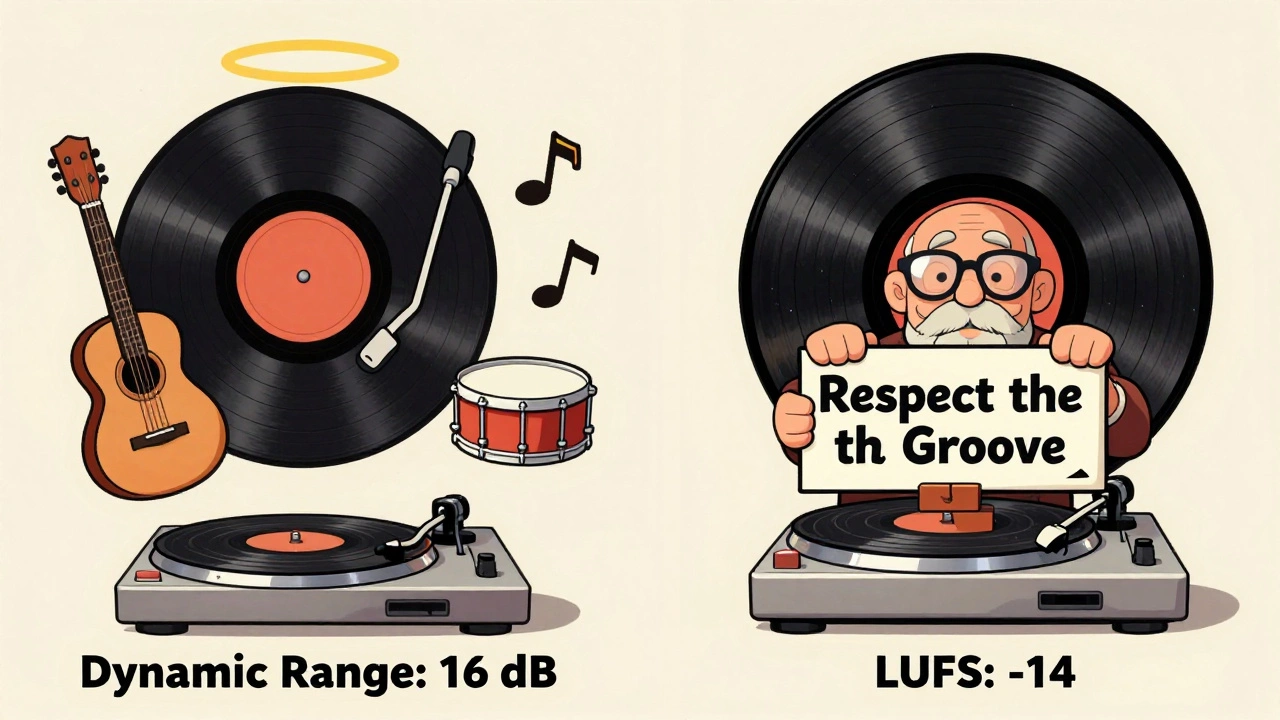
Dynamic range was king. Most albums from that era had between 14 and 18 dB of dynamic range. Compare that to today’s average of 6 to 8 dB on vinyl, and you start to see why older records feel more alive. Loudness wasn’t the goal. Space was. A snare drum had room to breathe. Bass didn’t fight the vocals. The music had breathing room. That’s why Fleetwood Mac’s Rumours still sounds like a live performance, even after 50 years.
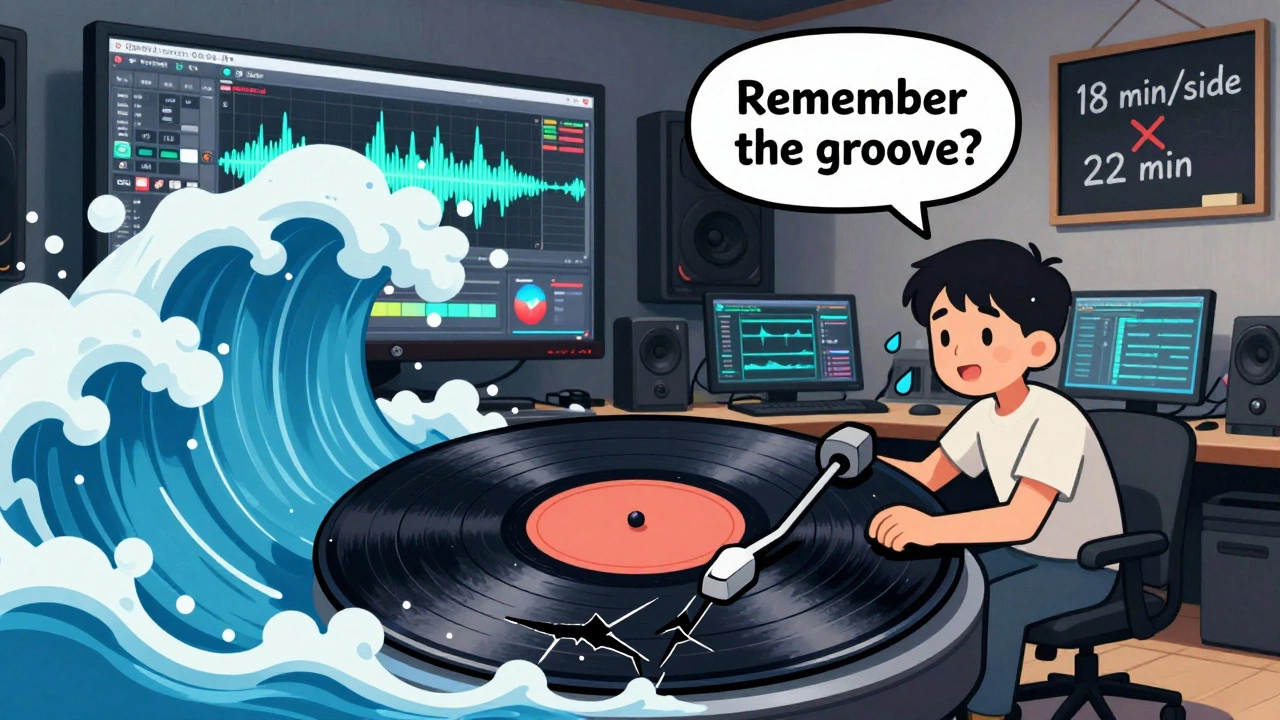
There was also no digital correction. If a track had phase issues or too much low-end energy, the engineer had to guess. They’d cut a test pressing, play it back, and adjust by ear. One wrong move meant starting over. That’s why most 1970s albums stayed under 18 minutes per side. Long sides meant quieter, thinner sound. Engineers knew the rules. They respected them.
How Vinyl Mastering Changed After 2000
Fast forward to today, and the process is almost unrecognizable. Modern mastering engineers use digital tools like iZotope Ozone 12 and Waves Kramer Master Tape to fine-tune every frequency, remove clicks, and fix phase problems that would’ve caused a 1970s pressing to skip. They can test 10 different versions before cutting the final lacquer. That’s a huge advantage.
But here’s the twist: we’re not just using digital tools-we’re using them to chase a sound that’s physically impossible on vinyl. The loudness war didn’t die with CDs. It just got smarter. Today’s vinyl masters average -14 LUFS, up from -18 LUFS in the 1970s. That’s not because listeners demand louder music. It’s because streaming algorithms reward loudness, and labels want their records to sound “competitive” on Spotify. So engineers compress and limit-but they can’t go too far. Vinyl has hard limits.
Too much bass? The needle jumps. Too much high-end? The groove loses definition. That’s why modern engineers use 150Hz mono summing to stabilize low frequencies and apply 0.5dB of pre-emphasis above 10kHz to compensate for playback loss. These techniques didn’t exist in the 1970s. We know more now. But knowing more doesn’t always mean better.
The Loudness Myth on Vinyl
A lot of people think vinyl escaped the loudness war. It didn’t. It just couldn’t keep up. CDs hit -6 LUFS by 2000. Vinyl? It maxed out around -12 LUFS before the needle started skipping. That’s why you rarely see a modern pop album mastered for vinyl that’s as loud as its CD version. The format forced restraint.
But here’s the irony: engineers today often push vinyl masters closer to CD loudness levels anyway. They think they can hide the damage. They can’t. Billie Eilish’s Happier Than Ever had a 19% return rate because side B’s inner grooves distorted. Why? The mastering was too loud. Too much bass. Too much compression. The record was physically overloaded. In the 1970s, that would’ve been caught before pressing. Today, it’s a post-production failure.
The truth? Vinyl’s physical constraints are still its greatest teacher. You can’t make a 20-minute side with pounding 808s and expect it to play clean. The 1970s didn’t have the tools to fix that. But they didn’t try. They adapted. They sequenced songs so the most complex tracks were on Side A. They kept bass under control. They left space. That discipline is disappearing.
What Listeners Actually Prefer
Ask a vinyl collector, and they’ll tell you: originals sound better. Reddit’s r/vinyl community had a 2024 poll: 57% preferred 1970s pressings for their “air” and “depth.” But ask a casual buyer who just got their first turntable, and they’ll say: “My new pressing sounds cleaner.”
Here’s why both are right. Double-blind tests by Dr. Sean Olive at Harman International showed listeners preferred 1970s pressings 58% of the time for acoustic music-jazz, folk, classic rock. But for electronic, hip-hop, and modern pop? They preferred modern pressings 63% of the time. Why? Because today’s engineers handle high frequencies better. They preserve detail above 12kHz. They reduce surface noise. They fix phase issues that made old records skip.
Modern pressings have a 1.8% defect rate. Vintage pressings? 12.7%. That’s not a small gap. It’s life-changing for someone who just spent $40 on a record. No clicks. No pops. No skipping. That’s a win.
But there’s a cost. A 2024 analysis of 200 modern reissues found 43% suffered from “excessive digital limiting.” The transients were crushed. The punch was gone. The music felt flat. That’s not warmth. That’s fatigue.
The Best of Both Worlds
The standout examples today aren’t the ones that copy the past or the ones that push the limits. They’re the ones that learn from both.
Mobile Fidelity’s 2023 half-speed mastering of Dark Side of the Moon sold 85,000 copies because it cut the lacquer at 16.7 RPM-slower than normal-giving the cutting stylus more time to carve precise grooves. They used modern lathes, but they kept the 1970s approach: minimal compression, no limiting, wide dynamic range. The result? A record that sounds like the original, but plays cleaner.
Engineers like Emily Lazar and Kevin Gray are doing the same. They use analog gear for saturation, then fix phase issues with digital tools. They know the RIAA curve is now applied with ±0.2dB precision instead of ±1.5dB. That means the treble is accurate. The bass stays controlled. The music doesn’t fight the medium.
And that’s the real evolution: we’re not going back. We’re going forward-with respect.
What You Should Look For Today
If you’re buying vinyl today, here’s what to check:
- Side length: 18 minutes or less per side? Good sign. Over 20? Watch out for inner-groove distortion.
- Mastering credit: Look for names like Kevin Gray, Bernie Grundman, or Emily Lazar. These engineers know the limits.
- Label: Mobile Fidelity, Analogue Productions, and pristine reissues from original tapes usually get it right.
- Listen before you buy: YouTube has test tracks. Compare the new pressing to the original. Does it have body? Or just volume?
Don’t assume older is better. Don’t assume newer is better. The best vinyls today aren’t the ones that sound like the 1970s. They’re the ones that understand the 1970s-and use today’s tools to honor that.
The Future of Vinyl Mastering
Vinyl sales hit $1.2 billion in 2023. That’s more than half of all physical music revenue. Demand is growing. But here’s the problem: we’re running out of people who know how to do it right.
Only 32% of mastering engineers today have hands-on experience with 1970s analog gear. The rest learned on computers. That’s fine-until someone tries to master a 22-minute side of heavy bass with no reference. The tools are better. The knowledge isn’t always.
New tech is helping. AI algorithms now predict groove behavior before cutting. Eco-friendly lacquers are being tested. Even Dolby Atmos vinyl prototypes are being shown at CES. But none of that matters if the engineer doesn’t know when to say no.
Vinyl mastering today isn’t about being louder. It’s not about being cleaner. It’s about being thoughtful. The 1970s taught us that music has limits. Today’s engineers are learning that the best way to honor those limits is to understand them.