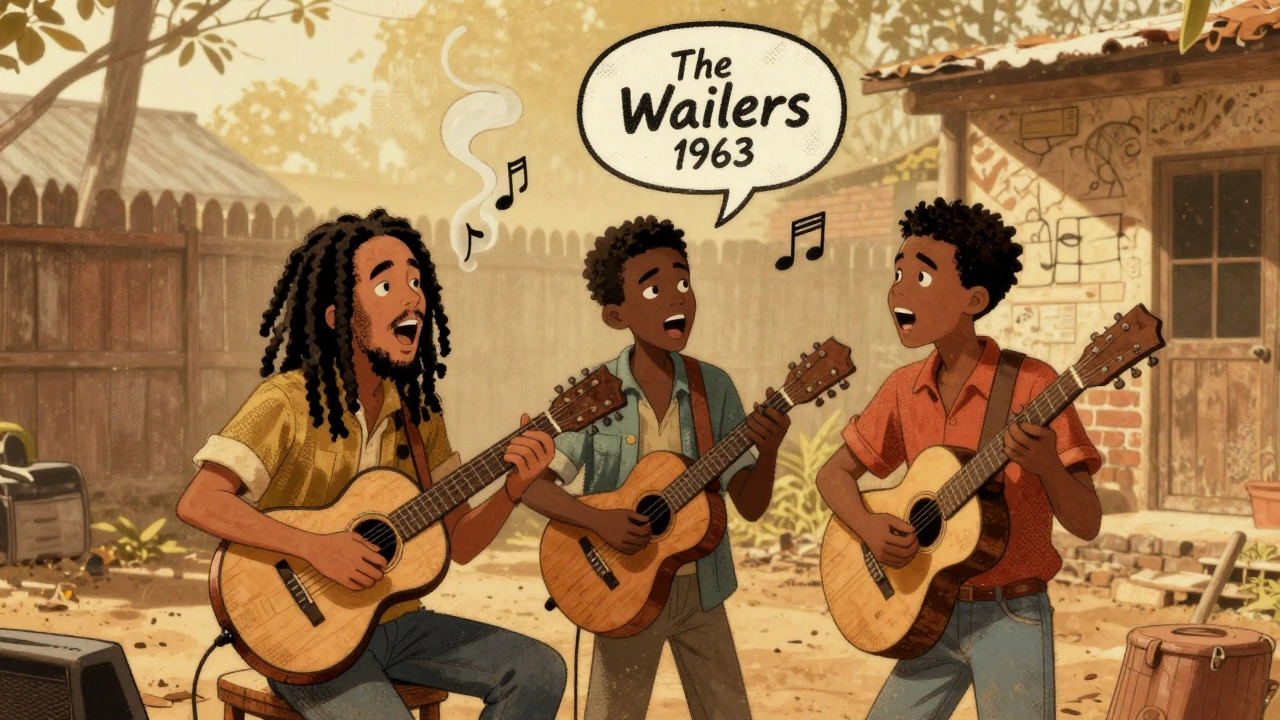

The Wailers didn’t start as a global phenomenon. They began in a small Kingston neighborhood called Trench Pen, where three teenagers-Bob Marley, Peter Tosh, and Bunny Wailer-shared a dream: to make music that spoke truth. Their early sound wasn’t polished. It wasn’t even fully formed. But it was raw, real, and rooted in the streets of Jamaica. What followed was a musical journey shaped by loss, change, and reinvention. The Wailers’ evolution isn’t just about who played what instrument. It’s about how the people behind the music changed the sound of a generation.
The Birth of a Sound: Studio One and the First Hits
In 1963, The Wailers weren’t a trio yet. They were a six-member group: Bob Marley on guitar, Peter Tosh on keyboard, Bunny Wailer on percussion, and backing vocalists Junior Braithwaite, Beverley Kelso, and Cherry Smith. Their breakthrough came not from a fancy studio, but from Clement "Coxsone" Dodd’s Studio One. With the legendary Skatalites band backing them, they recorded "Simmer Down." The song exploded in Jamaica. It wasn’t just a hit-it was a statement. For the first time, Jamaican youth heard their own language, their own rhythm, and their own struggles reflected in music. No more copying American R&B. This was reggae in its earliest form: rhythmic, rebellious, and unmistakably Jamaican.By 1966, the original lineup had fractured. Junior Braithwaite and Beverley Kelso left. The Wailers became a trio again. And that’s when the real transformation began. Bob Marley spent months in Delaware, USA, during this time. In his absence, Constantine "Dream" Walker stepped in. Rita Anderson, who would later become Rita Marley, started singing with them. These weren’t just lineup changes-they were signs of something deeper. The group was learning to adapt. They were becoming more than just singers. They were becoming a movement.
The Perry Years: Finding the Rhythm
After leaving Studio One, The Wailers connected with Lee "Scratch" Perry. Perry was wild, unpredictable, and brilliant. He didn’t just produce music-he shaped it. It was during this period that The Wailers met the Barrett brothers: Aston "Family Man" on bass and Carlton "Carly" on drums. These two weren’t just session players. They became the heartbeat of The Wailers. Their groove was tight, deep, and hypnotic. It turned reggae from a danceable beat into a living, breathing force.The albums "Soul Rebels" (1970) and "Soul Revolution Part 2" (1971) were the proof. The music was darker, more spiritual, more political. Tosh’s lyrics challenged authority. Bunny’s harmonies carried the weight of ancestral memory. Marley’s voice rose above it all-calm, urgent, and full of conviction. The Barrett brothers didn’t just play along. They locked in with the vocals, creating a sound that felt like a single organism. This was the foundation for what was to come.
The Classic Lineup: Catch a Fire and Burnin’
By 1972, The Wailers had a new sound-and a new name. Bob Marley & The Wailers. The lineup was now five core musicians: Bob Marley (vocals, rhythm guitar), Peter Tosh (vocals, guitar), Bunny Wailer (vocals, percussion), Aston Barrett (bass), and Carlton Barrett (drums). They added Earl "Wire" Lindo on keyboards and Al Anderson on lead guitar. This was the golden lineup. It wasn’t just about talent. It was chemistry. Every member had a role, and none of them overshadowed the others."Catch a Fire" (1973) and "Burnin’" (1973) changed everything. "I Shot the Sheriff" became a global smash. "One Love" turned into an anthem. "Redemption Song"? A quiet revolution. The music wasn’t just heard-it was felt. The Barrett brothers created a groove so deep it anchored every song. Lindo’s keyboards added color. Anderson’s guitar licks sliced through the mix. Tosh and Bunny didn’t just harmonize-they challenged Marley. Their voices pushed him to go further. This was reggae at its most powerful: political, spiritual, and undeniably human.
The Fracture: Tosh and Bunny Leave
In 1974, everything changed. Peter Tosh and Bunny Wailer walked away. Tosh wanted to speak his own truth. Bunny wanted to return to his roots, to Rastafarian spirituality away from the spotlight. Their departures weren’t just personal-they were seismic. The Wailers lost two of its three vocal pillars. Critics wondered if the band could survive. But Bob Marley didn’t break. He rebuilt.He brought in Tyrone Downie on keyboards. Al Anderson stayed. The band became more of a backing unit for Marley’s voice. The music shifted. It was still reggae, but less collective, more focused. Albums like "Exodus" (1977) and "Uprising" (1980) were global hits. But they weren’t The Wailers anymore-they were Bob Marley with a band. The spirit remained, but the soul had changed. The music still moved millions. But it wasn’t the same.
After Marley: Keeping the Flame Alive
Bob Marley died on May 11, 1981. The world mourned. But The Wailers didn’t disappear. Aston Barrett kept the band going. Junior Marvin took over lead guitar. They toured. They recorded. They became a living tribute. In 1989, they released "I.D.", their first album without Marley. It wasn’t about replacing him. It was about honoring him.Then came more losses. Carlton Barrett was murdered in 1987. Tyrone Downie passed in 2021. Earl Lindo in 2017. Seeco Patterson in 2021. Donald Kinsey in 2024. Each death carved another piece out of the band’s history. But they kept playing. In 1998, Gary Pine became lead vocalist. In 2003, they released a live DVD. In 2008, they appeared on Kenny Chesney’s country hit. They didn’t chase trends. They stayed true to the rhythm.
The Legacy Lives On
In 2015, Aston "Family Man" Barrett began reuniting former members. Junior Marvin, Al Anderson, Tyrone Downie-they came back for shows. It wasn’t nostalgia. It was a homecoming. The music still had power. The rhythm still had truth.Today, The Wailers Band is led by Aston Barrett Jr., son of the legendary bassist. Mitchell Brunings sings lead. Wendell "Junior Jazz" Ferraro plays guitar. Owen "Dreadie" Reid holds down the bass. The lineup is new, but the heartbeat is the same. The Barrett family’s legacy lives in every drum hit, every bass line, every harmony.
The Wailers’ evolution shows something deeper than music. It shows how art survives loss. How rhythm outlasts individuals. How a group of teenagers from Kingston built something that still moves the world. They didn’t just change lineups. They changed the course of music. And they’re still playing.
Who were the original members of The Wailers?
The original members of The Wailers were Bob Marley, Peter Tosh, and Bunny Wailer. They formed in 1963 in Kingston, Jamaica. Early on, the group expanded to include Junior Braithwaite, Beverley Kelso, and Cherry Smith as backing vocalists. By 1966, only Marley, Tosh, and Bunny remained as the core trio.
Why did Peter Tosh and Bunny Wailer leave The Wailers?
Peter Tosh and Bunny Wailer left The Wailers in 1974 to pursue solo careers. Tosh wanted greater creative control over his lyrics and message, while Bunny sought a deeper connection to Rastafarian spirituality away from the pressures of international fame. Their departures marked a major shift in the band’s sound and dynamic.
Who were the Barrett brothers, and why were they important?
Aston "Family Man" Barrett (bass) and Carlton "Carly" Barrett (drums) were the rhythmic backbone of The Wailers from 1972 onward. Their tight, innovative grooves defined the classic reggae sound heard on albums like "Catch a Fire" and "Exodus." They didn’t just play instruments-they created the pulse that made The Wailers’ music feel alive.
Did The Wailers continue after Bob Marley’s death?
Yes. Led by bassist Aston Barrett, The Wailers continued touring and recording after Bob Marley’s death in 1981. They released albums like "I.D." (1989) and maintained a global presence for decades. The band became a living tribute to Marley’s legacy, performing his music with the same intensity and reverence.
Who leads The Wailers today?
As of 2026, Aston Barrett Jr., son of Aston "Family Man" Barrett, leads The Wailers Band. He handles drums and vocals. The current lineup includes Mitchell Brunings on lead vocals, Wendell "Junior Jazz" Ferraro on guitar, Owen "Dreadie" Reid on bass, Andres "Ipez" Lopez on keys, and backing vocalists Teena "Tamara" Barnes and Leonard "Lennie" Chen.
What started as three boys singing in a Kingston yard became one of the most influential bands in history. The Wailers didn’t just play music. They carried a message-and they passed it on. Not through one person, but through generations. That’s the real evolution.


