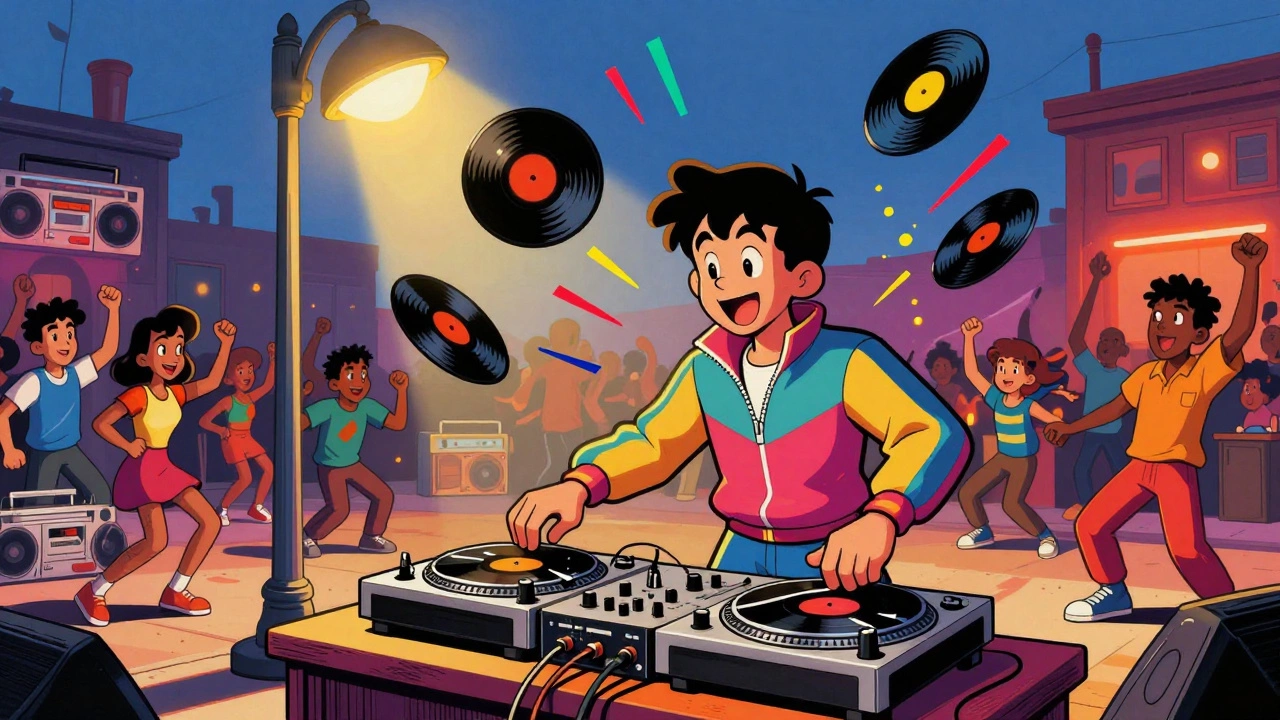

Before rap lyrics ruled the charts, before boomboxes blasted on street corners, and before hip-hop hit the mainstream, it was the turntables that made the music move. In the 1980s, DJs didn’t just play records-they rebuilt them. They turned vinyl into raw material, slicing beats, scratching rhythms, and stitching together grooves that had never existed before. This wasn’t background noise. This was the heartbeat of a new culture, and the turntable? It became the most important instrument in hip-hop.
From Party Speakers to Musical Tools
In the early 1970s, Clive ‘Kool Herc’ Campbell started throwing parties in the Bronx. He noticed that people went wild during the short, punchy drum breaks in funk and soul records-like James Brown’s ‘Funky Drummer’ or The Incredible Bongo Band’s ‘Apache.’ So he got two copies of the same record, played one, then switched to the other at the exact moment the break started. That’s how the breakbeat was born. No MCs yet. No synthesizers. Just two turntables, a cheap mixer, and a crowd that wouldn’t stop dancing.
By the 1980s, that simple trick exploded into something far more complex. DJs weren’t just extending breaks anymore. They were creating new songs out of old ones. Grandmaster Flash didn’t just mix tracks-he made them talk. His 1981 track ‘The Adventures of Grandmaster Flash on the Wheels of Steel’ was the first time a recording featured nothing but turntable manipulation. No vocals. No live instruments. Just scratches, beats, and transitions, all built from vinyl. People thought it was magic. It wasn’t. It was technique.
The Gear That Changed Music
DJs in the 1980s didn’t have laptops or digital software. Their tools were heavy, expensive, and built to last. The Technics SL-1200 turntable was the gold standard. It cost nearly $500 in 1980-over $1,700 today-but it was the only one that could handle the abuse. DJs spun records backward, dropped needles mid-beat, and scraped the stylus across the groove. The SL-1200’s direct-drive motor didn’t stall. It held steady, even under extreme manipulation.
Paired with the Shure M44-7 cartridge and a basic two-channel mixer, a DJ’s setup could cost over $1,100 ($3,780 today). That’s a lot of money for a teenager in the Bronx. But they found ways. Some worked extra shifts. Others traded records for equipment. A few even stole gear. The stakes were high because if your turntable broke, your whole performance died.
Scratching, Juggling, and the Birth of Turntablism
GrandWizzard Theodore accidentally invented scratching in 1975 when he was trying to stop a record from playing. He moved the vinyl back and forth under the needle-and heard something new. A rhythmic squeal. A percussive sound. By the 1980s, DJs turned that accident into an art form. They called it scratching. But it wasn’t just one technique. There was the ‘crab scratch,’ the ‘transformer scratch,’ the ‘flare scratch.’ Each one required different finger movements, timing, and pressure.
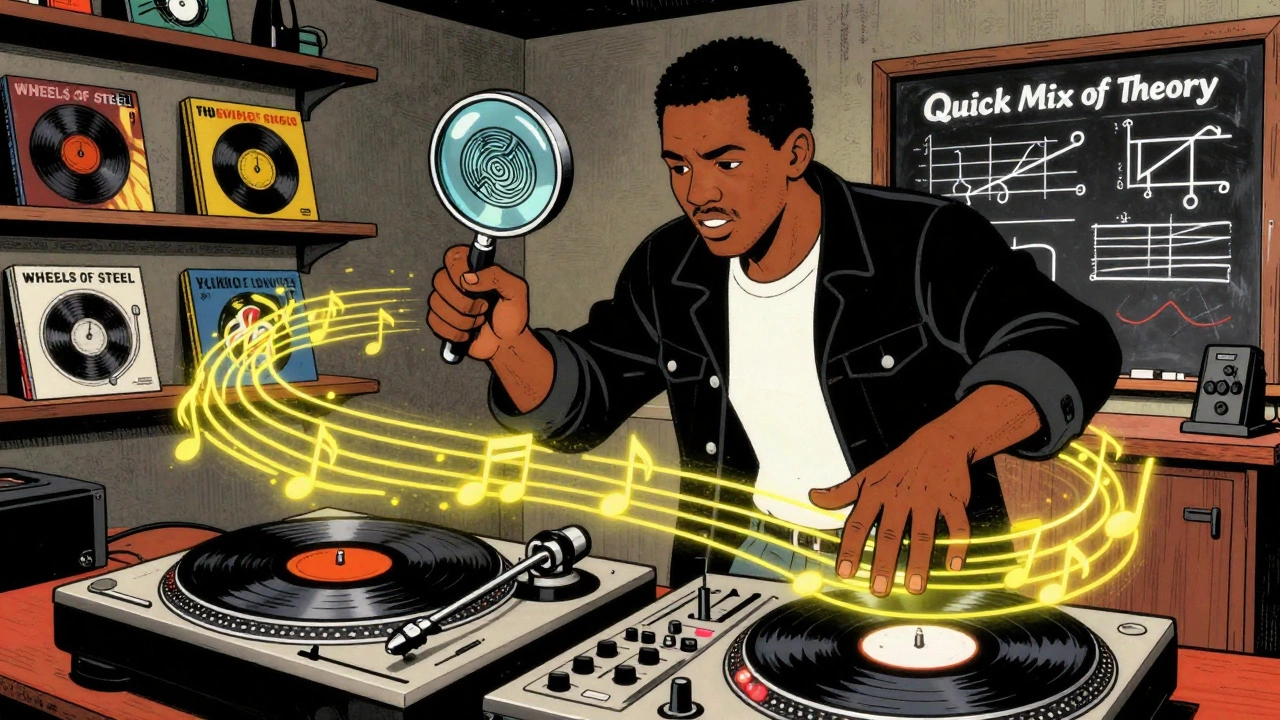
Then came beat juggling. Grandmaster Flash developed his ‘Quick Mix Theory’-a method of dropping beats in and out of two identical records to create new rhythms. Imagine playing the same drum loop twice, but shifting one slightly forward. Now you’ve got a stutter, a syncopation, a groove you never heard before. He taught this in his 1985 video ‘Master of Records,’ which became the bible for aspiring DJs.
These weren’t party tricks. They were compositions. A skilled DJ could build a full song using only two turntables and a mixer. No studio. No producer. Just raw creativity.
Regional Styles, Different Sounds
Not all DJs sounded the same. New York DJs like Grandmaster Flash and DJ Jazzy Jeff focused on smooth, musical scratches. Their style was clean, precise, almost like a melody. But in Philadelphia, DJ Cheese won the 1986 New Music Seminar DJ Battle with something wilder-fast, aggressive, almost chaotic scratching. It was raw. It was loud. It was different.
On the West Coast, DJs like Egyptian Lover mixed turntables with Roland TR-808 drum machines. The result? Electro-hop. A robotic, synth-heavy sound that made tracks like ‘Egypt, Egypt’ feel like they were coming from the future. Miami DJs leaned into deep bass. LA DJs added reverb. Each city had its own flavor, and each DJ shaped it.
The Hidden Architects of Hip-Hop
When Run-DMC dropped ‘Rock Box’ in 1984, the guitar riff and hard-hitting beat made headlines. But who made that sound? Jam Master Jay. He didn’t just cue the track. He cut the beat, timed the drop, and locked the rhythm so the MC could spit with perfect flow. He was the invisible architect. Yet, on album credits, he was listed as ‘DJ’-not producer, not composer, not arranger.
That was the norm. Of the 1980s hip-hop tracks studied by Dr. Joseph Schloss, 85% relied on DJ techniques as the core of their sound. But only 15% gave the DJ proper credit. Most were just named in small print. No royalties. No recognition. Just the music.
Even Grandmaster Flash, who changed music forever, didn’t get producer credit on his own tracks. He was paid to perform, not to create. And yet, without his turntable work, ‘The Message’ and ‘White Lines’ wouldn’t have had their iconic grooves.
Training Like an Athlete
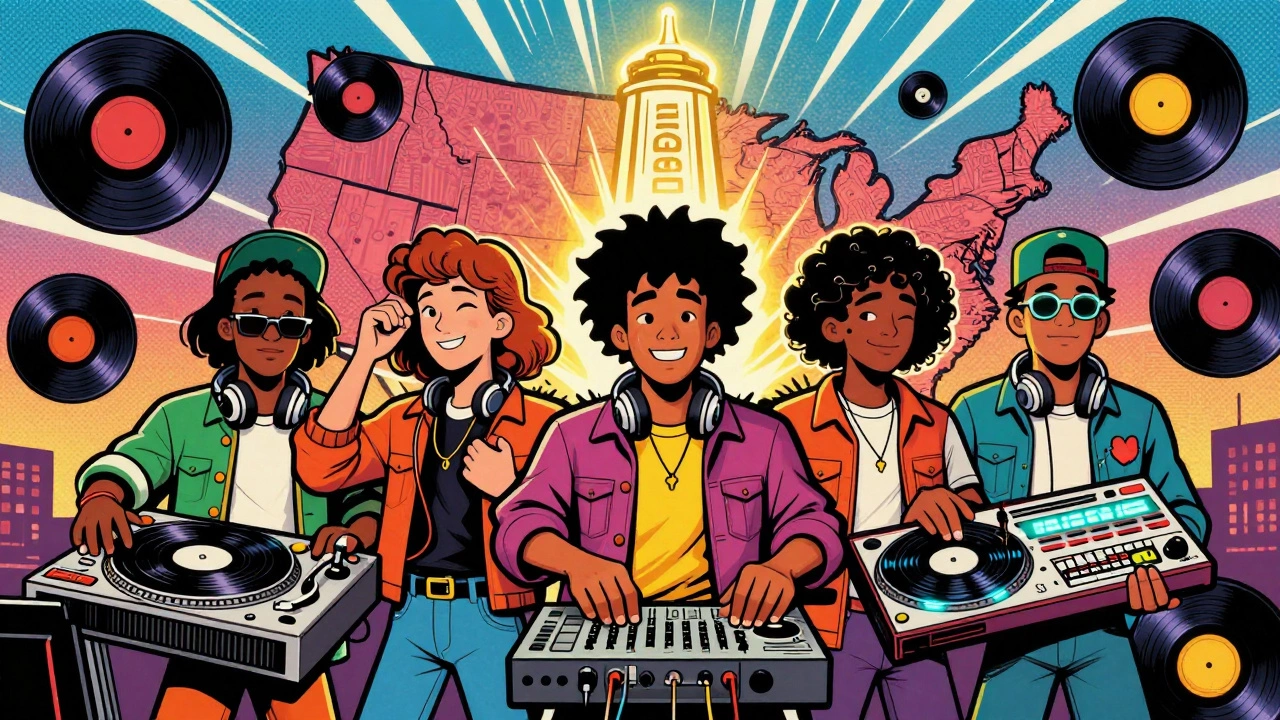
Becoming a top DJ in the 1980s wasn’t about talent alone. It was about discipline. Grandmaster Flash said it took 500 to 700 hours just to master beatmatching-keeping two records in perfect sync. Advanced scratching? That took over 1,000 hours. Most DJs practiced for hours after school, after work, after parties. They’d spend nights in basements, spinning the same 30-second break over and over until their fingers bled.
They also had to dig for records. ‘Crate digging’ meant spending $20-$50 a week (about $70-$175 today) on vinyl, hunting for obscure funk, soul, and jazz records with the perfect break. One DJ told a reporter he’d spend hours in record stores, listening to every track on a single album. One bad beat could ruin a whole set.
And the physical toll? A 1987 Mixmag survey found 37% of professional DJs suffered from wrist injuries. Cartridges wore out every 500 hours and cost $129 to replace. Turntables needed constant cleaning. Mixers broke. It was expensive. It was exhausting. But they kept going.
Women, Credit, and the Culture Left Behind
For all the innovation, turntablism was still a boys’ club. The YouTube documentary ‘30 OLD SCHOOL DJs Who Defined 80s HIP HOP’ mentions female pioneers who fought for recognition-but names are rarely given. No one remembers DJ Lady B, who spun in Philly, or DJ Dee, who rocked underground clubs in Brooklyn. They were there. They were skilled. But they were erased.
And then there was the money. A DJ in Philadelphia told Reddit users in 2023 that in 1986, he played a block party for $50 and a case of soda. Meanwhile, the MCs got album deals. The producers got royalties. The DJs? They got the noise.
It wasn’t until 1989 that DJ Jazzy Jeff & The Fresh Prince won a Grammy for Best Rap Performance. It was the first time a DJ was honored on that level. But even then, the award went to the duo, not the turntables.
Legacy: The Sound That Never Left
Today, most hip-hop is made with software. Beats are programmed. Samples are dragged and dropped. But listen closely. The scratches in Kendrick Lamar’s ‘m.A.A.d city.’ The vinyl crackle in Drake’s ‘Started From the Bottom.’ The rhythmic stabs in Travis Scott’s ‘SICKO MODE.’ They all trace back to 1980s turntablism.
Modern DJs still use time-coded vinyl to control digital tracks. Schools teach turntablism as a formal art. The Smithsonian has Grandmaster Flash’s original turntables on display. And 78% of today’s top turntablists say Flash was their biggest influence.
The turntable didn’t just become an instrument in the 1980s. It became a voice. A way for kids with no money, no studio, and no access to traditional music to say: ‘This is ours.’ And they made it loud enough for the world to hear.


