
The 1990s didn’t just give us flannel shirts and dial-up internet-it gave us a world where music crossed borders faster than ever before. You could hear a Swedish pop band on the radio in Tokyo, a British rock group blasting from a car in Mexico City, or a Brazilian samba track in a Berlin club. This wasn’t just coincidence. It was the result of a massive, messy, and fascinating global exchange of music that reshaped how the world listened.
CDs Took Over the World
The 1990s were the golden age of the CD. By 1998, compact discs made up nearly 90% of all music sales worldwide, pushing cassette tapes into the background and burying vinyl records under piles of plastic. Global music sales hit $38.7 billion that year-more than triple what they were in 1982. That growth wasn’t just about technology. It was about accessibility. CDs were durable, portable, and sounded better than anything before them. For the first time, people in small towns in Indonesia or rural Argentina could buy the same albums as people in New York or London.
The biggest driver? American and European labels. The United States alone accounted for about 40% of all music exported globally by the end of the decade. But here’s the twist: even though the U.S. was the top exporter, it wasn’t the biggest importer. Europe, especially countries like Germany, France, and the UK, bought far more foreign music than they sold. In 1993, Europe imported 61% of all international music sales. The U.S. imported less than 6%. Why? Because Americans loved their own music. Europeans, however, were hungry for something new-and they had the money to buy it.
Who Was Really Selling?
When you think of 1990s global music, you probably think of Nirvana, TLC, or Spice Girls. But the real story wasn’t just about big names-it was about tiny countries punching far above their weight. Take Sweden. In 1994, a band called Ace of Base sold enough records to make up 76% of Sweden’s entire international music sales that year. One group. One year. That’s more than the entire music output of countries like Brazil or South Korea combined. It wasn’t luck. It was a perfect storm: catchy hooks, polished production, and a global pop machine ready to push them.
Australia had done something similar in 1978 when the Bee Gees accounted for 73% of its music exports. The pattern was clear: a single artist, often from a small country, could dominate global trade. It didn’t matter if your country had a population of 9 million. If you made a song that stuck, the world would buy it.
Meanwhile, the UK, which had ruled global music exports since the 1960s, started to slip. Its share of international sales dropped from over 40% in the late 1980s to around 25% by 1999. Why? Because the U.S. wasn’t just keeping up-it was pulling ahead. American pop, rock, and hip-hop weren’t just popular overseas. They were becoming the default sound of global youth culture. Bands like Pearl Jam and artists like Whitney Houston didn’t just sell records abroad-they defined what music sounded like to millions.
The Six Giants Who Controlled Everything
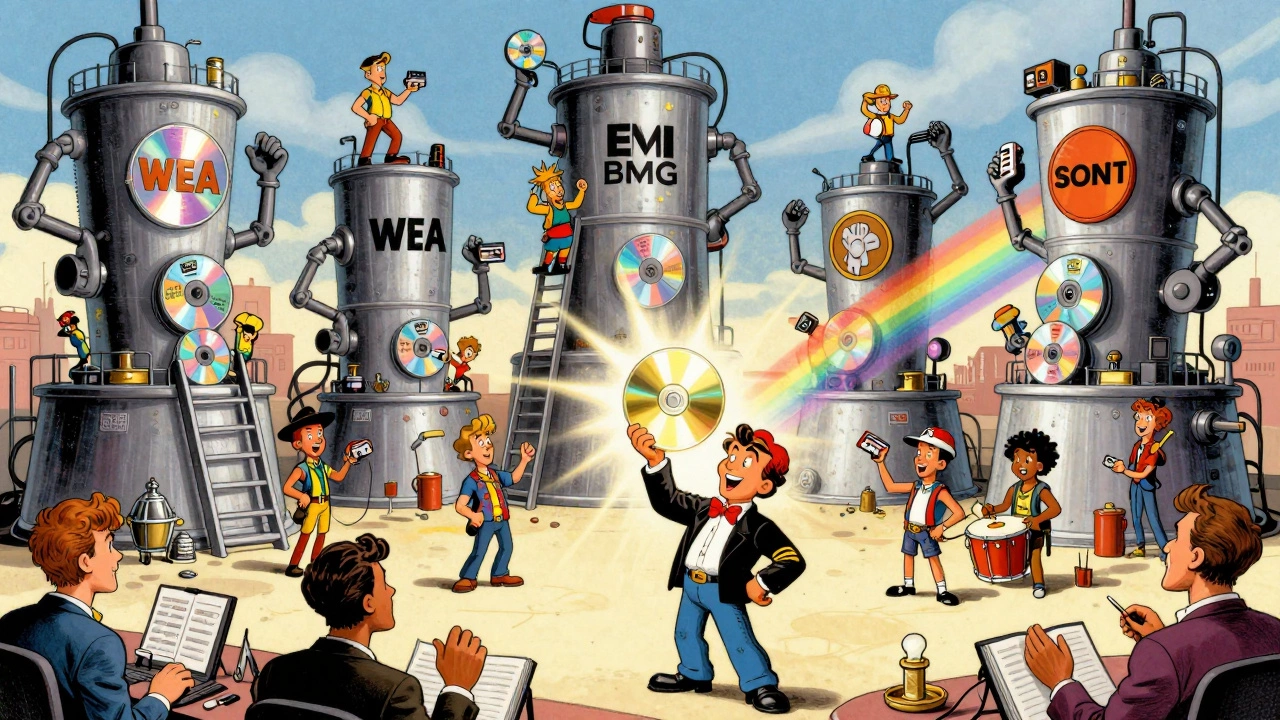
Behind all these hits was a tiny group of companies. By the mid-1990s, just six record labels-WEA, BMG, EMI, CBS (Sony), and two others-controlled 80% of the world’s music sales. These weren’t just companies. They were global engines. They had factories in Asia, distribution networks in Europe, marketing teams in North America, and royalty collection systems in every country with a radio station.
These giants didn’t just release music. They decided what music got heard. If your band wasn’t signed to one of them, your chances of breaking out internationally were slim. That’s why so many artists from non-English-speaking countries had to adapt-sing in English, work with American producers, or repackage their sound to fit global tastes. It wasn’t always about talent. It was about access.
Language, Distance, and Why Some Music Crossed Borders-and Some Didn’t
People assumed American music dominated because it was pushed hard. But research showed something stranger: trade flows followed logic, not force. Music sold best between countries that shared a language or were close geographically. A German listener was more likely to buy a Dutch album than a Japanese one. A French fan preferred British pop over Korean ballads. Even in the age of satellite radio and MTV, culture still had borders.
And yet, exceptions proved the rule. When Michael Jackson’s Thriller came out in 1982, it sold everywhere. In the 1990s, it was the same with Celine Dion, Dr. Dre, or Shania Twain. These weren’t just hits-they were cultural events. They crossed language barriers because they tapped into universal emotions. Love, heartbreak, rebellion. You didn’t need to understand the lyrics to feel them.
What’s fascinating is that home bias didn’t disappear. In fact, it grew. In most countries, local music made up a bigger share of the market by the end of the decade than it did at the start. People in Japan still bought Japanese pop. People in Brazil still bought Brazilian samba. The U.S. didn’t erase local scenes-it added to them. Global music wasn’t about replacing local sounds. It was about letting them coexist.
Royalties and the Invisible Money Flow
Behind every song sold was a trail of money no one saw. By 1995, international royalty collections hit $6 billion-15% of all music sales. ASCAP in the U.S. collected $482 million in 1997, up from $375 million in 1991. The UK’s PRS saw its income jump from £137 million to £201 million in the same period. The U.S. and UK were the only two countries that earned more in international royalties than they paid out. Why? Because their artists were everywhere. A song written in Nashville might be played on a radio in Lagos, a club in Seoul, or a café in Oslo-and someone, somewhere, was paying for the right to play it.
These systems didn’t just pay artists. They kept the whole industry alive. Without royalties, songwriters, producers, and session musicians wouldn’t have had a way to earn from global success. For many, a single hit overseas could mean financial survival.
What the 1990s Taught Us About Music and Globalization
The 1990s didn’t end with the rise of Napster or the fall of CDs. It ended with a quiet realization: music doesn’t spread because of power. It spreads because it moves people. The U.S. didn’t dominate because it had a bigger economy. It dominated because it kept making songs that people couldn’t ignore. Sweden didn’t break through because of government support. It broke through because a few kids in a studio made a chorus that stuck in your head for days.
And here’s the real lesson: globalization didn’t erase local music. It gave it a stage. A Mexican rock band could now be heard in Canada. A South Korean ballad could find fans in Italy. The tools changed-the CD, the radio, the MTV channel-but the heart of music stayed the same. It was always about connection.
By 2000, the world had learned something new: you didn’t need to be from a big country to make global music. You just needed to make something that mattered.
Why did CDs dominate music sales in the 1990s?
CDs became dominant because they offered better sound quality than cassettes, were more durable than vinyl, and were easier to mass-produce. By 1998, CDs made up nearly 90% of global music sales, with sales growing from $12 billion in 1982 to $38.7 billion. The rise of portable CD players and car stereos also helped drive adoption worldwide.
How did Sweden become a major music exporter in the 1990s?
Sweden’s sudden rise was largely due to Ace of Base, whose 1993 debut album sold over 20 million copies worldwide. In 1994 alone, the band accounted for 76% of Sweden’s total international music sales. Their blend of Europop, dance beats, and catchy hooks appealed to global youth markets, proving that small countries could dominate global trade with one breakout act.
Why did the U.S. export more music than it imported?
The U.S. exported far more music than it imported because American artists-like Nirvana, TLC, and Whitney Houston-became global icons. At the same time, American consumers largely preferred domestic music. In 1993, the U.S. imported less than 6% of global music sales, while Europe imported 61%. This reflected a cultural preference for homegrown content rather than a lack of access to foreign music.
Did globalization kill local music scenes in the 1990s?
No. In fact, local music markets grew stronger. Studies showed that home market shares increased during the 1990s. People in Japan, Brazil, and India still bought more local music than foreign music. Globalization didn’t replace local scenes-it gave them more exposure. A Brazilian samba artist could now be heard in Europe, and a Japanese pop group could chart in Australia.
Why did the UK lose its dominance in global music exports?
The UK’s share of global music exports fell from over 40% in the 1980s to around 25% by 1999 because the U.S. began producing more internationally appealing pop, rock, and hip-hop. While British acts like Oasis and Blur remained popular, American artists like Nirvana, Tupac, and Mariah Carey had broader global reach. The shift wasn’t about quality-it was about volume, marketing, and the rise of American media power.


