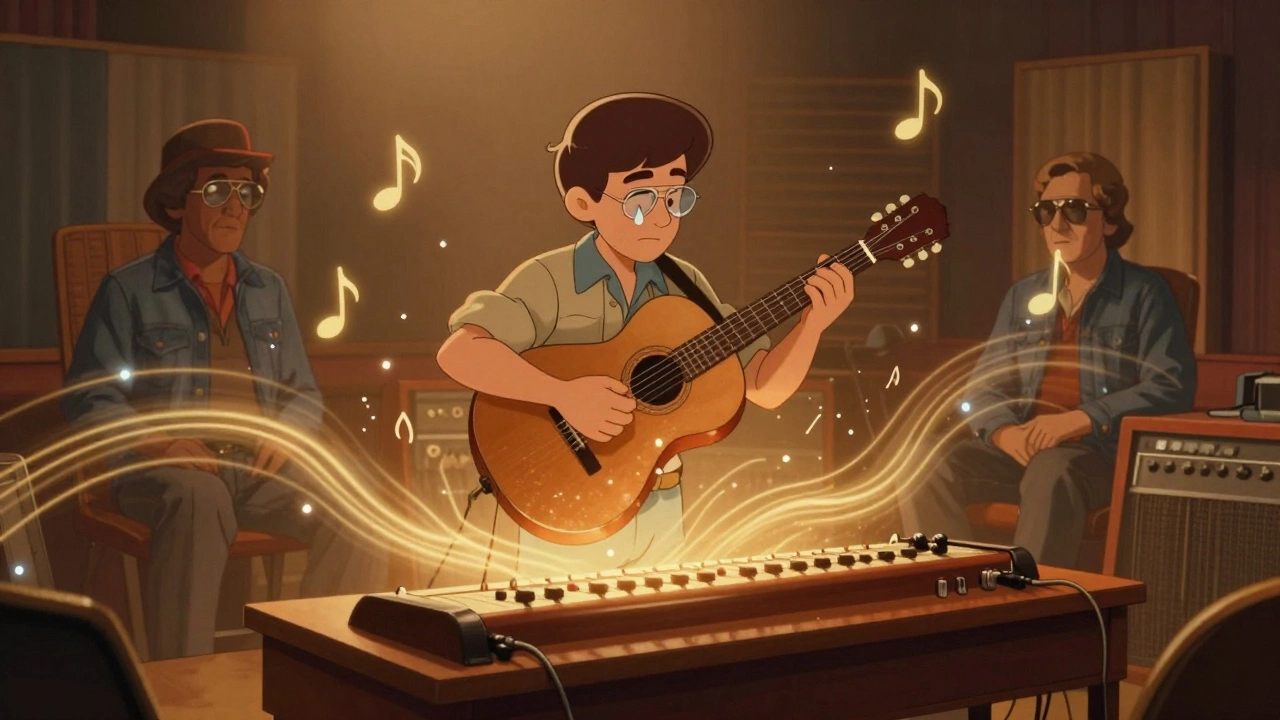

The Sound That Cried When Words Couldn’t
There’s a moment in every great 1970s country song where the music seems to pause-just for a breath-and then the steel guitar slides in like a sigh you didn’t know you were holding. It doesn’t shout. It doesn’t scream. It just aches. That sound wasn’t just an instrument. It was the voice of heartbreak, loneliness, and quiet hope wrapped in steel strings and pedal mechanics.
Before the 1970s, the steel guitar was mostly heard in honky-tonks and Western swing bands. But something shifted. Bob Dylan didn’t just pick up a guitar-he picked up a whole new audience for country music. Suddenly, kids who wore tie-dye and listened to The Doors were buying records with pedal steel humming in the background. Gram Parsons, Neil Young, The Byrds, and even Steely Dan started using it. The instrument went from regional oddity to national obsession.
The Nashville 9th Tuning: The Secret Code of the Era
Every great steel player in the 1970s spoke the same musical language: the Nashville 9th tuning. Also called D9th/A6th universal tuning, it wasn’t just a setup-it was a key to unlocking emotion. This tuning gave players access to rich, full chords that could bend and cry without losing their shape. The most famous move? The G-to-C chord change. It’s simple on paper: you go from a G major to a C major. But on pedal steel, it’s magic.
That transition isn’t just a chord shift. It’s a lift. A release. A tear you didn’t see coming. Pedal steel players didn’t just play notes-they pulled them. Using pedals and knee levers, they could lower or raise strings mid-note, creating a glide that no fingerpicked guitar could match. That’s why you hear it on songs like Rick Nelson’s “Someday Soon” or Emmylou Harris’s “Luxury Liner.” The steel doesn’t play the melody. It becomes the feeling behind it.
Licks That Made You Feel It
There’s a reason modern players still study 1970s licks like gospel. They’re not flashy. They’re not fast. They’re carefully placed, like punctuation in a letter you read three times before sleeping. The most common pattern? Cascading runs using open strings. You start on the third fret of the G string, hammer onto the D string, then let the open G ring out underneath. Hybrid picking-using a pick and fingers together-keeps those notes alive, layered, and ringing. That’s the trick: you don’t play one note at a time. You play clusters. You let four or five strings sing together.
One of the most copied licks comes from Buddy Emmons’ work on “She Belongs to Me.” It’s not a solo. It’s a response. A counter-melody that weaves around the vocal. It’s subtle. It’s quiet. But it’s the part you remember. That’s the power of the 1970s steel: it didn’t need to be loud to be unforgettable.
Why It Couldn’t Be Replaced
Why didn’t they just use a regular guitar? Because a guitar can’t bend a chord. A flatpicked note is sharp or flat. A fingerpicked note is clean or muddy. But a pedal steel? You can bend a whole triad. You can take a C major chord-C, E, G-and bend the E note up a half-step into F#, making it a C major 7th. All while keeping the other notes ringing. That’s not a technique. That’s alchemy.
Compare that to a standard electric guitar. Even with a whammy bar, you’re changing the pitch of one string at a time. The steel guitar lets you change multiple strings at once-pedals for the big shifts, knee levers for the tiny adjustments. That’s why players like Buddy Emmons could make a simple chord progression feel like a conversation. The steel didn’t just play the song. It answered it.
The Players Who Made It Real
Buddy Emmons wasn’t just a player-he was the blueprint. He recorded over 2,500 sessions between 1965 and 1980. You can hear him on records by Ray Charles, Elvis Presley, and even Frank Sinatra. But in country, he was the voice. He didn’t just play the notes-he shaped the emotional tone of an entire genre.
Then there was Ben Keith, Neil Young’s right-hand man. On “Harvest,” his steel guitar doesn’t just accompany the songs-it holds them together. Listen to “Heart of Gold.” The steel enters after the second verse. It doesn’t jump in loud. It just appears, like sunlight breaking through clouds. That’s the 1970s style: restraint. Precision. Emotional weight.
Greg Lee, Paul Franklin, and other session giants worked out of Nashville’s Studio A. They weren’t rock stars. They were ghosts in the mix. But if you took their parts out, the song would collapse. That’s how vital they were.
The Cultural Shift: Hippies, Outlaws, and Steel
This wasn’t just a musical trend. It was a cultural merger. Country music was seen as old-fashioned. Rock was rebellious. But in the early 1970s, the lines blurred. Young people who hated Nashville’s polished sound suddenly found themselves drawn to its honesty. Outlaw country-Willie Nelson, Waylon Jennings-used steel guitar not to sweeten songs, but to deepen them. The steel didn’t smooth the edges. It made them sharper.
It wasn’t just about the music. It was about identity. A teenager in Oregon or Ohio who’d never been to Tennessee could hear a steel guitar on a record and feel something real. It was the sound of someone who’d been hurt, who’d been alone, who’d kept going anyway. That’s why it connected. The steel didn’t lie.
The Sound Still Lives
Today, you can find tutorials on YouTube with over 150,000 views teaching 1970s steel licks. Modern players like Brad Paisley and Vince Gill don’t just use the techniques-they honor them. Molly Tuttle, in her Americana work, layers steel textures into songs about modern loss and resilience. The emotional language hasn’t changed.
Why? Because the 1970s steel guitar didn’t just play notes. It played silence. It played longing. It played the space between heartbeats. No other instrument in country music has ever done that so completely.
That’s why, even now, when someone asks what makes country music different, the answer isn’t fiddles or banjos. It’s the steel. The one that cried when no one else would.
What made the pedal steel guitar so unique in 1970s country music?
The pedal steel guitar stood out because it could bend entire chords, not just single notes. Using pedals and knee levers, players altered the pitch of multiple strings at once, creating smooth, crying tones that no other instrument could replicate. This allowed for emotional, vocal-like phrasing that matched the storytelling nature of 1970s country songs.
What is the Nashville 9th tuning, and why was it so important?
The Nashville 9th tuning (also called D9th/A6th) was the standard setup for pedal steel guitars in the 1970s. It gave players access to rich, extended chords and made it easy to execute the iconic G-to-C chord change-the backbone of countless country ballads. This tuning allowed for fluid, lyrical lines and harmonically complex bends that defined the era’s signature sound.
Who were the most influential pedal steel players of the 1970s?
Buddy Emmons was the most recorded and influential player, appearing on over 2,500 sessions. Ben Keith brought the steel into rock-infused country with Neil Young’s “Harvest.” Greg Lee and Paul Franklin shaped the session sound in Nashville. Their playing defined the emotional tone of the decade, from outlaw anthems to countrypolitan ballads.
How did the 1970s steel guitar differ from earlier lap steel styles?
Lap steel guitar was mostly limited to single-note lines and simple slides. The pedal steel added pedals and knee levers, allowing players to change string pitches while holding chords. This enabled complex harmonies, chordal bends, and seamless transitions between notes-making it far more expressive and musically versatile than its predecessor.
Why did pedal steel appear on pop and rock records in the 1970s?
The “hippie country” movement, sparked by artists like Bob Dylan, The Byrds, and Gram Parsons, made country sounds cool to rock audiences. The pedal steel’s emotional depth and unique tone added authenticity and warmth to pop and rock tracks. It wasn’t just a gimmick-it was a tool for expressing vulnerability, which resonated with the era’s introspective lyrics.
Is the 1970s pedal steel sound still used today?
Absolutely. Artists like Brad Paisley, Vince Gill, and Molly Tuttle still use 1970s-style licks and techniques. Modern tutorials on YouTube show that these licks are among the most popular country guitar lessons. The emotional honesty and tonal warmth of that era’s playing remain unmatched, making it the foundation of modern country and Americana steel guitar.