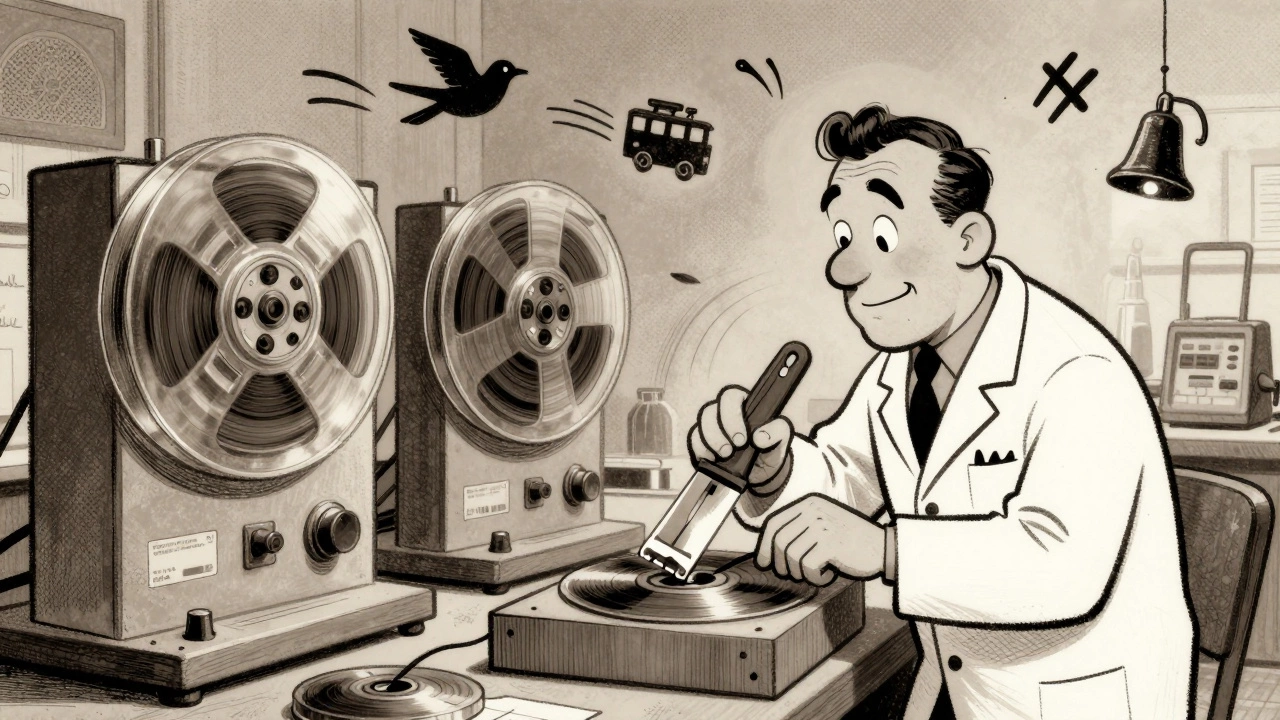

Before there were digital samplers like the Fairlight CMI or the Akai MPC, there was magnetic tape-spools of plastic coated in iron oxide, humming on spinning reels, cut with razor blades, and spliced together by hand. This wasn’t just recording. It was sound sculpting. From the late 1940s to the early 1980s, composers, engineers, and avant-garde musicians turned tape machines into the first real samplers. They didn’t press a button to loop a sound. They physically rewrote music one inch of tape at a time.
The Birth of Sound as Material
Before magnetic tape, sound was locked in place. Turntables could play records faster or slower, but you couldn’t record new sounds or edit them. Acetate discs were brittle. Wire recorders hissed and couldn’t capture full frequency ranges. Then came the German Magnetophon, developed in the late 1930s with AC bias technology that slashed distortion below 3%. After World War II, these machines flooded into Allied studios. Suddenly, sound wasn’t just captured-it could be manipulated. Cut. Reversed. Layered. Stretched. Speeded up. Slowed down. For the first time, a composer could take a scream, a bell, or a bird call, and turn it into something entirely new.
Pierre Schaeffer, working at Paris’s Studio d’Essai, called these manipulated sounds “objets sonores”-sound objects. He didn’t care where they came from. A train whistle became a rhythm. A piano note turned into a drone. The source didn’t matter anymore. Only the sound itself. This was the birth of musique concrète, and it was all done with tape.
How Tape Manipulation Actually Worked
Tape machines ran at 7.5, 15, or 30 inches per second. Higher speeds meant better fidelity. A 15-inch-per-second machine could capture frequencies up to 15 kHz-far beyond what vinyl could do. Tape width mattered too. Consumer machines used 1/4-inch tape. Studios used 2-inch, allowing up to eight tracks to be recorded simultaneously by 1967.
Here’s how they made music:
- Splicing: A razor blade cut the tape at a precise 45-degree angle. Then, using DuPont #413 cellophane tape as adhesive, two pieces were joined. One mistake meant losing hours of work. John Cage’s “Williams Mix” (1952) required 600 splices. Each one had to be perfect. About 40% failed on the first try.
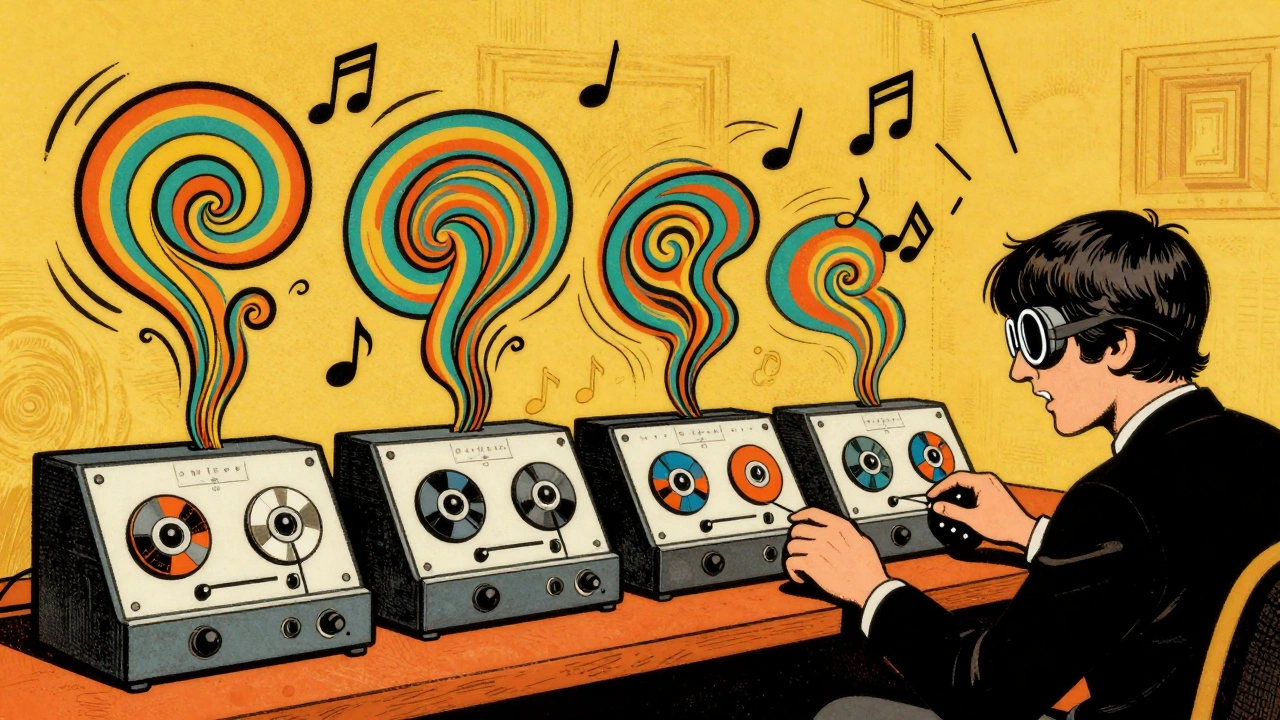
- Tape loops: To repeat a sound, you’d cut the tape, overlap the ends, and glue them together. A 3-second loop at 15 ips created a steady pulse. The Beatles used four tape machines running loops on “Tomorrow Never Knows,” each playing a different loop at slightly different speeds to create a swirling, hypnotic effect.
- VariSpeed: Turning the speed dial changed both tempo and pitch. Increase speed by 5%, and the pitch rises by roughly a semitone. No digital pitch-shifting here-just physics. Louis Barron, who scored “Forbidden Planet” in 1956, made the iconic “blaster” sound by splicing 27 pieces of tape across three machines, each at slightly different speeds.
But tape had limits. Every copy added 3-5dB of noise. Tape stretched over time-0.1% to 0.3% per playback. A reel of 1,800-foot tape cost $15 in 1960 (about $140 today). Most composers reused tape seven to ten times before the sound degraded too much.
The People Who Made It Happen
This wasn’t just studio magic. It was grueling, hands-on labor.
Halim El-Dabh, in 1944, used a wire recorder at Cairo’s radio station to manipulate the sounds of an exorcism ritual. He changed playback speed and direction, creating a piece called “The Expression of Zaar.” He later said: “I discovered that by adjusting the speed and direction… I could create something otherworldly.”
Pauline Oliveros built multi-deck tape systems for live performance. Each 5-minute piece took 30 minutes to set up. She had to monitor tape tension, prevent snarls, and manually restart machines if they stopped. On average, she had 2.3 tape breaks per performance.
Steve Reich’s “It’s Gonna Rain” (1965) used two tape machines playing the same loop of a preacher’s voice. One machine was slowed down by a fraction, creating a gradual phase shift. The result? A hypnotic, evolving rhythm. Reich later said: “The tape machine was the first sampler.”
And then there was John Cage. His “Williams Mix” was guided by the I Ching. Each splice was determined by chance. A 193-page “dressmaker’s pattern” told him where to cut. It took months. The final result? A chaotic, layered collage of environmental sounds-rain, sirens, voices, drums-all stitched together by hand.
Why Tape Was the Original Sampler
Modern samplers let you trigger a sound with a keypress. Tape didn’t work that way. But it did the same thing: it captured a sound, stored it, and let you play it back differently. The core idea-sound as a reusable, transformable material-was invented here.
When Fairlight CMI developers built their first digital sampler in 1979, they didn’t start from scratch. They looked at tape loops. The Page R interface? It was designed to mimic the physical act of looping tape. 92% of early sampler users had backgrounds in tape manipulation.
Even today, the legacy lives on. Eurorack modules like the Make Noise Echophon replicate tape echo with 0.5-3 second delays. Producers use tape saturation plugins to recreate the warmth and noise of analog generations. MoMA acquired El-Dabh’s original wire recordings in 2022. The curator called them “the origin point of all sampling culture.”
The Cost of Innovation
This wasn’t cheap. An Ampex 350-2 tape recorder cost $2,495 in 1955-$25,800 today. Most studios didn’t own one. Radio stations, universities, and film studios did. That’s why the movement was concentrated in places like Columbia-Princeton Electronic Music Center, the BBC Radiophonic Workshop, and Schaeffer’s Paris studio.
Learning to splice tape took 6-12 months of supervised practice. Beginners failed more than half the time. Documentation was scarce until Robert B. Ingraham’s 1957 book, which gave exact splicing angles and adhesive specs. Knowledge spread through newsletters with fewer than 200 subscribers worldwide.
And yet, the payoff was huge. By 1970, 85% of Billboard Top 40 hits used tape multi-tracking. “A Day in the Life” by The Beatles took 4 hours to edit just 30 seconds of tape. But that sound-those swelling orchestral crashes, those reversed guitar solos-changed popular music forever.
The End of an Era
By 1985, digital samplers had taken over. They were faster. They didn’t stretch. They didn’t degrade. You could undo mistakes. But something was lost. Tape demanded patience. It forced you to think in physical terms. Every cut was permanent. Every loop had to be measured. Every splice had to be perfect.
Alvin Lucier put it best: “The physical act of splicing created a direct composer-medium relationship impossible with digital interfaces.”
Tape didn’t just record sound. It shaped how we thought about it. It turned the studio into an instrument. It taught us that music doesn’t have to be played-it can be built.
Today, when you load a sample into your DAW, you’re using a tool that started with a razor blade, a splicing block, and a reel of tape.


