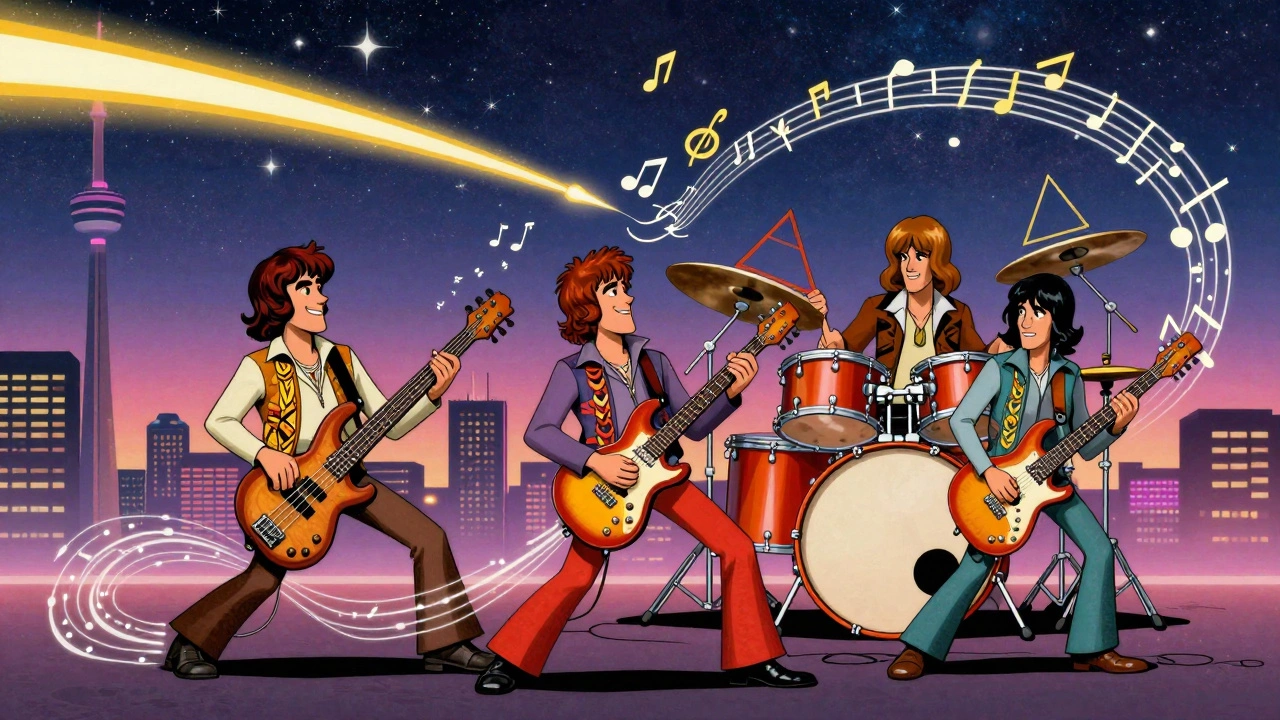

Rush didn’t just play music-they rebuilt what rock could do. When the Canadian trio of Geddy Lee, Alex Lifeson, and Neil Peart hit their stride in the late 1970s, they turned complex time signatures, layered harmonies, and drum solos that told stories into something that radio stations played and fans screamed along to. This wasn’t prog rock for intellectuals. This was prog rock that made you move, think, and wonder how anyone could play it live.
The Foundation: From Blues Rock to Technical Precision
Rush started in 1968 with a sound borrowed from Led Zeppelin and Cream-loud, bluesy, and raw. Their 1974 debut album had the energy of a garage band with a budget. But by 1976, something shifted. 2112 wasn’t just an album; it was a declaration. The seven-part suite, inspired by Ayn Rand’s dystopian novel, opened with a 12-minute title track that moved through orchestral synths, acoustic interludes, and crushing metal riffs-all in one piece. And yet, it wasn’t bloated. Every section served the story. Every change felt intentional.
What set Rush apart from bands like Yes or Genesis wasn’t just length. It was control. While others stretched songs to 15 or 20 minutes, Rush kept theirs between four and six. They packed more into less. A single song like “The Camera Eye” from 1981’s Moving Pictures had 17 chord changes in its first two minutes alone. Lifeson’s guitar didn’t just riff-it wove counter-melodies, arpeggios, and distorted textures that shifted like weather. Lee’s bass wasn’t background. It carried the melody, jumped octaves, and locked into Peart’s drums like a precision machine.
The Drummer Who Redefined the Kit
Neil Peart didn’t just play drums-he engineered them. By 1977’s A Farewell to Kings, his setup had grown to include gongs, chimes, tympani, electronic pads, and even a triangle. He didn’t use these for show. Each sound had a purpose. In “YYZ”, the opening rhythm isn’t just a groove-it’s the Morse code for Toronto Pearson Airport: Y-Y-Z. The song’s 5/4 time signature isn’t a gimmick. It’s a heartbeat that never feels off. Drummers worldwide still struggle to replicate it. Drumeo’s 2022 course on Peart found that 78% of students need six to eight months just to play “Tom Sawyer” accurately. Only 12% reach professional level in a year.
Peart’s solos weren’t about speed. They were about architecture. In “La Villa Strangiato”, his solo doesn’t just follow the song-it leads it. He shifts between jazz swing, metal blast beats, and classical snare rolls without breaking the flow. Guitar Player magazine called his approach “the Rosetta Stone for understanding how technical complexity and mass appeal can coexist.” He didn’t play to impress other drummers. He played to make the whole band sound bigger.
The Bassist Who Played Like a Lead Guitarist
Geddy Lee’s bass lines are the secret sauce of Rush’s sound. He didn’t just root the chords-he rewrote them. In “La Villa Strangiato”, his bass moves like a second guitar, jumping between harmonized melodies and syncopated rhythms. He played with a pick, not fingers, giving his tone a sharp, cutting edge that cut through Lifeson’s layered guitars and Peart’s dense percussion.
Lee also sang in a three-octave range, often switching between high-pitched wails and low, growling tones mid-phrase. On “The Trees”, he sings in a soft, almost whispery tone over a 5/4 groove, then explodes into a full-throated chorus. He didn’t just sing the melody-he told the story with his voice. And he did it while playing complex bass patterns that required both hands to move independently. Few bassists have ever had to do that live, night after night.
The Guitarist Who Played Everything
Alex Lifeson’s guitar work is the glue that held Rush’s sound together. He didn’t stick to one style. He switched between fingerpicked acoustic passages, heavy metal riffing, clean jazz chords, and ambient textures-all in the same song. On “The Camera Eye”, he moves from a soft, echoing arpeggio to a distorted, chugging rhythm in under 30 seconds. His chord voicings used 7ths, 9ths, and 11ths borrowed from jazz, making even simple progressions sound rich and unexpected.
By the early 1980s, Rush’s sound changed. Synths took over. Lifeson’s guitar was mixed lower. On Signals, he played fewer riffs and more textures. Critics called it a sellout. Fans called it evolution. But even then, his playing was deliberate. He adapted to the new sound instead of fighting it. In “Subdivisions”, the opening triplet figure isn’t just a synth pattern-it’s a rhythmic seed. Lifeson’s guitar enters later, not as a solo, but as a counterpoint, weaving around the electronic beat. It’s subtle. It’s smart. And it’s still technically demanding.
Why Rush Outlasted Their Peers
Yes had orchestral suites. Genesis had theatrical storytelling. King Crimson had avant-garde chaos. Rush had something else: accessibility. They made complex music feel natural. “YYZ” is a 5/4 instrumental that became a fan favorite. “Tom Sawyer” has a drum pattern so tight it’s become a cultural reference. Even fans who didn’t know what a polymeter was could tap their foot to it.
They sold over 25 million albums worldwide. They had 24 consecutive gold or platinum albums in the U.S. between 1975 and 2012. They were the only prog band to consistently chart in the Top 10. While other prog bands faded into cult status, Rush stayed in the mainstream. Why? Because they never sacrificed melody for complexity. Every odd time signature had a hook. Every technical passage had emotion.
The Legacy Lives On
After Neil Peart’s death in January 2020, Rush disbanded. But their influence grew. Dream Theater’s John Petrucci says every one of their albums has a Rush homage. Don Caballero’s Ian Williams credits “The Camera Eye” as the blueprint for math rock. Berklee College of Music added a full course on Rush’s composition techniques in 2021. Enrollment jumped from 28 to 147 students in two years.
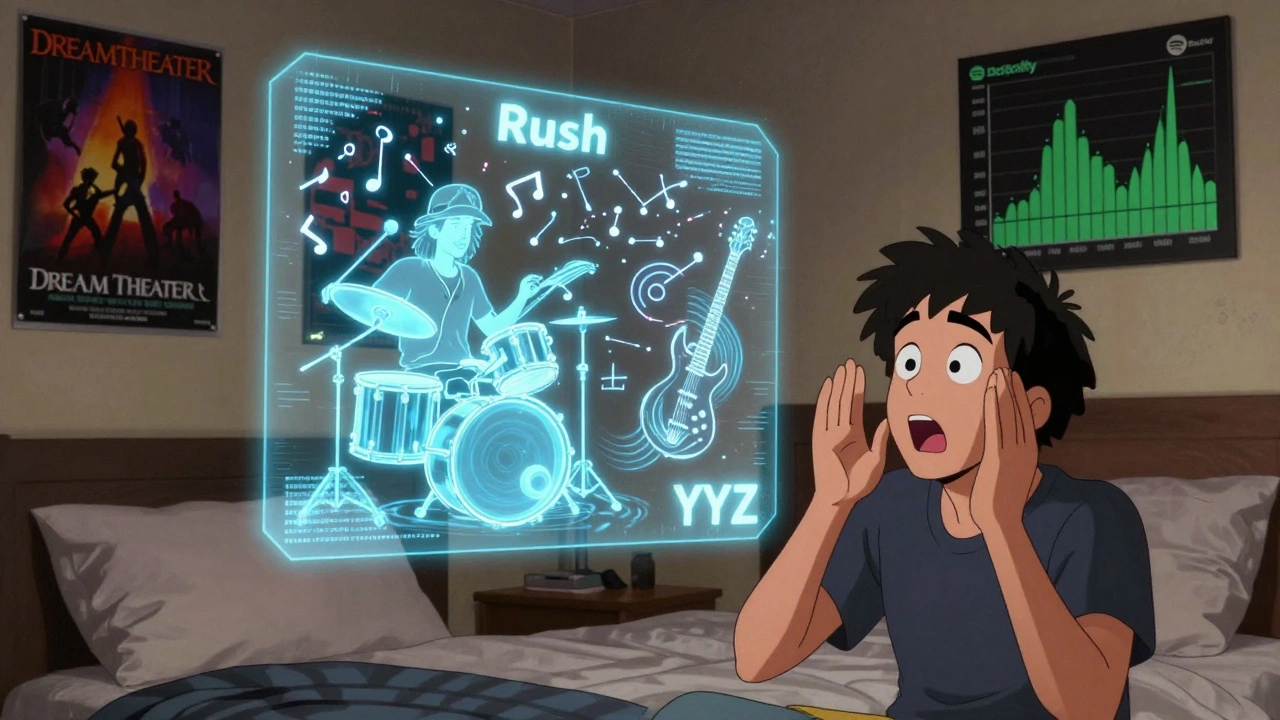
Spotify data shows 62% of Rush listeners are under 35. “YYZ” and “La Villa Strangiato” are growing faster among Gen Z than ever before. Tribute bands like The Spirit of Rush sell out 98% of their North American shows. Guitar Player’s January 2024 issue called Rush’s approach “the Rosetta Stone for understanding how technical complexity and mass appeal can coexist in rock music.”
They didn’t just play music. They proved that intelligence and passion don’t have to be opposites. That complexity doesn’t mean alienation. That a band can be technically brilliant and still make you want to sing along.
What made Rush’s music technically different from other prog rock bands?
Unlike Yes or Genesis, Rush kept songs under six minutes while packing in odd time signatures, jazz-influenced harmonies, and intricate interplay between instruments. They didn’t rely on 20-minute epics. Instead, they made every second count-using complex rhythms like 5/4 in "YYZ" or 7/8 in "The Camera Eye" without losing melody or groove. Their music was dense but never bloated.
Why is Neil Peart considered one of the greatest drummers of all time?
Neil Peart combined technical precision with musical intelligence. His solos weren’t just fast-they told stories. He used a massive kit with chimes, gongs, and electronic pads not for show, but to add texture and structure. In "Tom Sawyer," he locked into a 4/4 beat while playing syncopated fills that felt organic. Drummer World ranked him #1 in 2017 for transforming drumming from timekeeping into composition.
Did Rush’s shift to synthesizers in the 1980s hurt their legacy?
Some fans felt alienated when Lifeson’s guitar took a backseat on albums like "Signals," but the shift was intentional. Rush adapted to new technology instead of resisting it. Songs like "Subdivisions" used synths to create rhythmic foundations, not replace guitars. The band’s technical core remained-complex time signatures, layered harmonies, and lyrical depth. Many now see this era as bold evolution, not compromise.
How did Geddy Lee’s bass playing redefine the role of the bass in rock?
Geddy Lee treated the bass like a lead instrument. He played melodic counterpoints, jumped octaves, and used fingerstyle and pick techniques to create textures that often carried the main theme. In "La Villa Strangiato," his bass line alone requires three separate rhythmic patterns to be played simultaneously. He didn’t just support the rhythm-he shaped the song’s direction.
Why is Rush still relevant today, decades after their peak?
Rush’s music bridges generations because it’s both challenging and catchy. Gen Z listeners are discovering "YYZ" and "La Villa Strangiato" at record rates, with streaming numbers up 47% and 39% respectively. Their technical approach laid the groundwork for math rock and progressive metal. Bands like Dream Theater cite them as foundational. And with Berklee teaching their methods, their influence is now institutional-not just nostalgic.