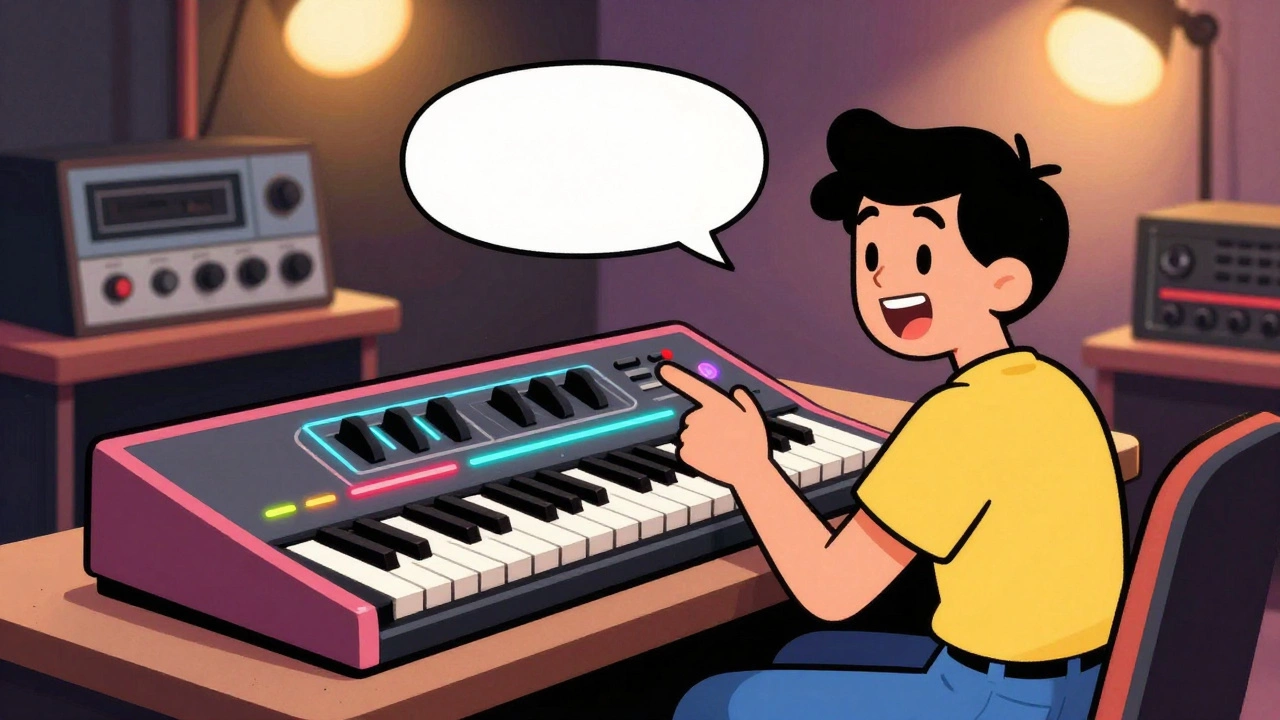

What Made the Juno-106 Special?
Released as an upgrade to the Juno-60, the Juno-106 doubled the patch memory to 128 presets (from 56) and added MIDI connectivity-a game-changer in 1984 when MIDI was just becoming standard. Its 61-key keyboard, 6-voice polyphony, and single digitally controlled oscillator (DCO) per voice delivered reliable tuning. Unlike fully analog oscillators that drifted, the DCO stayed perfectly in tune, making it a studio favorite. But the real magic? Its onboard stereo analog chorus circuit. This wasn’t just a subtle effect; it thickened sounds dramatically, creating lush pads and shimmering leads that became synonymous with 80s pop and synthwave.
How It Shaped Music in the 1980s
Depeche Mode used the Juno-106 on hits like "Enjoy the Silence" for those iconic warm pads. The Human League’s "Don’t You Want Me" featured its chorus-driven lead lines. Even The Chemical Brothers tapped into its sound in the 90s for tracks like "Chime." Why? It was accessible. Unlike the expensive Prophet-5 or Oberheim OB-Xa, the Juno-106 was affordable for working musicians. Roland sold about 45,000 units before discontinuing it in 1985, and its simplicity meant even beginners could create rich textures. As Keyboard Chronicles noted in 2023, "Its gentle learning curve let new users grasp patch creation in just 2-3 hours," making it a democratizing force in synth music.

The Dark Side: Voice Chip Failures
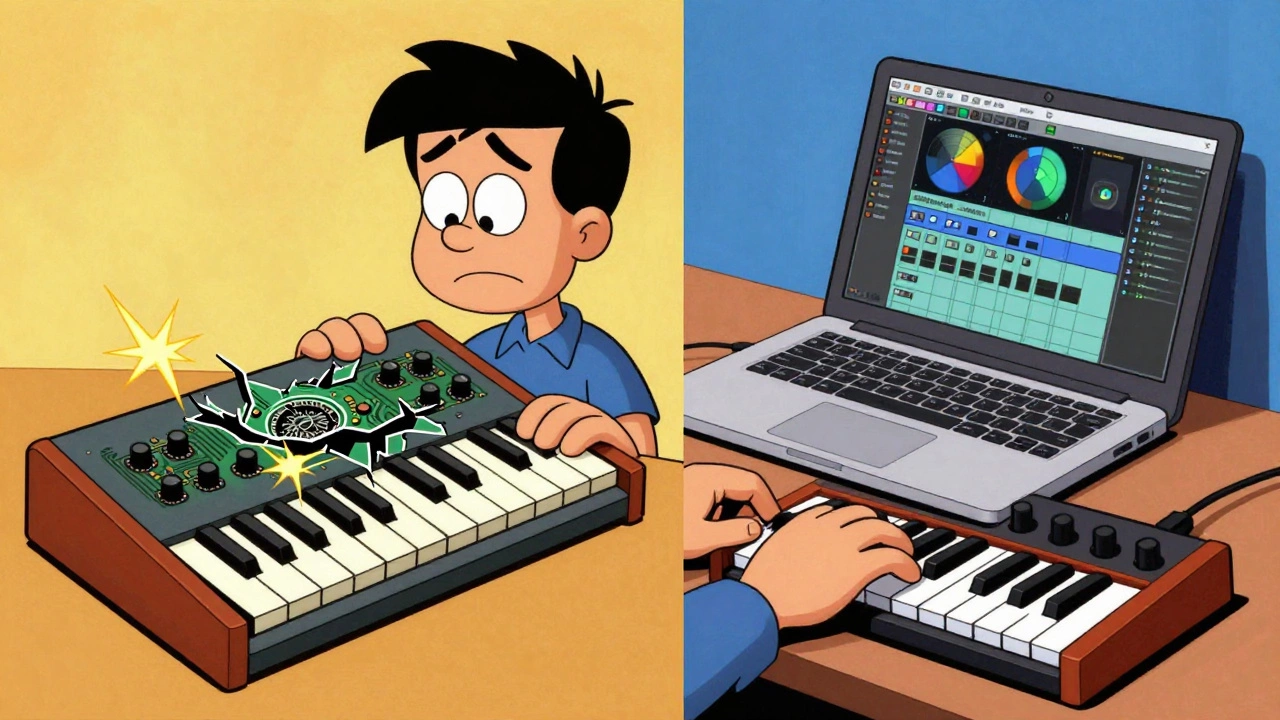
Despite its popularity, the Juno-106 has a notorious flaw: voice chips. These ICs, used to generate individual voices, often fail after 20 years due to design limitations. According to Roland Clan forum data, 65% of units made between 1984-1985 develop issues. Repairing them costs $300-$500, and finding technicians is tough. Reddit users like "AnalogEnthusiast87" describe the problem vividly: "One minute it’s perfect, the next, half the keys go silent." A 2022 Vintage Synth Explorer survey showed 63% of owners rate reliability as "poor," even though 78% praise the sound quality. It’s a trade-off many accept-because when it works, it sounds irreplaceable.
Why It’s Still Relevant Today
Modern musicians keep the Juno-106 alive. Used units sell for $800-$1,500 on Reverb.com, a 67-125% increase from 2015 prices. Roland’s 2019 JU-06A Boutique model captures its essence in a portable, battery-powered package with built-in speakers. Software emulations like Roland Cloud’s Juno-106 plugin let producers use its sound without hardware headaches. Even the Red Bull Music Academy reported in 2023 that 23% of synth-heavy tracks released that year used Juno-106 sounds. Its legacy isn’t just nostalgia; it’s a living part of current music production.
FAQs About the Roland Juno-106
Why does the Juno-106 have such a distinctive sound?
The onboard stereo analog chorus circuit is the secret. Unlike digital chorus effects, it adds warmth and depth by slightly detuning and delaying the signal, creating a "thickened" sound. Vintage Synth Explorer calls it "dramatic," and artists like Pet Shop Boys used it to make synth-pop tracks feel lush and emotional.
How does the Juno-106 compare to the Juno-60?
The Juno-60 has a slightly punchier sound because it modulates oscillator pulse width with the envelope, giving it more edge. But the Juno-106 added MIDI, doubled patch memory, and a more stable DCO. For most users, the 106’s versatility outweighed the 60’s sonic quirks, especially for studio work where tuning stability mattered.
Can I use the Juno-106 with modern gear?
Absolutely. Many use MIDI-to-CV converters like the Kenton Pro Solo Mk3 to integrate it with modular synths. Its MIDI implementation (with three modes for keyboard, hold, and SysEx control) works seamlessly with DAWs. Roland Cloud’s plugin also offers a software version that avoids hardware issues entirely.
What’s the best way to fix voice chip failures?
Specialized repair shops like Syntaur handle most fixes, replacing faulty ICs for $300-$500. The Roland Clan forum has a detailed guide with 4,852 views showing step-by-step replacement steps. However, parts are scarce-Syntaur reported a 40% year-over-year increase in Juno-106 repair parts sales from 2020-2022, showing how demand outstrips supply.
Is the JU-06A a good alternative?
Yes, for portability and modern features. The JU-06A combines Juno-60 and Juno-106 circuitry in a battery-powered unit with a built-in speaker. It adds a 16-step arpeggiator and chord memory, but purists argue it lacks the raw analog warmth of the original. For live use, it’s perfect; for studio authenticity, the original Juno-106 still wins.


