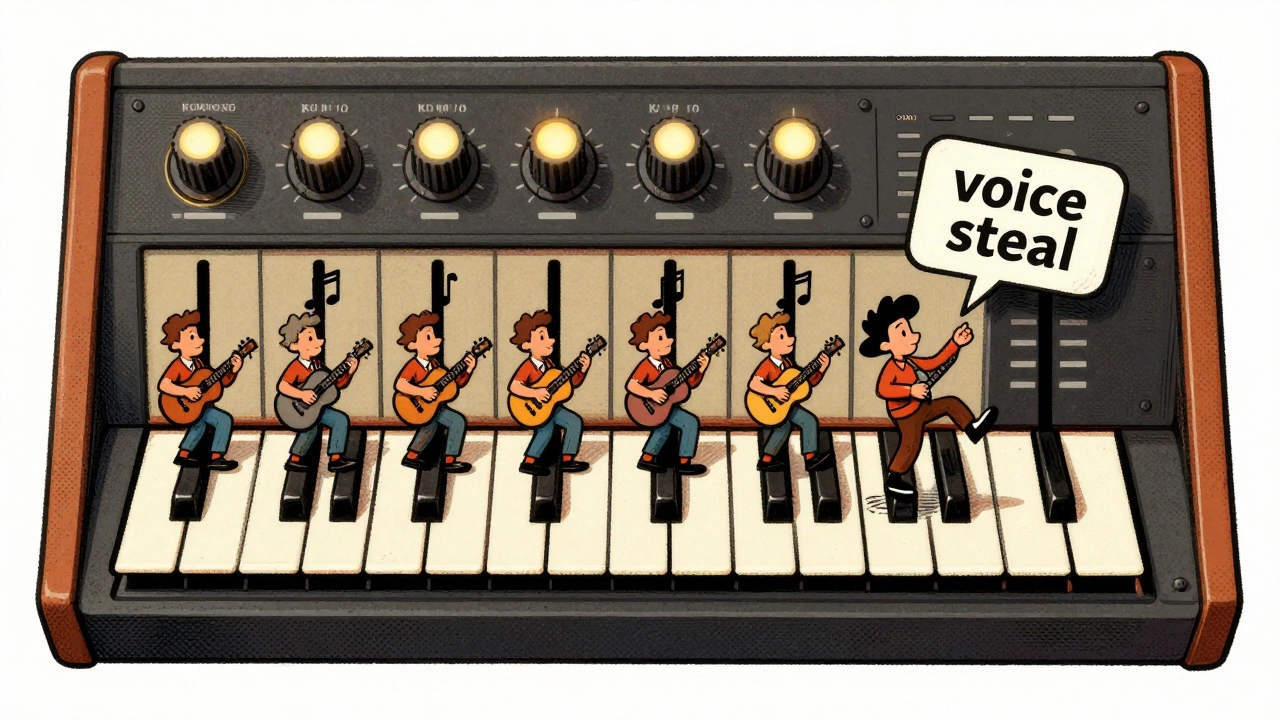

When you play a chord on a synth and every note rings out clearly-no notes cutting out, no glitches, no weird pitch jumps-you’re not just hearing music. You’re hearing decades of engineering breakthroughs hidden inside the machine. Polyphonic synthesis isn’t just about playing more than one note at once. It’s about voice allocation and chordal synthesis working together to make those notes feel alive.
What Exactly Is Polyphonic Synthesis?
Polyphony means a synth can play multiple notes at the same time. Simple enough, right? But behind that word is a complex system of resources, rules, and trade-offs. A 16-voice synth doesn’t just have 16 oscillators. It has 16 complete signal paths-each with its own oscillator, filter, envelope, and amplifier. That’s why a 16-voice analog synth costs more than a 4-voice one. Each voice needs its own circuitry. And in digital synths, each voice eats up CPU power.Early synths were monophonic. One note at a time. Think of the Moog Bass or the ARP Odyssey. You could play melodies, but chords? Forget it. Then came the Yamaha CS-80 in 1976. It didn’t just add polyphony-it reinvented how voices were managed. Its Sustain II system let you play a five-note chord with your left hand while soloing with your right, and the synth would never steal a note from the chord. That was magic. And it was expensive. Yamaha added 47 extra components per voice just to make it work. That’s why few other synths copied it.
How Voice Allocation Works
Voice allocation is the brain behind the polyphony. It decides which note gets which voice. When you press a key, the synth looks for an unused voice. If all are taken, it has to steal one. But which one?There are two main methods:
- Last-In, First-Out (LIFO): The oldest note gets cut off when you play a new one. Simple, but can sound jarring if a long-held chord note gets stolen.
- Round Robin: Voices are assigned in order. Voice 1 gets the first note, Voice 2 the second, and so on. When you hit the limit, it loops back to Voice 1. This spreads the load evenly.
Modern software like Cycling ’74’s RNBO gives you control over both. You can set @polyphony 8 for eight voices, and choose between simple (automatic) or user (manual) mode. In user mode, you can mute individual voices or send a note directly to Voice 3, Voice 7, or whatever you need. That’s powerful for live performance or complex sound design.
But here’s the catch: more voices mean more processing. On a laptop, going from 4 to 16 voices can spike CPU usage by 15-20%. That’s why some producers stick to 8 voices even if their machine can handle more. It’s not about capability-it’s about stability.

Chordal Synthesis: More Than Just Chords
Chordal synthesis isn’t just playing a C major triad. It’s about how those notes interact. A chord isn’t three random pitches-it’s a harmonic structure. And when each note in that chord has its own filter envelope, LFO, or modulation, the whole thing breathes.The CS-80’s genius wasn’t just voice allocation. It was how each voice responded independently to your touch. Press a chord softly, and the filters open gently. Slam it down, and they explode. That’s chordal synthesis in action: every note in the chord reacts to your dynamics, not just as a group, but as individuals.
Today’s synths like the Yamaha Reface CS and modern software plugins mimic this. But many still fall short. Some digital synths treat chords as a single unit-applying the same envelope to all notes. That kills the expressiveness. Real chordal synthesis lets you feel the tension between the root, third, and fifth. It’s what makes a synth sound human.
Why Modern Synths Still Struggle
Even with all the tech we have, polyphony isn’t solved. AI voice processing, for example, is terrible at handling chords. Sonarworks’ 2023 analysis found that polyphonic AI vocal processing creates 43% more artifacts than processing each voice separately. Why? Because when multiple voices overlap, their frequencies fight. The AI doesn’t know which note is which. It hears noise, not music.Even in hardware, compromises exist. A synth might advertise 32 voices, but if it’s multi-timbral (playing different sounds at once), those voices get split. 16 voices for the bass, 10 for pads, 6 for leads. That’s not 32-note polyphony-it’s 16-note polyphony with extra layers.
And then there’s latency. Cycling ’74’s RNBO adds one signal vector of delay to keep voices in sync. That’s barely noticeable to humans-but in live performance, even 5ms can throw off timing. Engineers have to choose: perfect sync or zero delay. You can’t have both.

The Future: Smarter Voices
The next leap isn’t more voices-it’s smarter ones. Mutable Instruments is already testing dynamic voice allocation. If you play a complex chord with rich harmonics, the system might assign three voices to one note. If you play a simple sine wave, it uses just one. It reallocates DSP power on the fly. That’s efficiency. That’s intelligence.Cycling ’74’s RNBO 1.3, released in early 2024, uses predictive voice stealing. It watches your MIDI velocity and note duration to guess which note you’re likely to hold. It won’t steal a long, soft note just because you hit a quick staccato. That’s huge. It’s not just managing voices-it’s understanding music.
Yamaha’s 2023 CS-80 reissue brought back the original Sustain II algorithm… and added 128-voice polyphony via firmware. That’s not just nostalgia. It’s proof that the old way still works better than most new ones.
What This Means for You
If you’re buying a synth, don’t just look at the polyphony number. Ask: How does it allocate voices? Does it steal notes randomly? Can you control them manually? Does it preserve chord integrity when you play melodies over them?For producers: if you’re using AI vocal tools, avoid polyphonic processing. Process each harmony line separately. It takes longer, but the quality is 10x better.
For programmers: RNBO’s user voice mode isn’t just for experts. Once you learn to use mute and target, you can build instruments that respond like living things. One voice for the bass, another for the melody, a third for shimmering harmonics-all controlled independently.
And if you’re a musician: try the Yamaha Reface CS. It’s the closest thing to the original CS-80 you can buy today. Spend two weeks learning its voice allocation. You’ll start hearing the difference-not just in sound, but in how you play.
Polyphony isn’t about how many notes you can play. It’s about how many you can feel.


