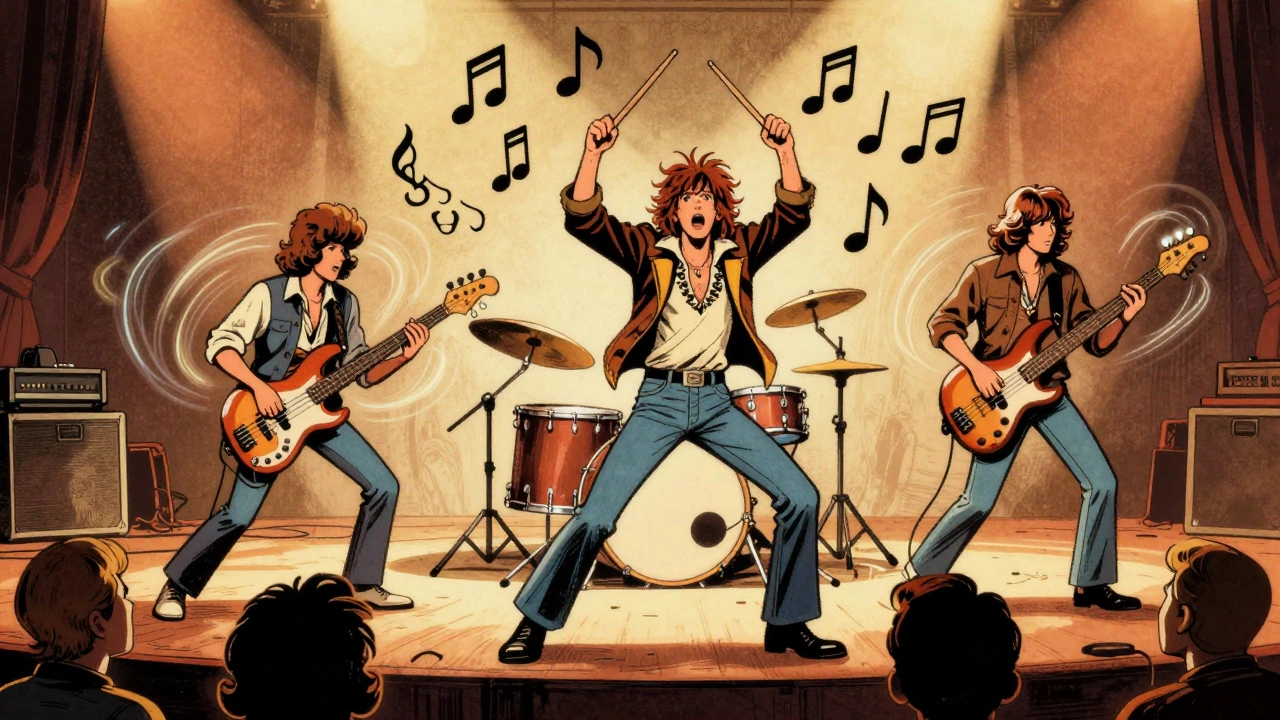

Most rock songs follow a simple beat: one-two-three-four, over and over. But in the 1970s, a handful of bands broke that rule-and changed rock music forever. Instead of sticking to 4/4, they used 7/8 and 13/8 time signatures to create grooves that felt off-kilter, hypnotic, and deeply human. These weren’t just gimmicks. They were the backbone of some of the most ambitious, enduring, and technically brilliant songs of the decade.
Why Odd Meters Mattered
Progressive rock didn’t just want to be loud or flashy. It wanted to be complex. While pop songs stuck to predictable rhythms, prog bands saw rhythm as a canvas. A measure of 7/8 doesn’t divide evenly. It doesn’t feel natural at first. That’s the point. It forces you to listen differently. It makes your head nod in a way you didn’t expect. It creates tension, then releases it in unexpected places. These odd meters weren’t chosen because they were hard. They were chosen because they sounded right for the story the music was telling. A 7/8 groove can feel like a stumble, a lurch, or a dance that never quite finds its footing. And that’s exactly what bands like Genesis and Rush wanted: music that made you feel something you couldn’t name.7/8: The Workhorse of Prog
Of all the odd meters used in the 1970s, 7/8 was the most common-and the most effective. Seven eighth notes per measure. That’s three beats longer than a standard 4/4 bar. But how you group those seven beats changes everything. You can split 7/8 into 2-2-3. That’s two beats, two beats, then three. It creates a lopsided swing, like a heartbeat that skips. Or you can do 4-3: four beats followed by three. That feels heavier, more deliberate. It’s the difference between stumbling and striding. Genesis used 7/8 to chilling effect in "Dance on a Volcano" from their 1976 album A Trick of the Tail. The song opens with a driving bassline and a snare that lands like a hammer on uneven ground. The drums don’t just keep time-they shape the mood. Every time the pattern resets, you feel it in your chest. It’s not just rhythm. It’s propulsion. Rush didn’t stop at one odd meter. In "Tom Sawyer," they layered 7/8 with 4/4, shifting back and forth like a train changing tracks mid-journey. The result? A groove that feels both chaotic and perfectly controlled. That’s the magic of prog: complexity that never feels messy.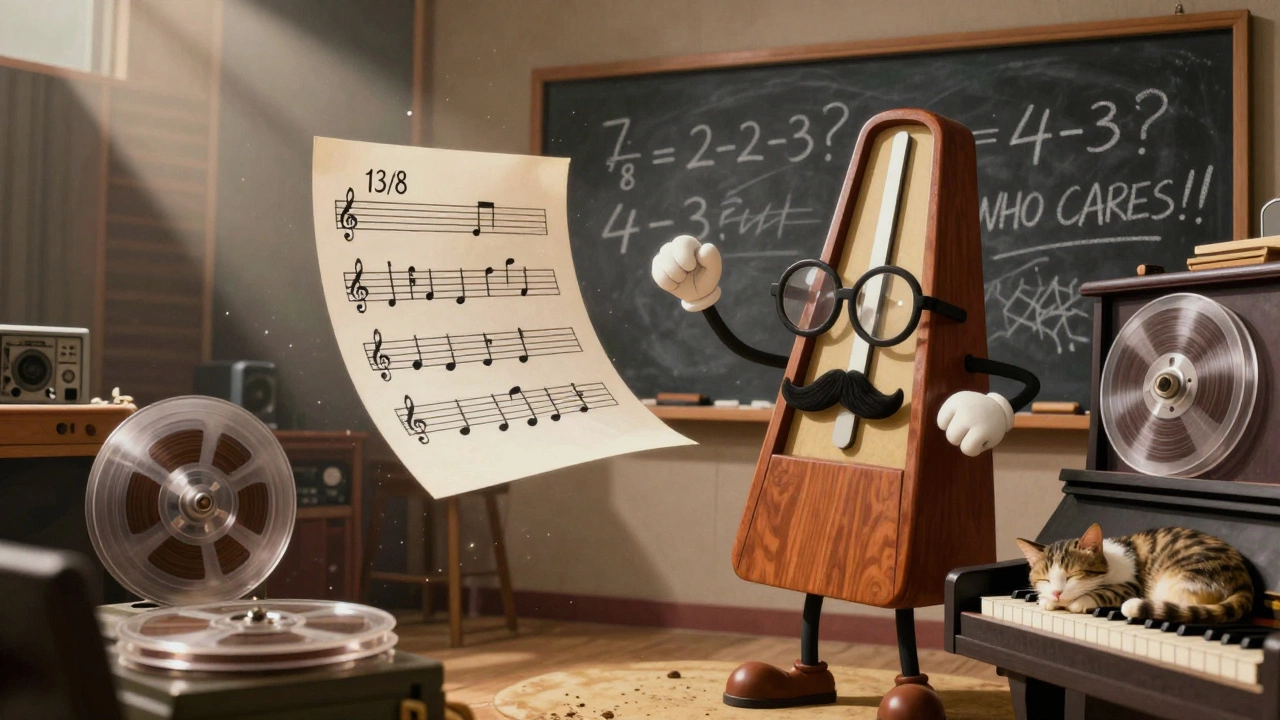
13/8: When Even the Experts Got Confused
Then there’s 13/8. Thirteen eighth notes. That’s more than a full bar of 4/4. It’s almost two bars long, but not quite. And that’s why it was so powerful. Genesis’s "Turn It on Again" is often cited as being in 13/8, but even the band members disagreed on how to count it. Was it 7/8 + 6/8? 6/8 + 7/8? Or one giant 13/8? The answer? It didn’t matter. What mattered was the feel. The song swings, stumbles, and locks back into place like a puzzle clicking together. It’s not about math. It’s about motion. Rush’s "Freewill" takes it further. The main groove can be counted as 6/4 + 7/4, which equals 13/4. But since 13/4 is just 13/8 doubled, the effect is the same: a long, winding phrase that refuses to settle. Neil Peart’s drumming here isn’t just technical-it’s poetic. He’s not playing notes. He’s telling a story in time.How These Meters Changed the Music
Before 7/8 and 13/8, rock drums were about keeping time. After them, drums became storytellers. Drummers like Phil Collins, Neil Peart, and Bill Bruford didn’t just play rhythms. They built them. They counted bars in their heads. They rehearsed patterns for weeks. They made odd meters feel natural, even inevitable. That’s why these songs still move people 50 years later. It wasn’t just about showing off. It was about pushing boundaries. These bands didn’t want to play songs that fit on the radio. They wanted to create worlds you could get lost in. A 7/8 groove doesn’t just carry a melody. It becomes part of the melody. It’s the heartbeat of the song.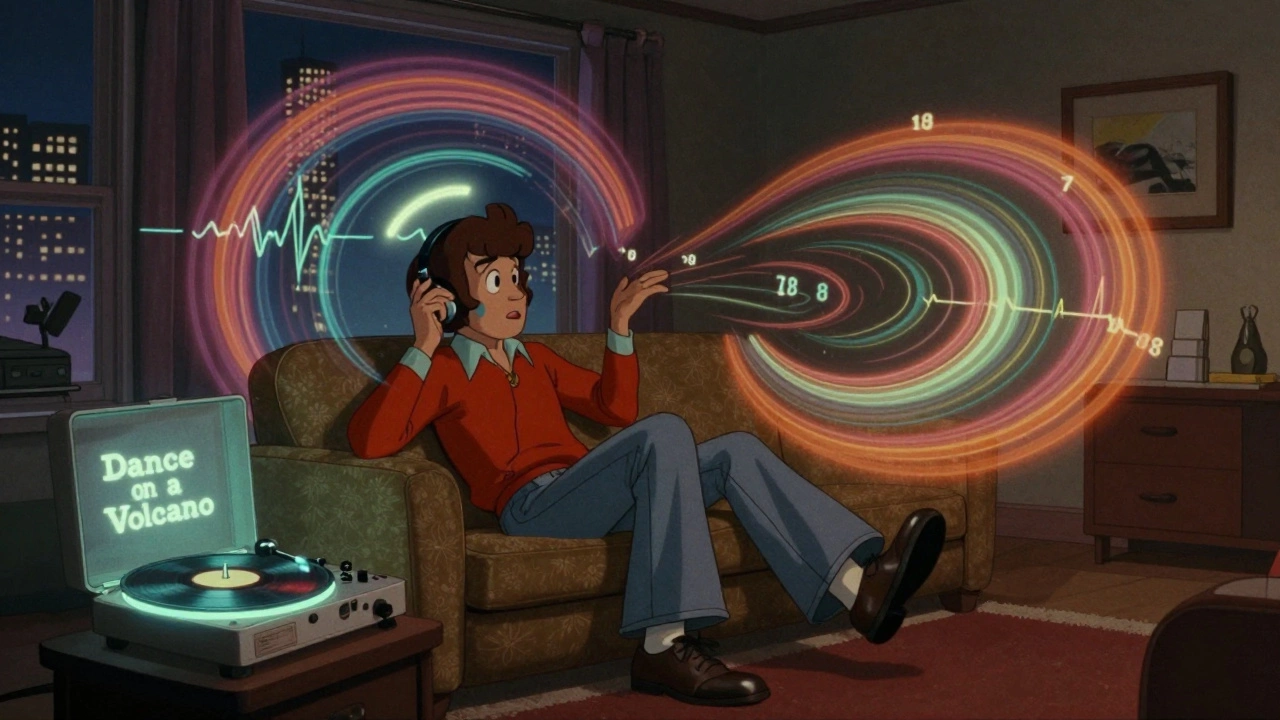
The Legacy Lives On
You hear 7/8 in modern metal bands like Tool and Meshuggen. You hear it in film scores and video game soundtracks. But it all started here-in the 1970s, in studios filled with tape reels and ambition. Pink Floyd’s "Money" used 7/4, not 7/8, but the spirit was the same. It was a groove that refused to be ordinary. It was a statement: rock music didn’t have to follow the rules. King Crimson’s "Red" uses shifting meters that feel like a storm breaking over a city. Van der Graaf Generator’s "Lament" twists 13/8 into something haunting. Jethro Tull’s "Aqualung" sneaks in odd beats beneath the folk-rock surface. Every one of these songs proves that rhythm doesn’t have to be simple to be powerful.Why You Still Feel It Today
Try this: put on "Dance on a Volcano" and tap your foot. You’ll probably start in 4/4. Then you’ll realize it doesn’t fit. You’ll pause. You’ll listen again. And then, without thinking, your body finds the groove. That’s the power of odd meters. They don’t just challenge your ears. They retrain your body. These songs weren’t made to be understood. They were made to be felt. And that’s why they still matter.What’s the difference between 7/8 and 7/4?
The difference is in the note value. 7/8 means seven eighth notes per measure, while 7/4 means seven quarter notes. That makes 7/4 twice as long as 7/8. 7/4 feels slower and heavier, like a marching band. 7/8 feels faster and more urgent, like a stumble or a dance. Pink Floyd’s "Money" uses 7/4, giving it that slow, clinking cash-register groove. Genesis’s "Dance on a Volcano" uses 7/8, making it feel like a nervous energy.
Why do some bands say "13/8" when others say "13/4"?
It’s about how you hear it. 13/8 means thirteen eighth notes. 13/4 means thirteen quarter notes-which is actually 26 eighth notes. So if a band says "13/4," they’re probably thinking in quarter-note groupings. But if the music feels fast, it’s likely meant to be counted as 13/8. Genesis and Rush often wrote in 13/8, even if they referred to it as 13/4. It’s less about math and more about feel. If it swings in eighths, it’s 13/8. If it drags in quarters, it’s 13/4.
Did any bands use 13/8 outside of prog rock?
Rarely. 13/8 is almost exclusive to progressive music because it’s so hard to make feel natural. You can find fragments of it in modern jazz and avant-garde classical music, but no mainstream pop or rock artist has used it as a core groove. That’s why it’s still a hallmark of prog. It’s not just complex-it’s rare.
Can you play 7/8 on a guitar?
Absolutely. In fact, guitarists like Tony Banks and Alex Lifeson used 7/8 to build riffs that locked into the drums. Genesis’s "Dance on a Volcano" has a guitar part that repeats every seven beats, creating a hypnotic pulse. Rush’s "Tom Sawyer" uses a guitar figure that shifts with the drums, making the odd meter feel like a natural groove. It’s not about playing fast. It’s about playing with intention.
Why did these time signatures fade after the 1970s?
They didn’t fade-they evolved. As punk and new wave took over in the late ’70s, complexity fell out of favor. But in the 1980s, metal bands picked up where prog left off. Dream Theater, Tool, and even System of a Down built entire albums around 7/8 and 13/8. The difference? The 1970s bands made it feel like art. The 1980s and ’90s bands made it feel like power. Both are valid. But the original spark? That was prog.


