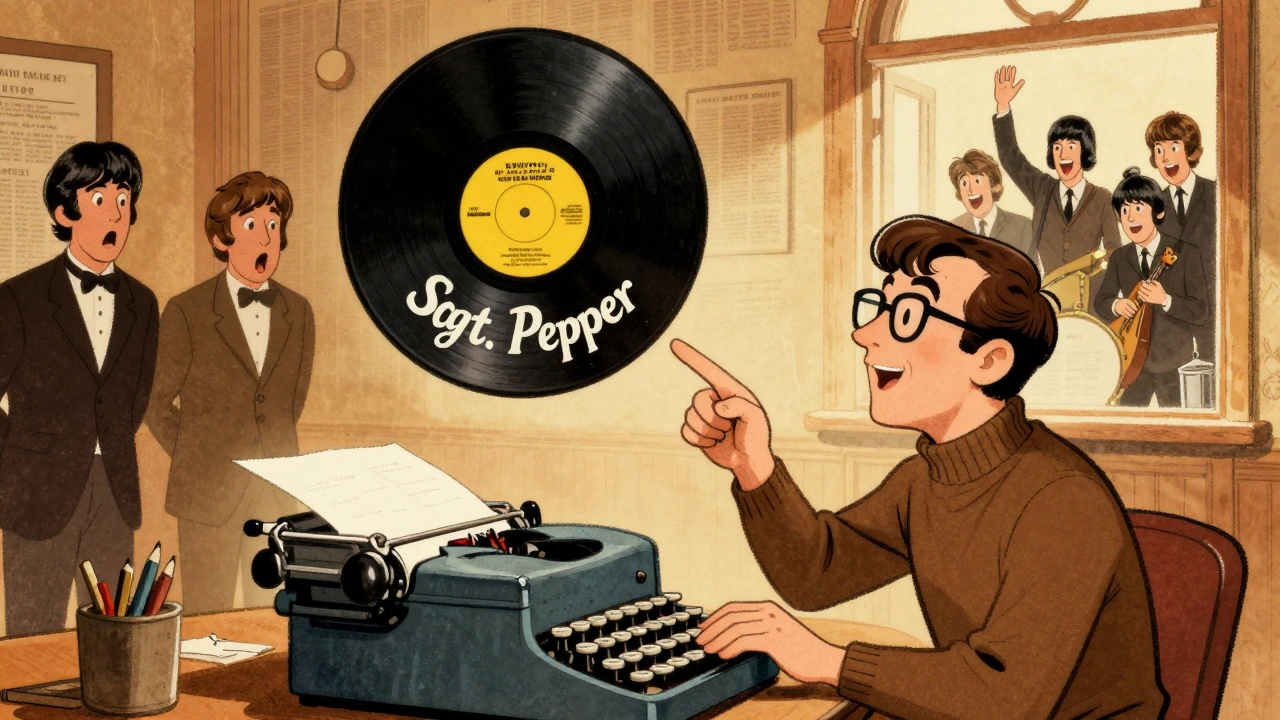

Think about the last album review you read. Was it about how the artist felt? The production choices? The cultural moment it came from? That kind of deep, thoughtful writing didn’t just appear out of nowhere. It came from a revolution in music journalism that started in the 1970s - a time when critics stopped treating rock and pop as just background noise and started treating them like art worth dissecting.
Before the 1970s: Pop Wasn’t Supposed to Be Taken Seriously
In the early 1960s, if you wanted to read about music in a serious newspaper, you’d find reviews of symphonies, operas, and classical concerts. Pop music? It was either ignored or treated like a passing fad. That changed in December 1963, when William Mann is a classical music critic for The Times who wrote one of the first serious appreciations of the Beatles. It was shocking. A major newspaper was treating a pop band like Beethoven. A year later, The Observer hired George Melly as its first "critic of pop culture," a title that signaled a major shift. Suddenly, pop wasn’t just for teens - it was for thinkers.
By 1968, The Guardian made it official: they hired Geoffrey Cannon as their first full-time rock critic. This wasn’t just a new job title - it was the birth of a new kind of journalism. Music was no longer just entertainment to be listed in the weekend section. It was something to be analyzed, debated, and defended.
The 1970s: When Music Journalism Became a Movement
The real transformation happened in the 1970s. Magazines like Melody Maker stopped just listing chart positions. They started publishing long-form essays on Led Zeppelin, David Bowie, and Can. Writers like Chris Welch and Ray Coleman treated musicians like authors - their albums as novels, their lyrics as poetry.
And it wasn’t just underground magazines. Time, Newsweek, and Life ran cover stories on Sgt. Pepper’s Lonely Hearts Club Band. That album didn’t just sell records - it forced the mainstream to ask: What if rock music was actually important? Critics started treating it like jazz or classical: complex, layered, worthy of scholarly attention.
The Birth of the "Unpop Avant-Garde"
Not everyone was into rock stars with long hair. In the late 1970s, a different kind of music journalism emerged around experimental scenes in the UK. Publications like Microphone, Musics, and Re/Search wrote about noise, improvisation, and non-Western influences. These weren’t just reviews - they were manifestos. They asked: Why should we only care about music that sells? What about the weird, the quiet, the abrasive?
This was the rise of the "unpop avant-garde" - a term scholars use to describe music that didn’t fit into any category. Critics didn’t dismiss it. They tried to understand it. That attitude - that all music deserves serious thought - is still alive today. When a critic writes about a drone album from Tokyo or a field recording from rural Nigeria, they’re following a path laid out by those 1970s writers.
Punk, New Wave, and the Myth of Authenticity
When punk exploded in the mid-1970s, music journalism didn’t just report on it - it helped shape it. Writers from Creem and NME didn’t just describe the music; they explained the attitude. They wrote about Patti Smith and Richard Hell not just as performers, but as cultural rebels.
That’s when the idea of "authenticity" became a critical tool. Was a band real? Were they selling out? Was their anger genuine? Seymour Stein of Sire Records didn’t just sign bands - he became a character in the story. Critics wrote about how he moved from underground clubs to major label deals, turning punk into "new wave." That tension - between underground ideals and commercial success - became a recurring theme in music writing. And it still is.
The Debate: Who Gets to Decide What’s Good?
Not everyone agreed on what music criticism should be. In 1967, Richard Meltzer wrote a piece in Crawdaddy! that mocked the idea of "high art" rock. He argued that critics were overthinking it. That sparked a fire. Robert Christgau and Lester Bangs responded with essays that were emotional, personal, and fiercely intelligent.
Bangs, in particular, became the model for a new kind of critic. He didn’t write cold, academic reviews. He wrote like he was screaming into a microphone. He loved The Stooges but also tore into them. He made you feel the music - but he also made you think about why you felt it. His writing created a tension that still defines music journalism: Do we value the emotion, or the craft? Do we praise an artist for raw feeling, or for technical skill? That question hasn’t been answered - and it never will be.

Poptimism: The 1970s Legacy That Fought Back
By the 2000s, a new generation of critics pushed back against the rock-centric canon that 1970s critics had helped build. They called it "poptimism." Instead of treating rock as the highest form of popular music, they argued that Britney Spears, Drake, and Rihanna deserved the same level of analysis as The Rolling Stones.
This wasn’t a rejection of the 1970s - it was an extension of it. The 1970s critics had fought to prove that pop could be art. The poptimists were fighting to prove that all pop could be art - not just the "serious" stuff. The debates they sparked - about elitism, taste, and cultural power - are direct descendants of the ones started by Meltzer and Bangs.
Today’s Critics: Carrying the Torch
Today, music journalism doesn’t look like it did in 1975. Magazines are gone. Blogs are fading. TikTok reviews are everywhere. But the core ideas? Still here.
When a critic writes about how Lizzo’s music challenges body image norms, they’re building on Ellen Willis’s feminist critiques from the 1970s. When someone analyzes the production of a Kanye West album as a cultural artifact, they’re using the same tools that Geoffrey Cannon used on David Bowie.
The tools have changed - streaming, social media, algorithms - but the mission hasn’t. Music journalism today still asks: What does this sound mean? Who made it? Why does it matter? Those questions were forged in the fires of the 1970s. And they’re still the only ones that matter.
Why did music journalism change in the 1970s?
Before the 1970s, popular music was rarely taken seriously by mainstream media. The shift happened because newspapers and magazines began hiring dedicated critics to cover rock, pop, and experimental music as legitimate art forms. Events like the release of Sgt. Pepper’s Lonely Hearts Club Band and the hiring of critics like Geoffrey Cannon at The Guardian institutionalized music criticism as a professional field. Writers began analyzing lyrics, production, and cultural context instead of just reviewing chart success.
Who were the most influential music critics of the 1970s?
Lester Bangs, Robert Christgau, and Ellen Willis were among the most influential. Bangs wrote with raw emotion and intellectual depth for Creem magazine, challenging both fans and fellow critics. Christgau developed the "Consumer Guide" ratings system that brought critical rigor to pop music reviews. Willis pioneered feminist music criticism, analyzing gender, race, and power in rock and pop. Their work set the standard for how music could be written about - not just as entertainment, but as cultural expression.
How did punk rock shape music journalism?
Punk forced critics to rethink what counted as "important" music. Bands like The Ramones and The Clash didn’t play technically complex songs, but their energy and politics demanded serious attention. Journalists began documenting not just the music, but the scenes, the DIY ethics, and the rebellion against industry norms. This led to a new kind of criticism that valued authenticity over polish - a legacy that still influences how underground music is covered today.
What is poptimism, and how is it connected to 1970s criticism?
Poptimism is the idea that all popular music - even mainstream pop - deserves serious critical analysis, not just rock or indie genres. It emerged in the 2000s as a reaction to the rock elitism that had dominated criticism since the 1970s. But it’s not a rejection of that era - it’s an extension. The 1970s critics fought to make pop music worthy of respect. Poptimists expanded that idea to include artists like Beyoncé and Justin Timberlake, arguing that cultural value shouldn’t be tied to genre or sales.
Is music journalism still relevant today?
Yes - but differently. While print magazines have declined, deep music writing lives on in newsletters, Substacks, podcasts, and long-form online essays. The core mission remains: to help listeners understand why music matters. Critics today still ask the same questions as in the 1970s - who made this? What does it mean? Why does it move people? Those questions don’t disappear just because the platform changes.


