
What Is a Simulcast, Really?
A simulcast isn’t just broadcasting the same thing twice-it’s sending the exact same live event out over multiple platforms at the exact same moment. Think of it like shouting the same message into five different megaphones at once: one aimed at your radio, one at your TV, one at your phone, one at your smart speaker, and one at YouTube. The goal? Reach more people, in more places, without having to film or record it all over again.
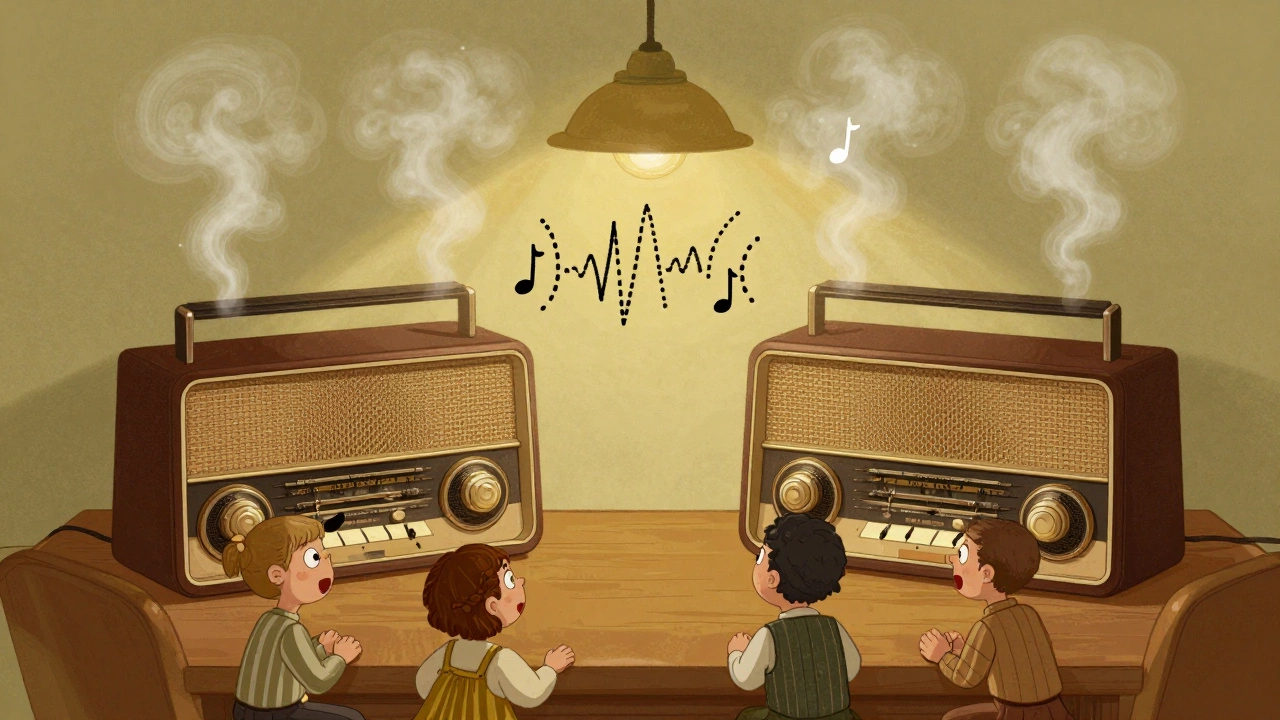
This isn’t new. Back in 1926, the BBC did something clever: they broadcast the same symphony concert on both medium-wave and long-wave radio. Listeners with two radios could tune into both and get a crude kind of stereo sound. No fancy headphones. No apps. Just two boxes on the table, playing the same music, slightly out of sync, but still better than one. That was the first real simulcast-and it worked because people were already used to showing up at a certain time to hear something special.
Appointment Listening: The Old Habit That Won’t Die
Before Netflix, before Spotify, before TikTok, people didn’t just listen whenever they felt like it. They scheduled their lives around the broadcast. Sunday night at 8 p.m.? That’s when Gunsmoke came on. Wednesday morning at 7:30? That’s when the morning news started. This was called appointment listening-and it built communities. Families gathered around the radio. Neighbors talked about the same episode the next day at the grocery store. It wasn’t just content. It was a shared experience.
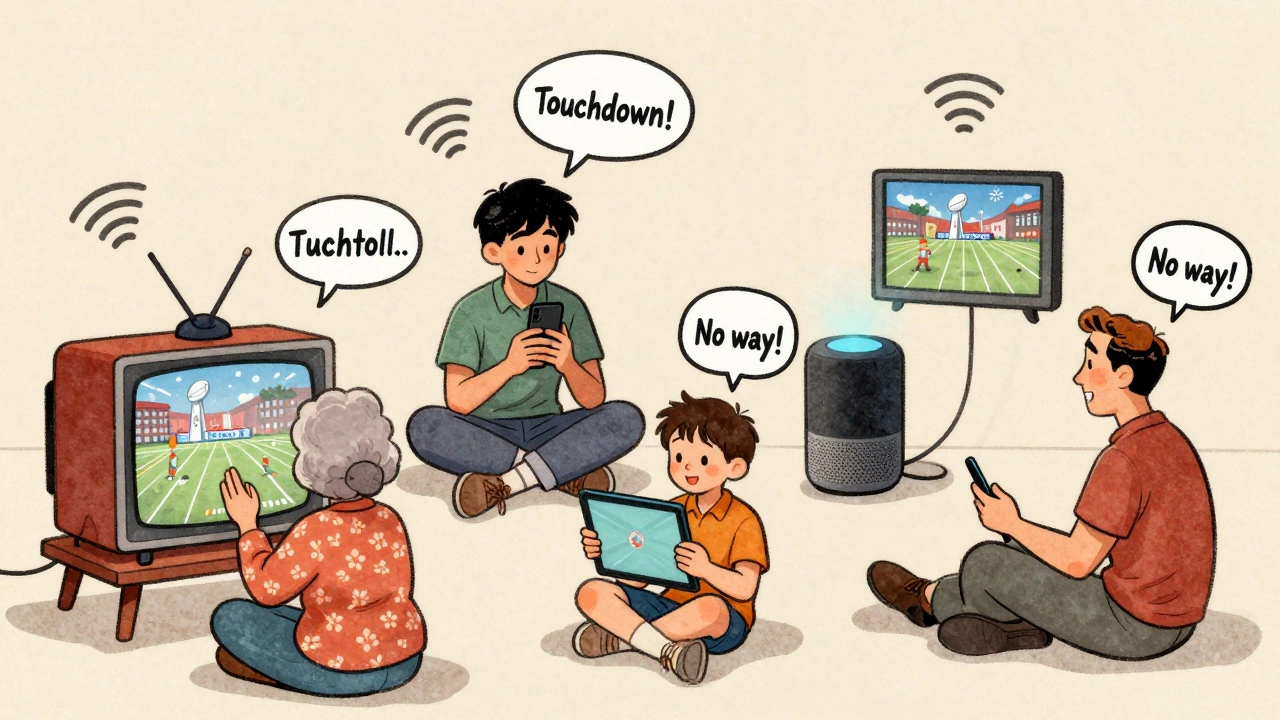
Even today, 63% of people still do it. Nielsen found that people still sit down for live sports, breaking news, and award shows. Why? Because something about watching or listening at the same time as millions of others feels meaningful. It’s not about convenience. It’s about connection. Simulcasting didn’t kill appointment listening-it gave it new legs. Now, instead of just your TV or radio, you can watch the Super Bowl on your phone while your cousin watches it on YouTube. You’re still showing up together. You’re just doing it on different screens.
How Simulcasting Works Today (No PhD Required)
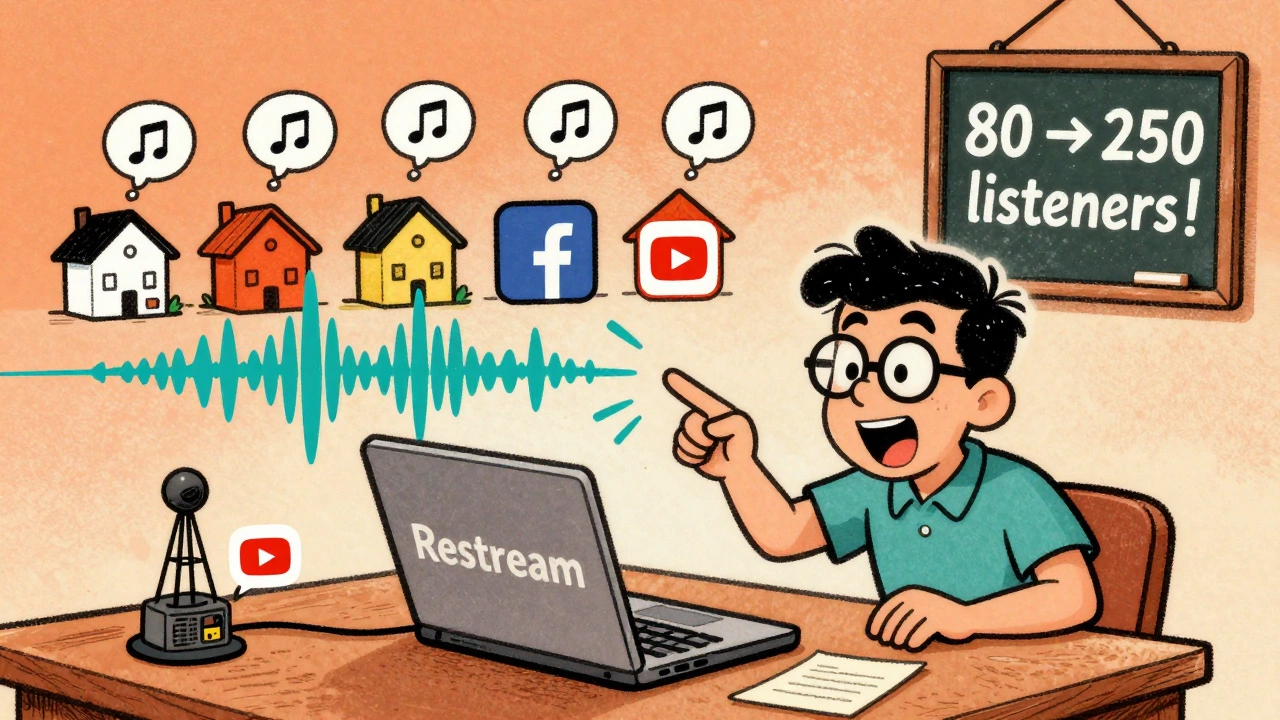
Back in the day, simulcasting meant running two radio transmitters or syncing a TV feed with a radio station’s audio. Today, it’s mostly done with software. You plug your camera and mic into a laptop, open a streaming tool like Restream or StreamYard, and click ‘Go Live Everywhere.’ The software takes your one video feed and pushes it out to YouTube, Facebook, LinkedIn, and Twitch-all at once. It even adjusts the resolution and bitrate for each platform so your stream doesn’t buffer on mobile but still looks sharp on a big screen.
Most small stations or podcasters can set this up for under $200. All you need: a decent internet connection (10 Mbps upload minimum), a simple encoder (many laptops can do it), and a few minutes to configure the platforms. No need for expensive broadcast gear. Even high school radio clubs are doing it now. One station in Oregon started simulcasting their weekly jazz show on Facebook and saw their audience jump from 80 listeners to over 250 in three months.
The Hidden Problems (And How to Fix Them)
It’s not all smooth sailing. The biggest complaint? Audio sync. You’re watching a live concert on YouTube, and the drums lag half a second behind the video. On your phone, the host’s voice is choppy. On the radio, it’s crystal clear. That’s not your fault-it’s the internet. Different platforms process streams differently. One might add a 2-second delay to prevent trolls from ruining the show. Another might compress the audio to save bandwidth.
Then there’s licensing. If you play a song on your radio station and simulcast it online, you’re not just covered by your broadcast license anymore. You need a separate digital performance right. In the U.S., that costs between $3,500 and $7,200 a year for a small station. Many don’t realize this until they get a letter from the Copyright Office. It’s a trap. Always check with your local radio association before going live online.
And don’t forget the sound quality. FM radio has a warm, rich tone. Internet streams? Often thin and tinny. That’s because they’re compressed to save bandwidth. Some stations solve this by sending a separate, high-quality audio feed just for their website-keeping the radio version as-is. It’s extra work, but loyal listeners notice the difference.
Why Big Broadcasters Can’t Afford to Skip Simulcasting
Major networks aren’t doing this because it’s trendy. They’re doing it because they have to. In 2023, 87% of radio stations offered an internet simulcast. That’s up from 42% in 2018. Why? Because their traditional audience is aging. Younger people don’t own radios. They don’t watch live TV. But they do scroll on their phones.
When the NFL simulcast its Thanksgiving game across broadcast TV, Amazon Prime, and YouTube in 2023, it hit 22.7 million concurrent viewers. That’s not just numbers-it’s survival. If you want to stay relevant, you need to be where the people are. And now, that’s everywhere.
Even public safety agencies use simulcasting. Emergency alerts now blast out over AM/FM radio, TV, cell phones, and even smart home speakers-all at once. It’s not about entertainment. It’s about making sure you hear the warning, no matter what device you’re using.
The Future: AI, Translation, and Personalized Simulcasts
The next leap? AI. In early 2023, a startup called Oreate AI started automatically adding live subtitles and voice translations to simulcasts in 15 languages. A concert in Portland could be watched in Spanish, Mandarin, or Arabic-with the translation synced to the music. That’s not science fiction. That’s happening now.
By 2026, analysts predict simulcasting will get smarter. Instead of sending the same feed to everyone, AI might adjust the stream based on who’s watching. Your phone gets a low-bandwidth version. Your smart TV gets the 4K feed. Your friend in Germany gets the Spanish translation. But the core event? Still live. Still synced. Still shared.
That’s the magic of simulcasting: it keeps the communal experience alive while letting each person experience it their own way. You don’t have to choose between tradition and technology. You can have both.
What You Can Do Today
- If you run a local radio show or podcast: Start with one platform. Facebook Live or YouTube is easy. Test it for a week. See how many extra people show up.
- If you’re a listener: Don’t just tune in on your radio. Check if your favorite station streams online. You might get better sound, extra commentary, or even live chats with the hosts.
- If you’re organizing a live event: Don’t just broadcast it on one channel. Simulcast it. Even if you’re small, you’ll reach people who missed it on TV or radio.
Simulcasting isn’t about replacing the old ways. It’s about expanding them. The same song, the same moment, the same feeling-just shared with more people, in more places, on more devices. That’s not just technology. That’s community.
What’s the difference between simulcasting and streaming?
Streaming means sending a live or recorded show over the internet to one platform, like YouTube or Spotify. Simulcasting means sending that same live show to multiple platforms at the exact same time-like YouTube, Facebook, and your radio station’s website-all at once. Simulcasting is a type of streaming, but not all streaming is simulcasting.
Is simulcasting the same as multicasting?
No. Simulcasting sends the same content to multiple platforms (like YouTube and radio) using separate connections. Multicasting sends the same content over a single network connection to many users at once-usually within a private system, like a company’s internal TV network. Multicasting saves bandwidth but doesn’t reach the public internet. Simulcasting is for public audiences.
Do I need special equipment to simulcast?
Not necessarily. For basic simulcasting, you just need a laptop, a webcam or microphone, and a stable internet connection (10 Mbps upload or higher). Free or low-cost software like Restream, StreamYard, or OBS can handle the rest. You don’t need a studio. Many podcasters and small radio stations use just a phone and a $30 mic.
Why does my simulcast sound worse online than on the radio?
Radio stations use high-quality, uncompressed audio for FM/AM broadcasts. Online streams are compressed to save bandwidth, which can make them sound thin or muffled. To fix this, some stations send a separate, higher-quality audio feed to their website or app-keeping the radio broadcast clean and the online version richer.
Can I simulcast copyrighted music without getting in trouble?
No. If you play music on your radio station and simulcast it online, you need a separate digital performance license. Broadcast licenses don’t cover internet streaming. In the U.S., this costs $3,500-$7,200 per year for small stations. Always check with your local broadcasters’ association before streaming music online.
Is appointment listening dead?
Not even close. While 89% of people scheduled their time around broadcasts in 2010, 63% still do today-especially for live sports, news, and major events. Simulcasting doesn’t kill appointment listening; it enhances it. Now, you can watch the same game on your phone, tablet, or TV, but you’re still watching it at the same time as everyone else. The ritual is alive-it’s just on more screens.


