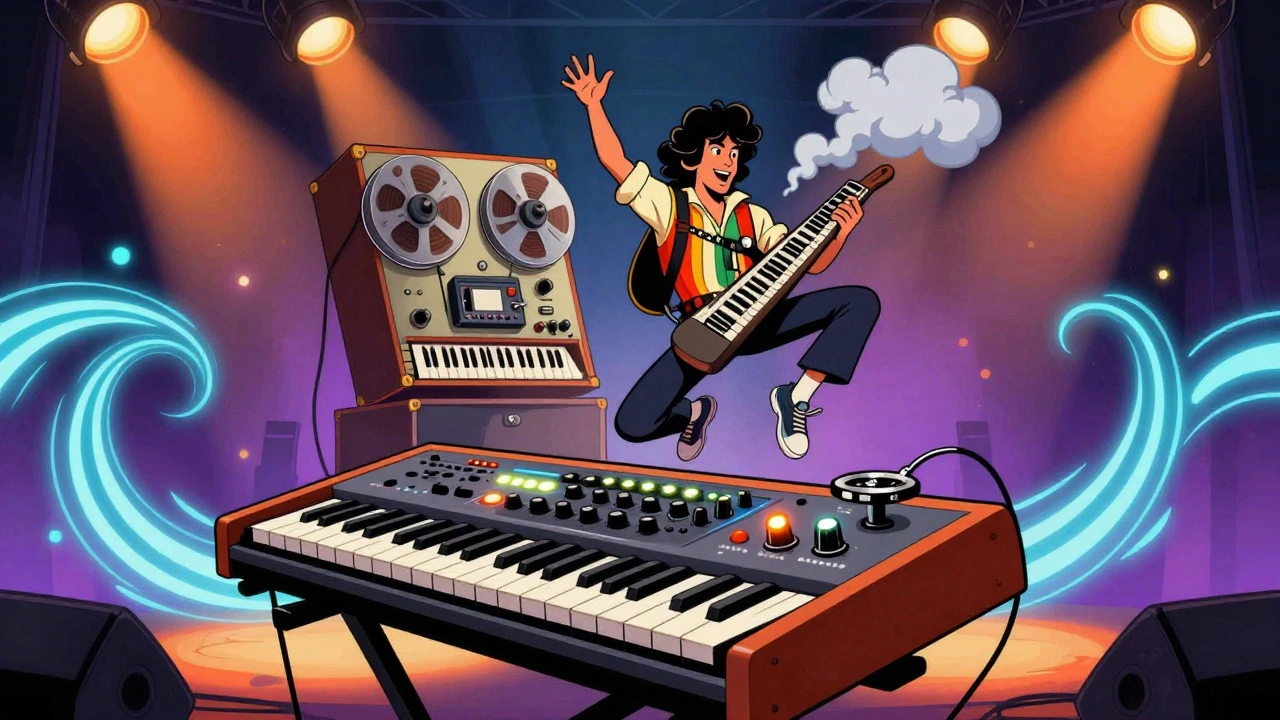

Back in the 1970s, if you walked into a progressive rock concert, you didn’t just see guitars and drums. You saw a wall of gear-massive machines with knobs, tapes, and cables that looked like something out of a sci-fi lab. These weren’t just instruments. They were sound factories. And at the heart of it all were three machines that changed how music was made: the Minimoog, the ARP synthesizers, and the Mellotron.
Why These Three Instruments Mattered
Before the 1970s, keyboards in rock bands mostly meant Hammond organs or pianos. They filled space, supported chords, and stayed in the background. Then came a wave of bands-Yes, Genesis, King Crimson, ELP-who wanted more. They wanted sounds that didn’t exist in nature. Sounds that could scream, swell, flutter, and cry like a human voice. That’s where these three machines stepped in.The Minimoog wasn’t the first synth, but it was the first one you could actually play live like a lead instrument. Released in 1970, it was compact, portable, and surprisingly intuitive. No patch cables. No modular chaos. Just three oscillators, a filter, and a pitch-bend wheel. It could sound like a horn, a bass, or a spaceship taking off. Rick Wakeman used it on Yes’s Close to the Edge to cut through the mix with searing leads. It didn’t just add color-it became the voice of the band.
ARP didn’t invent synths, but they fixed what Moog got wrong. Robert Moog’s early synths drifted out of tune when they got warm. ARP founder Alan Pearlman noticed this. He didn’t just tweak the circuitry-he put the entire oscillator system on one chip, so temperature changes didn’t throw things off. The result? The ARP 2600 and the ARP Odyssey. The 2600 had a detachable keyboard, which meant musicians like Edgar Winter could strap it to their chest like a guitar and play solos while moving across the stage. The Odyssey? It had a different pitch-bend feel. Duke, from the band The Aura, said he could get a vibrato with his thumb on the ARP that he couldn’t replicate on the Minimoog. It wasn’t just about sound-it was about how you moved your body while playing.
The Mellotron: A Tape Machine That Sounded Like an Orchestra
If the Minimoog was the lead singer, the Mellotron was the choir. It didn’t generate sound electronically. It played magnetic tape loops. Every key had a tiny strip of tape with a recording of a string section, flute, or choir. Press a key, and that tape played. Hold it, and the tape ran out after about eight seconds. That’s not a bug-it was a feature. Musicians had to think differently. If you wanted a sustained chord, you couldn’t just hold it. You had to layer inversions, add sevenths, or stagger the notes so the sound never died. Rick Wakeman used two Mellotrons on The Six Wives of Henry VIII, one for strings, one for brass. The result? A symphony played by one man.But it was heavy. Like, 150 pounds heavy. And the mechanism? Clunky. You could feel the resistance in the keys. Tape would jam. Dust got in. The machine needed a technician just to keep it running. But the sound? Nothing else could replicate it. Even today, digital samplers can’t fully capture the slight warble, the breathiness, the imperfection of those tapes. That’s why bands like Genesis and King Crimson kept using it-even when newer synths came out.
How They Worked Together
No one used just one. A typical 1970s prog keyboard rig looked like a control room. You’d have a Hammond organ for that warm, gritty tone. A Mellotron for strings and choirs. A Minimoog for screaming leads. And an ARP 2600 or Odyssey for weird textures and experimental sounds. On LIBRA’s 1977 album Shock, the keyboardist used all three: Minimoog, ARP Omni, and Mellotron. Each had its job. The Hammond laid the foundation. The Mellotron painted the sky. The Minimoog screamed through the clouds. The ARP added the metallic shimmer.It wasn’t just about stacking sounds. It was about contrast. The Mellotron’s tape hiss against the Minimoog’s clean sine waves. The ARP’s gritty filter sweeps against the Hammond’s organ growl. These weren’t random choices. They were deliberate. Each instrument brought something the others couldn’t. And that’s why these rigs became legendary.
The Limitations That Sparked Creativity
These machines were frustrating. The Mellotron’s tape loops meant you couldn’t hold a chord. The Minimoog was monophonic-you could only play one note at a time. The ARP 2600 had an inverted keyboard layout where C stayed C, but D flat became B. Joe Zawinul of Weather Report said it forced him to think differently. “You get different ideas,” he said. That’s the truth. You didn’t just play notes-you solved problems. You had to plan your phrases. You had to anticipate when a tape would run out. You had to learn how to bend a pitch with your thumb, not your ear.And that’s what made them special. They weren’t plug-and-play. They demanded skill. You had to understand voltage-controlled oscillators, envelope generators, and filter slopes. You had to know how to tune a synth in a hot venue. You had to carry a toolbox on tour. But the reward? Unique sounds no one else could replicate. That’s why bands like Tangerine Dream, Pink Floyd, and Emerson, Lake & Palmer didn’t just use these tools-they redefined rock music with them.
The Legacy Lives On
The original Minimoog Model D was reissued in 2016 with the exact same circuitry. The ARP Odyssey has been cloned by Behringer for a fraction of the price. The Mellotron still has a cult following, and Streetly Electronics still repairs vintage units and sells digital versions like the M4000D. Why? Because these machines weren’t just gadgets. They were instruments that forced musicians to think differently. They didn’t just make sounds-they shaped how music was composed.Today’s producers can load a plugin that mimics the Mellotron’s choir sound in milliseconds. But they’ll never feel the resistance of the tape mechanism. They’ll never have to plan their chord voicings around an eight-second loop. They’ll never have to wrestle with a synth that goes out of tune because the room got too warm. And that’s the secret. The magic wasn’t in the sound. It was in the struggle. The limitation. The imperfection.
That’s why, 50 years later, you still hear those sounds in modern prog, metal, and even pop. Because once you’ve heard a Minimoog scream, an ARP howl, or a Mellotron sigh, you can’t unhear it. Those machines didn’t just change rock music. They changed what music could be.


