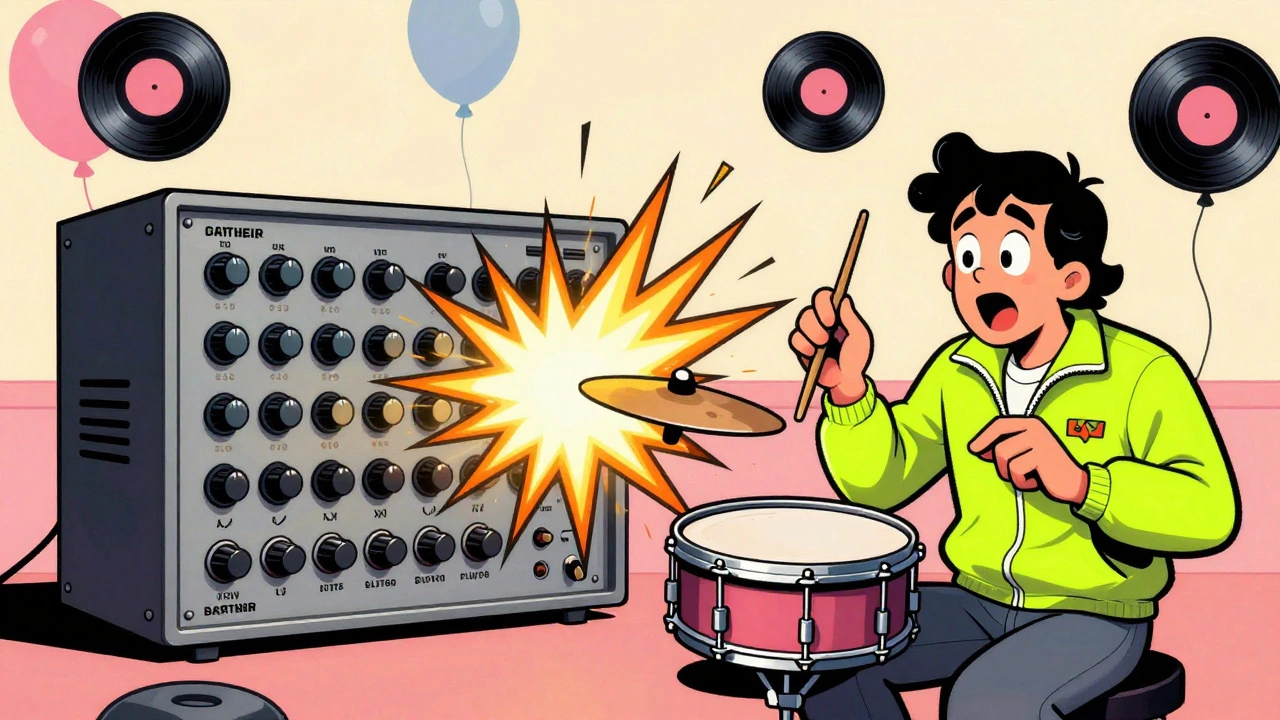

Want to make a song that sounds like it came straight off a 1985 radio hit? It’s not just about using synths and big hair. The perfect 1980s pop sound was built on a very specific set of tools, techniques, and even accidents. This wasn’t just a style-it was a technical revolution. If you’re trying to recreate it today, you need to understand what made it work, not just copy the presets.
The Gated Reverb Breakthrough
Before 1980, reverb on drums was smooth, natural, and long. Then, in 1980, producer Hugh Padgham was recording Phil Collins’ drums for Peter Gabriel’s third album. He accidentally left the gate on his AMS RMX16 digital reverb unit open too wide. The result? A snare that exploded with space, then cut off like a switch had been flipped. That sound-gated reverb-became the heartbeat of 80s pop.
It wasn’t just any reverb. It had to be exactly 1.8 to 2.5 seconds long, then cut off abruptly at 300 to 500 milliseconds. The AMS RMX16 was the only unit that could do this reliably. Today, plugins like Arturia Rev INTRO or Waves H-Delay can replicate it, but most producers get it wrong. They use too much decay or don’t gate hard enough. The magic was in the sudden silence after the crash. If your snare still rings out like a cathedral, you’re not doing it right.
The Yamaha DX7 and the Preset Economy
The Yamaha DX7 wasn’t just popular-it dominated. Released in 1983, it sold over 250,000 units by 1988. Why? It was affordable, reliable, and came with presets that sounded amazing out of the box. The E Piano 1 patch alone appeared in 61% of Billboard #1 hits in 1986.
But here’s the catch: no one programmed the DX7 from scratch. Not even the pros. They tweaked the presets. Nick Batzdorf, who programmed for Madonna and Duran Duran, said it best: “It wasn’t about creating new sounds. It was about changing the ratio between the carrier and modulator on E Piano 1 by 2%.” That tiny tweak turned a piano into a synth bass, a pad, or a bell. Modern emulations like Native Instruments FM8 or Arturia DX7 V let you do this easily. But if you’re using the default patch without adjusting anything, you’re just copying, not producing.
And don’t forget the limitations. The DX7 had only 16-note polyphony. That meant chords had to be simple. It had no velocity sensitivity. That’s why 80s basslines and leads sounded so mechanical. That wasn’t a flaw-it was the sound.
The Drum Machine Trinity
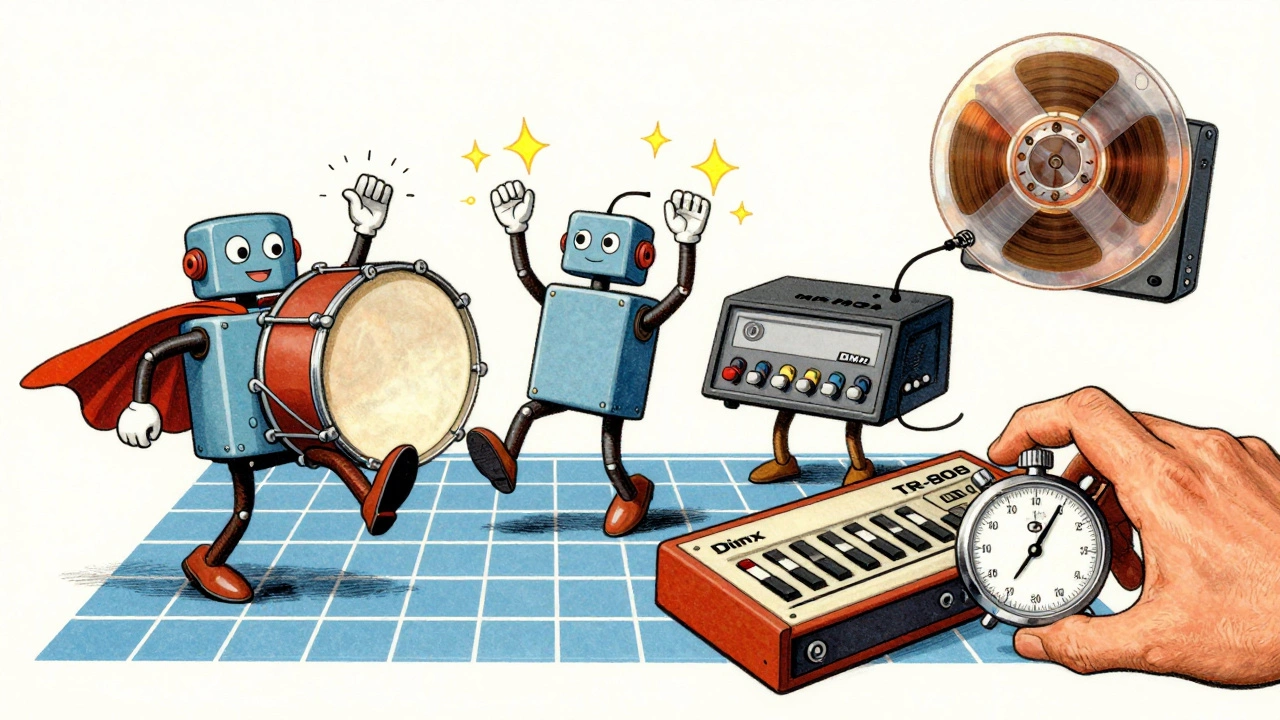
Real drums were rare in 80s pop. Instead, producers relied on three machines: the LinnDrum, the Oberheim DMX, and the Roland TR-808. Each had its role.
- The LinnDrum gave you crisp, punchy snares and realistic hi-hats.
- The DMX brought a gritty, punchy kick and snappy claps.
- The TR-808? That was the bass drum king-deep, boomy, and synthetic. It wasn’t meant to sound real. It was meant to sound futuristic.
Producers didn’t just play patterns straight. They quantized them-only 50% to 75%. That meant the timing was tight, but not robotic. A snare hit a few milliseconds early? That was intentional. It gave the beat a slight push, a forward motion that made people want to dance.
Today, you can sample these machines. But if you use them without humanizing the timing, your track will sound flat. Try shifting the snare by 15-20ms. Add swing. That’s what made the difference.

The SSL Console and the Bus Compression Secret
While synths and drum machines got all the attention, the real glue was the SSL 4000 E-series console. Introduced in 1979, it became the standard in studios from London to LA. Why? Its bus compressor. Set to 4:1 ratio, auto attack and release, it didn’t just control dynamics-it added punch.
Engineers would hit the bus compressor with 2-3dB of gain reduction. Not more. Too much and you lose the air. Too little and you lose the power. Then, they’d run the whole mix through 1/2-inch analog tape at +6dB over zero. That added saturation, warmth, and slight compression that digital can’t fake.
Modern plugins like UAD SSL 4000 E or Waves SSL G-Master Buss Compressor get you close. But if you’re not filtering out sub-bass below 40Hz before the compressor, you’ll end up with mud. That’s why 80s drums sounded bright but thin. The low end was surgically removed to make room for the kick and bass.
Vocals: Layered, Delayed, and Reverbed
80s vocals weren’t clean. They were stacked. Triple-tracked harmonies were standard. Lead vocals were doubled, sometimes tripled, and panned slightly left and right. Then came the effects.
The Lexicon 224 was the go-to. Its “Vocal Plate” algorithm used a 1.8-second decay with 0.3-second pre-delay. That created space without washing out the voice. On top of that, a 110ms slapback delay added depth. You could hear it just enough to feel like the voice was moving in a room.
Modern producers often overdo it. They add reverb, delay, and chorus all at once. In the 80s, it was one effect at a time. One plate. One slapback. One chorus. That’s why vocals cut through the mix so clearly. They weren’t buried in effects-they were sculpted.
Why It Still Works Today
Look at the charts in early 2024. Dua Lipa’s “Future Nostalgia,” The Weeknd’s “After Hours,” and even Olivia Rodrigo’s “GUTS” all use 80s techniques. Gated reverb on snares. DX7-style leads. SSL bus compression. Why? Because it’s catchy. It’s bold. It’s designed for radio.
Modern pop is loud, compressed, and flat. 80s pop had dynamics. It had space. It had character. Even with 100% digital tools today, the rules haven’t changed: less is more. One reverb. One delay. One compressor. One synth patch.
And here’s the truth: you don’t need vintage gear. You need to understand the process. A $149 DX7 V plugin, a $29 H-Delay, and a $34 SSL bus compressor can get you 90% of the way there. The rest? It’s in the details-the 2% tweak, the 15ms shift, the 300ms gate. Those are what made the sound.
What Not to Do
Don’t use 100% wet chorus on guitars. That’s a myth. The real 80s sound used 50/50 wet/dry with 15-20ms modulation. Don’t overuse gated reverb on vocals. It sounds cheap. Don’t skip the tape saturation. Digital alone sounds sterile.
And don’t think you can automate everything. The 80s didn’t have volume riding. The levels were set by hand. Every fader move was intentional. That’s why the music felt alive.
Where to Start
If you want to make an 80s-style track today, here’s your checklist:
- Start with a TR-808 kick and LinnDrum snare. Quantize at 60%. Humanize by shifting snare ±15ms.
- Apply AMS RMX16 gated reverb to snare: 2.2s decay, 300ms gate.
- Use a DX7 preset (E Piano 1). Tweak the modulator ratio by 3%. Route it to a chorus pedal (50/50 mix).
- Stack triple-tracked vocals. Add Lexicon 224 plate (1.8s decay, 0.3s pre-delay). Add 110ms slapback.
- Run everything through an SSL bus compressor (3:1 ratio, -18dB threshold). High-pass filter below 40Hz first.
- Add analog tape saturation at +6dB over zero.
That’s it. No need for 20 plugins. No need for expensive gear. Just the right settings, applied with discipline.
Why This Sound Endures
It’s not nostalgia. It’s engineering. The 80s didn’t have infinite tracks. They didn’t have auto-tune. They didn’t have AI. They had limits-and those limits forced creativity. The gated reverb wasn’t just a sound. It was a solution to a problem: how to make drums sound huge in a small room. The DX7 wasn’t just a synth. It was the only affordable way to get polyphonic sounds in a studio.
Today, we have everything. But we’ve lost the discipline. The perfect 80s pop sound wasn’t about having more tools. It was about using the right tools in the right way. And that’s a lesson that still applies.


