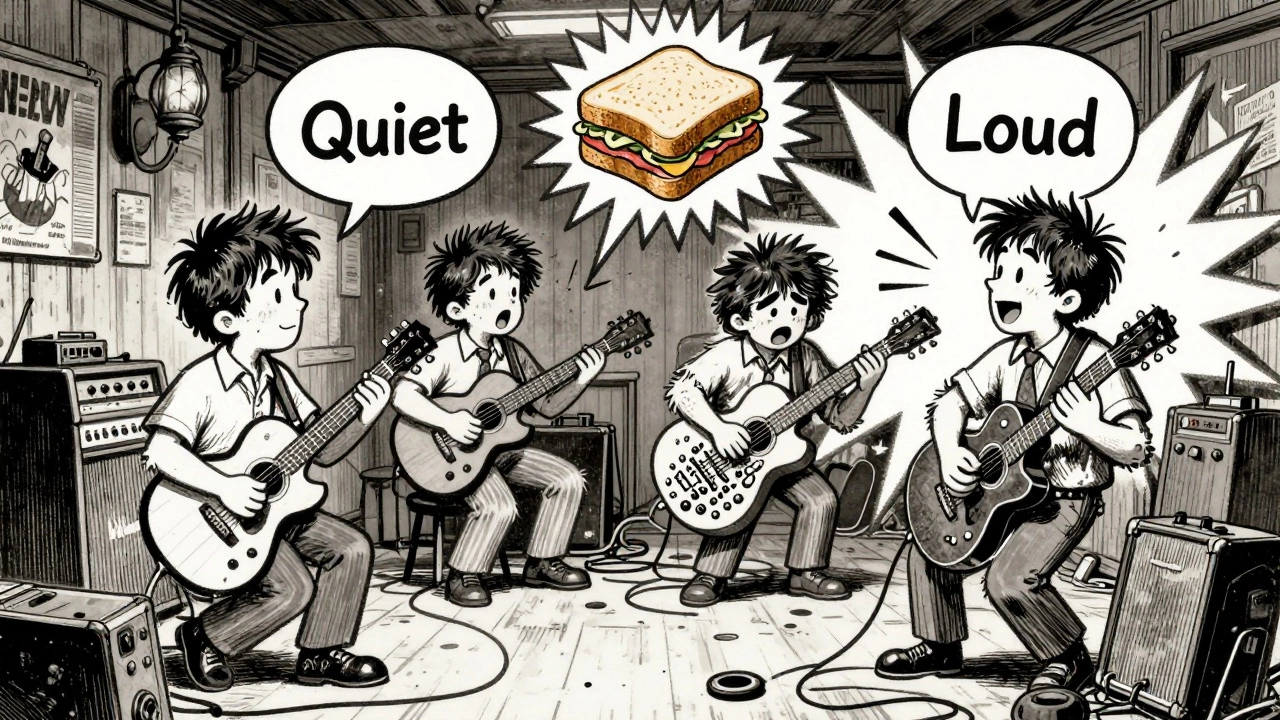

The quiet-loud-quiet structure didn’t start with Nirvana. It didn’t even start with grunge. It started in a cramped Boston basement in 1987, where four musicians who barely knew how to play their instruments stumbled into something that would rewrite rock music forever. The Pixies didn’t set out to invent a genre. They weren’t trying to be influential. They just played loud when they felt like it, and quiet when they didn’t. And somehow, that randomness became the most copied formula in alternative rock.
The Sandwich That Changed Rock
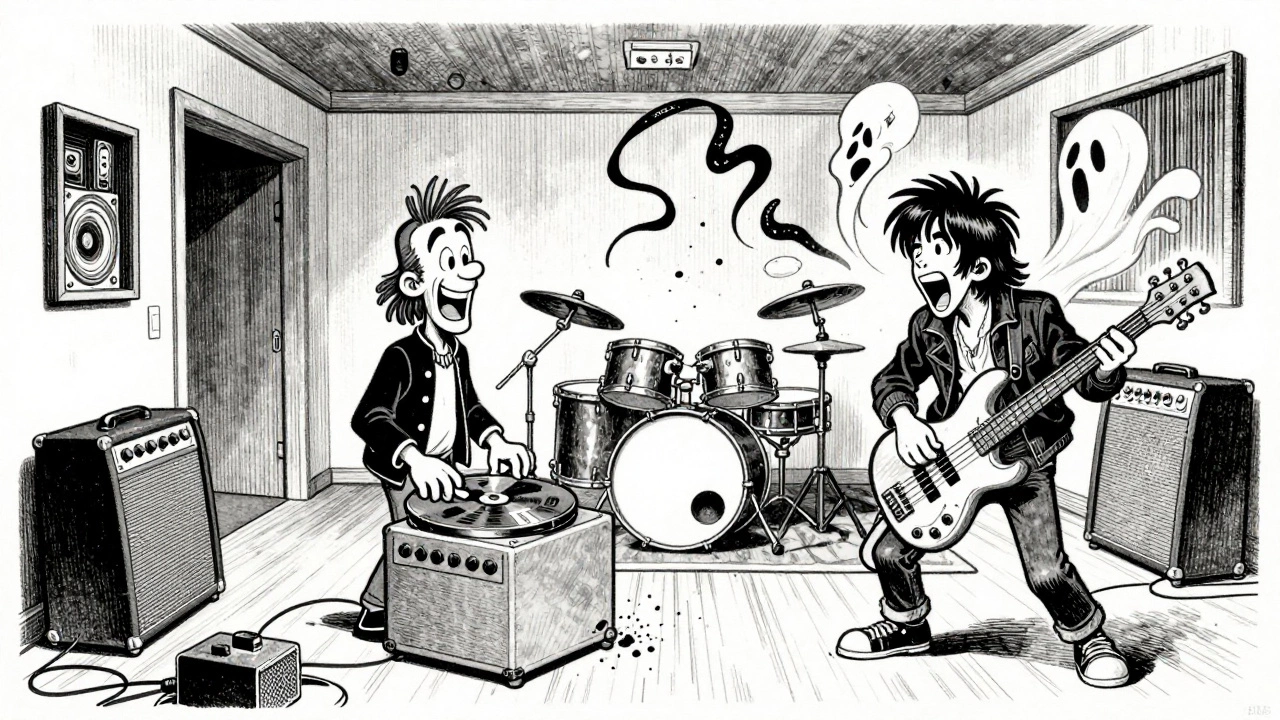
Black Francis described their song structure like a sandwich. Quiet bread on the outside. Explosive filling in the middle. No fancy theory. No music school training. Just instinct. On their 1988 debut album Surfer Rosa, produced by Steve Albini, that formula became undeniable. Songs like "Bone Machine" and "Something Against You" didn’t just shift dynamics-they slammed into each other like a car crash set to a melody. One moment, you’re listening to a whispery, almost folk-like verse. The next, the whole room explodes with distorted guitars, pounding drums, and Francis screaming like he’s being chased by ghosts.
That wasn’t new in punk. Hardcore bands had been loud for years. But the Pixies didn’t just stay loud. They pulled back. They let silence breathe. They made the quiet feel dangerous. And then, when the explosion came, it hit harder because you weren’t expecting it. It wasn’t just volume-it was tension. It was emotion. It was the sound of someone holding their breath for ten seconds and then screaming.
How They Made It Sound So Raw
They didn’t have fancy gear. They used tiny combo amps-portable ones meant for small gigs, not studios. The bass amp and guitar amps were shoved into a hallway to keep them from bleeding into the drum mics. The drums were recorded in one room, with no isolation. The result? A sound that was messy, alive, and full of bleed. Albini didn’t fix it. He didn’t clean it up. He let the noise live. That’s why Surfer Rosa sounds like it was recorded in a garage while the neighbors were yelling.
Kim Deal’s basslines didn’t just hold down the low end-they carried the melody. On "Gigantic," her first songwriting credit for the band, she sings in a soft, almost childlike voice over a hypnotic, looping bassline. The quiet parts feel like a secret. The loud parts feel like a confession. And when the guitars crash in, it’s not just loud-it’s cathartic. That’s the magic. It wasn’t about skill. It was about feeling.
The Song That Broke the Mold
"Monkey Gone to Heaven" is the perfect example. It starts with a gentle, almost lullaby-like guitar pattern. Francis sings about fish and God and the destruction of the planet in a tone that’s detached, almost bored. Then-boom. The drums kick in. The guitars roar. His voice cracks into a howl. And then, just as suddenly, it drops back to quiet. It’s not a chorus. It’s not a bridge. It’s a mood swing. And it works because it feels real. No one sat down and said, "Let’s make a hit song with this structure." They just played what felt right. And that honesty is what made it irresistible.
How Kurt Cobain Stole It (And Made It Global)
Kurt Cobain didn’t hide it. He said it outright: "Smells Like Teen Spirit" was his attempt to write a Pixies song. He didn’t copy the chords. He didn’t steal the lyrics. He copied the feeling. The quiet verse. The explosive chorus. The way the song holds its breath before it screams. When "Smells Like Teen Spirit" hit in 1991, it wasn’t just a hit-it was a revelation. Suddenly, every kid with a guitar and a distortion pedal knew: if you want to sound like you mean it, you have to let the quiet hurt before the loud breaks through.
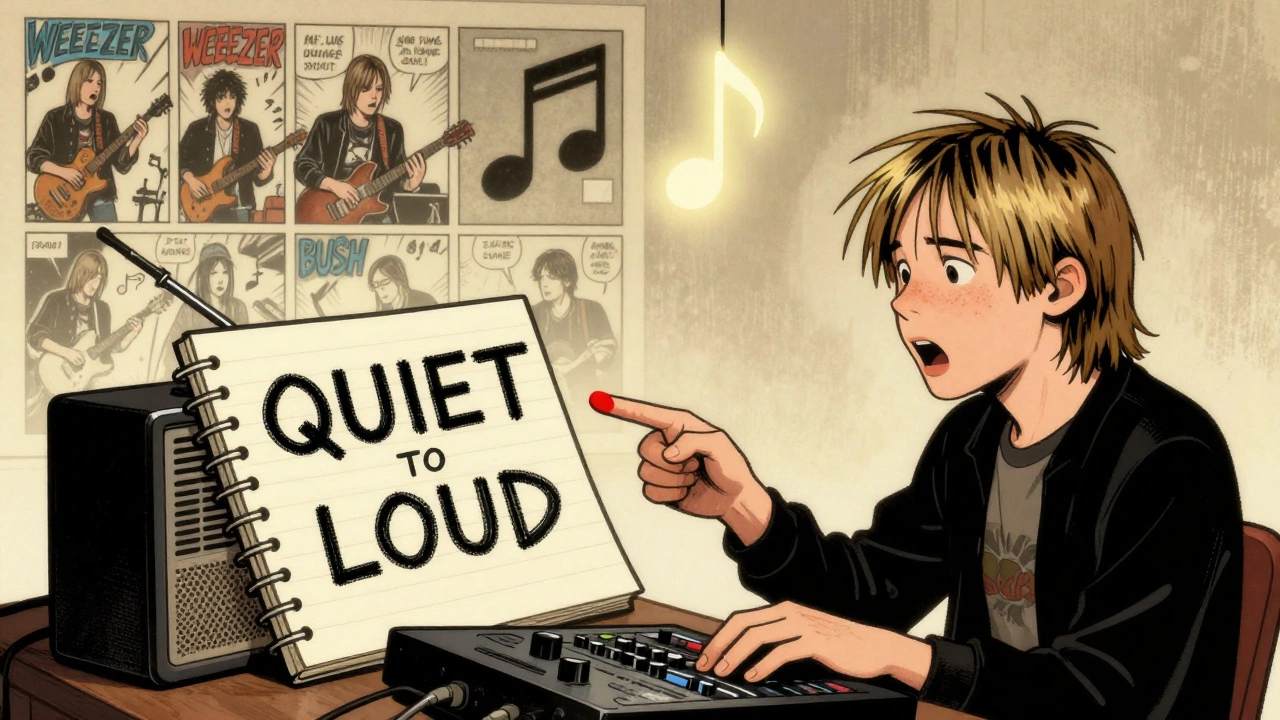
By 1993, bands like Weezer, Bush, and even Better Than Ezra were copying the formula. Their versions were smoother. More polished. Less chaotic. But the structure? Identical. "Good" by Better Than Ezra, released in 1995, didn’t just follow the Pixies’ template-it turned it into a radio-ready machine. The quiet parts were sweet. The loud parts were big. The transitions were predictable. The soul was gone. But the formula? Still there.
Why the Pixies Broke Up Just as They Became Famous
They never wanted to be famous. They didn’t care about MTV. In fact, they hated it. When they made the video for "Here Comes Your Man," Black Francis and Kim Deal just opened their mouths wide and stared at the camera-no lip-syncing, no dancing, no pretending. MTV refused to play it. And the band didn’t care. They were happy playing theaters while European crowds packed stadiums.
Inside the band, tensions were growing. Black Francis resented the attention Kim Deal got when she sang "Gigantic." He felt overshadowed. The creative balance was breaking. And then, in January 1993, during a BBC interview, he announced the band was over-without telling the others. They found out on the radio. The breakup was messy. But it was also perfect timing. Alternative rock exploded right after they vanished. The world was ready for their sound. And they weren’t.
The Legacy That Never Faded
The Pixies never had a Billboard top 10 hit. They never sold out arenas in the U.S. during their first run. But every band that came after them-Radiohead, Foo Fighters, Tame Impala, even modern indie acts like Phoebe Bridgers-uses their quiet-loud template without even realizing it. You hear it in the quiet build-up before the chorus in "Creep" by Radiohead. You hear it in the way Tame Impala lets a single synth note hang before the drums crash in. It’s everywhere.
People say the Velvet Underground started a thousand bands. The same is true of the Pixies. You don’t need to like their lyrics about aliens and biblical violence to feel the power of their sound. You don’t need to know who Steve Albini is to recognize the structure. You just need to have felt the rush of silence before the storm. That’s what they gave us-not a genre, not a trend, but a way to make emotion louder than noise.
Why It Still Matters Today
Modern pop songs are built on repetition. Drop the beat. Build the hook. Repeat. No dynamics. No tension. No release. The Pixies taught us that music doesn’t need to be loud all the time to be powerful. Sometimes, the quiet is the loudest part. Sometimes, the silence is what makes the explosion hurt.
When you hear a song today that starts soft and ends with everything crashing down-you’re hearing the Pixies. Even if you don’t know their name. Even if you’ve never listened to Surfer Rosa. Their blueprint is buried in the DNA of every alternative song made in the last 30 years. And it’s still working.


