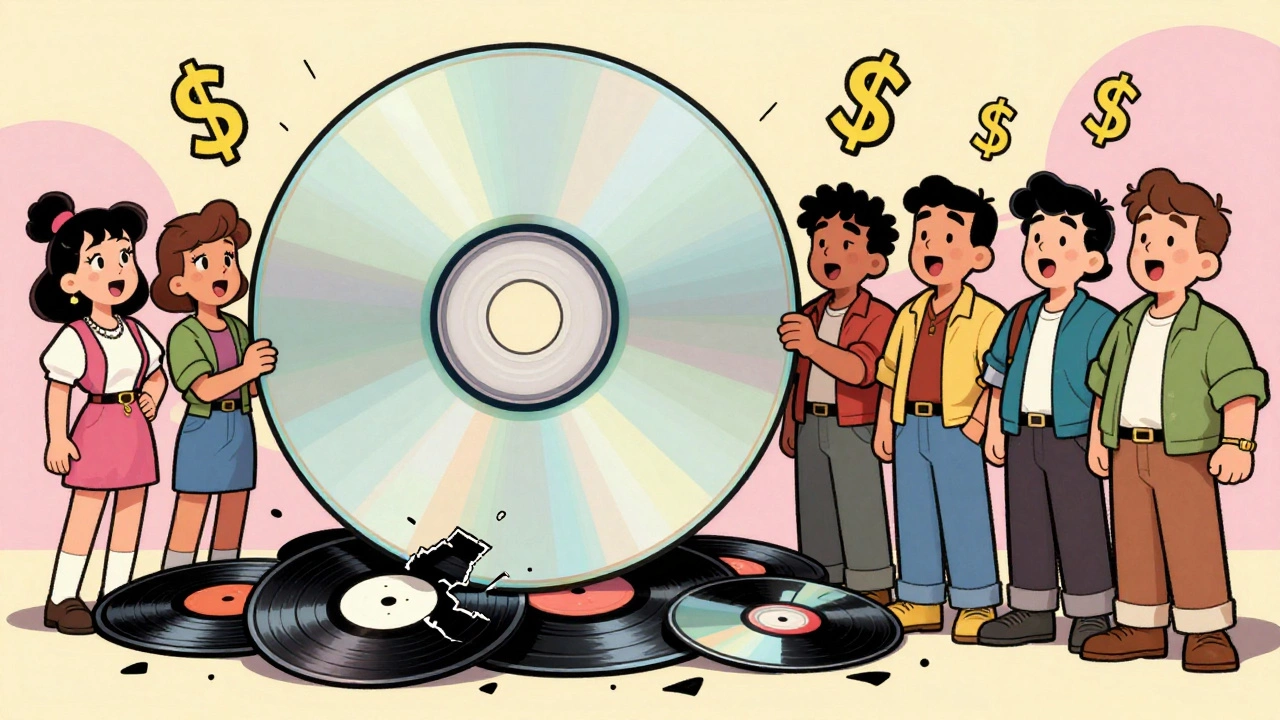

The music industry didn’t just evolve in the 1980s-it was rebuilt from the ground up.
In 1979, record sales dropped 11%. Labels were bleeding money. Radio was broken. Vinyl was fading. No one knew how to fix it. Then, in just ten years, everything changed. Two inventions-CDs and MTV-turned a dying industry into a global cash machine. But it wasn’t just about better sound or flashy videos. It was about who got to decide what music people heard, and who made the real money.
CDs didn’t just sound better-they cost more
Before the 1980s, most people bought albums on vinyl. A new LP cost about $11.98. It had scratches. It skipped. It wore out. But it was familiar. Then came the compact disc. It didn’t skip. It lasted forever. And it cost $14.98-30% more than vinyl. Labels didn’t just upgrade the format; they upsold the entire catalog. People who grew up with rock didn’t just buy one CD. They bought their whole collection again. In 1982, CD sales were $0. By 1985, they hit $4.2 billion. That’s not innovation. That’s a financial reset.
And it wasn’t just about the price. CDs held 60 minutes of music. Vinyl maxed out at 40. Labels used that extra space to pad albums with filler tracks. If you wanted the one hit song on the radio, you had to buy the whole album. That pushed profit per sale up by 250%. Suddenly, selling 1 million copies wasn’t enough. You needed to sell 2 million just to match the old revenue.
MTV didn’t just play music-it changed what music meant
On August 1, 1981, MTV launched. The first video? “Video Killed the Radio Star.” Irony didn’t matter. What mattered was that music was now visual. If your song didn’t have a video, you didn’t get played. And videos weren’t cheap. By 1985, the average music video cost $250,000. That’s over $600,000 today. Independent artists? They couldn’t afford it. So they stayed underground.
MTV didn’t just favor big labels-it created them. In 1983, the top six labels controlled 85% of MTV airplay. Michael Jackson’s “Thriller” video, made for $500,000, became a cultural event. It didn’t just sell records-it turned Jackson into a global icon. The album sold 66 million copies. Madonna, Prince, and Bruce Springsteen followed. These weren’t just musicians. They were brands. Their images mattered more than their chords.
Professor Robert Christgau called it out in 1985: “MTV’s requirement for visually striking content favored style over substance.” He was right. Bands with great guitar solos lost out to dancers in neon spandex. A drummer who couldn’t choreograph? He was out. A singer who looked good in slow motion? He got a record deal.

Big labels got bigger. Small labels got bought
While MTV pushed visual spectacle, corporate deals pushed consolidation. Bertelsmann bought RCA Records for $300 million in 1986. Sony bought CBS Records for $2 billion in 1988-the biggest media deal ever at the time. By 1989, six labels controlled 87% of the global market. That’s up from 62% in 1979.
But not all independent artists vanished. Some found a backdoor. R.E.M. didn’t get signed by a major label until 1988. Before that, they built a following on college radio, playing to 5.2 million listeners a week. I.R.S. Records, a small indie, put out their early albums. When the majors finally came calling, they paid a premium. Stanford Business School found that buying an indie band after they’d built a fanbase returned 300% more profit than signing unknowns directly.
Same with hip-hop. Def Jam Records started with $5,000. Run DMC’s “Raising Hell” sold 3 million copies. But by 1990, Def Jam’s total revenue was $12 million. Madonna, in the same period, made $400 million. The system wasn’t broken-it was designed to favor the few who could afford the system.
Digital recording changed how music was made
Behind the scenes, the studio was revolutionized. The Fairlight CMI and Synclavier let producers sample drums, manipulate vocals, and create sounds that didn’t exist in the real world. Dance music led the way. By 1987, even rock bands were using these tools. You didn’t need to be a great guitarist anymore. You just needed a keyboard and a programmer.
Engineers had to learn new skills. Mastering engineers needed six to nine months of training just to handle digital equipment. Live sound had to get louder and cleaner to match the crispness of CDs. Shure Brothers reported audiences expected 15dB more clarity at concerts. That meant bigger amps, better speakers, more money. The bar kept rising-and only the well-funded could keep up.

Music became advertising
In 1984, Michael Jackson signed a deal with Pepsi. It was worth $5 million in cash, plus $15 million in marketing. He didn’t just appear in a commercial. He performed “Billie Jean” in a live TV special. The ad campaign generated $1.2 billion in branded music partnerships by 1989. That’s not promotion. That’s product placement disguised as art.
Before the 1980s, record labels paid for tours to sell albums. After? Tours paid for albums. David Bowie said it plainly in 2002: “Live shows had once been subsidized by record companies. Now tours were the source of the major rock groups’ continued income.” By 2022, touring made up 75% of top artists’ income. The 1980s didn’t just change music-it flipped the entire business model.
The legacy: A world built on visuals and capital
The 1980s didn’t just give us “Thriller” or “Like a Virgin.” It gave us the template for the modern music industry. The CD’s premium pricing became the blueprint for streaming subscriptions. MTV’s visual obsession became TikTok’s 15-second hooks. The consolidation of labels created the oligopoly we live with today. The artists who made it didn’t just have talent-they had access to capital, connections, and cameras.
And the people who didn’t? They were left behind. A Reddit user from 1987 remembers: “My favorite local band never got MTV play because they couldn’t afford videos. I only heard them at shows until college radio picked them up in 1988.” That story didn’t end in the ‘80s. It just moved online.
The music industry didn’t get better in the 1980s. It got more expensive. More visual. More corporate. And the people who controlled the money? They never let go.
What was the biggest factor in the music industry’s recovery in the 1980s?
The combination of the compact disc (CD) and MTV. CDs allowed labels to charge 30% more for the same music and convinced consumers to rebuy their entire collections. MTV turned music into a visual medium, making videos essential for success. Together, they reversed a decade-long sales slump and drove global revenue from $7.1 billion in 1980 to $13.5 billion by 1989.
Why did independent artists struggle in the 1980s?
Music videos became mandatory for exposure, and each one cost $150,000 to $500,000. Independent artists couldn’t afford that. Without MTV airplay, radio stations ignored them. While college radio helped some, like R.E.M., most small acts stayed local. Major labels controlled 85% of MTV’s playlist by 1983, making it nearly impossible for outsiders to break through without corporate backing.
How did Michael Jackson’s Thriller change the music business?
Thriller sold over 66 million copies worldwide, making it the best-selling album of all time. Its music video was a cultural event, breaking racial barriers on MTV and proving that videos could drive album sales. It showed labels that investing heavily in visuals paid off. Jackson’s success also paved the way for branded partnerships-like his $20 million deal with Pepsi-turning artists into global marketing platforms.
Did CDs really sound better than vinyl?
Technically, yes-CDs had no surface noise, no wear, and a wider frequency range. But many listeners found the sound cold or sterile compared to vinyl’s warmth. The real advantage wasn’t sound quality. It was convenience and durability. And most importantly, labels could charge more for them. The sound improvement was real, but the profit increase was the real driver.
What happened to the singles market in the 1980s?
It collapsed. With CDs offering longer playtime and MTV pushing full-album promotion, labels stopped releasing singles as standalone products. Consumers had to buy entire albums to hear one hit. This increased profits per sale by 250% and made the album the dominant format. Even radio stations began playing album tracks instead of 45s. The single didn’t disappear-it became a promotional tool for the album.
How did the 1980s shape today’s music industry?
The 1980s set the foundation for today’s model: corporate control, visual-driven discovery, and profit through bundling. Streaming services now use algorithms the way MTV used playlists-favoring content that’s visually engaging and algorithmically optimized. Artists earn more from touring than recordings, just as David Bowie predicted. And the biggest winners? Still the labels and platforms with the deepest pockets.


