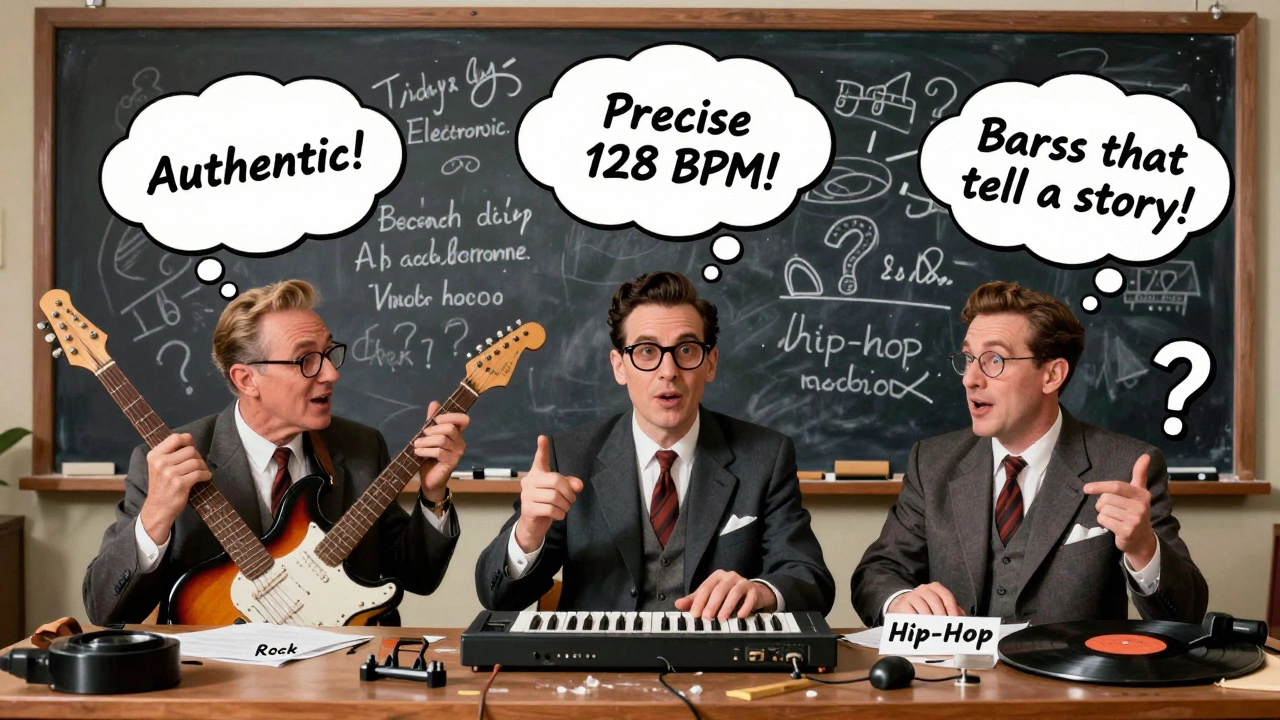

When you read a music review, you might think it’s just someone’s opinion. But behind every review-whether it’s a glowing five-star take on a jazz album or a scathing dismissal of a pop single-is a set of unspoken rules shaped by the genre itself. Critics don’t review metal the same way they review classical. They don’t judge hip-hop the same way they judge folk. The way a review is written, what it values, even the language it uses, changes depending on the genre. And if you’ve ever wondered why some albums get praised for being "raw" while others get knocked for being "too polished," the answer lies in how different genres are reviewed.
Why Genre Matters More Than You Think
Genre isn’t just a label. It’s a contract between the artist and the listener. When someone makes a lo-fi indie rock album, they’re not trying to sound like a symphony orchestra. When a trap producer drops a beat, they’re not aiming for acoustic warmth. Critics know this. And they judge each genre by its own standards.
Think about it: a review of a grindcore album might praise blast beats and guttural vocals as "authentic," while the same elements in a pop song would be called "unlistenable." A jazz critic might spend paragraphs analyzing harmonic complexity, while a country critic focuses on storytelling and vocal twang. These aren’t random preferences-they’re inherited expectations shaped by decades of listening, writing, and community norms.
Music journalism doesn’t operate on a one-size-fits-all model. Each genre has its own critical language, its own history of innovation, and its own set of unwritten rules about what counts as "good." And if you’ve ever felt like a review didn’t "get" your favorite band, it’s probably because the critic was using a different rulebook.
Rock: The Legacy of Authenticity
Rock criticism has been shaped by a decades-long obsession with authenticity. From the 1960s counterculture to today’s underground scenes, rock reviews often ask: "Is this real?" That means live energy matters more than studio polish. Raw vocals beat auto-tune. Guitar solos still carry weight. A review of a punk band might highlight sloppy drumming as "perfect for the message," while the same flaw in a pop record would be called "amateurish."
Rock reviews also value progression. Critics don’t just ask, "Is this good?" They ask, "Is this an evolution?" A new album from a veteran band gets compared to their 1990s work-not just for sound, but for how it fits into their legacy. If a band reinvents itself, critics celebrate. If they repeat themselves, they’re accused of stagnation. This is why a review of a rock album often reads like a mini-biography.
And don’t forget the role of the critic as gatekeeper. In rock journalism, there’s still a belief that critics help separate the "important" from the "noise." That’s why albums from small labels get more attention than major-label releases-even if the latter have bigger budgets. The genre’s history is built on rebellion, and critics still act as its archivists.
Electronic: The Science of Sound Design
Electronic music reviews are less about emotion and more about engineering. Critics don’t just listen-they analyze. They break down synth patches, layering techniques, tempo shifts, and spatial mixing. A rave track might be praised for its "precise 128 BPM pulse," while a glitchy ambient piece gets called "a masterclass in texture."
Unlike rock, where authenticity is king, electronic music is judged by technical mastery. Did the producer push boundaries? Did they use a new plugin in an unexpected way? Was the arrangement intelligent, or just repetitive? Reviews often read like technical notes: "The bassline uses a resonant filter sweep that mimics the decay of a modular synth," or "The drop exploits phase cancellation to create a sense of weight."
There’s also a strong emphasis on context. A techno track from Berlin might be reviewed differently than one from Detroit. A festival banger gets judged on dancefloor impact. A bedroom producer’s EP gets evaluated on innovation within limited gear. Genre boundaries here are fluid, and critics pay attention to subgenre shifts-like how deep house differs from minimal techno, or how future bass diverges from trap.
And let’s not forget the role of visuals. Electronic artists often release music with accompanying visuals, videos, or immersive experiences. Critics don’t just review the sound-they review the whole package. A review might say, "The 360-degree audio design transforms the listening space," because in electronic music, the experience is part of the art.
Hip-Hop: Bars, Beats, and Cultural Weight
Hip-hop reviews don’t just assess music-they assess culture. A critic doesn’t just listen to the flow; they dissect the wordplay. They don’t just hear the beat; they trace its sample back to a 1972 funk record. The best hip-hop reviews read like cultural analysis.
Lyricism is everything. A verse packed with internal rhymes, multisyllabic patterns, and social commentary gets praised-even if the production is basic. Conversely, a beat that sounds like a hit single might get dismissed if the lyrics feel shallow. Critics look for narrative arcs, political statements, and personal vulnerability. A review might say, "The third track reclaims the trauma of urban displacement through layered ad-libs," not just "The hook is catchy."
Production matters too-but differently than in electronic music. A trap beat might be called "stripped-down and effective," while a sample-heavy boom-bap track gets called "a love letter to the Golden Age."
There’s also a deep awareness of lineage. Critics compare new artists to legends like Nas, Tupac, or Wu-Tang-not just for style, but for impact. A rapper who brings back old-school recording techniques isn’t just being nostalgic; they’re making a statement about authenticity in a streaming era.
And let’s not ignore the role of geography. A review of a Southern rap album will mention regional slang, local slang, and cultural references that a New York critic would understand instantly. The genre’s diversity means critics must be culturally literate, not just musically trained.
Classical: The Weight of Tradition
Classical music reviews are the most formal-and the most historically rooted. Critics here don’t just evaluate a performance; they evaluate it against centuries of tradition. A review of a Beethoven symphony might compare the conductor’s interpretation to recordings from the 1950s, 1980s, and 2010s. They care about tempo choices, phrasing, and orchestral balance-not because they’re arbitrary, but because these elements have been debated for over 200 years.
There’s also a strong focus on technique. A violinist’s intonation, a cellist’s bow control, a choir’s blend-these aren’t just technical details; they’re the foundation of the review. A critic might write, "The second movement’s rubato was too hesitant, robbing the emotional climax of its power," because in classical music, emotion is tied directly to execution.
Unlike other genres, classical reviews rarely mention "vibes" or "mood." They talk about structure: sonata form, fugue development, thematic transformation. A review might spend paragraphs explaining how a composer used modulation to build tension, because that’s the language of the genre.
And there’s a quiet hierarchy. Major orchestras, famous soloists, and historic venues carry weight. A recording from the Berlin Philharmonic gets more scrutiny than one from a local ensemble-not because it’s better, but because the tradition demands it. Critics act as historians, preserving the lineage of performance practice.
Pop: The Algorithm and the Emotion
Pop music reviews are the most contradictory. On one hand, critics treat pop as disposable-chasing hooks, danceability, and chart potential. On the other, they treat it as a cultural mirror. A review of a Taylor Swift album might call it "a masterclass in emotional engineering," while a review of a K-pop group might analyze choreography, fan culture, and global marketing.
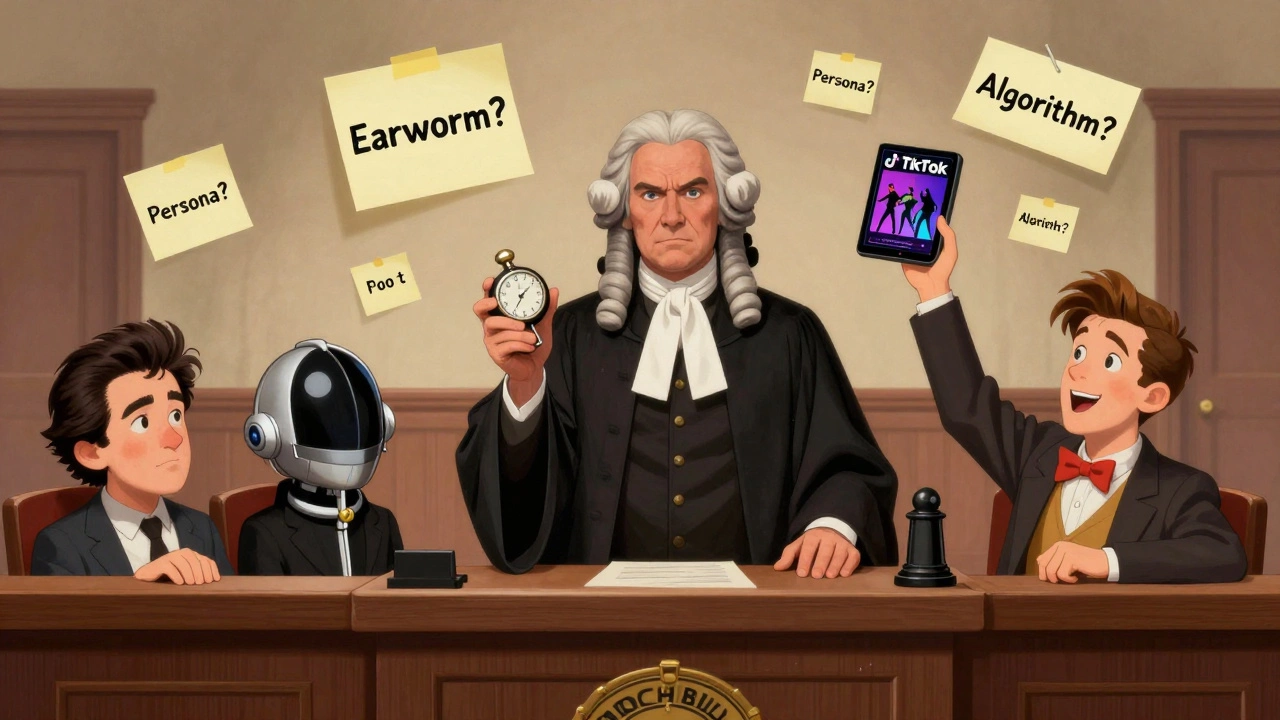
Pop critics are obsessed with catchiness. But not just any catchiness. They look for "earworms that linger," "lyrics that stick in the throat," "production that feels inevitable." A review might say, "The chorus uses a deceptive cadence that tricks the brain into replaying it," because pop is designed to be sticky.
There’s also a heavy focus on persona. Critics don’t just review the music-they review the artist’s image. Is this a reinvention? A comeback? A calculated brand move? A review of a pop star might spend more time on their social media strategy than their vocal range.
And let’s not forget the algorithm. Critics know that pop is shaped by streaming, TikTok, and playlist placement. A song might get praised for "perfect TikTok timing" or "designed for Spotify’s morning playlist." The genre’s success now depends on data as much as melody.
Yet beneath the surface, pop reviews still crave depth. The best ones find humanity in the hype. They notice when a synth line echoes a 1980s ballad, or when a lyric echoes a generational anxiety. Pop might be manufactured, but the emotion behind it? That’s real.
Country: Storytelling Over Sound
Country music reviews are built on one thing: truth. Not technical perfection. Not flashy production. But honesty. A review might praise a singer for "sounding like they’ve lived every word," even if their pitch wavers. A fiddle solo might be called "heartfelt," not "impressive."
Lyrics are everything. Critics look for details: pickup trucks, small towns, church pews, broken hearts. They don’t care if the melody is original-they care if the story feels real. A review might say, "The bridge captures the silence after a fight better than any dialogue ever could."
There’s also a strong sense of tradition. Country critics compare new artists to Johnny Cash, Loretta Lynn, or Dolly Parton-not just for sound, but for values. Is this music rooted in working-class experience? Does it honor the genre’s history? Is it pushing boundaries, or just recycling clichés?
Production matters, but differently. A modern country album might use auto-tune and electronic drums, but critics will still ask: "Does it still feel like a porch light on a summer night?" The genre’s soul isn’t in the gear-it’s in the feeling.
The Hidden Bias in Music Journalism
Here’s the uncomfortable truth: music critics are human. And humans have biases. Rock critics often undervalue electronic music because it doesn’t fit their "authenticity" mold. Pop critics sometimes dismiss hip-hop for being "too commercial." Classical reviewers might overlook avant-garde works because they don’t follow traditional forms.
These biases aren’t always intentional. They’re baked into the system. Critics are trained in certain traditions. They grew up listening to certain genres. Their editors expect certain kinds of reviews.
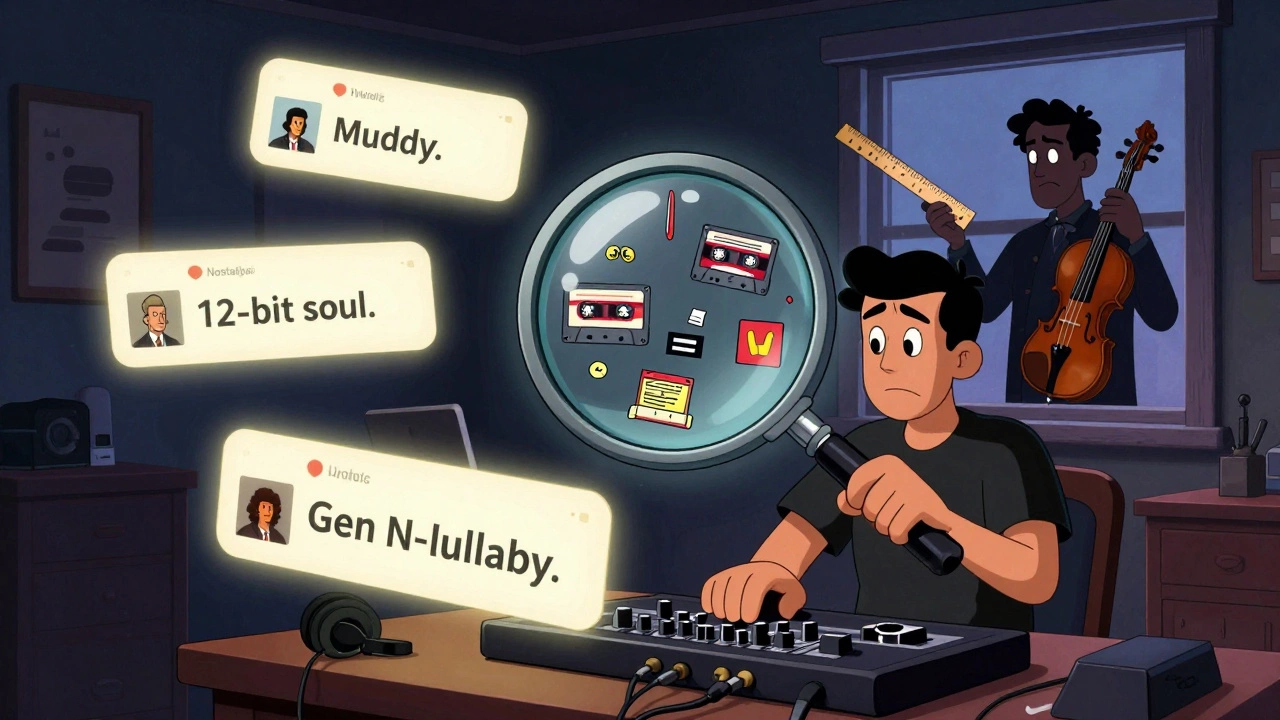
That’s why you’ll never see a review of a lo-fi hip-hop beat that says, "This track uses 12-bit samples to evoke nostalgia for early internet culture." It might be brilliant-but if the critic doesn’t understand the context, they’ll just call it "muddy."
And that’s why genre-specific coverage isn’t just about music. It’s about power. Who gets to define what’s good? Who gets to decide what counts as innovation? And who gets left out because their genre doesn’t fit the mold?
What This Means for You
If you’re a fan, it means you should read reviews with a grain of salt. A negative review of a metal album might not mean the album is bad-it might mean the critic doesn’t understand blast beats. A glowing review of a pop song might mean the critic loves hooks, not depth.
If you’re a creator, it means you should know your genre’s rules. Don’t just make music. Understand how it will be judged. A jazz artist who wants critical praise should focus on harmonic complexity. A hip-hop producer who wants to be taken seriously should prioritize lyrical density.
And if you’re a listener, it means you can start listening differently. Next time you hear a review, ask: "What’s the genre asking for here?" Is it asking for emotion? Innovation? Tradition? Then decide: does the music meet that standard-or is the critic just using the wrong ruler?
Why do critics judge different genres by different standards?
Each genre has its own history, audience, and purpose. Critics don’t apply one set of rules to everything because music isn’t one thing. A jazz album is meant to explore complexity; a pop song is meant to stick in your head. Critics evaluate based on what the genre is trying to achieve, not some universal idea of "good music."
Can a critic be biased toward one genre?
Absolutely. Many critics grew up with rock or classical music and carry those preferences into their reviews. They might praise a distorted guitar solo but dismiss a synth drop as "cold" or "mechanical." That’s not always fair, but it’s common. The best critics try to recognize their own biases and adjust their standards accordingly.
Do genre reviews change over time?
Yes. In the 1990s, critics praised hip-hop for being "raw" and "unpolished." Today, they praise it for its production sophistication. Electronic music went from being dismissed as "robotic" to being celebrated for its innovation. Genre standards evolve as the music changes-and critics slowly catch up.
Why do some genres get more serious reviews than others?
Historically, genres tied to white, male, Western traditions (like classical and rock) were seen as "artistic," while genres rooted in Black, Latino, or youth cultures (like hip-hop, reggae, or EDM) were seen as "entertainment." That bias is fading, but slowly. Today, more critics are treating all genres with equal depth-but it’s still a work in progress.
How can I tell if a review is fair for the genre?
Look for two things: Does the review acknowledge the genre’s goals? And does it judge the music based on those goals? A fair review of a country song won’t complain about lack of synths. A fair review of a techno track won’t say it’s "too repetitive"-it’ll ask if the repetition serves a purpose. If the critic is using the wrong ruler, the review isn’t fair.


