
The 1980s didn’t just have music-it had movements. While today we think of charts as dominated by pop or hip-hop, back then, it was a wild free-for-all. No single genre ruled the airwaves. Instead, you had synth-pop dancing beside heavy metal, R&B bumping into country ballads, and hip-hop sneaking into the top 10 like it had something to prove. The Billboard charts didn’t just reflect what people were listening to-they showed how music was changing, fast.
Early 1980s: The Transition Years
The decade didn’t start with a bang. It started with a stumble. Disco had collapsed by 1979, and no one knew what would replace it. In 1980, the charts were a mix of leftover soft rock, yacht rock, and adult contemporary. Dan Fogelberg’s "Longer" sat at #2. Ambrosia’s "Biggest Part of Me" hit #3. Billy Joel’s "You May Be Right" made it to #7. These weren’t rebellious tracks-they were smooth, safe, and meant for late-night drives with the windows up. But change was coming. Blondie’s "Call Me" topped the charts that year, blending new wave, rock, and dance. It wasn’t just a hit-it was a signal. The synthesizer was no longer a novelty. It was becoming the backbone of pop. And then, in 1981, MTV launched. Suddenly, music wasn’t just heard. It was seen. And that changed everything.Pop and Synth-Pop Take Over
By mid-decade, pop wasn’t just popular-it was dominant. Michael Jackson’s "Thriller" didn’t just break records, it broke ceilings. It became the best-selling album of all time, and songs like "Billie Jean" and "Beat It" ruled radio and TV. Madonna wasn’t just singing; she was redefining image, attitude, and sound. "Like a Virgin" wasn’t just a #1 hit-it became a cultural moment. Her music videos turned her into a global icon before the internet even existed. Prince didn’t need videos to dominate. His sound was too unique. "Purple Rain" was a movie, a soundtrack, and a statement all at once. He fused funk, rock, pop, and soul into something no one else could replicate. Meanwhile, Hall & Oates kept the pop engine running with smooth harmonies and catchy hooks. "Private Eyes" and "Maneater" were everywhere. Synth-pop was the sound of the decade’s middle years. Depeche Mode, Pet Shop Boys, and A-ha turned electronic tones into emotional anthems. "Take On Me" by A-ha didn’t just chart-it broke the U.S. market with its animated video. These weren’t just songs. They were mood pieces, built on drum machines and oscillators, and they appealed to teens and adults alike.Glam Metal and Hard Rock: Loud, Flashy, and Everywhere
If pop was the quiet king, glam metal was the loud prince. Bands like Bon Jovi, Mötley Crüe, and Poison didn’t just play music-they put on shows. Their songs were anthems for teenagers with big hair and even bigger dreams. "Livin’ on a Prayer," "Shout It Out Loud," and "Every Rose Has Its Thorn" weren’t just chart-toppers-they became part of the soundtrack of American youth. Def Leppard’s "Hysteria" sold over 12 million copies. Quiet Riot’s "Metal Health" was the first metal album to hit #1 on the Billboard 200. Van Halen stayed relevant through two lead singers. And then came Guns N’ Roses. "Appetite for Destruction" didn’t just come out in 1987-it exploded. It was raw, dangerous, and real. It outsold everything else that year. This wasn’t just rock. It was spectacle. And it worked. These bands didn’t just rely on radio-they owned MTV. Their videos were cinematic, over-the-top, and impossible to ignore.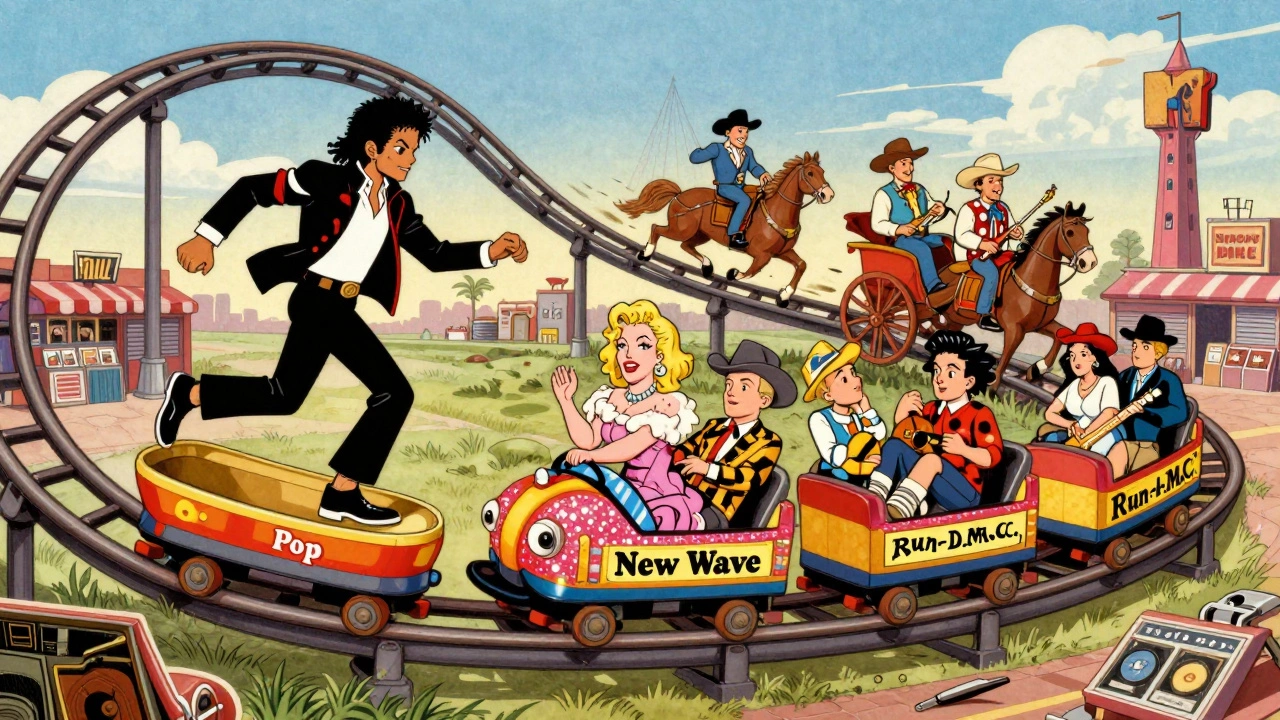
R&B, Hip-Hop, and the Rise of Urban Sounds
While the rockers were rocking, something quieter but just as powerful was building in the streets. R&B and hip-hop didn’t start on MTV-they started in block parties, basement studios, and inner-city radio stations. In 1980, Run-D.M.C. hadn’t even formed yet. By 1986, they had a gold album and a spot on MTV. "Walk This Way," their collaboration with Aerosmith, wasn’t just a cover-it was a bridge. It showed rock fans that hip-hop wasn’t a fad. It was here to stay. Whitney Houston brought soul to pop with a voice that could shake buildings. "I Will Always Love You" wasn’t released until 1992, but her 1980s hits like "Saving All My Love for You" and "How Will I Know" laid the groundwork. She made R&B accessible to white audiences without losing its soul. Hip-hop’s golden age began in the mid-80s. Public Enemy’s "It Takes a Nation of Millions to Hold Us Back" wasn’t just music-it was a manifesto. LL Cool J, Beastie Boys, and Eric B. & Rakim pushed boundaries. The charts didn’t always reflect it, but the culture did. By 1989, hip-hop had its first #1 single: "The Message" by Grandmaster Flash and the Furious Five had been a hit years earlier, but now, the genre was ready to take over.Country, Soft Rock, and the Quiet Contenders
While everyone was screaming or dancing, country kept its steady rhythm. George Jones’s "He Stopped Loving Her Today" in 1980 wasn’t just a country hit-it was a masterpiece. It stayed on the charts for weeks. Conway Twitty hit his 40th #1 country single in 1986. That’s not luck. That’s legacy. Soft rock and adult contemporary didn’t need flashy videos. They just needed a good melody. Kenny Rogers’s "Coward of the County" and "Lady" were everywhere. John Denver, Anne Murray, and The Carpenters’ legacy lived on through artists like Air Supply and Christopher Cross. These songs didn’t chart as high as Michael Jackson’s, but they sold consistently-week after week, year after year. Smooth jazz and quiet storm formats carved out space on FM radio. Artists like George Benson and Sade brought a cool, late-night vibe that appealed to adults who wanted something less aggressive than metal or more soulful than synth-pop.
Alternative Rock: The Quiet Revolution
While the charts were full of glitter and bass drums, a quieter rebellion was brewing. R.E.M. released "Murmur" in 1983. It didn’t hit #1. It didn’t even crack the top 10. But it was everywhere on college radio. Their jangly guitars, cryptic lyrics, and earnest delivery became the blueprint for indie rock. By the late 80s, bands like The Pixies, Sonic Youth, and Hüsker Dü were building underground followings. They didn’t need MTV. They didn’t need radio. They just needed fans who cared enough to tape their songs off the radio and trade them like gold. This wasn’t about chart positions. It was about authenticity. And it laid the foundation for the grunge explosion of the 90s. Nirvana didn’t come out of nowhere. They came out of the late 80s underground scene.Female Artists: Breaking the Mold
The 80s didn’t just have male rock stars. It had queens. Madonna wasn’t just a pop star-she was a force. Diana Ross had five top-ten hits in the decade. Tina Turner’s comeback with "What’s Love Got to Do with It" in 1984 was one of the greatest comebacks in music history. She was 44 and owned the charts. Pat Benatar didn’t just sing. She roared. "Heartbreaker" and "Love Is a Battlefield" were anthems for women who refused to be quiet. Donna Summer’s "She Works Hard for the Money" was a feminist anthem disguised as a dance track. These weren’t side notes-they were chart-toppers.Why the 1980s Still Matters
The 1980s didn’t have one sound. It had dozens. And that’s what made it special. You could turn on the radio and hear a country ballad, then a metal anthem, then a hip-hop track, then a synth-pop hit-all before lunch. No other decade offered that kind of variety on the charts. It was the last decade before digital music changed everything. Before streaming, before downloads, before playlists. Back then, you had to buy the album. You had to wait for the single. You had to watch MTV to see what was hot. That made every hit feel bigger. The genres that ruled the 80s didn’t just fade away. They evolved. Synth-pop became EDM. Glam metal became nu-metal. Hip-hop became the dominant genre of the 21st century. Country never left. And alternative rock? It became the new mainstream. The 1980s charts weren’t just about numbers. They were about identity. People didn’t just listen to music-they chose sides. Rock or pop? Metal or R&B? Country or new wave? And in choosing, they defined who they were.What genre had the most number-one hits in the 1980s?
Pop music had the most number-one hits overall, led by artists like Michael Jackson, Madonna, and Prince. However, no single genre dominated the entire decade. Rock, R&B, and synth-pop each had long runs at the top. Billboard’s year-end charts show that pop and rock acts collectively accounted for over 60% of the top singles, but the distribution shifted yearly-there was no single "winner."
Did hip-hop chart in the 1980s?
Yes, but not at first. Early hip-hop tracks like "The Message" by Grandmaster Flash (1982) and "Fight the Power" by Public Enemy (1989) made the Billboard Hot 100, but rarely cracked the top 10. It wasn’t until 1986, with Run-D.M.C.’s collaboration with Aerosmith on "Walk This Way," that hip-hop broke into mainstream charts in a major way. By 1989, hip-hop had its first #1 single on the R&B chart, and its presence on the Hot 100 was growing steadily.
Was MTV responsible for the success of 1980s genres?
MTV didn’t create the genres, but it amplified them. Bands like Bon Jovi, Madonna, and Prince used music videos to build global fanbases overnight. MTV’s visual focus favored artists with strong imagery-flashy costumes, dramatic lighting, and dance routines. That helped synth-pop and glam metal thrive. But genres like hip-hop and country had to fight harder for airtime. By the mid-80s, MTV began playing more R&B and rap, thanks to public pressure and the success of videos like "Walk This Way."
Did country music do well on the Billboard charts in the 1980s?
Absolutely. While pop dominated the overall Hot 100, country music ruled its own charts. George Jones, Conway Twitty, and Dolly Parton consistently topped the Billboard Hot Country Singles chart. Twitty hit his 40th #1 country single in 1986. Country crossovers like Kenny Rogers’s "Islands in the Stream" (with Dolly Parton) also made the pop charts, proving country had wide appeal.
Why did synth-pop become so popular in the 1980s?
Synth-pop took off because of technology and timing. Affordable synthesizers and drum machines like the Roland TR-808 made it possible for artists to produce full songs without a full band. MTV loved the colorful, futuristic visuals that came with synth-pop. Bands like Depeche Mode, New Order, and Pet Shop Boys used electronic sounds to create emotionally powerful songs that felt both modern and timeless. It wasn’t just a trend-it was a new way to make pop music.


