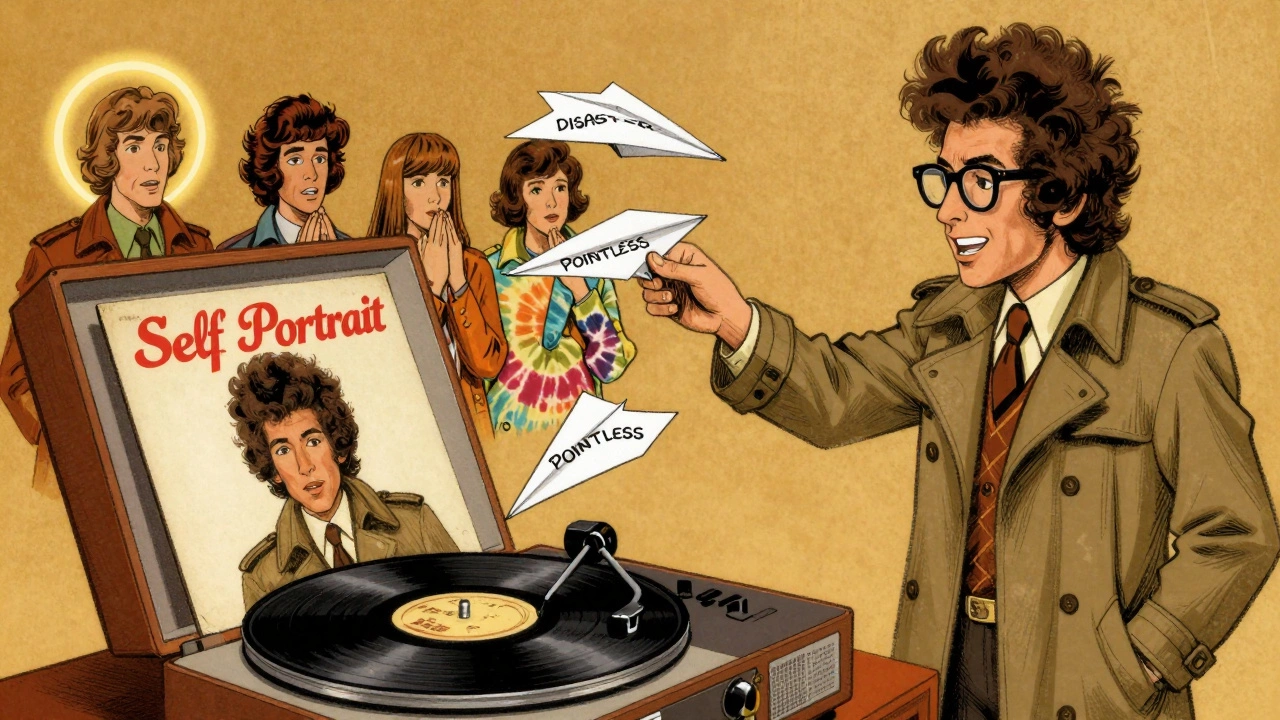

When 1970s music first hit the airwaves, critics didn’t always get it right. Some of the most beloved albums today were panned at release. Albums like Bob Dylan’s "Self Portrait" a 1970 double album filled with covers, live takes, and oddball experiments, or Paul McCartney’s "Ram" a quirky, layered pop record from 1971, were called confusing, pointless, or even embarrassing. Decades later? They’re hailed as masterpieces. This isn’t just nostalgia. It’s a pattern - one that reveals how time, context, and shifting tastes can rewrite musical history.
When Critics Got It Wrong: The Case of "Self Portrait"
Bob Dylan had just released "Nashville Skyline," a warm, country-tinged album that surprised fans. Then came "Self Portrait" in 1970. Two records. Over 20 tracks. Half of them covers. No liner notes. No clear direction. Critics reacted like someone had thrown a bucket of cold water on a bonfire. Rolling Stone called it "a disaster." Newsweek said it was "the worst album of the year."
But here’s what they missed: Dylan wasn’t trying to make a coherent album. He was mocking the idea that artists had to be "profound" all the time. He was poking fun at expectations. He was saying, "I don’t owe you a masterpiece. Here’s me singing "Old Man" and "The Boxer" in a half-awake voice. Deal with it."
Fast forward to the 2010s. Music historians started re-listening. They noticed how the album’s chaos mirrored the fractured state of post-1960s culture. Fans began sharing bootlegs of live versions where Dylan reworked the songs into something raw and real. By 2020, critics at The Guardian and Pitchfork were calling "Self Portrait" a "brilliant act of anti-art." It wasn’t a failure - it was a statement. And that’s the thing about the 1970s: a lot of albums weren’t meant to be understood right away.
"Ram" - The Album That Broke McCartney
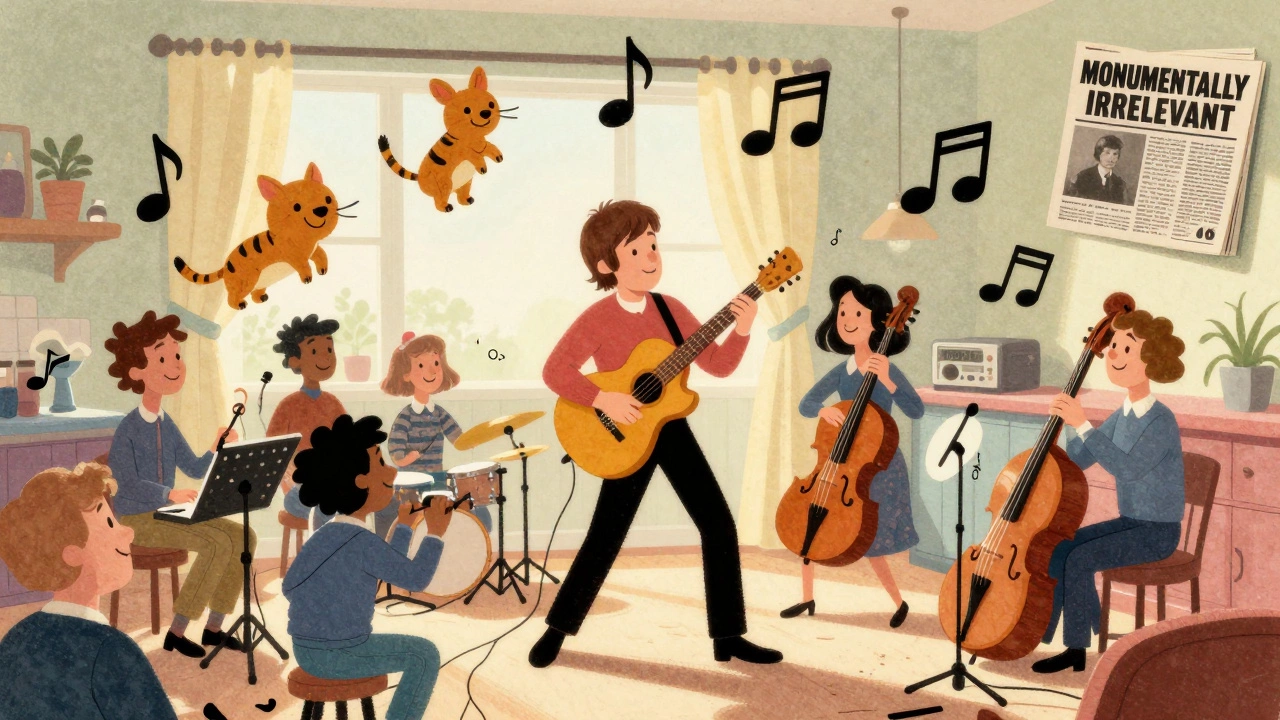
Paul McCartney’s "Ram," released in 1971, was his first full album after The Beatles broke up. He recorded it with his wife Linda, in their kitchen, with a playful energy. It had songs like "Uncle Albert/Admiral Halsey," a swirling mix of harmonies and whimsy, and "The Back Seat of My Car," a three-part epic that sounded like a rock opera written by someone who’d just won the lottery.
Critics didn’t get it. Rolling Stone called it "monumentally irrelevant." Even McCartney himself felt crushed. He later admitted he stopped listening to it for years. But fans kept playing it. Over time, people noticed something: the production was ahead of its time. The layered vocals? The unexpected key changes? The way it blended pop, folk, and psychedelia? It sounded like the blueprint for 1980s art-pop - years before Brian Eno or Talking Heads made it cool.
By 2012, when a remastered version dropped, critics changed their tune. Mojo called it "McCartney’s most underrated work." NME said it "predicted the future of pop." Today, it’s on countless "Greatest Albums of All Time" lists. The lesson? Don’t trust a critic who hates a song because it’s too happy.
"Tusk" - The Album That Was Too Big to Fail
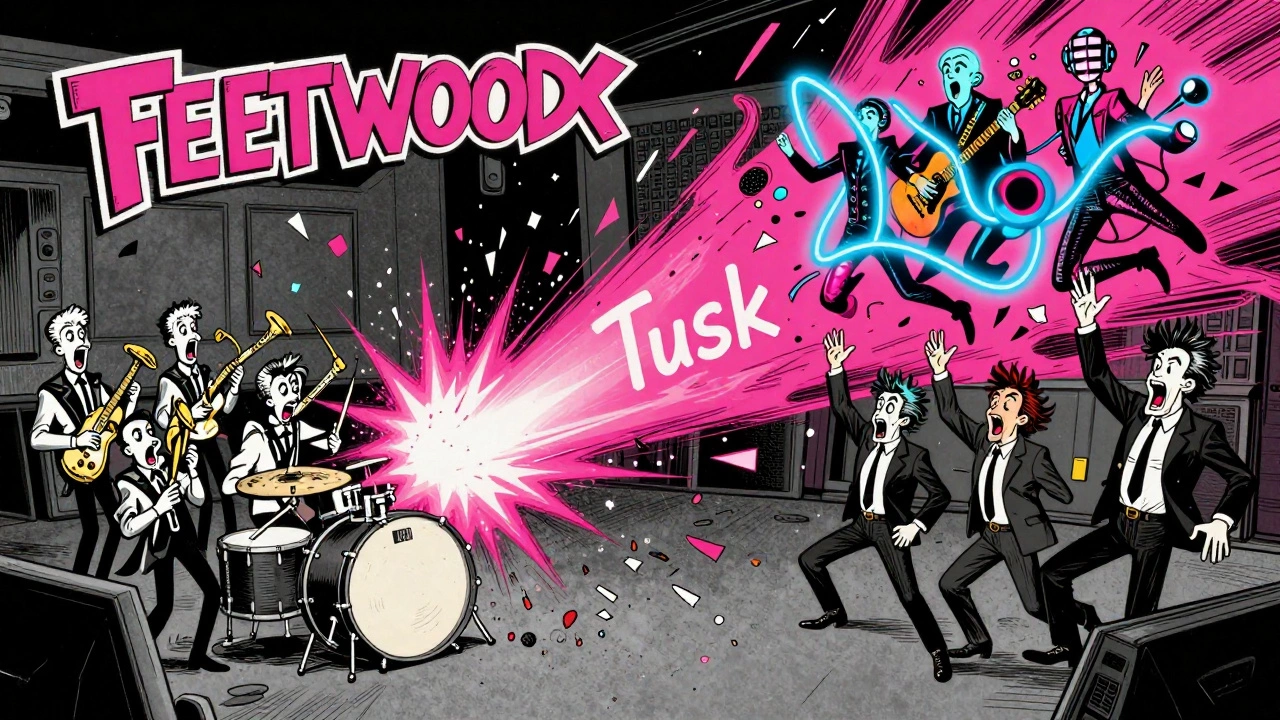
Fleetwood Mac’s "Rumours" was a monster. Released in 1977, it sold over 40 million copies. It was everywhere. Then came "Tusk" in 1979. The band spent $1 million on it - more than any rock album before. They recorded in a studio with no windows. They brought in a marching band. They used a drum machine on "The Ledge." Critics were confused. "It’s messy," said Creem. "It’s self-indulgent," said Rolling Stone. It sold half as much as "Rumours." They called it a flop.
But here’s what no one said: "Tusk" was the first major rock album to experiment with punk energy and new wave sounds. The title track? A 10-minute, multi-part suite that sounds like a post-punk band trying to break into a disco. "Think About Me"? Pure pop genius. "Sara"? A haunting, slow-burning ballad that still gives people chills.
Today, "Tusk" is considered Fleetwood Mac’s most adventurous album. It’s the one fans argue about. It’s the one that influenced bands like The Cure and Prince. The critics didn’t fail - they were looking at the wrong metric. "Tusk" wasn’t supposed to be "Rumours Part 2." It was supposed to be a rebellion. And it was.
The Songs That Never Got a Second Chance
Not every 1970s song got a redemption arc. Some are still cringe.
Paul Anka’s "(You’re) Having My Baby," released in 1974, hit No. 1 on the charts. It was meant to be sweet - a tribute to his wife. But the lyrics? "You’re having my baby, and I’m so proud of you." The production? A syrupy string section that sounds like a soap opera theme. Today, it’s a meme. People use it in comedy sketches. No one defends it. Critics still call it "patronizing" and "embarrassing."
Then there’s Terry Jacks’ "Seasons in the Sun." Originally a French ballad about a dying friend, Jacks rewrote it to sound like a cheerful goodbye. The Beach Boys tried to cover it in 1970 and quit because they thought it was "too wimpy." The 1974 version became a hit. But no one listens to it now with reverence. It’s a relic - a relic of bad taste.
These songs prove something important: not everything that sells gets reevaluated. Sometimes, it’s just bad. And that’s okay. Not every album deserves a second chance.
Why This Matters Now
The reassessment of 1970s music isn’t just about old records. It’s about how we judge art today. We live in a world of instant reviews. A song drops on Spotify, and by the next day, 500 YouTube critics have weighed in. But history shows us: that first reaction is often wrong.
Art isn’t judged by how loud it screams on release. It’s judged by how long it lingers. "Ram" didn’t win because it was perfect. It won because it made people feel something - even if they didn’t know what, at first. "Tusk" didn’t win because it was polished. It won because it dared to be weird.
When you hear a new album and think, "This is strange," don’t dismiss it. Wait. Listen again. Maybe in 15 years, you’ll be the one saying, "I knew it was good all along."
What We Learned
- Critics often judge art based on what’s popular at the moment, not what’s lasting.
- Albums that feel "messy" or "unfocused" at first can become groundbreaking later.
- Commercial success doesn’t guarantee critical respect - and failure doesn’t mean the music is bad.
- Some songs never recover. That’s part of the landscape.
- Time doesn’t fix bad art. But it reveals hidden depth in art that was misunderstood.
Why do critics change their minds about music decades later?
Critics change their minds because context shifts. What seemed confusing or indulgent in 1975 might look bold and innovative in 2025. Cultural values change - so do listening habits. A song once dismissed as "too pop" might now be seen as a precursor to modern synth-pop. Also, younger critics didn’t live through the original backlash. They hear the music fresh, without the noise of the past.
Did any 1970s albums get worse with time?
Yes. Albums like Lynyrd Skynyrd’s "Gimme Back My Bullets" (1976) or The Bay City Rollers’ "Rollin’" (1975) were once popular but now feel dated, shallow, or even offensive. The production, lyrics, or attitudes don’t hold up. What’s worse, some of these albums were never deep to begin with. Time doesn’t magically improve bad art - it just exposes its weaknesses.
How did fan culture influence the reassessment of 1970s music?
Fans kept playing the albums when critics didn’t. Bootlegs, cassette swaps, and later, online forums kept these records alive. When a song becomes a cult favorite, critics can’t ignore it forever. The fan-driven revival of "Ram" and "Tusk" forced mainstream media to take another look. Critics don’t always lead - sometimes they follow.
Are there modern equivalents to 1970s albums that critics got wrong?
Absolutely. Think of Kanye West’s "Yeezus" (2013) - critics called it abrasive and chaotic. Now it’s seen as a landmark in industrial hip-hop. Or Taylor Swift’s "1989" (2014) - dismissed by some as "too pop" at first, now recognized as a genre-defining pop album. Even Beyoncé’s "Lemonade" (2016) faced early skepticism about its length and structure. Time and fans turned those into classics.
Can a song be both a hit and a critical failure?
Yes - and the 1970s are full of them. "Seasons in the Sun" and "(You’re) Having My Baby" both hit No. 1. But neither gained artistic respect. Commercial success measures sales, not depth. A song can be everywhere and still be shallow. That’s why we need critics - and why we need to wait.
What Comes Next?
Today’s music is being judged in real time. TikTok trends, streaming spikes, and viral reviews shape opinions before the album even drops. But history teaches us: the real story isn’t written on day one. It’s written in quiet listening rooms, late-night car rides, and rediscovered vinyl. The next great album might be the one you rolled your eyes at last week.