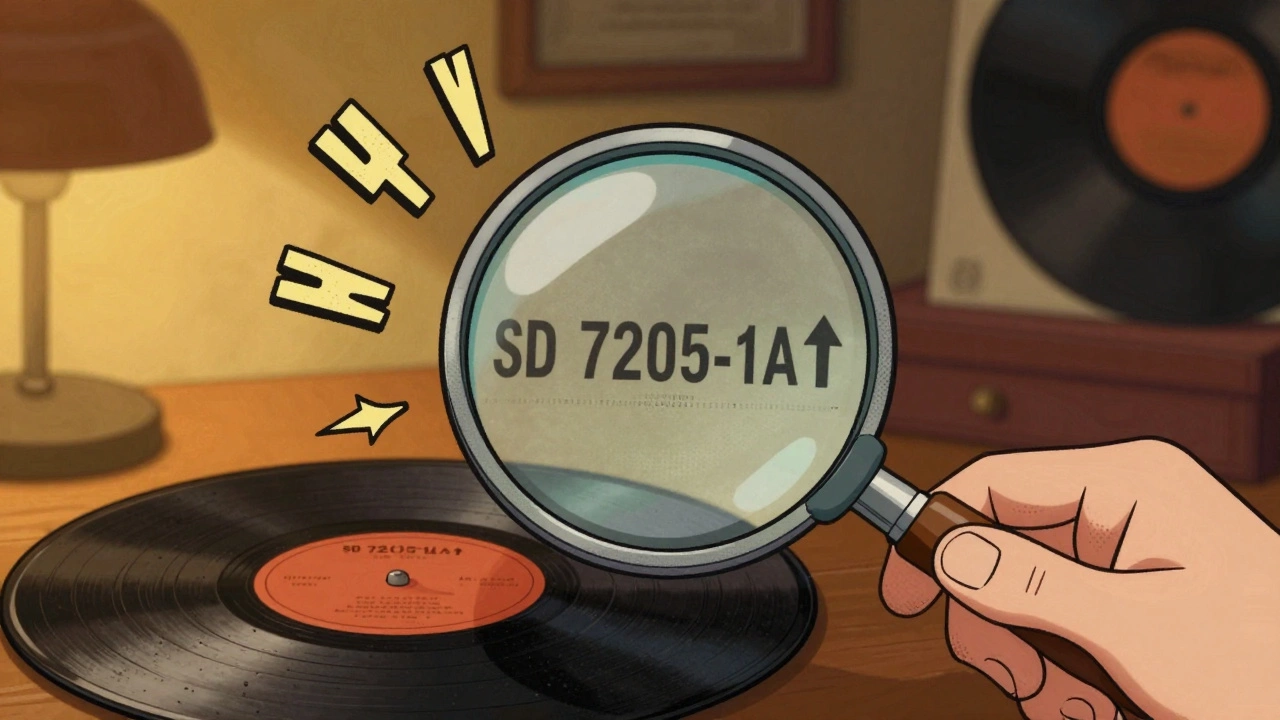

When you pick up a vinyl record, you’re not just holding music-you’re holding a piece of manufacturing history. Hidden in the run-out groove, often barely visible, are tiny alphanumeric codes called matrix numbers. These aren’t random scratches. They’re forensic fingerprints that tell you where, when, and how the record was made. For collectors, these tiny marks can mean the difference between a $20 used copy and a $1,200 original pressing.
What Matrix Numbers Really Are
Matrix numbers are stamped or etched into the master disc during the cutting process. They’re not printed on the label-they’re carved into the metal or plastic itself. This makes them far harder to fake than label designs or cover art. The earliest systems started in the 1920s when labels like Columbia and Victor began using them to track which lathe cut which side of which master. Today, they’re still the most reliable way to identify a pressing’s origin.
There are two main types: surface-printed codes (on the foil layer of the label) and physical etchings (in the run-out groove). The etched ones are the gold standard. They last longer, survive wear, and are harder to alter. A 1971 Led Zeppelin IV with a matrix reading Atlantic SD 7205-1A↑ is a first pressing. The same album with SD 7205-1A↓ is a later reissue. The arrow isn’t decorative-it’s a directional clue from the cutting engineer that tells you which stamper was used.
How Matrix Formats Differ Around the World
Matrix numbering isn’t global. It’s regional, and each region developed its own logic. In the U.S., labels like RCA and Columbia used simple formats: Catalog-Number-Cut. A Columbia LP might read CS 9001-1, where 1 means the first cutting. A second cutting would be -2.
The UK was more detailed. Island Records used ILP 9001-1A↑, where the arrow indicated the direction of the stamper rotation. German pressings from the 1960s often added 1A or 1B to show stamper generations. Hansa Tonstudio in Berlin even used tiny dots next to the numbers to mark cut sequence-something only experts noticed until recently.
Japanese pressings are the most complex-and the most valuable. Companies like Toshiba-EMI used four-character suffixes like ABCD to indicate the cutting engineer. Many included DMM (Direct Metal Mastering), a technique that produced clearer sound. Some even mixed kanji characters with Roman letters. A 1980s Japanese pressing of Pink Floyd’s Dark Side of the Moon with a DMM code and a specific engineer’s initials can sell for 60% more than the U.S. version.
Eastern Bloc pressings add another layer. Czech and Polish records from the 1970s used Cyrillic characters in their matrix codes. Many Western collectors mistake them for damage or printing errors. In reality, a Polish pressing with a Cyrillic П prefix might be rarer than its Western counterpart.
Why Matrix Numbers Matter in Collecting
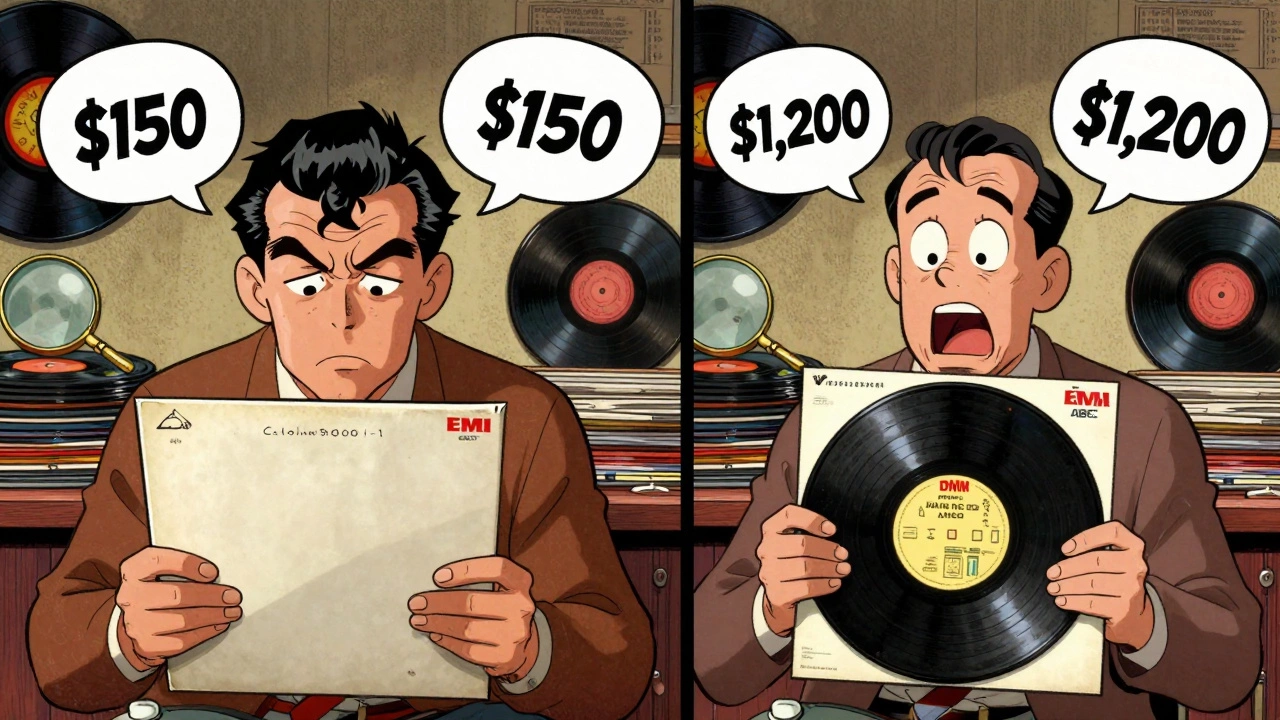
For most people, a vinyl record is just a record. For serious collectors, it’s a puzzle. Matrix numbers unlock provenance. A white label promo (WLP) with no label art can still be authenticated if the matrix number matches known early pressings. The 1973 Capitol Records pressing of Dark Side of the Moon with matrix 7205-1A↑ is worth over $1,200. Later pressings with no arrow or a different number? Around $150.
Matrix numbers also exposed a major forgery ring in 2019. Counterfeit Beatles pressings were circulating with fake labels-but the matrix etchings didn’t match the depth, angle, or spacing of authentic 1960s stampers. Preservation experts at the Library of Congress confirmed the fakes using their Discographical Authentication Protocol, which relies on matrix data to date pressings within six months.
Even the physical depth of the etching matters. Pre-1970s stampers were cut with mechanical lathes that left deeper grooves (0.2-0.3mm). Modern laser-etched numbers are shallower (0.1mm). A collector who doesn’t know this might mistake a modern reissue for an original.
The Dark Side of Matrix Hunting
Not everyone agrees that matrix numbers are worth the obsession. Music historian David Simons argues in The Vinyl Myth that 88% of price differences between pressings come from myth, not sound quality. He points out that two records with different matrix numbers often sound identical. The premium is about rarity, not audio.
There’s also confusion in the data. Atlantic Records between 1971 and 1973 used inconsistent numbering. Some pressings shared the same matrix code but came from different plants. Others had mismatched numbers. This led to years of misvaluation. Even today, 76% of collectors say they’ve encountered matrix variations with no documentation.
And then there’s the learning curve. A 2022 survey by the Vinyl Collectors Association found only 23% of new collectors could correctly identify Japanese matrix notations. Most give up. But those who stick with it? They’re the ones who find the hidden gems.
Tools and Techniques for Identifying Pressings
You don’t need a lab to read matrix numbers. You need three things: a 10x jeweler’s loupe (under $40), good lighting, and a smartphone with macro mode. Angle the light across the run-out groove-shadows reveal depth. Take a photo, zoom in, and compare it to Discogs or 45worlds.com.
Reference guides like the Discographical Reference Guide (2023 edition) list known matrix patterns for over 50,000 records. Online databases are free, but subscription sites like 45worlds.com offer deeper archives, including scans of original master sheets.
Some collectors use AI tools now. The MatrixScan app, released in January 2023, uses image recognition to match your photo against 2.3 million known variants. It’s 89% accurate. But many veterans still prefer the old way-the slow, careful hunt.
The Vinyl Collectors Association offers a certification: Matrix Identification Specialist. To pass, you must identify 15 unknown pressings in 30 minutes. Only 78% do. Those who pass get listed in their database-and often get first access to rare finds.
The Market and Future of Matrix-Based Collecting
The global vinyl market hit $1.2 billion in 2023. But not all of that value is equal. Casual collectors make up 78% of sales volume but only 66% of total value. Specialist collectors-those who chase matrix numbers-make up just 12% of buyers but drive 34% of the market’s worth.
Auction houses like Christie’s now require matrix documentation for high-value lots. In 2023, demand for fully documented pressings jumped 63% compared to 2020. Specialized services like Vinyl Authentication Services process over 1,200 requests a month-with a three-week wait.
New tech is changing the game. The Vinyl Preservation Project, funded by the National Endowment for the Humanities, has archived 417,000 pressings with linked audio samples. Sony Music is testing blockchain to record matrix numbers at pressing, creating tamper-proof ownership records.
But not everyone welcomes this. Veteran collector Mark Block told Record Collector magazine: "The joy was in the hunt, in finding that subtle variation others missed. When everything’s instantly verifiable, we lose part of what made collecting special."
Still, demand is growing. MIDiA Research predicts a 15% annual increase in authenticated pressings through 2027. The hunt isn’t over-it’s just getting smarter.
What exactly is a matrix number on a vinyl record?
A matrix number is an alphanumeric code etched into the run-out groove of a vinyl record during manufacturing. It identifies the specific stamper, cutting engineer, and production sequence used. Unlike label text, it’s physically carved into the plastic, making it a reliable marker for authentication and dating pressings.
Why are Japanese pressings more valuable?
Japanese pressings often use Direct Metal Mastering (DMM) and include four-character engineer codes, which indicate superior mastering quality. They were pressed in smaller quantities, with tighter quality control, and frequently used original master tapes. These factors, combined with matrix notations that are harder to replicate, make them highly sought after-often commanding 40-60% higher prices than equivalent U.S. pressings.
Can matrix numbers be faked?
While label art and cover designs are easy to copy, matrix numbers are much harder to fake. They require the same cutting lathe, stamper, and etching depth as the original. Counterfeiters often get the alphanumeric sequence right but miss subtle details like etching depth, angle, or spacing. Experts use magnification and comparison to detect these inconsistencies.
How do I check the matrix number on my record?
Hold the record under a bright light at an angle and look at the run-out groove (the smooth area between the last track and the label). Use a 10x jeweler’s loupe or a smartphone’s macro camera. Write down the numbers and symbols, then compare them to databases like Discogs or 45worlds.com. Pay attention to arrows, dots, and suffixes-they’re often the key.
Are matrix numbers important for modern vinyl releases?
Yes, but differently. Modern pressings often use standardized codes, and many use laser etching, which is harder to distinguish between pressings. However, limited editions, audiophile reissues, and special releases still use matrix numbers to indicate unique runs. Some new pressing plants even include engineer initials or batch codes-collectors are watching closely.


