

Why Sixteenth-Notes Are the Heart of Funk Guitar
Most guitarists think of funk as flashy solos and wah pedals. But the real magic? It’s in the funk guitar comping - the quiet, tight, locked-in rhythm that makes you move without even trying. Forget power chords and fast licks. Funk is built on sixteenth-note subdivisions: 16 tiny pulses in every beat. That’s not just counting - it’s feeling. When you nail this, the whole band locks in. The bass grooves harder. The drums snap tighter. And suddenly, you’re not just playing guitar - you’re driving the groove.
Think of Prince’s "Kiss," Bootsy Collins on "One Nation Under a Groove," or even Bruno Mars’ "Uptown Funk." None of those songs rely on complex chords or screaming leads. They live and die by the rhythm guitar. That’s the power of sixteenth-note comping. It’s not flashy. It’s not loud. But it’s impossible to ignore.
The 16th-Note Grid: How to Count It Right
You can’t play what you can’t count. The foundation of funk comping is the "1 e & a" system. In a 4/4 bar, you break each beat into four parts:
- 1
- e
- &
- a
That’s one beat. Do it four times: "1 e & a 2 e & a 3 e & a 4 e & a." That’s your 16th-note grid. No shortcuts. No guessing. Say it out loud while you play. Even when you’re silent. Even when you’re not touching the strings. Your mouth has to be in sync with your hand.
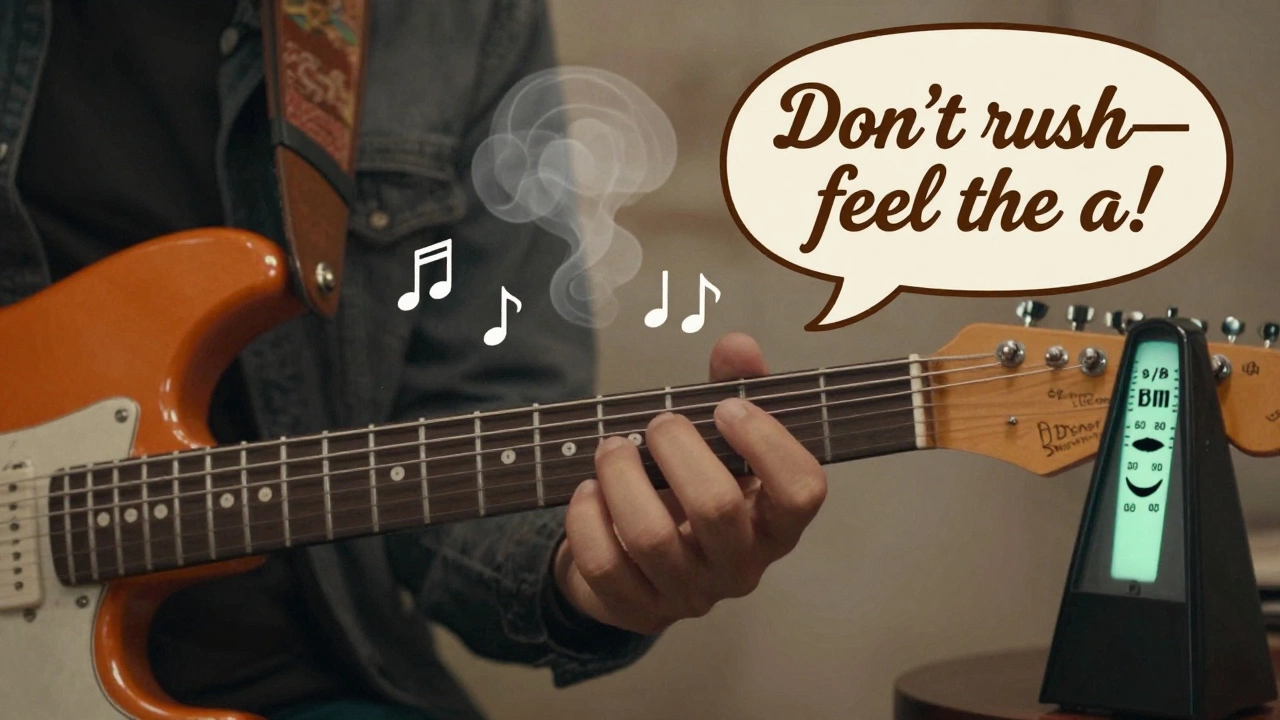
Most beginners rush. They hear a groove and try to play it fast. That’s why 78% of new players fail at first. You don’t need speed. You need precision. Start at 60 BPM. Play only the "a" subdivision - just that one note, every fourth pulse. Then add the "e." Then the "&." Slow down until your timing is rock solid. Record yourself. Listen back. If it feels off, it is off.
Muting: The Secret Weapon You’re Ignoring
Here’s the dirty truth: most funk guitarists don’t play full chords. They play ghosts. They barely touch the strings. That’s muting. Your fretting hand isn’t just pressing down - it’s hovering. Lightly resting on the strings so they don’t ring out fully. You’re not muting to kill the sound. You’re muting to control it.
The E9 chord is the starter kit. Fingers on the 4th string (D string) at the 2nd fret, 3rd string (G string) at the 1st fret, and let the open B and high E ring. That’s your voicing. Now, don’t press hard. Just rest your fingers. Strum. Let the strings buzz slightly. That’s the sound. It’s not clean. It’s not pretty. But it’s funk.
Advanced players use 7#9 (the "Hendrix chord") and 13th voicings, but they all start with the same rule: light touch. Heavy strumming? That’s rock. Funk needs air. It needs space. If your strings are ringing out too long, you’re not comping - you’re jamming.
Displacement: Moving the Beat Without Changing Tempo
Here’s where funk gets sneaky. You don’t always hit the beat. You hit it a little late. Or a little early. That’s displacement. Take a simple pattern: play the chord on the "1" and the "&." Now shift it. Play it on the "e" and the "a." The tempo hasn’t changed. The chords haven’t changed. But the feel? Totally different.
This is what makes funk feel alive. It’s not mechanical. It’s human. It’s off-kilter in the right way. Bootsy Collins didn’t play on the beat - he played just after it. Prince didn’t play every note - he left gaps so the bass could breathe. That’s the art.
Try this exercise: play a simple E9 chord on every sixteenth note. Now, skip the "1" and "3." Play only on "e,&,a,2,e,&,a,4,e,&,a." That’s 12 notes. The silence on the downbeats makes the groove bounce. That’s displacement. That’s funk.
Chord Voicings That Work - and the Ones That Don’t
Not all chords are created equal in funk. Big barre chords? Too heavy. Full 6-string voicings? Too muddy. You need clarity. You need space. Here are the voicings that actually work:
- E9: 0-2-1-0-0-0 (open strings ring - perfect for muting)
- A7#9: x-0-2-1-2-0 (the "Hendrix" sound - great for punch)
- D13: x-5-4-5-5-5 (tight, high voicing - cuts through the mix)
- G7: 3-2-0-0-0-1 (simple, bright, works over bass slides)
Avoid full 6-string open chords like C major or G major. They ring too long. You need short, staccato hits. Think of your guitar as a percussion instrument. You’re not harmonizing - you’re drumming.
Practice Routines That Actually Work
You don’t need hours. You need focus. Five minutes a day, done right, beats an hour of guessing. Here’s a proven routine:
- Ghost Strums (2 min): Hold your pick. Don’t touch the strings. Move your hand as if you’re strumming sixteenth notes. Count out loud: "1 e & a." Feel the motion. No sound. Just rhythm.
- Muted 16ths (3 min): Rest your fretting hand lightly on the strings. Strum all 16 notes with no chord shape. Just mute. Keep it even. No accents. No speed.
- Chord on "e" and "a" (5 min): Play E9 only on the "e" and "a" of each beat. That’s 8 hits per bar. Use a metronome. If you rush, stop. Reset. Repeat until it feels natural.
- Displacement Drill (5 min): Play the same chord, but shift it one sixteenth note later each time. Play on "1,&" then "e,a" then "&,1" - keep cycling.
- Play Along (5 min): Find a track like "Super Bad" by James Brown or "Kiss" by Prince. Mute your strings and mimic the rhythm exactly. Don’t try to play the chords. Just match the feel.
Do this every day for two weeks. You’ll hear the difference in your playing. You’ll feel the groove in your bones.
Common Mistakes (And How to Fix Them)
Here’s what goes wrong - and how to fix it:
- Rushing: 78% of beginners speed up. Solution: Use a drum machine. Play with a simple backbeat. Let the drums hold you back.
- Too much pressure: Heavy strumming = muddy sound. Solution: Hold the pick like you’re holding a butterfly. Light grip. Light motion.
- Not muting: Strings ring too long. Solution: Rest your palm lightly on the bridge. Let the strings die instantly.
- Ignoring the "a": Most players forget the last sixteenth. Solution: Practice playing only on the "a" for 5 minutes straight. It’s the secret pulse.
- Playing too many notes: Funk is space. Solution: Play half as many chords as you think you should. Leave room.
Why This Technique Is Everywhere Now
Funk guitar comping isn’t just for 70s records anymore. It’s in pop, R&B, indie rock, and even electronic music. Dua Lipa’s "Levitating"? That rhythm guitar? Pure funk comping. Bruno Mars’ "24K Magic"? Same. Even TikTok’s "funk challenge" videos - millions of views - are all built on this exact technique.
Why? Because people are tired of flat, quantized beats. They want human groove. They want rhythm that breathes. And that’s what sixteenth-note comping gives you - the feel of a live band, even if you’re playing alone.
According to Berklee’s 2023 survey, over 30% of indie rock guitarists and 22% of modern R&B players now use these patterns. It’s not a niche skill anymore. It’s a core tool. And it’s growing.
Final Thought: It’s Not About Playing Notes - It’s About Timing
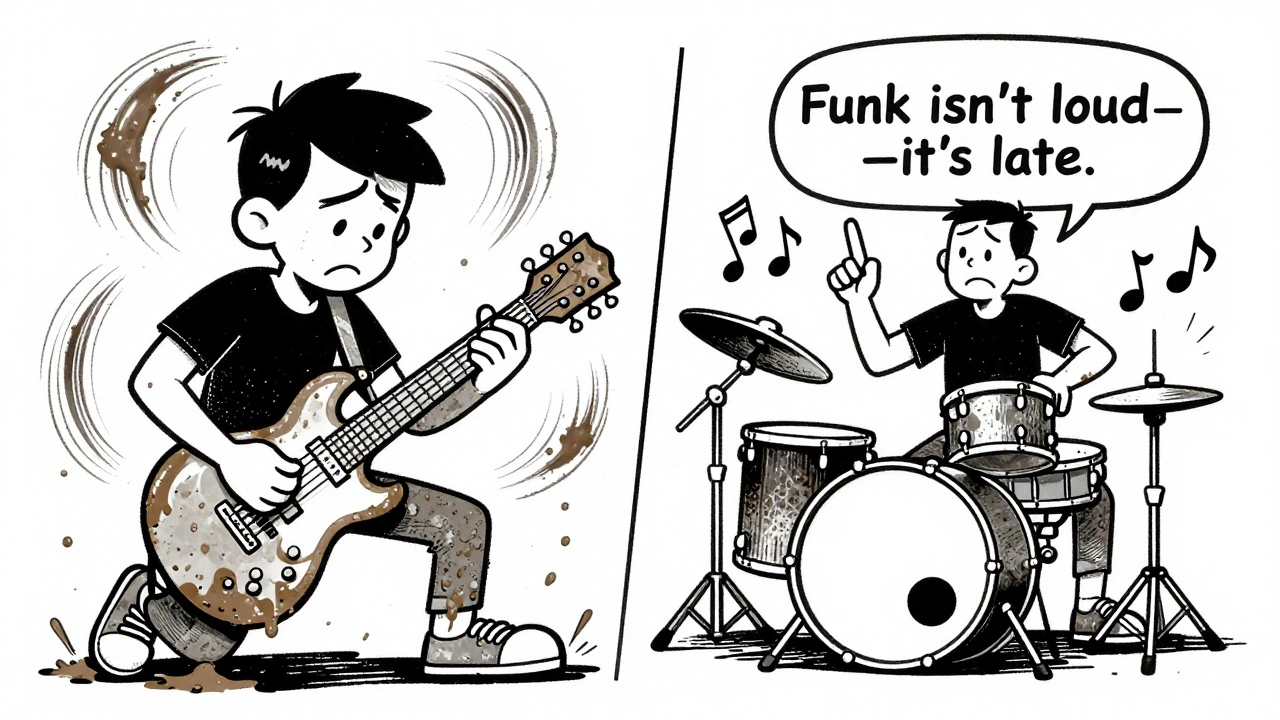
Funk guitar isn’t about what you play. It’s about when you play it. A single chord, played on the right sixteenth note, can move a crowd. A chord played a millisecond too early? It dies. That’s the razor’s edge.
You don’t need to learn 100 chords. You don’t need to shred. You need to listen. To the bass. To the kick. To the silence between the notes. That’s where the groove lives.
Start slow. Mute hard. Count out loud. Play with a drum track. And for heaven’s sake - don’t rush. The beat will find you. You just have to wait for it.
What is the best chord to start with for funk guitar comping?
The E9 chord (0-2-1-0-0-0) is the best starting point. It uses open strings for natural resonance, making it easy to mute and control. The open B and high E strings ring clearly when lightly touched, giving you that bright, punchy funk tone without needing complex fingerings.
Why do I keep rushing when playing sixteenth-note patterns?
Rushing happens because your brain wants to finish the pattern quickly. The fix? Practice with a metronome set to 60 BPM or slower. Focus on one subdivision at a time - like only playing on the "a" for a full minute. Let your body learn the space between notes. Speed comes from control, not effort.
Do I need to use a pick for funk comping?
Yes - a pick gives you the attack and clarity needed. Fingers are too soft and blurry for the staccato hits funk requires. Use a medium-gauge pick (0.73mm-0.88mm) for control. Hold it lightly. The goal is precision, not power.
Can I use this technique in rock or pop music?
Absolutely. Funk comping is now standard in modern pop, R&B, and indie rock. Artists like Dua Lipa, Bruno Mars, and Tame Impala use these patterns to add groove and movement. Even if you’re not playing funk, adding sixteenth-note muting to your rhythm parts will make them feel tighter and more alive.
How long does it take to get good at funk comping?
With 15 minutes of focused daily practice, most players see real improvement in 4-6 weeks. The key isn’t time - it’s consistency. One week of practicing the "a" subdivision correctly will do more than a month of mindless strumming.
What’s the biggest mistake beginners make?
Focusing only on the picking hand. The real secret is fret-hand muting. If your strings ring too long, your groove will be muddy. Practice muting even when you’re not playing chords - just rest your fingers on the strings and strum. That’s the foundation.


