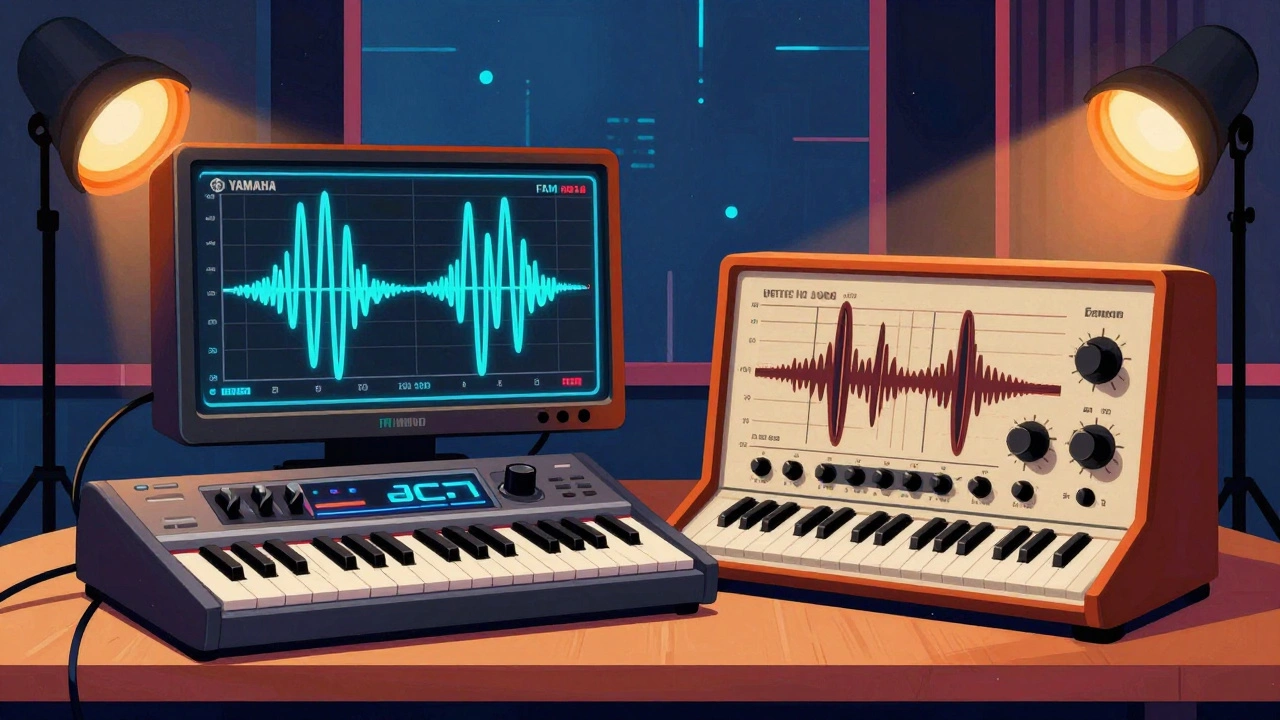

The 1980s Synth Revolution
In 1983, the Yamaha DX7 became the first synthesizer to sell over 200,000 units worldwide. Its success wasn't just about price-it was about a new way of creating sound. While analog synths like the Minimoog dominated the 1970s, the 1980s saw a clash between two sound design philosophies: FM synthesisFrequency Modulation synthesis is a digital sound generation technique where one waveform modulates the frequency of another, creating complex harmonic structures. and subtractive synthesisSubtractive synthesis starts with harmonically rich waveforms and filters out unwanted frequencies to shape the sound.. This battle defined the sonic landscape of the decade.
Subtractive Synthesis: Sculpting Sound from Rich Tones
Subtractive synthesis began with Robert Moog's modular systems in the 1960s. By the 1980s, it was the go-to method for analog synths like the Minimoog Model D, Roland Jupiter-8, and Sequential Circuits Prophet-5. These instruments used voltage-controlled oscillators (VCOs) to generate waveforms-sawtooth, square, or triangle-and then passed them through voltage-controlled filters (VCFs) to remove specific frequencies. Think of it like chiseling stone: start with a block of sound and carve away what you don't need.
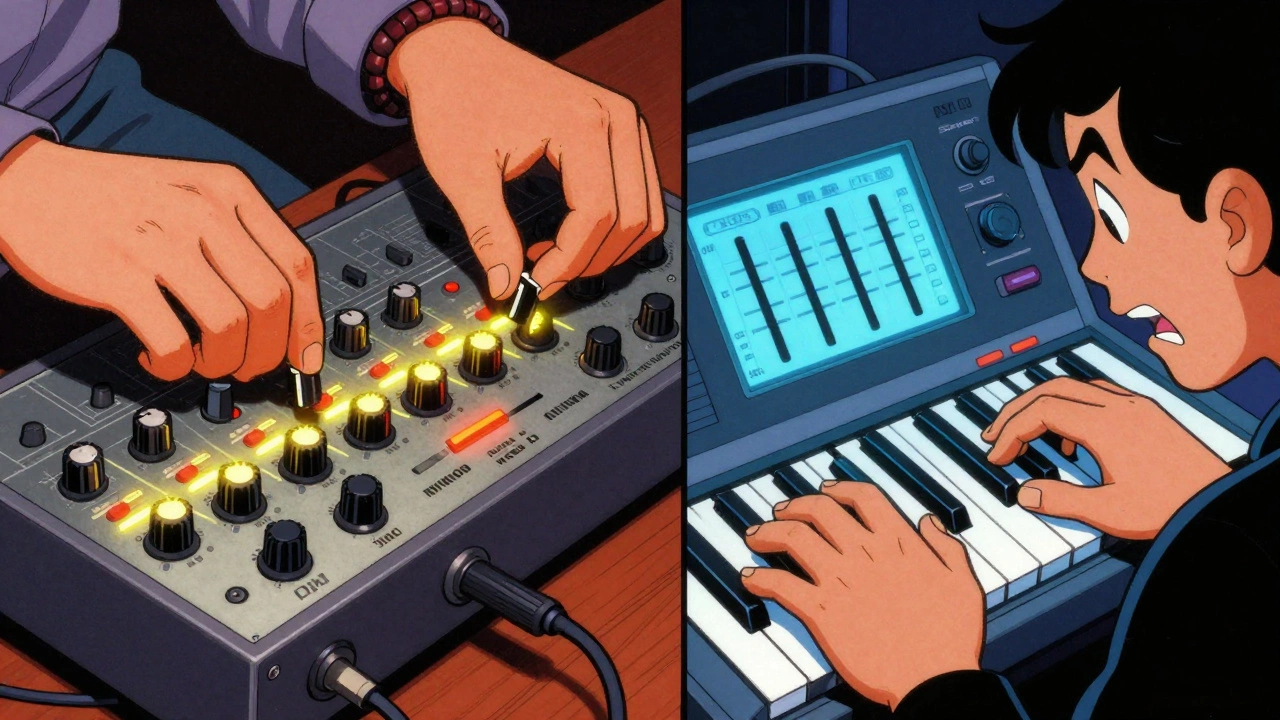
The Minimoog, for example, had a signature 24dB/octave low-pass filter that gave basslines their warm, resonant punch. Musicians loved how tweaking a knob instantly changed the sound. A Roland Jupiter-8 user could adjust a filter cutoff in real-time while playing, making it perfect for expressive leads and evolving pads. These synths typically offered 4-8 voices of polyphony and were priced between $2,800 and $5,000 in the early 1980s. Their tactile controls made them intuitive for live performance, but they struggled to create metallic or bell-like tones without extra processing.
FM Synthesis: The Digital Math of Sound
FM synthesis was invented by John Chowning at Stanford University in the late 1960s and commercialized by Yamaha in 1973. The Yamaha DX7The Yamaha DX7 was the first mass-market FM synthesizer, featuring 6 operators per voice and 32 algorithms for complex sound design. launched in 1983 for $1,995-less than half the price of high-end analog synths-and offered 16 voices of polyphony, MIDI support, and tuning stability. Instead of filtering waveforms, FM used digital operators (sine waves) to modulate each other's frequencies. One operator (the carrier) produced the audible sound, while another (the modulator) altered its frequency to create harmonics.
This method allowed for bright, metallic sounds impossible with analog gear. The DX7's "E.Piano 1" preset became ubiquitous in 1980s pop music. But programming it was tough. Users navigated menus via a small LCD screen and slider, with no physical knobs. A single change to an operator's envelope could drastically alter the entire sound. Sound on Sound magazine noted in 1984 that "once you grasp the fundamental relationships, FM opens sonic territories completely inaccessible to subtractive methods," but the learning curve was steep. Yamaha's internal studies showed it took 40-60 hours just to achieve basic proficiency with the DX7.
Key Differences: FM vs Subtractive Synthesis
| Aspect | Subtractive Synthesis | FM Synthesis |
|---|---|---|
| Sound Characteristics | Warm, organic tones (basses, pads, expressive leads) | Metallic, digital, bell-like textures (electric pianos, percussion) |
| Programming Complexity | Intuitive knob-based control; immediate results | Menu-driven interface; abstract parameter relationships |
| Price (1980s) | $2,800-$5,000 (e.g., Minimoog, Jupiter-8) | $1,995 (Yamaha DX7) |
| Polyphony | 4-8 voices | 16 voices (DX7) |
| Common Use Cases | Basslines, live performance, warm pads | Electric pianos, synth brass, complex digital textures |
Why the 1980s Were a Turning Point
The 1980s were a perfect storm for synth evolution. The global synthesizer market grew from $120 million in 1980 to $380 million in 1985. Digital synths captured 58% of the market by 1985-up from just 12% in 1980. The Yamaha DX7 alone drove this shift, accounting for $200 million in sales between 1983-1989. Its affordability and polyphony made it accessible to studios worldwide, while analog synths like the Minimoog (priced at $2,800 in 1980) felt expensive for what they offered.
MIDI's introduction in 1983 accelerated this change. The DX7 became the standard for MIDI implementation, while many analog synths needed retrofit kits. Billboard reported in 1987 that 78% of top 100 hit songs used analog subtractive synths for bass parts, but 63% relied on FM for keyboard textures. This wasn't a winner-takes-all battle-it was a complementary coexistence. Producers used both methods: subtractive for warmth, FM for brightness.

User Experiences: The Human Side of Synthesis
For many musicians, the choice between FM and subtractive was deeply personal. On Elektronauts forum in 2018, user "analogjunkie84" (a professional since 1982) recalled: "I bought a DX7 in '84 after using Minimoogs for a decade-the first month was pure frustration trying to make anything that didn't sound like a broken calculator. By '85, I was creating sounds I'd never imagined possible." Meanwhile, a Gearspace forum user in 2020 said: "My Jupiter-8 was my voice-I could tweak a knob and immediately hear the change-but with the DX7, I'd spend hours programming only to accidentally reset it and lose everything because of its single memory buffer."
Sound designer Brian Eno captured the emotional divide in a 1987 retrospective: "FM gave us sounds we'd never heard before, but subtractive gave us sounds we could feel." Professor Gareth Loy's 1989 Stanford study confirmed this, finding FM synthesis required 37% more cognitive load than subtractive for equivalent tasks. Yet the DX7's iconic sounds became impossible to ignore. When you hear "Sweet Dreams (Are Made of This)" by Eurythmics, that piercing synth lead? Pure FM. When you hear "Billie Jean" by Michael Jackson, that bassline? Subtractive synthesis on a Roland Juno-60.
Legacy Today: How These Methods Live On
The 1980s synthesis war didn't end-it evolved. Analog synths saw a resurgence in the 2010s with Moog reissuing the Model D (selling 14,000 units between 2014-2020). FM synthesis found new life in software like Native Instruments' FM8 (2008), which simplified programming with graphical interfaces. Modern hybrid synths like the Korg Opsix (2021) and Arturia DX7 V (2022) deliberately blend both approaches. A 2024 Berklee College of Music survey found 73% of electronic music producers now use both subtractive and FM elements in their work.
Moog's CEO summed it up at the 2025 NAMM Show: "Subtractive is about emotional expression through immediate tactile control, while FM is about sonic exploration through mathematical relationships-both remain essential tools for different creative purposes." The 1980s taught us that sound design isn't about one method winning. It's about choosing the right tool for the job, whether you're crafting a warm bassline or a shimmering digital bell.
Frequently Asked Questions
What is the main difference between FM and subtractive synthesis?
Subtractive synthesis starts with harmonically rich waveforms and filters out frequencies to shape the sound, while FM synthesis creates complex tones by modulating one waveform's frequency with another. Subtractive is like sculpting stone; FM is like mixing colors mathematically.
Why did the Yamaha DX7 become so popular?
The DX7 sold over 200,000 units because it was affordable ($1,995), offered 16 voices of polyphony, had MIDI compatibility, and produced iconic sounds like electric pianos and bells. It outsold analog synths like the Minimoog by combining digital precision with practical features for studio musicians.
Is subtractive synthesis still used today?
Yes. Modern analog synths like the Moog Model D reissue and hybrid instruments like the Arturia MicroFreak use subtractive synthesis for warm basslines, leads, and pads. Its intuitive workflow makes it ideal for live performance and tactile sound design.
How does FM synthesis work technically?
FM synthesis uses digital operators (sine waves) where one operator's frequency modulates another's. The "carrier" produces the audible sound, while the "modulator" alters its frequency to generate harmonics. Yamaha's DX7 used 6 operators per voice arranged in 32 algorithms for complex modulation paths.
Which is easier to program: FM or subtractive synthesis?
Subtractive synthesis is generally easier for beginners. Its knob-based interface provides immediate feedback (e.g., turning a filter knob changes sound instantly). FM synthesis requires navigating menus and understanding abstract relationships between operators, making it steeper to learn-though it offers unique sonic possibilities once mastered.


