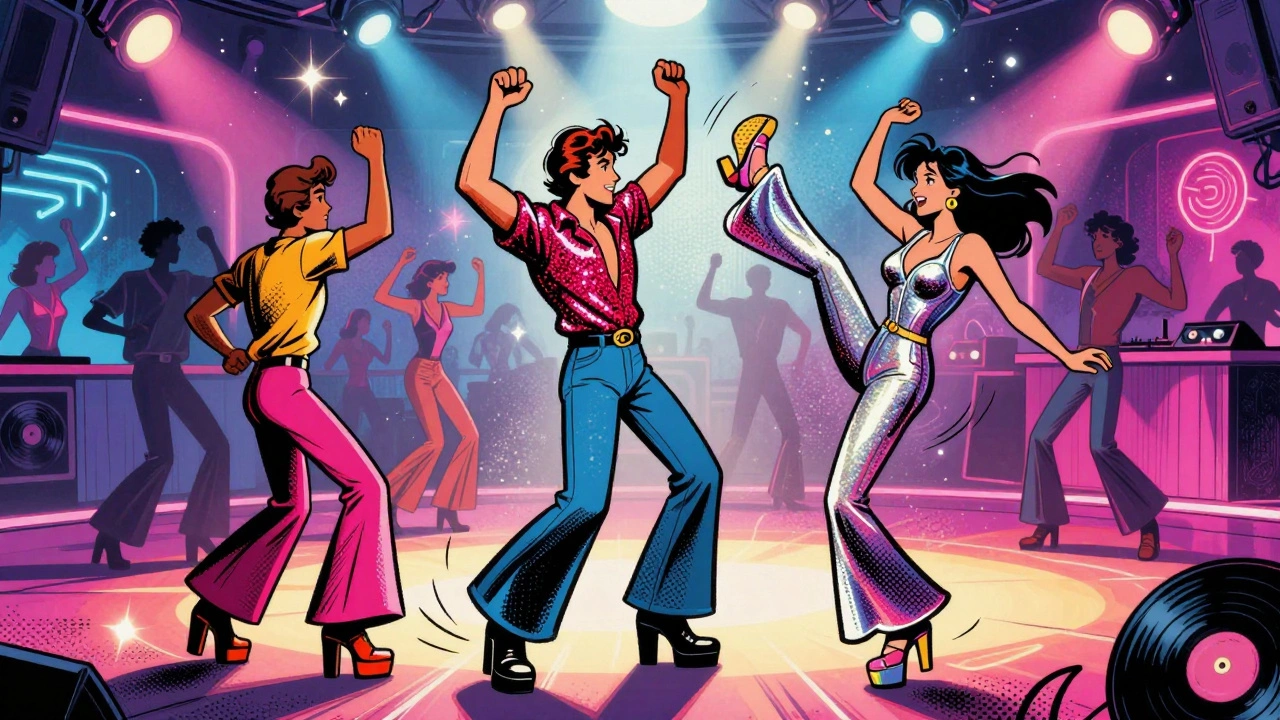

When you think of the 1970s, what comes to mind? Glittering dance floors, thumping basslines, and people moving in ways that made you wonder how they didn’t fall over? That’s because they weren’t just dancing-they were wearing clothes designed to make every step a statement. Bell bottoms and platform shoes weren’t just trends. They were armor. They were rebellion. They were the visual language of a generation that refused to blend in.
From Navy Uniforms to Dance Floors
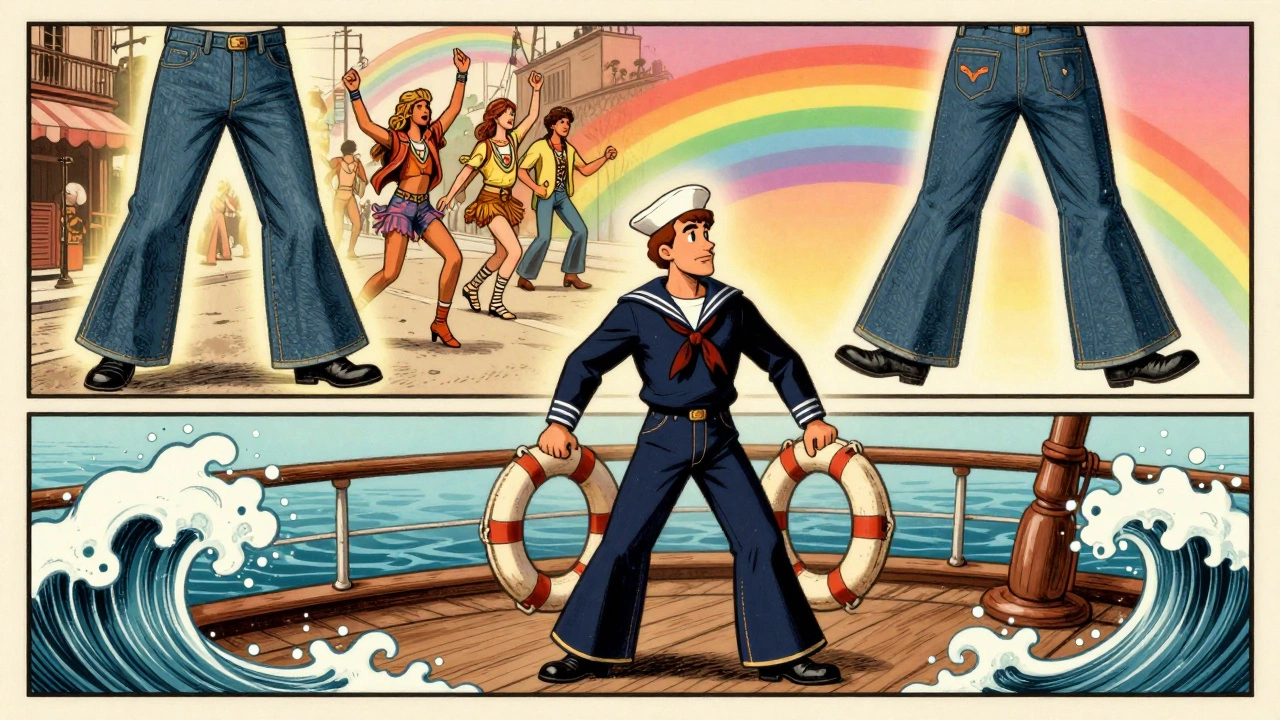
Bell-bottoms didn’t start on a runway. They started on a ship. Back in the 1800s, the U.S. Navy designed wide-legged trousers so sailors could easily kick them off if they went overboard. The flare acted like a float, helping them stay above water while waiting for rescue. The British Royal Navy copied the design. It was practical. Functional. Not exactly glamorous.
Fast-forward to the 1960s. In San Francisco, a boutique called Mnasidika in Haight-Ashbury began selling custom Levi’s jeans with flared hems. Peggy Caserta, the owner, hired a tailor to sew extra fabric into the legs-just enough to make them swing when you walked. People loved it. By 1969, Levi’s released its own version: the 646 Bell Bottom. Suddenly, millions had them. Men. Women. Teens. Hippies. Rock stars. The shape didn’t just fit the body-it fit the mood.
By the early 1970s, the flare had grown. What started as a gentle curve at the calf became a dramatic sweep that pooled around the ankles. Some versions, called elephant bells, were so wide they swallowed the shoes entirely. And that’s when the next piece fell into place.
Why Platforms Weren’t Just About Height
Platform shoes weren’t invented in the 70s. Salvatore Ferragamo made them for Judy Garland in the 1930s. But they didn’t catch on-not until disco did.
Think about it. Bell bottoms dragged. They pooled. They scraped the floor. In a club lit by strobe lights and smelling like sweat and perfume, that was a disaster. You couldn’t spin. You couldn’t kick. You couldn’t dance like you meant it if your pants were constantly catching on the ground.
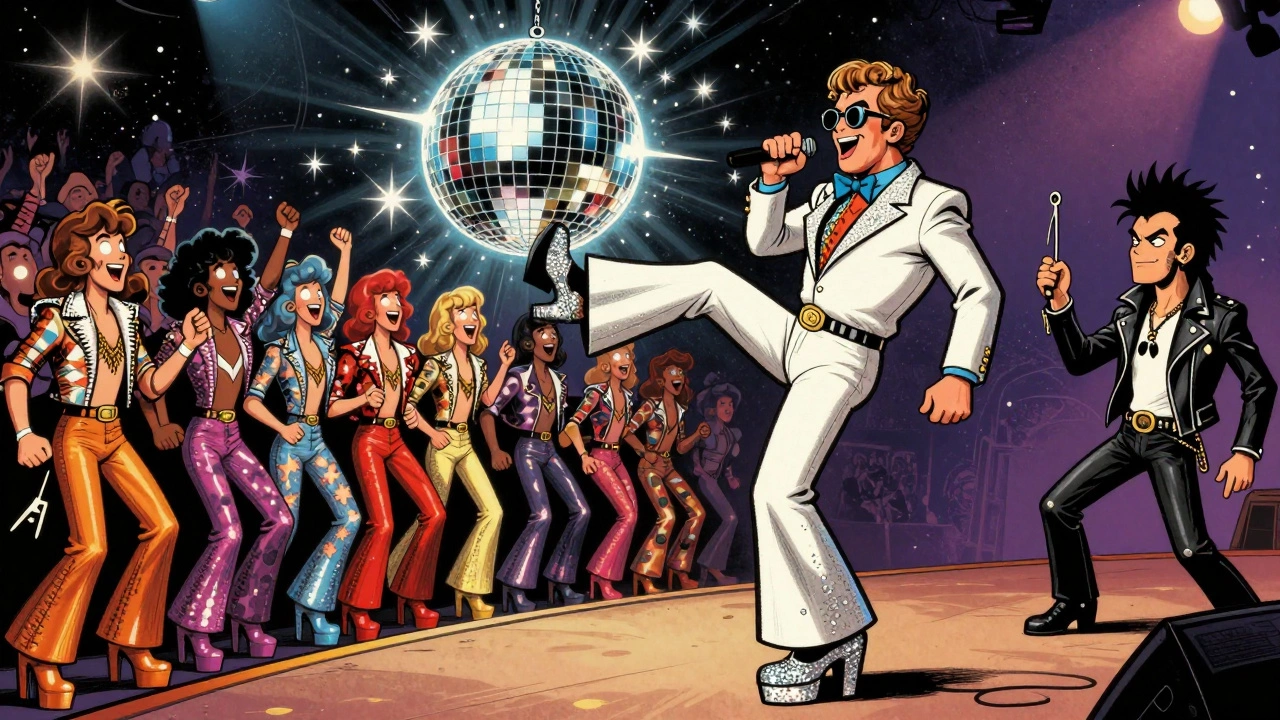
Platforms solved that. With soles at least two inches thick and heels four to five inches high, they lifted the wearer just enough to keep the fabric off the floor. But that wasn’t all. These shoes didn’t just elevate your feet-they elevated your presence. Cher wore them. Bianca Jagger wore them. Elton John wore them on stage, glittering under lights, legs stretched out in wide flares. KISS turned them into spectacle. Queen made them part of the show.
They weren’t just shoes. They were props. Tools. A way to say, I’m here, I’m loud, and I’m not going to be ignored.
The Disco Aesthetic: More Than Just Sequins
Studio 54 opened in 1977, and with it came a new kind of visual culture. It wasn’t just about dancing. It was about being seen. The music was fast, the lights were flashing, and the clothes had to match.
Sequin jumpsuits. Halter tops. Metallic fabrics. Polyester that caught the light like liquid silver. Bell bottoms and platforms were the base. Everything else was built on top. Women wore cropped tops with wide-legged pants that flared like trumpets. Men wore satin shirts unbuttoned to the navel, paired with the same flares. No one wore black unless it sparkled.
And it wasn’t just New York. From Los Angeles to London, the look spread. It wasn’t just fashion-it was identity. If you wore bell bottoms and platforms, you were saying you belonged to a world that celebrated freedom, excess, and joy. It was a rebellion against the muted tones of the 60s and the rigid conformity of the 50s.
Why It All Fell Apart
By 1979, the shine started to fade. Punk rock exploded. Black leather. Safety pins. Spiked hair. The message was clear: Disco is over. Bell bottoms? Too flashy. Too indulgent. Too much.
Skinny jeans took over. Drainpipe pants. Tight. Dark. Minimal. The opposite of everything bell bottoms stood for. By 1980, the look was considered dated. People didn’t just stop wearing them-they actively avoided them. They became symbols of a decade that had gone too far.
And yet, fashion has a way of recycling itself.
The Comeback: Boot-Cuts, Bootlegs, and Beyond
In 1996, bell bottoms returned-but not as they were. They were slimmed down. Lowered. Rebranded as “boot-cut” or “bootleg” jeans. The flare was subtle, just enough to fit over a pair of ankle boots. No more elephant bells. No more five-inch platforms. Just a gentle curve. Women wore them with crop tops. Men wore them with sneakers. They weren’t rebellion anymore-they were nostalgia.
By 1999, the flare widened again. The 90s version of bell bottoms had more volume than the 90s boot-cut, but less than the 70s original. They were the happy medium. Comfortable. Feminine. Not too loud. They stayed popular until 2006, when skinny jeans took over again. Fashion editor Sharon Haver once said it perfectly: “It’s as if all the girls wearing premium boot-cut jeans threw them away one day, and the next day began wearing skinny jeans and flats.”
But here’s the thing. They’re back again.
Today, flared jeans are trending once more. Not the wild 70s versions. Not the 90s boot-cuts. New versions. Slightly flared at the knee. Made from organic cotton. Paired with chunky loafers or minimalist sandals. The message is different now. It’s not about rebellion. It’s about balance. About mixing past and present. About remembering that fashion isn’t just about what looks good-it’s about what felt good.
Why This Matters
Bell bottoms and platform shoes weren’t just clothes. They were a response to a world that was changing too fast. A generation that wanted to move, to dance, to be seen. They came from a navy uniform. They became a symbol of freedom. They got crushed under the weight of punk. They came back as a comfort. Now, they’re being reinvented again.
That’s the real story. Not how they looked. But how they made people feel. When you put on a pair of flared jeans and a pair of chunky heels today, you’re not just dressing up. You’re tapping into something deeper. A history of resistance. A rhythm of joy. A visual culture that refused to sit still.
So next time you see someone wearing flares, don’t think ‘retro.’ Think: They’re dancing.
Why did bell-bottoms become popular in the 1970s?
Bell-bottoms exploded in popularity during the 1970s because they matched the energy of the disco era. They were bold, colorful, and perfect for dancing. Celebrities like Sonny and Cher, Cher, and Bianca Jagger wore them on TV and at clubs, making them a must-have. The rise of Studio 54 and disco music turned fashion into performance, and bell-bottoms-especially when paired with platform shoes-gave people the freedom to move without tripping over their own pants.
Were platform shoes only worn by women?
No. While women wore them with flared dresses and jumpsuits, men in glam rock and disco scenes wore them too. Elton John, KISS, and Queen’s Brian May all rocked thick-soled platforms on stage. They weren’t just for height-they were part of the theatricality of the music. Men’s platforms often had block heels and bold colors, matching their sequined shirts and wide-leg pants. The look was unisex in spirit, even if the styles differed.
How did bell-bottoms go from military gear to fashion?
Bell-bottoms began as functional Navy uniforms in the 1800s, designed to help sailors swim and remove wet pants quickly. They faded from military use by the mid-20th century. In the 1960s, counterculture movements in San Francisco and London revived them as a symbol of rebellion. Peggy Caserta’s custom Levi’s in Haight-Ashbury were among the first commercial versions. By 1969, Levi’s launched their own line, and the rest followed. What started as utility became identity.
Why did platform shoes disappear after the 1970s?
Platform shoes vanished because they became tied to disco, which was seen as excessive and out of touch. The punk movement of the late 70s rejected everything flashy, favoring minimalism and rawness. Skinny jeans and flat shoes became the new norm. Platforms were labeled as outdated, even ridiculous. They didn’t disappear entirely-some niche designers kept making them-but mainstream fashion moved on until the 90s revival.
Are bell-bottoms coming back today?
Yes-but differently. Modern flares are slimmer than 70s versions. They’re made from sustainable fabrics and often paired with low block heels or sneakers, not towering platforms. Designers like Madewell, Levi’s, and Reformation have released updated versions. They’re not about rebellion anymore. They’re about comfort, individuality, and blending past styles with today’s values. The shape is familiar, but the meaning has shifted.


