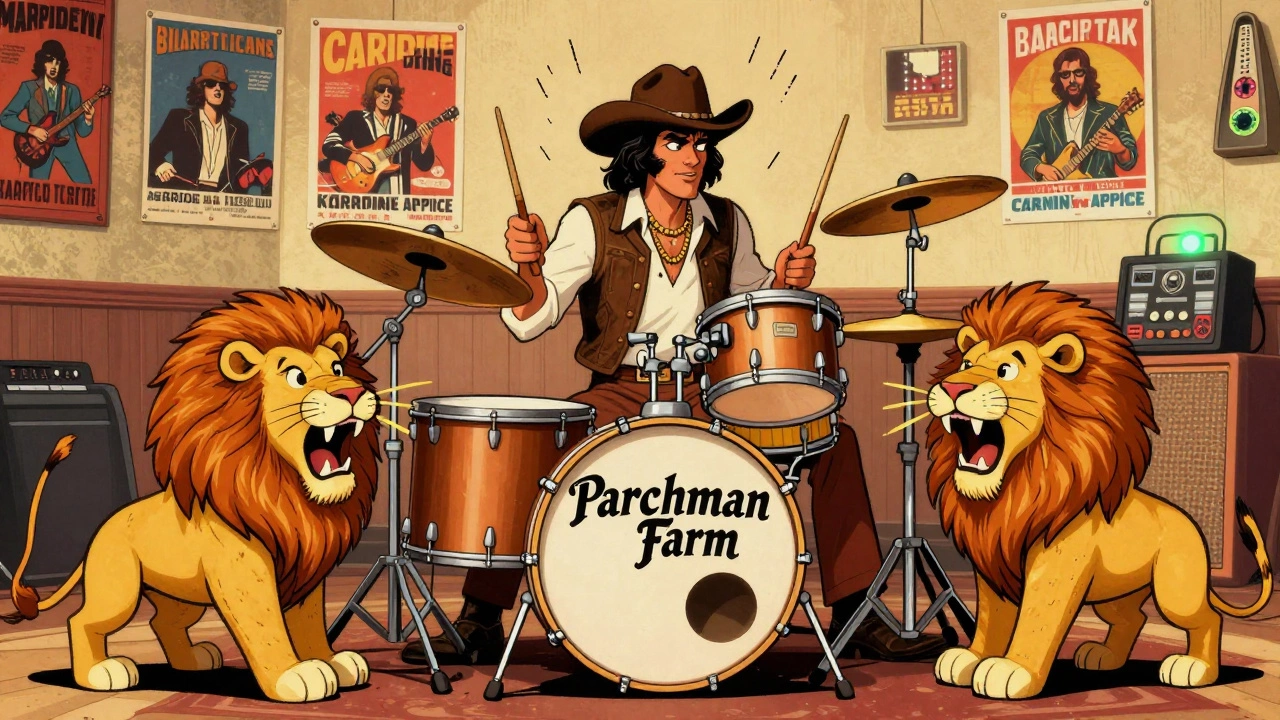

Before blast beats and hyper-speed fills became the norm in metal, there was a quiet revolution happening behind the kit. In the 1970s, a handful of drummers didn’t just play the drums - they rewrote what the bass drum could do. Double-kick drumming, the use of two pedals or two separate bass drums to strike rapid, alternating patterns, wasn’t invented in a metal studio. But it was in the raw, loud, and untamed world of 1970s hard rock and early metal that it found its voice - and its purpose.
Where It Came From: Jazz, Not Metal
You won’t find double-kick drumming on a Led Zeppelin record from 1969. But you will find it on Louis Bellson’s 1952 track "Skin Deep," where he played two bass drums like a jazz drummer flexing his chops. Bellson, playing with Duke Ellington, used the technique for solos, not rhythm. Big band music didn’t need two kicks driving the beat - it had a steady hi-hat and snare. But Bellson proved something simple: two feet could do what one foot couldn’t. Fast. Repeated. Precise. The idea crossed over to rock in the late 1960s. Ginger Baker of Cream, Keith Moon of The Who, and Mitch Mitchell of the Jimi Hendrix Experience started using two bass drums. It looked flashy. It sounded massive. But it was expensive. Most drummers couldn’t afford two full kits. So it stayed rare - a novelty for the elite.The 1970s Breakthrough: When Double-Kick Became a Weapon
Then came 1970. Carmine Appice, behind the kit for the hard rock band Cactus, played "Parchman Farm." The song opens with a shuffle - a rolling, syncopated groove. But instead of one kick, Appice used two. He didn’t just play fast. He played with groove. With feel. With weight. That groove became the blueprint. It wasn’t just about speed. It was about rhythm. It was about making the kick drum talk. Around the same time, Billy Cobham was doing something even wilder. With Mahavishnu Orchestra, he wasn’t just playing double-kick patterns - he was layering them. Ghost notes on the snare. Swing on the ride. Syncopated accents that made the whole kit feel like it was falling apart… and somehow holding together. His 1973 track "Quadrant 4" is a masterclass. It’s chaotic, but controlled. Fast, but never frantic. Cobham didn’t just play double-kick - he turned it into a language. These weren’t isolated moments. They were the start of a shift. Metal, still finding its identity, needed more than just loud guitars. It needed a rhythmic force - something that could match the power of distorted riffs. Double-kick drumming became that force.The Mechanics: How It Actually Works
There are two main ways to play double-kick. The old way: two separate bass drums, side by side. You sit between them. You swing your legs out like a cowboy. It looks dramatic. It sounds huge. But it’s bulky. Expensive. Hard to transport. The modern way: a double pedal. One bass drum. Two pedals connected by a shaft. The right foot drives the main beater. The left foot drives a secondary beater linked to the same drum. This setup, popularized by brands like Sleishman, made double-kick practical. Suddenly, a drummer could buy one kit, not two. The technique itself? Three core patterns dominate:- Single-stroke roll: Alternating feet - right, left, right, left - like a machine. Clean. Repetitive. Relentless.
- Triplet groove: Three kicks in the space of one beat. Think "1-and-a, 2-and-a." It’s the heartbeat of early metal.
- Galloping rhythm: Two quick kicks followed by a longer one. Like "kick-kick-kick… kick-kick-kick…" It’s the sound of a horse running. That’s why it shows up in "Hot for Teacher" - Alex Van Halen borrowed it straight from 1970s hard rock.
Who Didn’t Use It - And Why It Still Mattered
Here’s the twist: not every metal drummer used double-kick. Iron Maiden’s Clive Burr and Nicko McBrain? Single pedal. John Bonham of Led Zeppelin? Used it once or twice, then dropped it. Ian Paice from Deep Purple? Only on "Fireball." Why? Because metal didn’t need double-kick to be heavy. Bonham’s single kick on "When the Levee Breaks" is heavier than any double pedal ever recorded. Paice’s tight, punchy groove on "Smoke on the Water" still moves crowds. Double-kick wasn’t the only way. But it became the loudest. The 1970s didn’t make double-kick mandatory. It made it desirable. It made it a symbol. A sign that a band was pushing forward. That they weren’t just playing rock - they were building something new.The Ripple Effect: How 1970s Double-Kick Shaped Metal
By 1980, double-kick was no longer a curiosity. It was a standard. Metallica’s "Master of Puppets"? Double-kick. Slayer’s "Raining Blood"? Double-kick. Megadeth’s "Holy Wars"? Double-kick. Dave Lombardo didn’t invent the technique. But he took it to another level. On "Raining Blood," he didn’t just play fast. He played with precision. With attack. With timing so tight it felt like a machine. He made double-kick a weapon. And every extreme metal drummer since has been trying to match that. Even death metal, which exploded in the late 80s, built its entire identity on double-kick. Bands like Death and Cannibal Corpse didn’t just use it - they turned it into a storm. Blast beats? They’re just double-kick mixed with snare rolls. The roots? 1970s hard rock.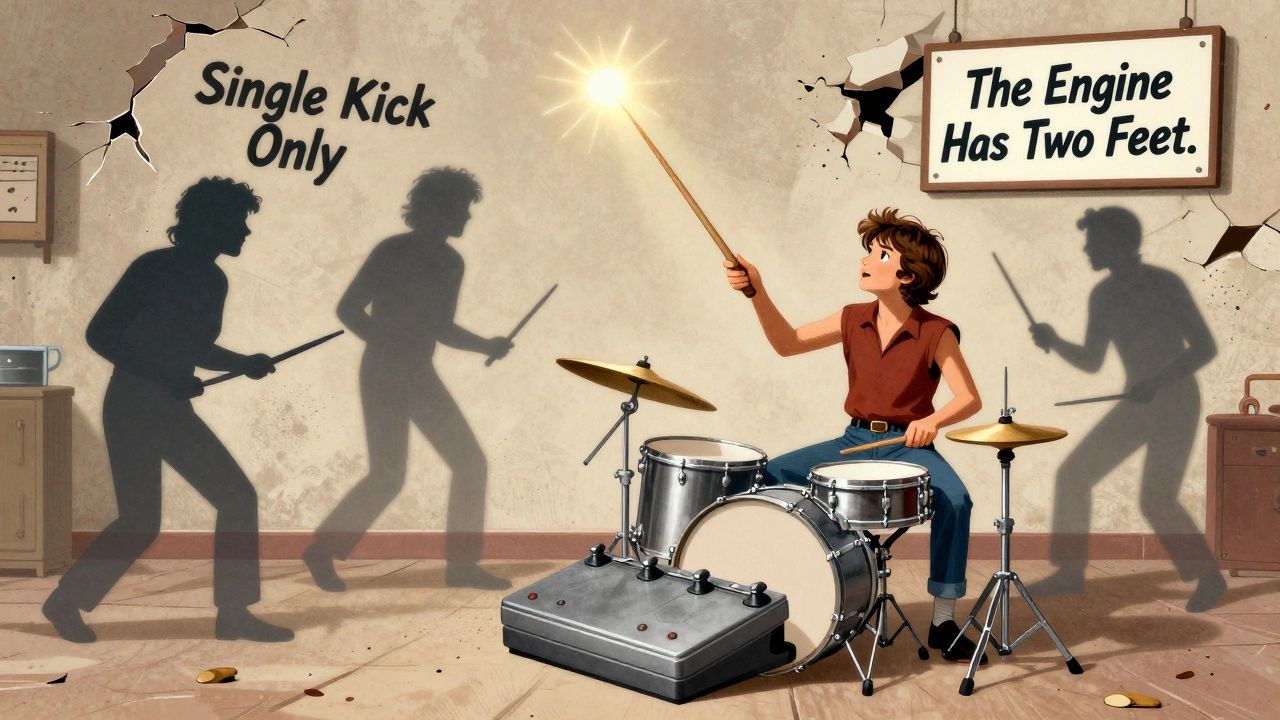
Why This Still Matters Today
Look at any modern metal band. Whether it’s Ghost, Gojira, or Architects - if they’re playing a fast section, you’ll hear double-kick. It’s everywhere. Not because it’s flashy. But because it works. It drives. It pushes. It doesn’t let up. The 1970s didn’t just give us double-kick. It gave us a new way to think about rhythm in heavy music. Before, drums were the backbone. After, they became the engine. And that shift started with a few drummers in a studio, experimenting with two pedals, trying to see how far they could push it. Today’s drummers don’t just learn double-kick because it’s cool. They learn it because it’s essential. Because the music demands it. Because the sound of metal - the real, unfiltered, high-octane sound - needs two feet hitting the pedal, not one.What You Can Learn From the Pioneers
If you’re learning double-kick today, don’t just chase speed. Study the pioneers.- Watch Carmine Appice’s groove. Feel the swing. Don’t just play the notes - play the space between them.
- Listen to Billy Cobham. Notice how he layers the snare and ride. His double-kick isn’t isolated - it’s part of a conversation with the whole kit.
- Study Dave Lombardo’s timing. He didn’t play fast to impress. He played fast to serve the song.
Was double-kick drumming used in early metal songs before 1980?
Yes. Carmine Appice used it on Cactus’s "Parchman Farm" in 1970, and Billy Cobham pushed it to new technical heights with Mahavishnu Orchestra between 1971 and 1974. These were not isolated experiments - they became foundational influences on later metal bands like Slayer and Metallica. By 1978, double-kick was already appearing in proto-thrash recordings.
Do you need two separate bass drums to play double-kick?
No. While early adopters like Ginger Baker and Appice used two full bass drums, modern double-kick drumming almost always uses a double pedal - one bass drum with two connected pedals. This setup is more compact, cheaper, and easier to tune. Most professional drummers today use the double pedal, even in extreme metal.
Why did some legendary metal drummers avoid double-kick?
Because heavy music doesn’t need double-kick to be powerful. John Bonham’s single-kick grooves on "Whole Lotta Love" and "When the Levee Breaks" are some of the heaviest in rock history. Clive Burr and Nicko McBrain of Iron Maiden proved you could play fast, complex metal with one pedal. Double-kick became popular because it was loud and fast - not because it was necessary. Many drummers still choose single-kick for tone, control, or personal style.
What’s the difference between double-kick and blast beats?
Double-kick is two rapid, alternating bass drum hits, usually paired with snare or hi-hat patterns. Blast beats combine fast double-kick with a continuous, rapid snare roll and cymbal hits - often in 16th or 32nd notes. Blast beats are a subset of double-kick technique, but they’re faster, more chaotic, and used mostly in black and death metal. The 1970s pioneers laid the groundwork, but blast beats evolved later in the 1980s.
Can you learn double-kick without a double pedal?
You can learn the motion and coordination using a single pedal and a practice pad, but you won’t be able to play real double-kick patterns at performance speed without a double pedal or two bass drums. A double pedal is the standard tool today. If you’re serious about playing metal, investing in one is necessary - not optional.
Is double-kick drumming harder than single-kick?
It’s not necessarily harder - it’s different. Single-kick requires more dynamic control and groove. Double-kick demands independent foot coordination, endurance, and timing precision. Many drummers find double-kick harder to start with because it requires new muscle memory. But once you build the technique, it becomes just another tool - not a challenge.


