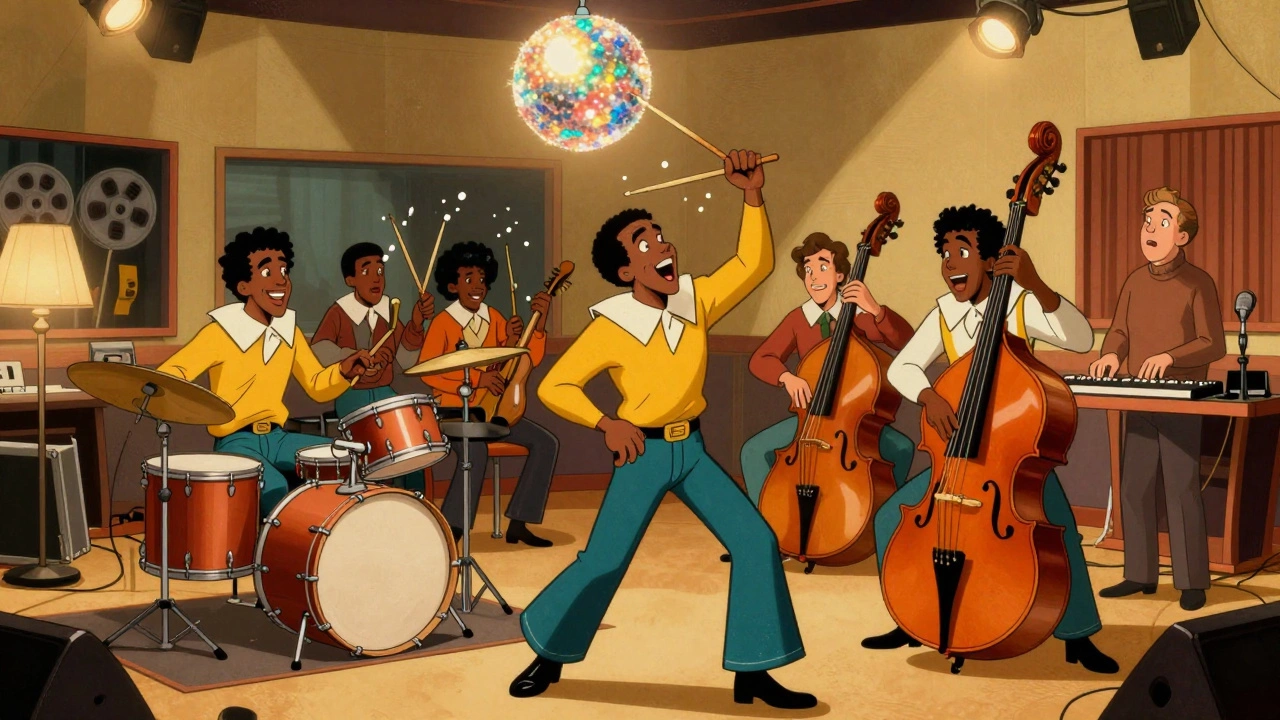

When you think of disco, you probably picture glitter balls, bell-bottoms, and Donna Summer singing "I Feel Love." But behind every booming bassline, every sweeping string swell, and every tight drum groove was a group of musicians you never saw on stage-session players who turned studio sessions into dancefloor explosions. These weren’t background noise. They were the heartbeat of disco. And without them, the 1970s sound simply wouldn’t have existed.
The Invisible Architects of the Dancefloor
Disco wasn’t made by one person. It wasn’t even made by one band. It was built in recording studios by a rotating crew of elite musicians who showed up, read charts, nailed takes in one or two tries, and left without a credit. These were professionals who could play jazz, funk, R&B, and classical-all in the same session. They didn’t need fame. They needed paychecks. And they got paid well, especially when working on jingles or film scores, which often paid more than album sessions.
In Los Angeles, the legacy of the Wrecking Crew a group of Los Angeles-based session musicians who played on hundreds of 1960s and 1970s hits, including tracks by The Beach Boys, The Monkees, and Frank Sinatra still lingered. Drummer Hal Blaine, bassist Carol Kaye, and pianist Mac Rebennack (better known as Dr. John) had set the standard. But by the mid-70s, a new wave of players took over-musicians who could lock into a groove with surgical precision. Names like Jeff Porcaro, Leland Sklar, and Jim Keltner became staples in LA studios. They didn’t just play; they shaped the feel of songs. A single snare hit from Porcaro could turn a mediocre track into a hit.
New York’s Secret Weapon: The Philly Sound Machine
While LA leaned toward polished pop-rock, New York and Philadelphia became the epicenter of disco’s raw, orchestral power. Here, the Philadelphia Sound a lush, string-heavy R&B and disco production style developed by Kenny Gamble and Leon Huff at Philadelphia International Records, featuring live orchestras and tight rhythm sections ruled. It wasn’t just about beats-it was about drama. Think of the soaring strings on The O’Jays’ "Love Train" or the slow-burn groove on Teddy Pendergrass’s "I Don’t Want to Be a Lover." Those weren’t synthesized. They were played by real musicians.
The rhythm section for most Philly records came from a tight-knit group of players who worked out of Sigma Sound Studios. Bernard Purdie on drums. Jerry Jemmott on bass. Cornell Dupree on guitar. Richard Tee on keys. These weren’t session gigs-they were family. They knew each other’s moves. They’d play a song once, then again, then again, each time tightening the groove until it felt like it was breathing. Purdie’s "Purdie Shuffle" became a gold standard for disco and funk drumming. Jemmott’s basslines were so melodic, they often carried the song’s hook.
And then there was Vincent Montana’s Salsoul Orchestra a studio ensemble formed by arranger Vincent Montana Jr. that became synonymous with the orchestral disco sound, recording hits for Salsoul Records in the mid-to-late 1970s. This wasn’t just a band. It was a full orchestra-strings, horns, percussion-all recorded live in one room. When they played "Tangerine" or "Boogie Nights," they didn’t layer tracks. They played together, feeding off each other’s energy. That’s why those songs still move people today.
How the Music Was Made (Before Computers)
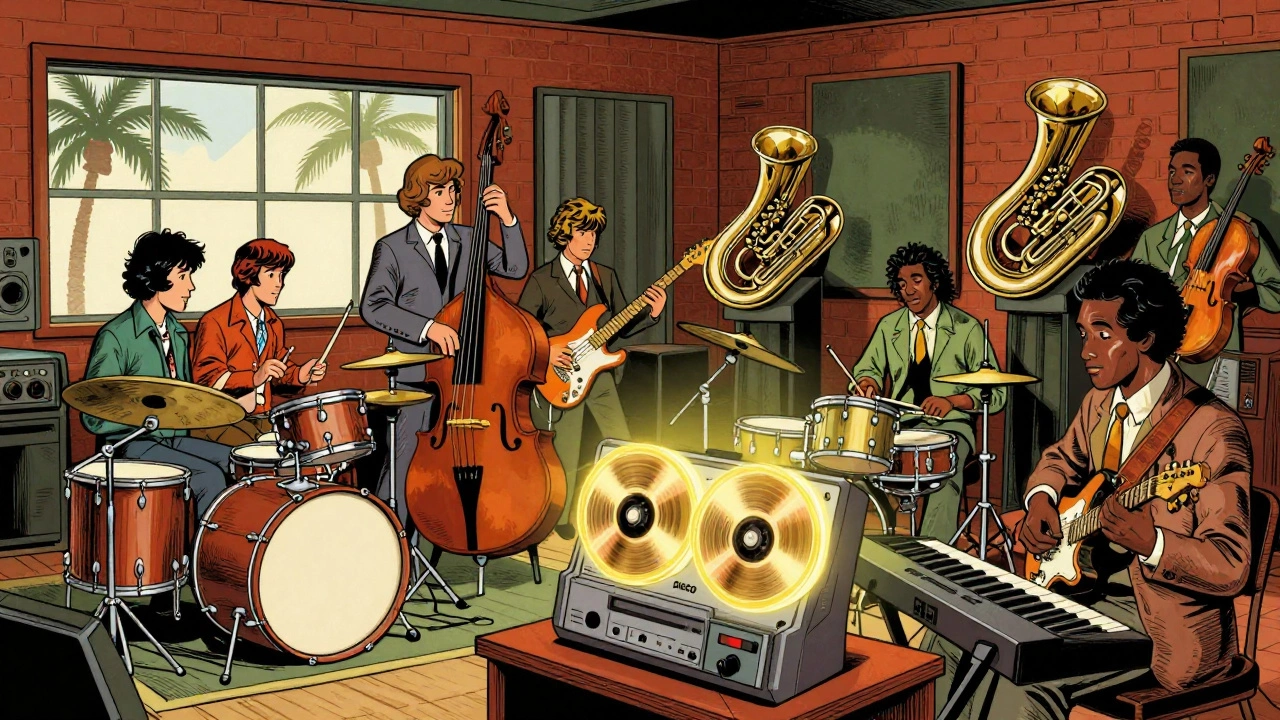
Today, a producer can program a beat in five minutes. Back then? It took hours. Studios used 16- or 24-track tape machines. Every instrument had its own track. The drummer played first. Then the bassist. Then the guitar. Then the strings. Each part had to be perfect. No copy-paste. No Auto-Tune. No metronome. If the groove didn’t feel right, they did it again. And again.
Session players didn’t just follow the chart. They improved it. Pianist Frank Owens was recording with Tony Orlando and Dawn when he started playing a simple riff on the keys. The producer stopped the tape. "Keep playing that." That riff became "Tie a Yellow Ribbon," one of the biggest hits of 1973. No one wrote it. Owens just played it. And it stuck.
Drummers didn’t just count off. They invented grooves. Steve Gadd’s ghost notes, Bernard Purdie’s syncopated hi-hats, and Jim Keltner’s subtle brushwork became the backbone of dozens of disco and funk tracks. Bassists like Carol Kaye and Jerry Jemmott didn’t just play root notes-they created counter-melodies. Guitarists like Cornell Dupree and Waddy Wachtel added rhythmic stabs that cut through the mix like a knife.
The Shift: From Live to Synth
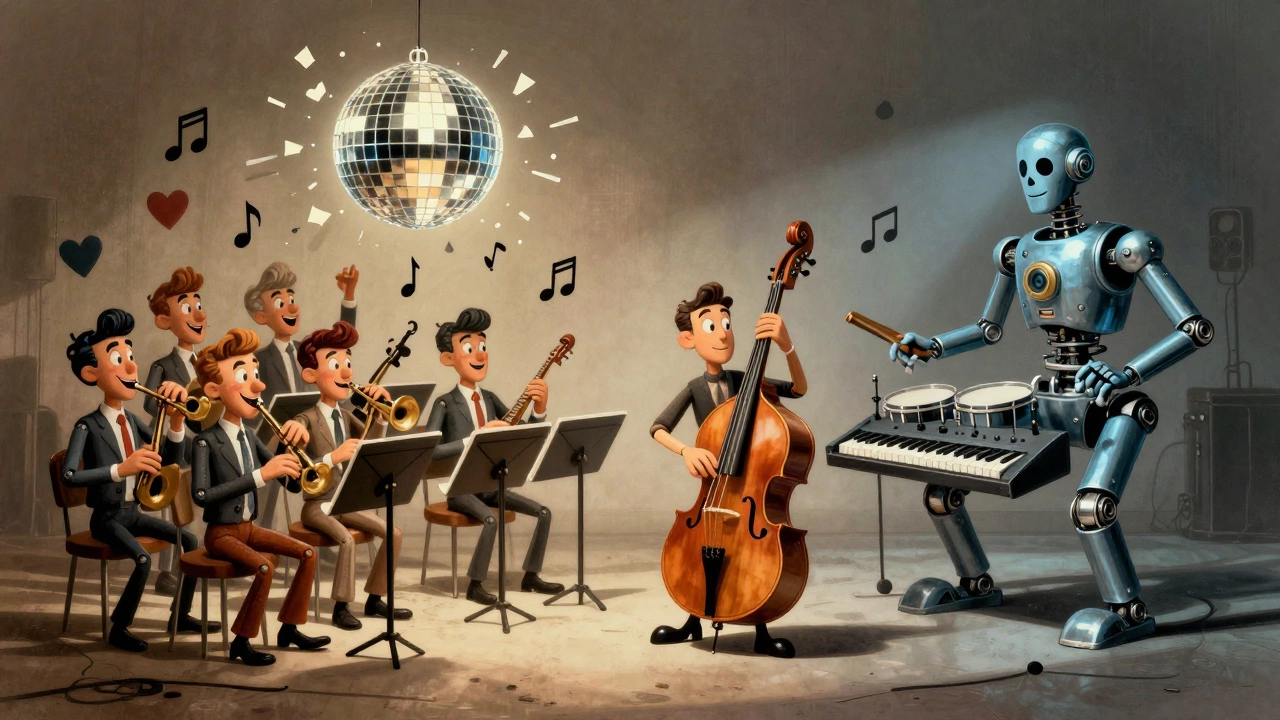
By 1977, everything started changing. Synthesizers got cheaper. Drum machines like the Roland CR-78 appeared. Producers began to favor control over chaos. Instead of hiring five musicians, they’d hire one programmer. The live orchestra became a luxury. The groove got tighter-but colder.
The release of the first 12-inch disco single, Walter Gibbons’ remix of Double Exposure’s "Ten Percent," changed the game. It wasn’t just longer-it was designed for clubs, not radios. And as clubs grew, producers wanted tracks that could be mixed seamlessly. That meant consistent tempo. Clean separation. No human error. Session musicians, with their slight timing variations and emotional phrasing, became a liability.
By 1979, the tide turned. Disco was declared dead. But the musicians? They didn’t disappear. They moved on. Jeff Porcaro formed Toto. Leland Sklar played with Linda Ronstadt and James Taylor. Richard Tee became a sought-after session player for Steely Dan and Paul Simon. The sound changed. But the skill? That never went away.
Why They Still Matter
Disco’s legacy isn’t just in the songs. It’s in the way music is made. Every time a producer today layers a live bass over a programmed beat, they’re following the blueprint laid by these session players. The groove of "I Will Survive," the lift of "Le Freak," the pulse of "Don’t Leave Me This Way"-all were built by hands, not software.
These musicians didn’t need fame. But they gave us something better: timelessness. They played for the love of the groove, not the spotlight. And because of that, their work outlasted trends, fads, and even the genre itself.
Next time you hear a disco track that makes you move, don’t just think of the singer. Think of the drummer who nailed the beat on the third take. The bassist who found the pocket after three tries. The string arranger who wrote the part while eating a sandwich. They’re the real stars. And they never got a standing ovation.
Who were the most famous session musicians in disco?
The most influential session musicians in disco came from two main camps: New York/Philadelphia and Los Angeles. In Philly, Bernard Purdie (drums), Jerry Jemmott (bass), Cornell Dupree (guitar), and Richard Tee (keys) formed the core rhythm section for Philadelphia International Records. In LA, Jeff Porcaro, Leland Sklar, and Jim Keltner played on countless disco and pop records. Carol Kaye, though more known for 1960s pop, also contributed bass lines to early disco tracks. Vincent Montana Jr. led the Salsoul Orchestra, a full ensemble of studio players who recorded orchestral disco hits.
Why didn’t session musicians get credit?
Record labels saw session players as interchangeable parts. The focus was always on the singer or the producer. Credits were reserved for artists, songwriters, and producers-never the musicians who actually played the instruments. It wasn’t until decades later, with documentaries like "The Wrecking Crew" and books like "Bass Player" by Carol Kaye, that these musicians began receiving public recognition. Even today, most disco credits list only the producer or label, not the individual players.
How did session musicians influence disco production?
Session musicians defined the sound of disco through their playing style. They brought live swing and human feel to music that was meant to be danced to. The tight, syncopated grooves of Bernard Purdie and the punchy string arrangements of Vincent Montana created a sound that felt both sophisticated and raw. Their ability to play complex arrangements on the fly-often with no rehearsal-allowed producers to experiment. Without them, disco would have been mechanical. With them, it became soulful.
Did session musicians play on both disco and pop records?
Absolutely. Most session musicians worked across genres. Jeff Porcaro played on Toto’s rock hits and Donna Summer’s disco tracks. Leland Sklar recorded with Linda Ronstadt and Chic. Carol Kaye played on Beach Boys pop songs and early disco singles. The lines between pop, R&B, and disco were blurry in the studio. A musician who played on a Diana Ross ballad might show up the next day for a Chic session. Their versatility was their value.
What happened to session musicians after disco faded?
Many transitioned into other genres or formed bands. Jeff Porcaro co-founded Toto, which became a major 1980s act. Leland Sklar continued as a top session bassist for decades. Richard Tee played with Paul Simon and Steely Dan. Others moved into film and TV scoring, where live musicianship remained essential. The rise of synthesizers and drum machines pushed many out of studio work, but those who adapted found new roles as arrangers, producers, or educators. Their influence never faded-just evolved.


