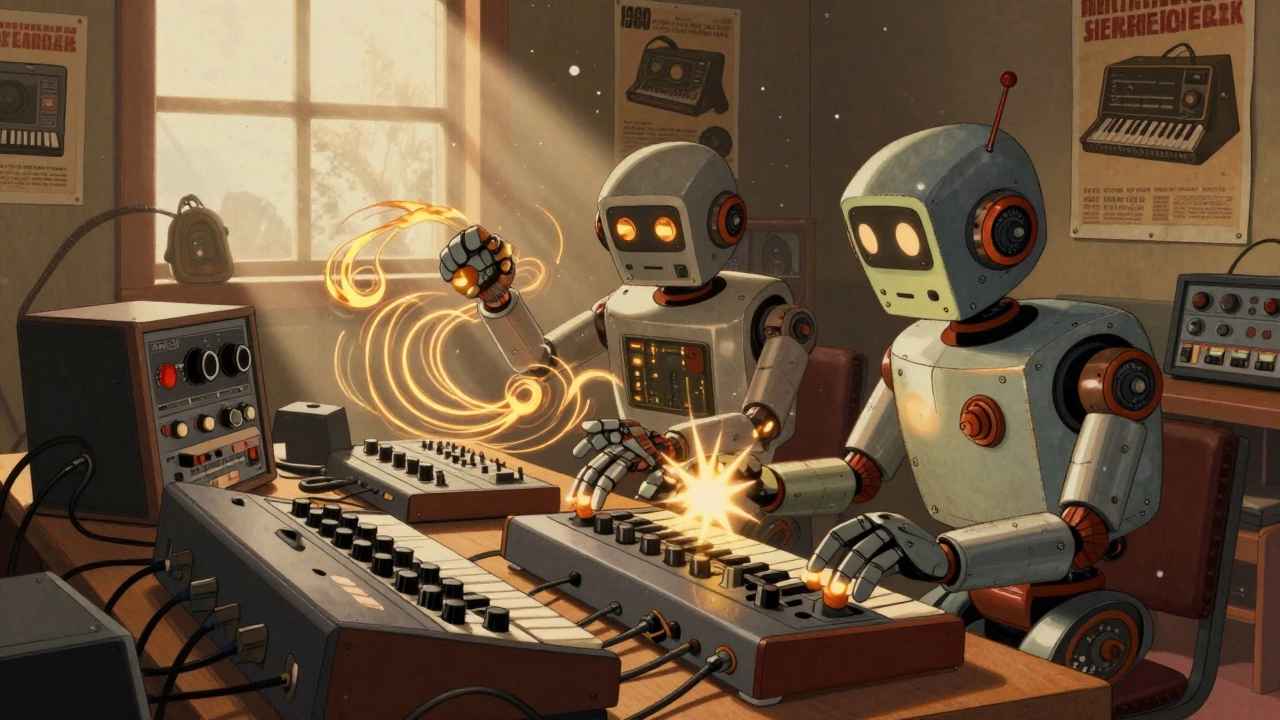

When Daft Punk dropped Homework in 1997, no one expected a pair of French guys in robot helmets to change the course of electronic music. But they did - not by using the latest software, but by digging up gear from the 1980s and making it sound brand new. Their sound wasn’t nostalgic. It was revolutionary. And it all came down to a handful of analog synthesizers that most people had already thrown out.
The Gear That Made the Sound
Daft Punk didn’t sample old records. They built their tracks from the ground up using real hardware. The Roland Juno-106, released in 1984, was their secret weapon. That little synth had a built-in chorus effect - not a fancy plugin, but a real analog circuit borrowed from the JC-120 guitar amp. When you turned it on, the sound thickened, swelled, and moved like a living thing. That’s what gave tracks like "Rollin’ & Scrathin'" their hypnotic glow. It wasn’t just a sound. It was a texture you could feel. Then there was the Roland TB-303. Originally designed as a cheap accompaniment for solo guitarists, it became the heart of acid house. Daft Punk used it in "Da Funk" to create that squelching, wobbly bassline that still makes people move. It wasn’t even meant to be a bass synth. But they turned its flaws into features. The filter was unstable. The sequencer was clunky. And that’s exactly why it worked. The Prophet VS, from 1986, was their most advanced tool. It didn’t just play notes - it moved them. With vector synthesis, you could slide between four different waveforms in real time, creating evolving pads that felt alive. You hear it in "Around the World" - the way the chords shift and shimmer without ever changing pitch. That’s not a trick. That’s the Prophet VS being pushed beyond its design limits. And let’s not forget the Minimoog Model D. Even though it came out in 1970, it was still the go-to for deep, punchy bass. Daft Punk used it on nearly every album. Why? Because nothing else had that weight. Digital synths could mimic it, but they couldn’t replicate the way the filter responded to your fingers, the slight drift in tuning, the warmth that came from heat and age.Why They Refused to Use Software
In 1999, Thomas Bangalter gave an interview in Japan where he said something shocking: "We don’t use software emulations. Not because we can’t - because we won’t." At the time, digital synths were getting cheaper, faster, and more powerful. But Bangalter didn’t care. He wanted the physicality of turning knobs, the smell of old plastic, the way a Juno-106 would go out of tune if you played it too long. That instability wasn’t a bug - it was the point. He called it "tactile creativity." You couldn’t just click and drag a slider. You had to learn how the synth behaved. You had to wait for it to warm up. You had to adjust the chorus manually every time you changed the patch. That slowed them down. But it forced them to make better decisions. Every sound had to earn its place. Compare that to today’s producers who can load a preset and have a Daft Punk-style pad in five seconds. That’s efficient. But it’s also empty. Daft Punk’s sound came from struggle. From hours of tweaking. From broken gear. From learning how to make a machine do something it wasn’t meant to do.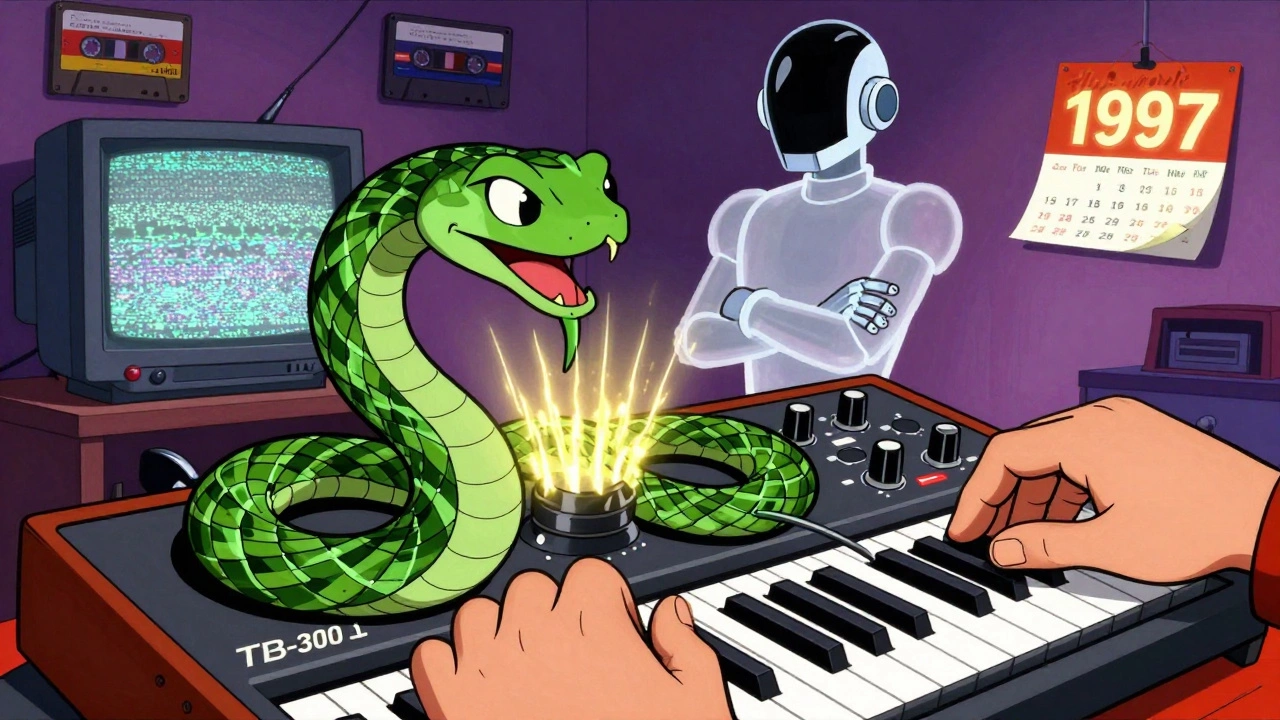
The Ripple Effect
You can’t talk about modern electronic music without talking about Daft Punk’s gear. After they broke up in 2021, the market for vintage synths exploded. The Juno-106, which sold for $600 in 2013, now goes for $1,800. Roland noticed. In 2022, they released the Boutique Juno-DS - a $1,499 reissue that copied the original circuitry almost exactly. Then in 2025, they dropped the Juno-Xm, a $2,199 machine with authentic analog filters and expanded controls. All because of Daft Punk. The same thing happened with the TB-303. Sales of original units went up 40% in 2022. Producers who couldn’t afford $2,000 for a vintage box started looking for alternatives. That’s how the "Daft Engine" plugin suite got made - a collection of 47 presets built from real Juno-106 and TB-303 recordings. It’s been downloaded over 12,000 times. Even schools are teaching it. Point Blank Music School launched the Daft Punk Production Masterclass in January 2025. It’s taught by engineers who worked on their albums. Over 3,200 students from 78 countries have enrolled. The curriculum? How to use analog gear the way Daft Punk did - not to copy them, but to understand how sound behaves when it’s real.
The Cost of Authenticity
This isn’t just about cool gear. It’s about a philosophy. Daft Punk proved you didn’t need the newest tools to make groundbreaking music. You just needed to know your tools inside out. But there’s a dark side. A Reddit thread from 2022 titled "I spent $1,200 on a broken Juno-106" has over 1,200 upvotes. The user spent three months fixing capacitors, replacing DC coupling chips, and recalibrating the chorus circuit. Was it worth it? "Absolutely," he wrote. "I finally got that sound. The one I’ve been chasing for ten years." But not everyone can do that. A KVR Audio user posted in 2023: "The Roland Cloud Juno sounds sterile. It’s like a ghost of the real thing." That’s the problem. Software emulations are accurate - but lifeless. They lack the imperfections that made the originals magical. And then there’s the economic barrier. If you’re a young producer in a small town, you can’t afford a $1,800 Juno-106. Four Tet said it plainly in a 2018 interview: "Their gear obsession created a wall. New producers see Daft Punk and think they need the same $5,000 setup. That’s not inspiration - that’s exclusion." Daft Punk never meant to make gear expensive. But their legacy did.What’s Left Behind
The legacy isn’t just in the synths. It’s in the mindset. Before Daft Punk, most electronic music was either cold and robotic (think Kraftwerk) or messy and chaotic (think early rave). Daft Punk found a middle ground - warm, human, groovy, and precise. They made machines feel alive. Today, artists like Parcels and Breakbot don’t just use Juno-106s - they use them the same way. The French touch revival isn’t a trend. It’s a movement built on the idea that analog gear isn’t old - it’s timeless. And the data backs it up. A 2025 Future Music poll of 350 producers found that 68% now own at least one 1980s analog synth. Not because they’re collectors. Because they finally get it: the sound isn’t in the machine. It’s in how you use it. Daft Punk didn’t invent electro-house. But they gave it a soul. And that soul came from transistors, capacitors, and a whole lot of patience.Did Daft Punk use samples in their music?
No, not in the way most people assume. While they did use samples occasionally - like vocal snippets or drum hits - the core of their sound came from live recordings of analog synthesizers. They avoided software emulations and built every bassline, pad, and lead from hardware like the Juno-106, TB-303, and Prophet VS. Their process was hands-on, often taking hours to tweak a single patch.
Why is the Roland Juno-106 so important to Daft Punk’s sound?
The Juno-106’s built-in chorus circuit gave their pads and chords a rich, swirling texture that digital synths couldn’t replicate. Unlike the cleaner Juno-60, the Juno-106’s chorus was derived from the JC-120 amp, creating a natural, organic movement. It became the backbone of their "French touch" style - heard in "Rollin’ & Scrathin'" and "One More Time." Its instability and warmth made it feel alive, not programmed.
Can you recreate Daft Punk’s sound with modern software?
You can get close, but not exactly. Software emulations like Roland Cloud’s Juno-106 or the Daft Engine plugin offer accurate presets, but they lack the subtle imperfections of aging hardware - slight tuning drift, filter saturation, and the physical response of knobs and switches. Many producers say software versions feel "sterile" compared to the real thing. The only way to truly capture their sound is to use original gear or high-end hardware recreations like the Juno-Xm.
What happened to the original synthesizers Daft Punk used?
Most of their original gear is still in use - either by other producers, in museums, or in private collections. Roland estimates only 15-20% of original Juno-106 units remain fully functional today. The rest have been repaired, upgraded, or retired. But demand is so high that Roland has released multiple reissues, including the Boutique Juno-DS and Juno-Xm, designed to replicate the original circuits exactly.
Is Daft Punk’s influence still growing today?
Yes. The vintage synth market grew from $187 million in 2013 to $412 million in 2025, largely driven by Daft Punk’s legacy. Their sound is now taught in music schools, referenced in documentaries like "Synth Odyssey," and emulated by artists worldwide. The Daft Punk Production Masterclass has enrolled over 3,200 students across 78 countries since January 2025. Their influence isn’t fading - it’s becoming foundational.


