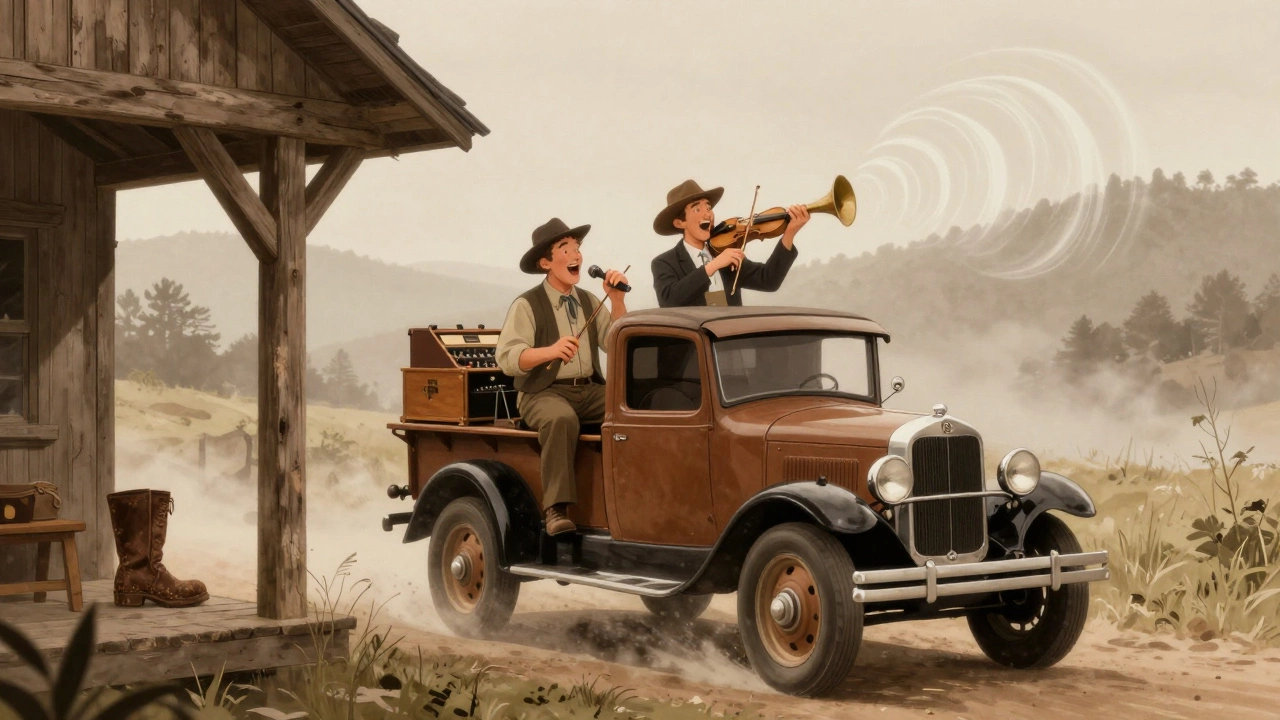

When you think of classic country music, what comes to mind? A fiddle wailing over a quiet steel guitar? Or a smooth, polished vocal wrapped in strings and background harmonies? The answer depends on which label you’re listening to. Two companies-RCA and Columbia-didn’t just release country records. They shaped the very sound of the genre, each in their own way. One captured the raw, earthy roots of rural America. The other built a studio machine that turned country into a national phenomenon. Their rivalry, their methods, and their choices still echo in today’s country music.
Columbia’s Early Recordings: Capturing the Real Thing
In 1928, a man named Frank Buckley Walker drove into the hills of Tennessee with a portable recording rig. He wasn’t looking for pop stars. He was hunting for real people-farmers, preachers, fiddlers-who sang about heartbreak, hard work, and faith. In Johnson City, he recorded Clarence Horton Greene, Fiddlin’ Charlie Bowman, and others. These weren’t polished studio sessions. They were live, unfiltered moments, captured in churches, homes, and town halls. The equipment was basic. The room reverb was natural. The emotion? Unmistakable.
Columbia didn’t treat country as a novelty. They built a whole catalog around it. By the 1950s, they had a dedicated 20,000 series for country singles-separate from their pop releases. This wasn’t just marketing. It was respect. They signed the Chuck Wagon Gang in 1936 and watched them sell over 37 million records. That’s not a fluke. That’s a movement. These were gospel-infused harmonies that spoke to rural families who didn’t see themselves in mainstream radio. Columbia gave them a voice.
They also recorded Charles Davis Tillman-the first known commercial gospel artist. They didn’t try to clean up the rough edges. They didn’t add studio tricks. They let the music breathe. And that’s why collectors today still hunt for Columbia’s 78 rpm discs from the 1920s and 30s. They’re not just old records. They’re time capsules.
RCA’s Nashville Sound: The Studio That Changed Everything
RCA didn’t start early. They were slow to get into country. In the 1930s and 40s, they labeled country releases with a green sticker-like it was a side project. But everything changed in 1956, when they opened Studio B at 1611 Hawkins Street in Nashville. What happened there wasn’t accidental. It was engineered.
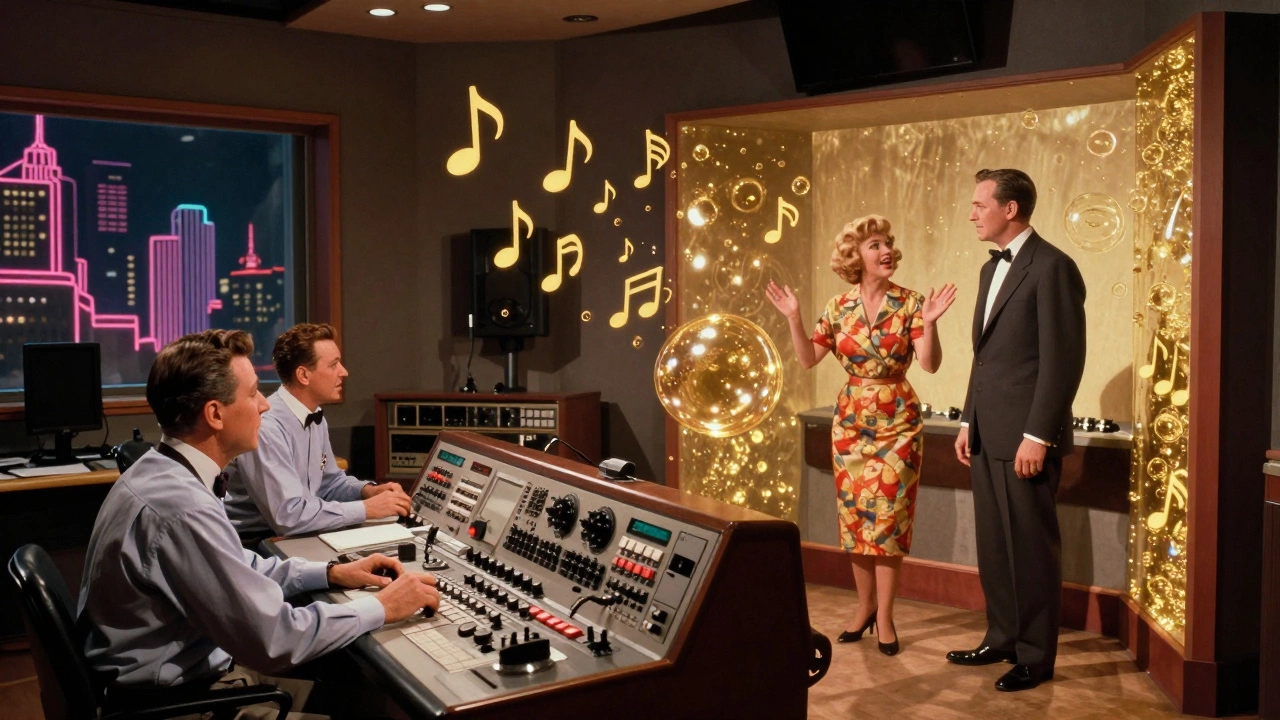
Producer Chet Atkins and engineer Owen Bradley turned a modest building into a sonic laboratory. They buried echo chambers under the floor. They built custom tube consoles. They used lush string arrangements, background choirs, and controlled reverb to soften the rough edges of traditional country. The goal? Make it appeal to city listeners. Make it sound like pop music, but with a twang.
The results were undeniable. From 1956 to 1975, RCA’s Studio B produced 60% of all Billboard country chart hits. Patsy Cline, Jim Reeves, and Tammy Wynette didn’t just record songs-they created a new standard. The Nashville Sound didn’t replace country. It expanded it. Suddenly, country wasn’t just for the backroads. It was on AM radios in Chicago, Detroit, and Los Angeles.
And then there was Elvis. In 1955, Columbia bid $15,000 for Elvis Presley’s contract from Sun Records. They thought they had him. But Colonel Tom Parker said no. He took Elvis to RCA. That one signing flipped RCA’s entire image. Overnight, they went from a label that ignored country to the powerhouse that defined its future.
The Clash of Philosophies: Raw vs. Refined
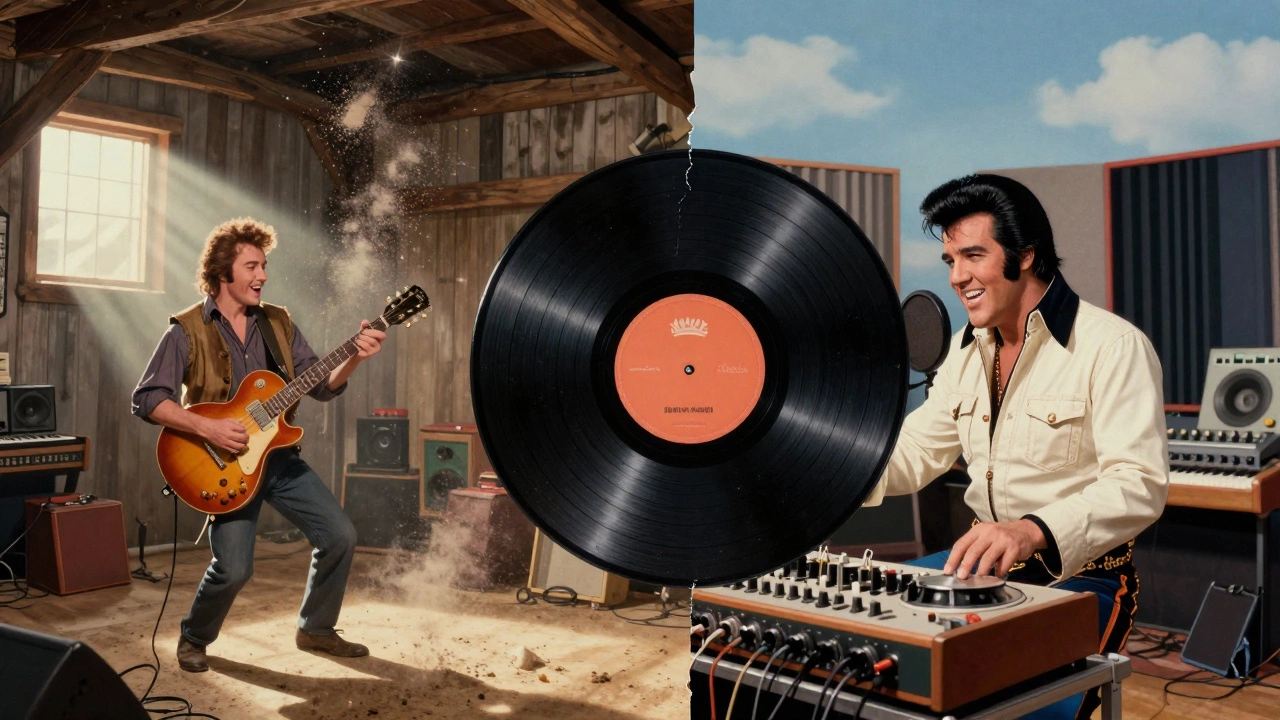
Think of Columbia and RCA as two different photographers. Columbia was the documentary filmmaker. They showed the world as it was-dusty, loud, imperfect. RCA was the Hollywood director. They lit the scene, chose the angles, and made sure every frame looked perfect.
Columbia’s recordings used portable equipment. Artists played in real rooms. You can hear the creak of a wooden floor. The breath between lines. The clink of a guitar pick. That’s why modern producers seeking authenticity still study Columbia’s early sessions. They’re the blueprint for what country was before it became a product.
RCA, on the other hand, controlled every element. A singer might record vocals one day. Strings another. The bass was overdubbed. The harmonies were layered. The final product was seamless. Critics called it slick. Fans called it magic. It worked. By the 1960s, RCA’s Nashville Sound was the default for country radio.
Discogs user ratings tell the story. Columbia’s early 78s average 4.6 out of 5 stars for authenticity. RCA’s 1950s-70s LPs average 4.8 for production quality. One isn’t better. They’re just different.
Who Won? Neither. Both.
Some say RCA dominated because they had more #1 hits. True. From 1956 to 1975, RCA held 38% of Billboard’s country chart-toppers. Columbia had 22%. But numbers don’t tell the whole story.
Columbia didn’t need to win the charts. They preserved the roots. Without their early recordings, we wouldn’t have the raw material that inspired later generations. Johnny Cash, who signed with Columbia in 1958 after Elvis went to RCA, brought that grit back into the spotlight. He didn’t sound like Chet Atkins. He sounded like Fiddlin’ Charlie Bowman.
RCA didn’t invent country. But they made it a billion-dollar industry. Studio B didn’t just produce hits. It created a production model that still exists today. Look at modern country hits. The layered vocals? The polished drums? The subtle strings? That’s the Nashville Sound-born in RCA’s basement.
Today, Sony Music (which owns Columbia) runs a streaming playlist called The Columbia Country Classics, with over 1,200 tracks and 854,000 subscribers. RCA’s Studio B is now a museum. But they still let artists record there-using the original equipment. Chris Stapleton’s 2024 session hit 12.7 million streams in one month. That’s not nostalgia. That’s relevance.
The Legacy Lives On
Modern country music still splits along these lines. One side leans into the stripped-down, live-off-the-floor sound-think Tyler Childers or Sturgill Simpson. The other side goes full pop-country-think Luke Combs or Morgan Wallen. One sounds like it was recorded in a Tennessee barn. The other like it was mixed in a Los Angeles studio.
That split? It started with Columbia and RCA. One label said: preserve the truth. The other said: make it universal. Neither was right or wrong. They were both necessary. Country music needed the soul of Columbia and the polish of RCA to become what it is today.
So when you hear a country song, ask yourself: Is this the sound of a fiddle in a church basement? Or strings in a Nashville studio? The answer might surprise you. But it’s always rooted in these two labels.