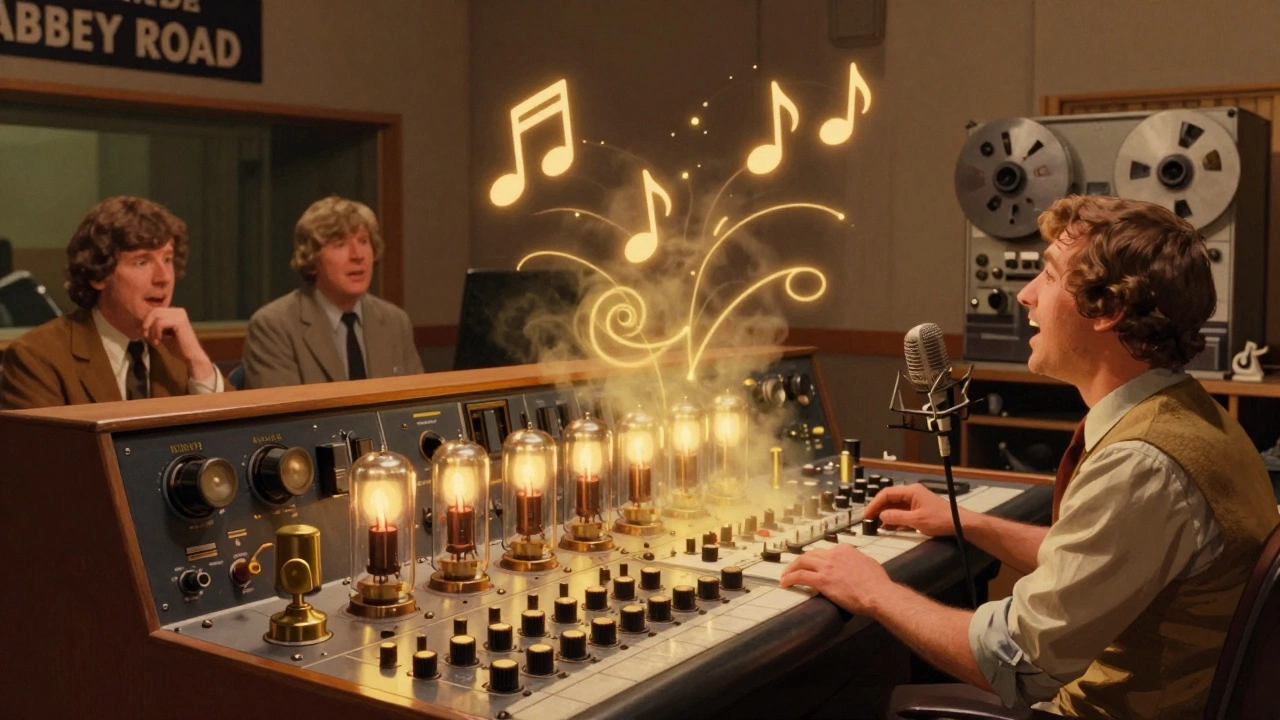

The idea of a three-way battle between Neve, API, and SSL in 1970s studios is a myth. It sounds logical - big names, big sound - but history doesn’t back it up. SSL didn’t even show up in serious studios until the early 1980s. If you walked into a professional recording room between 1970 and 1979, you weren’t choosing between SSL and Neve. You were choosing between Neve and API. And that choice shaped the sound of rock, soul, and pop for decades.
Neve: The British Warmth That Defined the Era
By 1972, if you were recording in London, Abbey Road, or Olympic Studios, chances are you were sitting behind a Neve console. The 1073 preamp and EQ, introduced in 1970, became the gold standard. It wasn’t just a piece of gear - it was the voice of the decade. Think of the drum sound on Led Zeppelin’s IV or the vocal warmth on Pink Floyd’s Dark Side of the Moon. That wasn’t magic. That was the Neve 1073.
What made it special? The Carnhill transformers. The discrete Class-A circuitry. The way it gently crushed the signal instead of clipping it. Neve didn’t just amplify sound - it added body. A thick, rounded character that clung to vocals, strings, and acoustic guitars. Engineers called it "musical distortion." It wasn’t noise. It was color. And it was intentional.
Neve consoles were heavy. They ran hot. They needed their own power lines. Studios in the UK spent over $50,000 on a single 80-series unit - that’s over $400,000 today. But they did it anyway. Why? Because when you tracked a vocal through a Neve, it didn’t just sound good - it sounded alive. You could feel the singer’s breath in the low-mids. The highs didn’t bite. They shimmered.
API: The American Punch That Cut Through
While Neve ruled the UK, API was taking over American studios. Founded by Saul Walker in 1968, API didn’t try to copy Neve. They built something different. Their 2520 op-amp design was transformerless. No warmth. No saturation. Just raw, fast, and loud.
API consoles were the go-to for drums, bass, and electric guitar. Why? Because they had headroom. Real, measurable headroom. Tests showed API preamps could handle 3 to 6 dB more signal before distorting than Neve units. That meant you could hit the tape harder without frying it. The result? Punch. Attack. Definition. The snare on Steely Dan’s Aja? That crack? API. The bass tone on Bruce Springsteen’s Born to Run? API again.
The 550 EQ was another game-changer. Its proportional Q design meant the bandwidth narrowed as you boosted. A 3 dB boost on 1 kHz didn’t just lift that frequency - it carved out a focused, singing peak. That’s why so many 1970s rock records had that midrange presence - it wasn’t just EQ. It was API.
But API wasn’t perfect. Those discrete circuits? They needed constant tuning. One engineer told me, "You didn’t just run the console. You babysat it." Temperature changes, aging transistors, loose connectors - if you didn’t check it every morning, the sound would drift. But for studios that could afford the upkeep, the payoff was worth it.
SSL? Not in the 1970s
Let’s clear this up once and for all: SSL didn’t matter in the 1970s. Solid State Logic was founded in 1969, sure. But their first console, the SL 4000, didn’t hit the market until 1977. And even then, only a handful of studios had one. Abbey Road got theirs in late 1978. That’s it.
SSL’s whole thing was clean. Transparent. Automated. None of that mattered in 1978. Studios weren’t looking for automation. They were looking for character. SSL’s transformerless design? It was the opposite of what Neve and API offered. No saturation. No harmonic richness. Just clean gain. It was perfect for mixing - but useless for tracking in the 1970s.
So when you hear someone say, "I love the SSL sound from the 70s," they’re wrong. That sound didn’t exist yet. The SSL sound came later - in the 1980s, with Michael Jackson’s Thriller and the rise of digital recording. But in 1975? You’d be hard-pressed to find an SSL in a real control room.
Why the Choice Mattered
It wasn’t about which was "better." It was about what kind of record you wanted to make.
If you were recording a folk album with acoustic guitars and harmonies? Neve. You wanted the sound to wrap around the listener. You wanted it to feel like a hug.
If you were tracking a punk band with screaming vocals and distorted guitars? API. You needed the transients to snap. You needed the sound to cut through a mix that was already loud.
Some studios had both. But those were rare. Most studios picked one and stuck with it. A studio in Chicago would buy three API consoles and call it a day. A studio in London would buy two Neves and never look back.
And here’s the thing: the choice wasn’t just technical. It was cultural. Neve was British. Elegant. Refined. API was American. Loud. Direct. The consoles didn’t just shape sound - they shaped identity.
Legacy: What’s Left Today
Today, you can buy a plugin that emulates a Neve 1073 for $29. Or an API 550 for $99. But none of them capture the weight of the original. The way the transformers breathed. The way the circuitry warmed up over hours. The way the knobs had a physical resistance you could feel in your fingers.
Modern recreations from Heritage Audio and Brent Averill Enterprises try to fix that. They rebuild the 1073 and 500-series modules with original schematics. But even they admit: the magic isn’t just in the circuit. It’s in the age. The wear. The accumulated history of thousands of takes.
And that’s why, even now, engineers still fight over which one to use. Not because one is better. But because they’re different. One sings. One shouts. And in the 1970s, you didn’t choose between them - you chose which voice your music needed.
What You Should Know
- Neve and API were the only two major players in 1970s studios - SSL was irrelevant until the 1980s.
- Neve = warmth, saturation, musical distortion. Best for vocals, strings, and acoustic instruments.
- API = punch, headroom, clarity. Best for drums, bass, and electric guitar.
- SSL’s clean, transparent sound was designed for mixing - not tracking - and didn’t enter studios until 1978.
- Neve consoles cost more, ran hotter, and needed more power. API consoles needed more maintenance but handled louder signals.
- Studio choice wasn’t about price - it was about sound philosophy. British vs. American. Soft vs. sharp. Warmth vs. attack.
Was SSL ever used in 1970s studios?
Very rarely, and only in the last year of the decade. Solid State Logic’s first console, the SL 4000, was installed at Abbey Road in late 1978. Even then, it was used for mixing, not tracking. In 1975, you’d be hard-pressed to find an SSL in any major studio. The console wars of the 1970s were between Neve and API - SSL didn’t enter the ring until the 1980s.
Why did Neve consoles sound warmer than API?
Neve used custom Carnhill transformers and discrete Class-A circuitry, which added harmonic saturation and softened high frequencies. API used transformerless circuits with a proprietary 2520 op-amp, which preserved transients and offered more headroom. The transformers in Neve gear naturally compressed and colored the signal, while API’s design aimed for clarity and speed.
Which console was more popular in the U.S. vs. the U.K.?
API dominated U.S. studios, capturing about 75% of the professional console market by 1978. Neve ruled the U.K. and Europe, with roughly 65% of major British studios using their consoles by 1975. The difference reflected regional preferences: American producers favored punch and clarity, while British engineers leaned into warmth and saturation.
Can modern plugins truly replicate the sound of Neve and API consoles?
They come close - especially plugins from Universal Audio and Waves - but they can’t replicate the physical behavior of vintage hardware. The way transformers saturate over time, the thermal drift of discrete circuits, the mechanical resistance of aged knobs - these aren’t just sonic traits. They’re environmental. Plugins simulate the output, but not the experience. Many engineers still use original hardware for critical tracks.
Did engineers in the 1970s know which console was "better"?
No. They didn’t think in terms of "better." They thought in terms of "right for the job." A Neve might be perfect for a soul vocal but terrible for a distorted guitar amp. An API might handle drums beautifully but lack the body for strings. The best engineers didn’t pick one console - they picked the tool that matched the music.


