
On August 1, 1971, two concerts at Madison Square Garden didn’t just draw 40,000 people-they changed the way music could move the world. The Concert for Bangladesh wasn’t another rock show. It was a lifeline for 10 million refugees fleeing genocide, famine, and war. And it was the first time musicians came together not to perform, but to save lives.
Why Bangladesh? A Crisis the World Ignored
In 1970, a cyclone killed over 300,000 people in East Pakistan. Then came the war. The Pakistani military launched a brutal crackdown on Bengali civilians, burning villages, targeting intellectuals, and mass raping women. By summer 1971, 10 million people had fled into India. They were starving. Dying of cholera. Lacking clean water, medicine, or shelter. But the world looked away. The U.S. government, locked in Cold War politics, was secretly backing West Pakistan. China and the Soviet Union were on opposite sides. No one was talking about Bangladesh-not because it wasn’t happening, but because no one wanted to admit it. That’s when Ravi Shankar, the legendary sitar player from India, walked into George Harrison’s life. Shankar’s home state of West Bengal was overwhelmed with refugees. He begged Harrison: “You have to do something.” Harrison didn’t hesitate. He wrote a song in five days. He called it “Bangla Desh.” He didn’t say “East Pakistan.” He used the name the people fighting for freedom had chosen for themselves: Bangladesh.The Lineup That Changed Music History
Harrison didn’t just ask for help-he pulled together a lineup no one thought possible. Eric Clapton, fresh off quitting Derek and the Dominos, showed up. Bob Dylan, who hadn’t played a live show in three years, stepped back on stage. Ringo Starr was there. Leon Russell. Billy Preston. Badfinger. Even Klaus Voorman, the bassist who drew the cover for Revolver. And then there was the Indian side: Ravi Shankar on sitar, Ali Akbar Khan on sarod, Alla Rakha on tabla. This wasn’t a fusion experiment. It was a declaration. The concert opened with Shankar’s “Bangla Dhun”-a folk melody from the region, played with fire and purpose. The audience didn’t know it yet, but they were hearing the sound of a nation being born. Harrison’s set included “Something,” “While My Guitar Gently Weeps,” and “Bangla Desh.” Dylan played “A Hard Rain’s A-Gonna Fall” and “Blowin’ in the Wind.” Clapton played “Layla” and “Badge.” No one was paid. No one took a cut. They flew in, rehearsed for two days, and gave everything.A Concert That Made Politics Visible
Most charity events try to stay quiet about politics. This one didn’t care. The very name “Concert for Bangladesh” was political. So was the music. So was the message. The U.S. State Department was still recognizing East Pakistan. The concert refused to. By naming the country, Harrison and Shankar forced the world to see it as real. As one analyst put it: “They didn’t ask for sympathy. They demanded recognition.” Two days after the show, a U.S. presidential briefing noted “mounting press and Congressional pressure on our assistance to Pakistan.” That wasn’t a coincidence. The concert had turned a humanitarian crisis into a headline. People were talking. Politicians had to respond.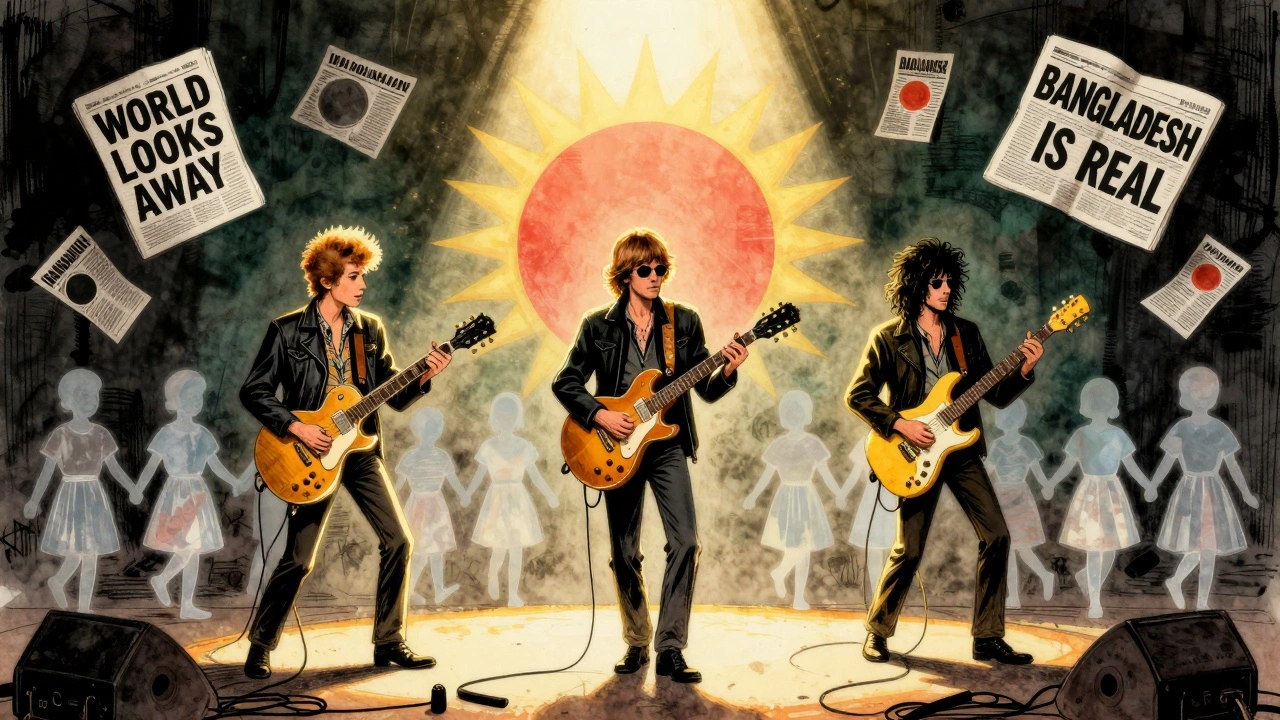
The Money, The Mess, and The Legacy
The concerts raised $250,000-ten times what they hoped for. Harrison didn’t stop there. He set up a UN-administered relief fund. But here’s the ugly truth: the money got stuck. Legal battles. Tax issues. Bureaucratic delays. Much of it didn’t reach refugees until after Bangladesh won independence in December 1971. Still, the impact wasn’t just in dollars. It was in visibility. In morale. In proof that the world could care. A freedom fighter from Bangladesh later told Harrison: “When we were in the jungle fighting, it was great to know somebody out there was thinking of us.” The concert was turned into a triple LP and a documentary film. The film was groundbreaking-split screens showed musicians listening to each other, reacting, connecting. It wasn’t just a performance. It was a conversation.How It Changed Everything
Before 1971, benefit concerts were small, local, or church-based. After? They became global. Live Aid in 1985? Direct descendant. Farm Aid? Inspired by it. Band Aid? Built on the same idea. But none of them had the same stakes. This wasn’t about drought. It was about genocide. Not about hunger, but about a people fighting to exist. The music industry in 1971 was broken. Hendrix and Joplin were dead. The peace-and-love dream had turned violent. Rock music needed a reason to matter again. The Concert for Bangladesh gave it one. John Harris, a music historian, put it simply: “The invention of the charity rock concert arguably saved rock music as much as rock music saved Bangladesh.”