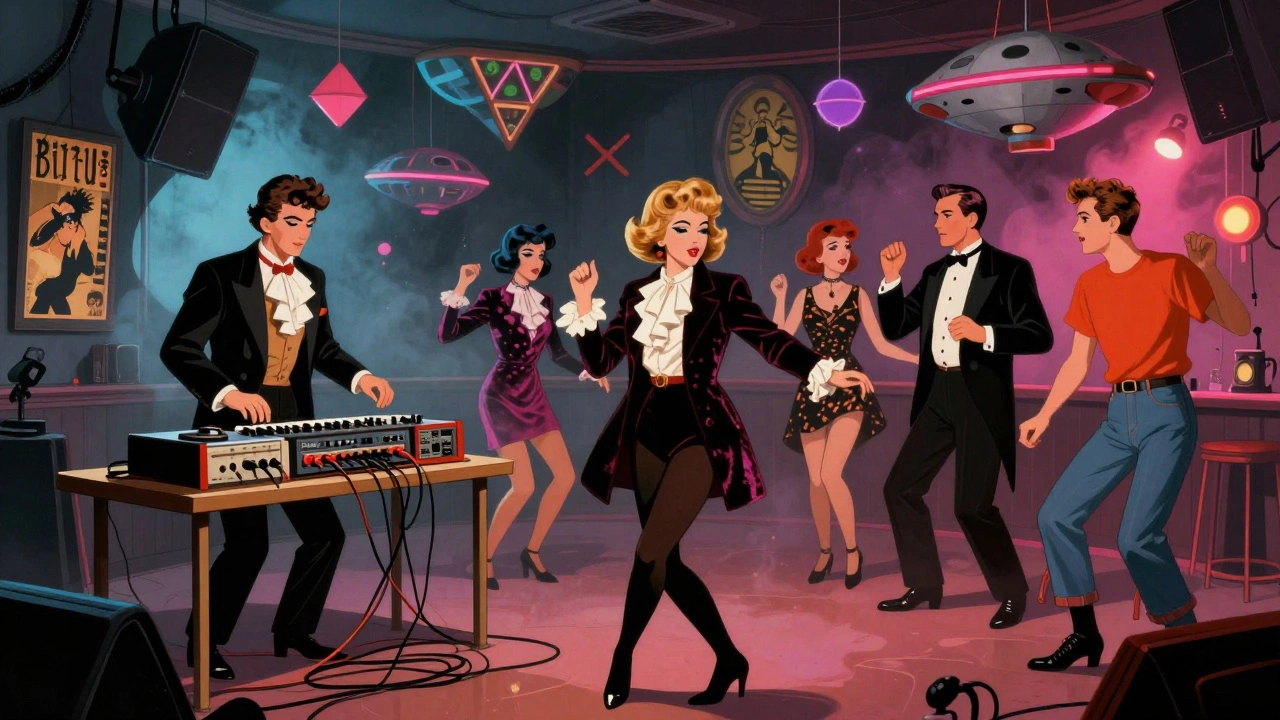

The 1980s didn’t just bring big hair and shoulder pads-it brought a whole new sound. A sound born not in a recording studio, but in a cramped, dimly lit London club where people dressed like alien royalty and danced to machines that had never been heard before. This was synth-pop, and it didn’t just replace guitars-it redefined what music could look like, feel like, and who could make it.
The Blitz Club: Where Fashion Became a Weapon
In 1979, a tiny venue at 4 Great Queen Street in Covent Garden opened its doors for one night a week: Tuesday. That night was the Blitz. No one knew it then, but this was the birthplace of a cultural earthquake. Steve Strange, a former punk with a love for Bowie and sci-fi movies, turned the club into a testing ground for identity. If you showed up in jeans and a T-shirt, you were turned away. No exceptions. You had to wear a ruffled shirt, heavy makeup, a velvet coat, or something that looked like it came from a 1920s silent film mixed with a spaceship. The door policy wasn’t about money-it was about creativity. And only about 200 people ever made the cut.
These were the Blitz Kids. They weren’t just clubgoers. They were performers. Every Tuesday, they transformed themselves into living art. Robert Elms, a regular, later wrote that it felt like being inside a painting. And that’s exactly what it was: a moving canvas of androgyny, fantasy, and rebellion. The music? It wasn’t disco. It wasn’t punk. It was something new-cold, mechanical, but strangely emotional. Synth-pop didn’t just play in the background. It was the reason people showed up.
The Sound: Analog Machines and DIY Magic
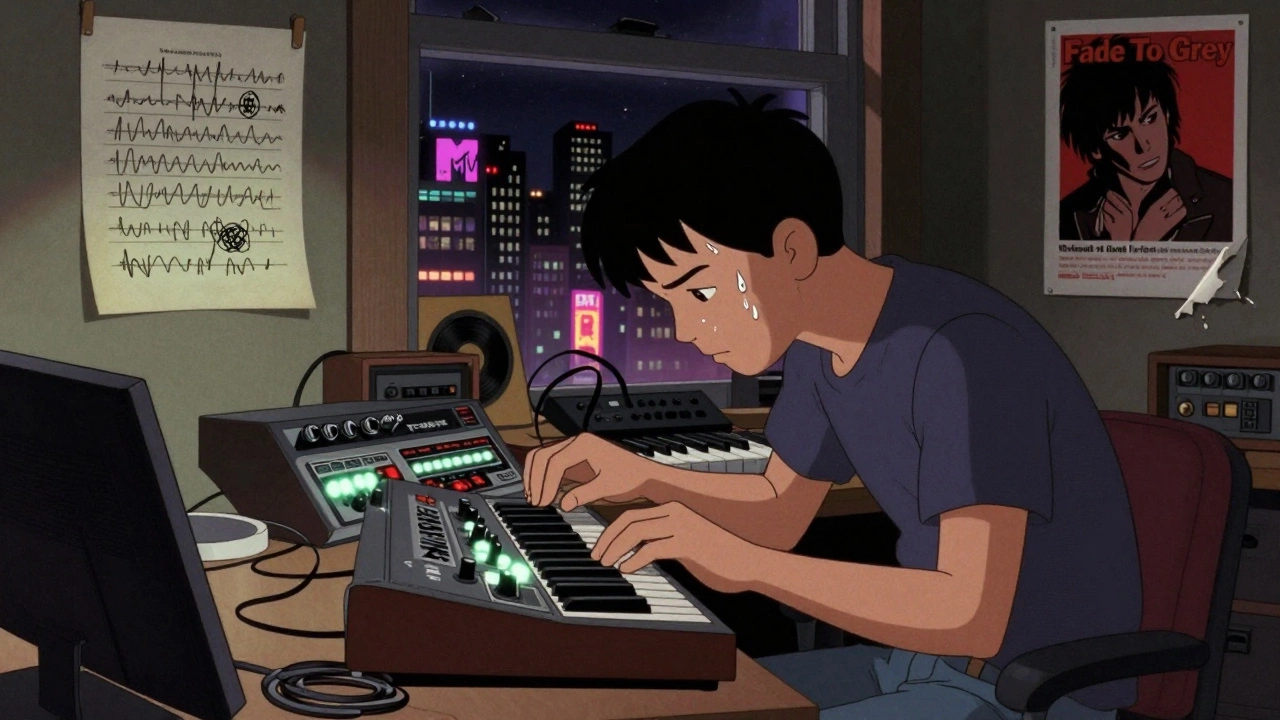
Before the Blitz, most pop music was built on guitars, drums, and live vocals. But the Blitz Kids didn’t have bands-they had machines. The Minimoog, the Roland Jupiter-8, the Korg MS-20. These weren’t easy to use. Each had only a few knobs, no presets, and no memory. If you wanted a bassline, you had to build it from scratch. Every note had to be programmed by hand, often using patch cables and tape loops. Depeche Mode’s Martin Gore once said learning to program a Minimoog took as much skill as learning guitar. And for many, it was harder.
There was no MIDI until 1983. That meant if you wanted your drum machine to sync with your synth, you had to tape them together and hope they stayed in time. Bands like OMD and Visage spent hours in tiny studios, editing tape by hand. One mistake? You started over. But that limitation became a strength. It forced musicians to think differently. Instead of playing chords, they built textures. Instead of singing melodies, they layered echoes. The result? Songs like ‘Fade To Grey’ and ‘To Cut a Long Story Short’ didn’t just hit the charts-they rewired how people thought about pop music.
The Rise: From Underground to MTV
By 1981, the Blitz had closed. But its DNA was everywhere. Spandau Ballet, Culture Club, Duran Duran-they all came from that scene. Steve Strange didn’t start a band. But his club trained a generation of artists who did. Visage’s ‘Fade To Grey’ reached number 5 in the UK in 1980. Spandau Ballet’s first single hit the Top 5 a year later. By 1983, nearly 4 out of every 10 songs in the UK Top 40 were synth-driven. That’s not a trend. That’s a takeover.
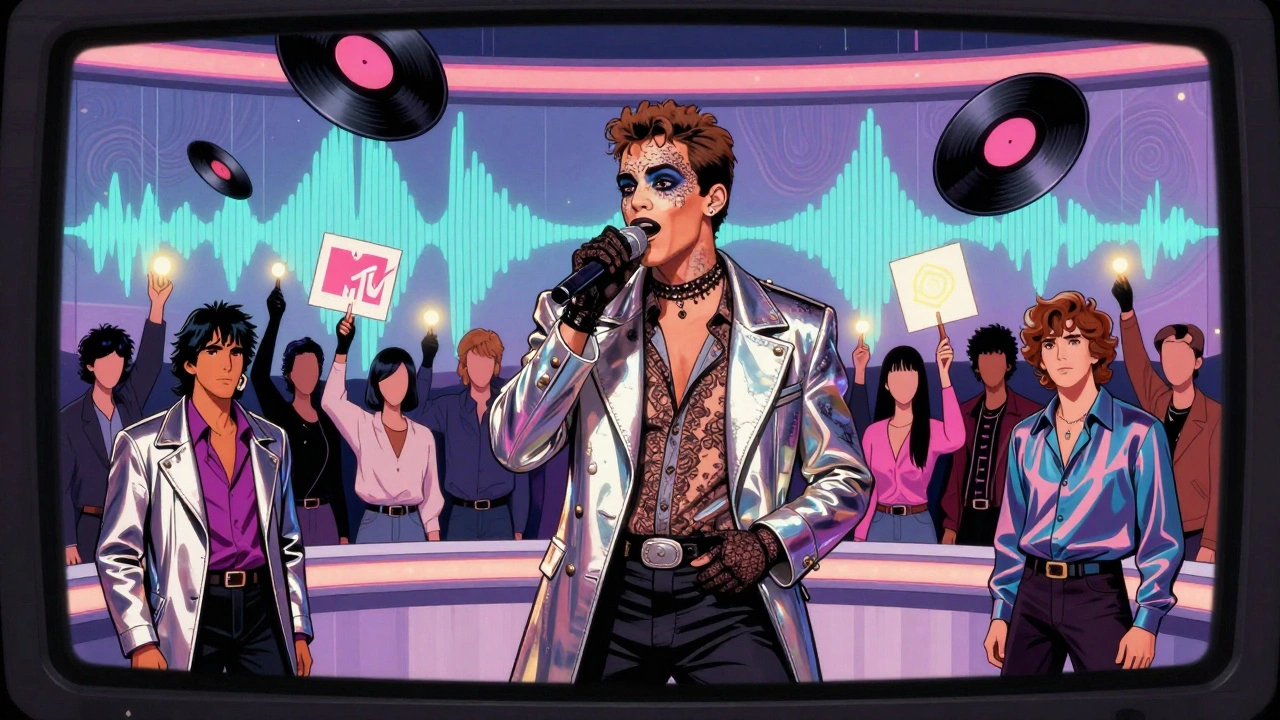
MTV launched in 1981, and it was the perfect match. Synth-pop wasn’t just heard-it was seen. Boy George in his makeup and lace, Duran Duran in their silk shirts, Gary Numan in his metallic coat. These weren’t just musicians. They were icons. MTV didn’t invent the look-it amplified it. By 1983, Boy George was the most-played artist on the channel. The music industry noticed. Labels like EMI and Virgin created entire departments just for synth-pop acts. They didn’t just sign bands-they built brands.
The Cost: Money, Time, and Exclusivity
Being a Blitz Kid wasn’t cheap. A single outfit could cost £50 to £100 in 1980-that’s £200 to £400 today. People spent hours sewing, gluing, and painting. Some used vintage fabrics from London’s theater district. Others raided thrift stores for 1940s suits and turned them into alien armor. And for what? A few hours in a club where the music was often just a tape loop playing over speakers. No live bands at first. Just the sound, the lights, and the costumes.
That exclusivity had a dark side. Only 17% of regulars were women. The scene was overwhelmingly male, gay, or gender-fluid, but not always welcoming to others. Critics called it pretentious. One former attendee admitted they were so focused on looking revolutionary, they forgot to make good music. And by 1982, the look was everywhere-on TV, in fashion magazines, even on children’s toys. The subculture had become a cliché. The Blitz had created a movement, but it couldn’t survive its own success.
The Legacy: From Manchester to the Weeknd
The Blitz closed in 1981. The Haçienda in Manchester opened in 1982, but it didn’t explode until the late 80s. The Warehouse in Leeds hosted Soft Cell’s first show. These places carried the torch, but none had the same magic. The Blitz was never about the music alone. It was about the ritual. The transformation. The idea that you could walk in as yourself and leave as someone else.
Today, you can still hear it. Dua Lipa’s synth-pop album Future Nostalgia didn’t just borrow the sound-it copied the spirit. The same drum machines. The same arpeggiated synths. The same sense of euphoria wrapped in artificiality. The Weeknd’s After Hours is full of echoes from Visage and Depeche Mode. Even Honey Dijon, a modern DJ, says the Blitz Kids taught her that club culture isn’t about the playlist-it’s about the world you build around it.
Original vinyl of ‘Fade To Grey’ now sells for £200 to £500. The Design Museum’s 2023 exhibition on the Blitz drew over 140,000 visitors. People aren’t just nostalgic. They’re rediscovering something deeper: a time when music wasn’t just entertainment-it was a revolution in clothes, sound, and identity.
Why It Still Matters
Today, bedroom producers with laptops make music that sounds like 1981. But they’re not using analog synths. They’re using plugins. And yet, they’re chasing the same thing: the feeling of making something strange, beautiful, and totally personal. The Blitz didn’t just start a genre. It started a mindset. You don’t need a band. You don’t need a studio. You just need a synth, a costume, and the courage to be different. That’s the real legacy of synth-pop-not the hits, but the idea that anyone, anywhere, could change the world with a machine and a dream.
What was the Blitz Club, and why was it so important?
The Blitz Club was a Tuesday-night venue in London that operated from 1979 to 1981. It became the epicenter of the New Romantic movement, where fashion, music, and identity collided. Steve Strange, its founder, enforced a strict door policy: only those who dressed in flamboyant, handmade outfits were allowed in. This created a tight-knit community of artists, musicians, and outsiders who later formed bands like Spandau Ballet and Culture Club. The Blitz didn’t just host music-it created a cultural blueprint for synth-pop’s visual and sonic identity.
How did synth-pop differ from punk and disco?
Punk was raw, fast, and guitar-heavy-often angry and DIY. Synth-pop was the opposite: controlled, layered, and machine-made. It used synthesizers instead of guitars and focused on melody, texture, and mood. Disco was about four-on-the-floor beats and dancing in clubs. Synth-pop at the Blitz rejected that beat entirely. Instead, it used odd rhythms, cold tones, and atmospheric sounds. It wasn’t meant to make you move-it was meant to make you feel something strange, almost alien.
What equipment did early synth-pop artists use?
Early synth-pop artists relied on analog synthesizers like the Minimoog, Roland Jupiter-8, and Korg MS-20. These machines had limited polyphony (usually 4-8 notes at once), no memory, and required manual patching with cables. Drum machines like the Roland TR-808 and TR-606 were also crucial. Since MIDI didn’t exist until 1983, artists had to sync devices using tape loops or manual timing. This made production slow and difficult-but also pushed creativity. Bands like Depeche Mode and OMD turned these limitations into signature sounds.
Why did the New Romantic movement fade so quickly?
The movement faded because it was too exclusive and too focused on image. The Blitz’s strict dress code and small scene made it unsustainable. Once the look went mainstream-on TV, in fashion stores, on magazine covers-it lost its edge. People started copying the style without understanding the music or the rebellion behind it. By 1983, the New Romantic look was being mocked on comedy shows. The music survived, but the scene didn’t. The energy of the Blitz couldn’t be replicated once it became a trend.
How is synth-pop still relevant today?
Modern artists like Dua Lipa, The Weeknd, and CHVRCHES openly cite 1980s synth-pop as a major influence. Their albums use the same drum machines, arpeggiated synths, and vocal effects. The revival isn’t just nostalgia-it’s a return to the ethos: using technology to express identity. Today’s bedroom producers, armed with software synths, are doing exactly what Depeche Mode did in their garage: turning machines into emotional art. The Blitz taught us that music doesn’t need to be loud to be powerful. Sometimes, all you need is a synth, a dream, and the courage to be different.


